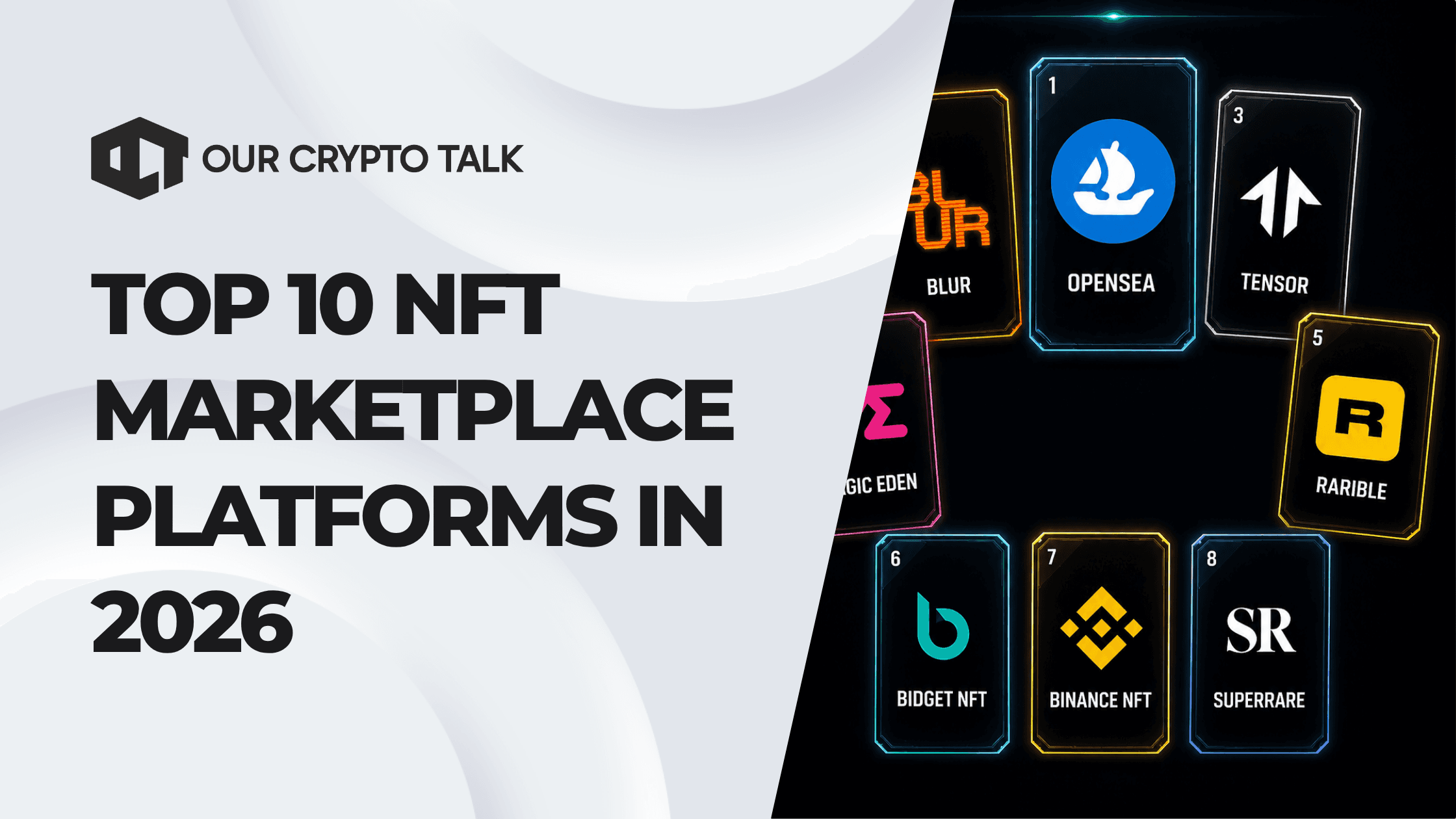
Explore the best NFT marketplace platforms in 2025, from OpenSea to Blur and discover where creators, collectors, and traders thrive.

Author: Akshat Thakur
The NFT market looks very different in 2026 than it did a year ago. Trading is quieter, speculation has cooled, and platforms are competing less on hype and more on usability, fees, and real utility. If you’re choosing where to buy, sell, or mint NFTs today, the right platform depends heavily on what you actually want to do across today’s NFT marketplace platforms.
Below is a clear, data-driven breakdown of the top NFT marketplaces in 2026, including fees, supported chains, and who each platform is best suited for.
The biggest shift is simple: speculation is no longer the main driver across NFT marketplace platforms. NFT trading volume dropped significantly through 2026, with total volume around $5.5 billion, down roughly 37% year-over-year. The quick flip-for-profit cycle that defined the 2021–2022 boom has largely faded. What replaced it is more grounded.
Utility NFTs are now a major category. Gaming assets, membership passes, loyalty rewards, and identity-linked NFTs make up a growing share of transactions across leading NFT marketplace platforms. Gaming alone accounts for close to 38% of NFT activity. Bitcoin NFTs are no longer niche. Ordinals pushed NFTs onto Bitcoin in a meaningful way, and marketplaces adapted quickly. Platforms like Magic Eden and Gamma now support Bitcoin-based assets alongside Ethereum and Solana collections.
Solana has also made a strong comeback within NFT marketplace platforms. Lower fees and faster execution pulled users back in, with platforms like Tensor and Magic Eden driving renewed activity. At the same time, AI-generated NFTs created a new debate. Platforms now experiment with labeling AI-generated art, and collectors are paying more attention to provenance and originality.
Finally, financialization is expanding across NFT marketplace platforms. NFT lending platforms like Blur’s Blend allow users to borrow against NFTs, turning illiquid assets into collateral. This has attracted more advanced traders and even some traditional finance interest.
OpenSea remains the default starting point for most users. It supports multiple chains, has the largest catalog of NFTs, and offers a straightforward interface. For beginners, it’s still the easiest place to understand how NFT buying and selling works.
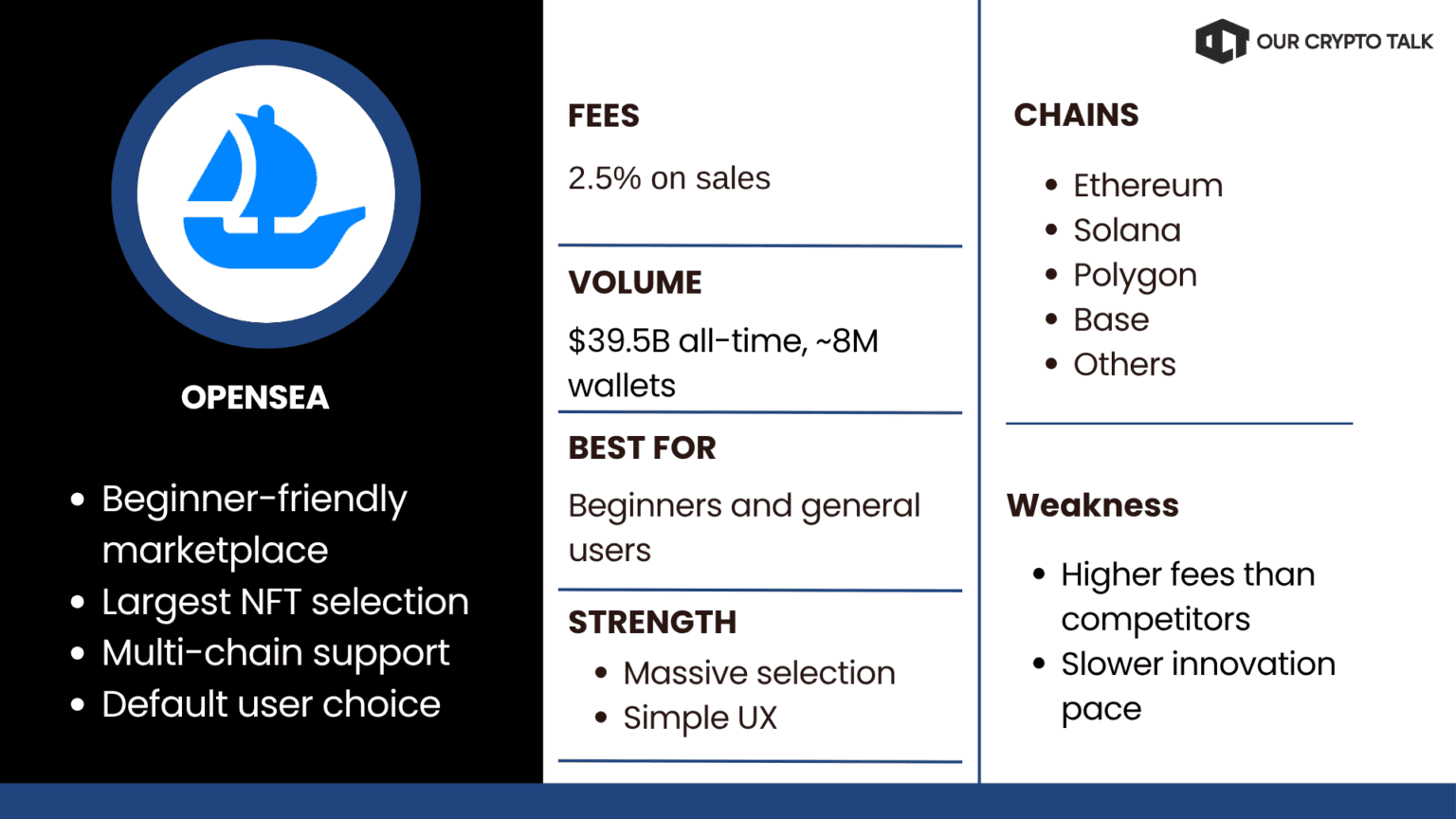
Blur is built for traders, not collectors.
It strips away traditional marketplace design and focuses on speed, analytics, and execution. Its zero trading fee model and advanced tools make it the go-to for flipping NFTs.
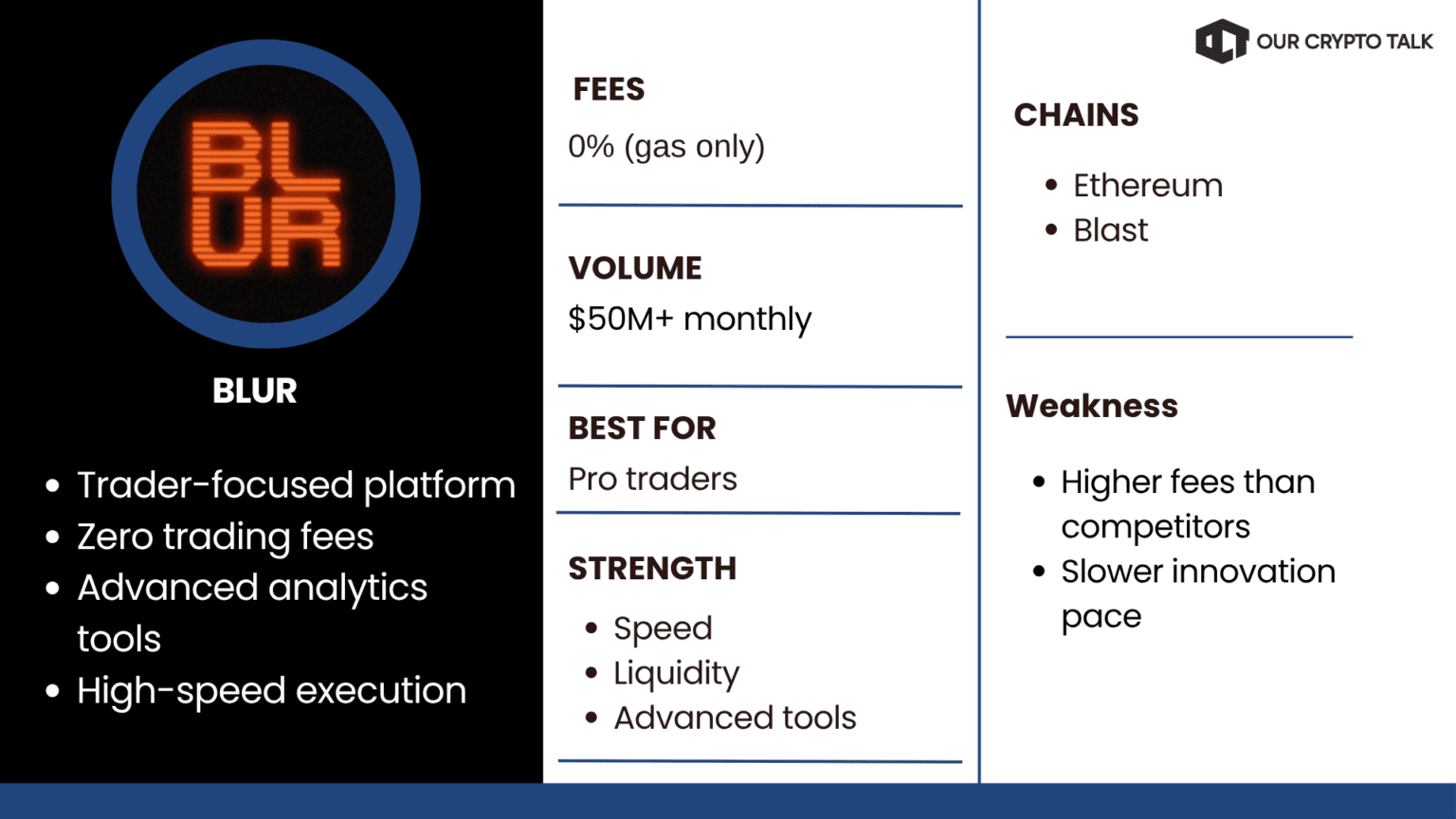
Magic Eden evolved into a multi-chain powerhouse.
Originally dominant on Solana, it now leads in Bitcoin Ordinals and supports multiple ecosystems. It’s particularly strong in gaming NFTs and newer asset types.
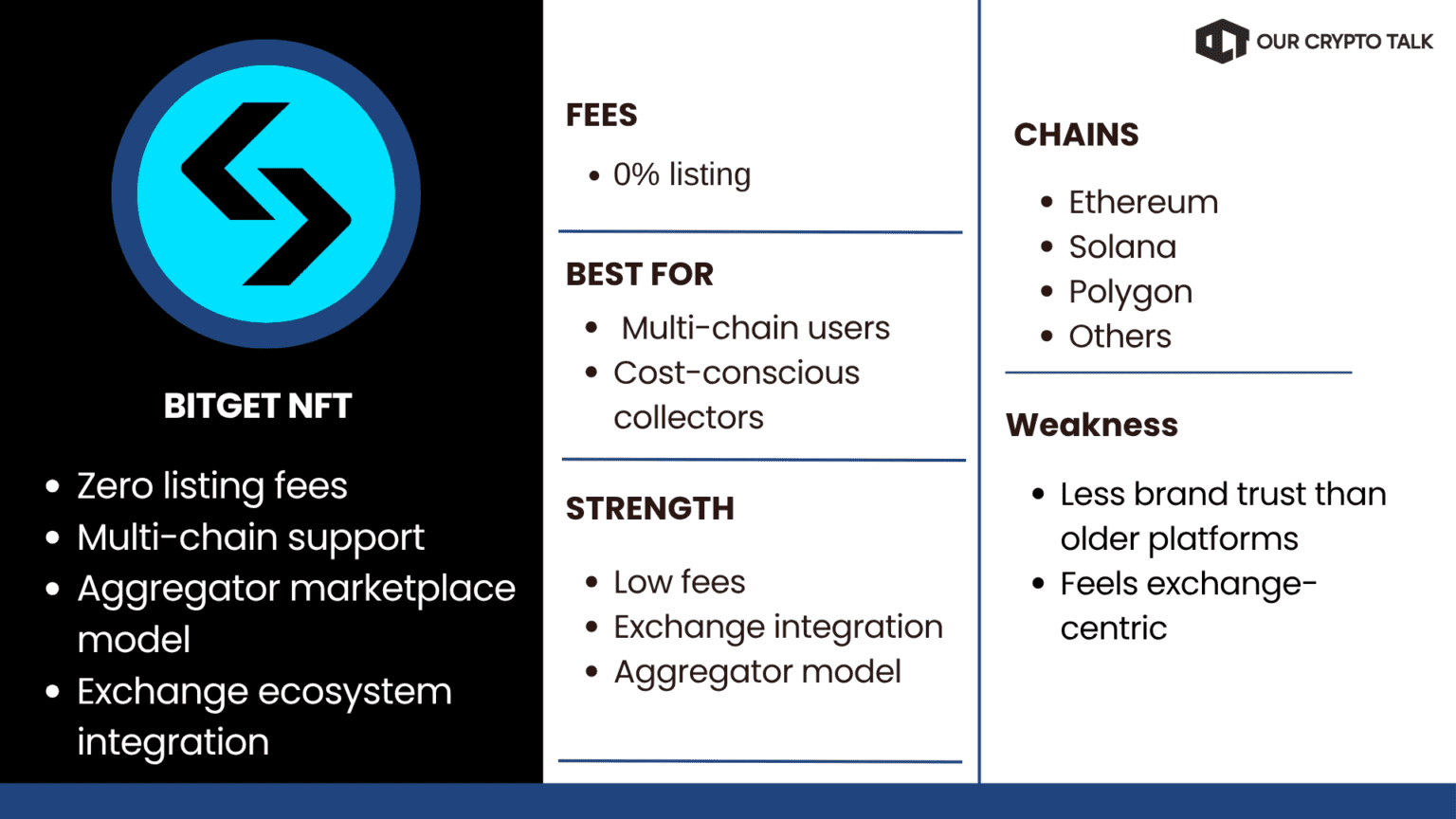
Bitget NFT has climbed rapidly into top rankings, largely due to cost efficiency and integration. Its biggest advantage is zero listing fees combined with a multi-chain setup. It also connects directly with Bitget’s broader exchange ecosystem, allowing users to move between trading and NFTs without friction.
The platform works as an aggregator as well, surfacing listings from other marketplaces alongside its own. Another notable feature is wallet flexibility. Users can purchase NFTs using various tokens without manually swapping first.
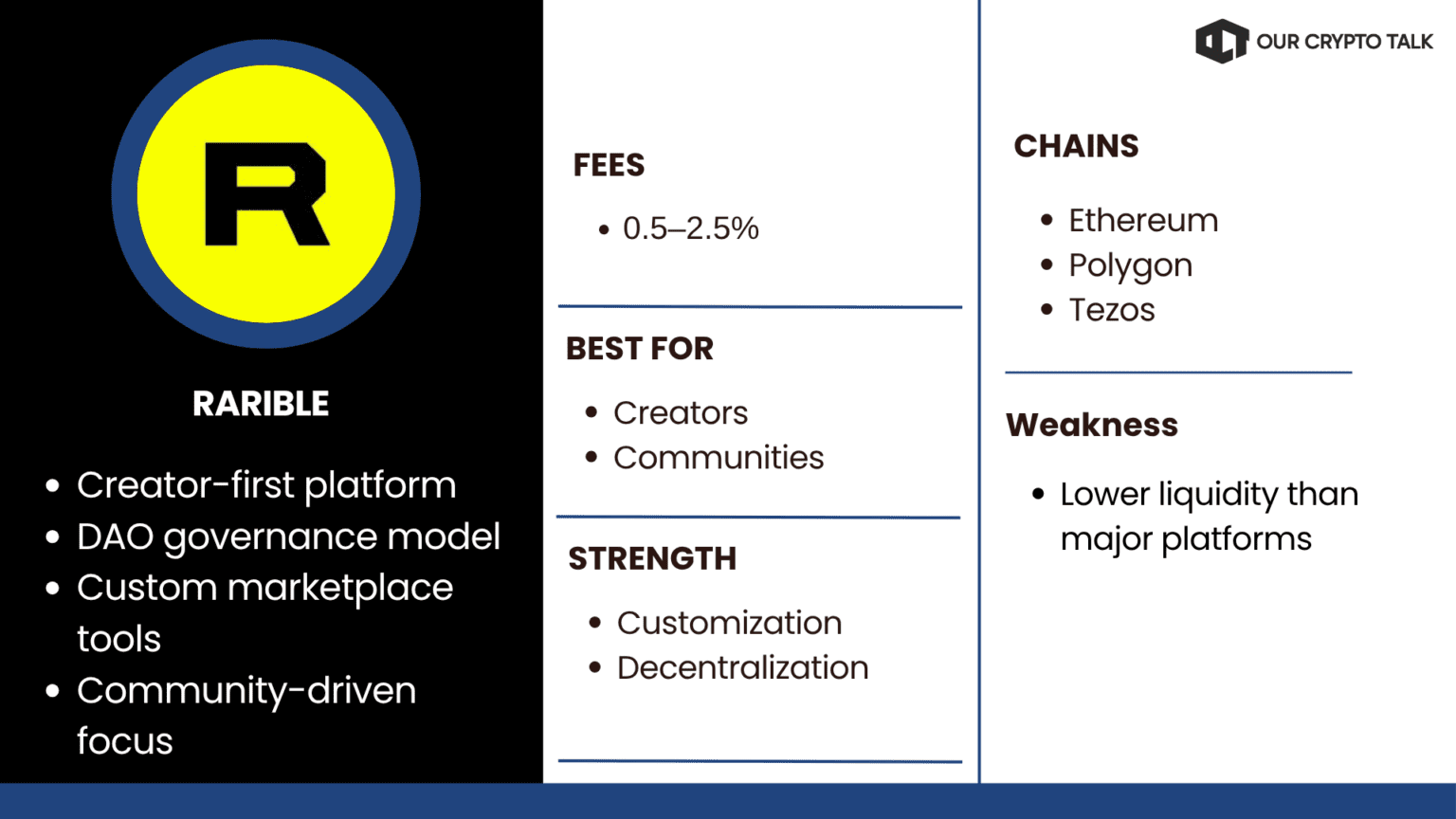
Rarible focuses on creators and community ownership.
It operates with DAO governance and allows users to build and manage their own NFT marketplaces. It’s less about trading volume and more about flexibility.
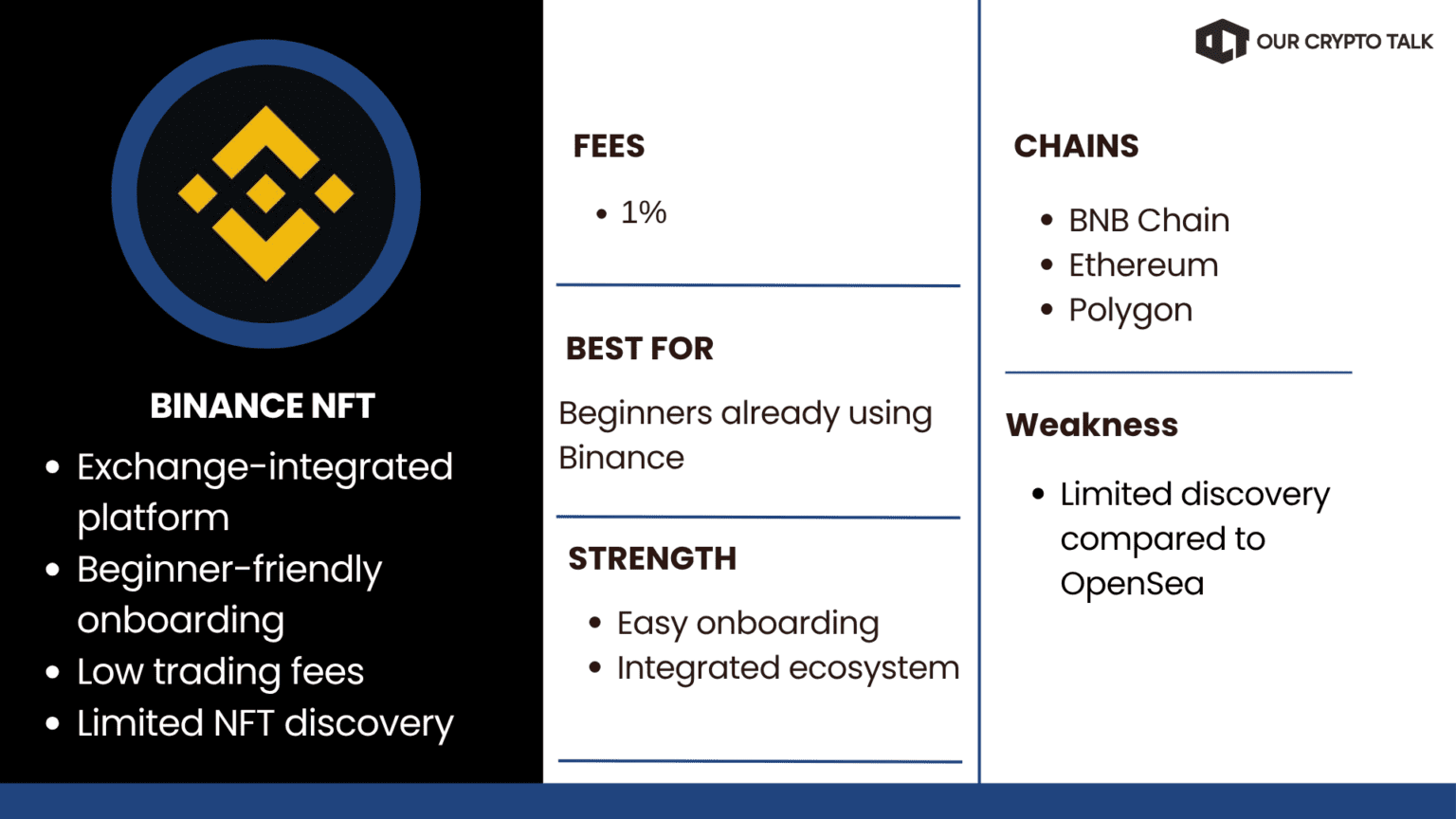
Binance NFT benefits from its connection to a massive exchange.
It’s particularly useful for users already active on Binance, offering a simple entry point into NFTs with relatively low fees.
Fees: 1%
Chains: BNB Chain, Ethereum, Polygon
Best for: Beginners already using Binance
Strength: Easy onboarding, integrated ecosystem
Weakness: Limited discovery compared to OpenSea
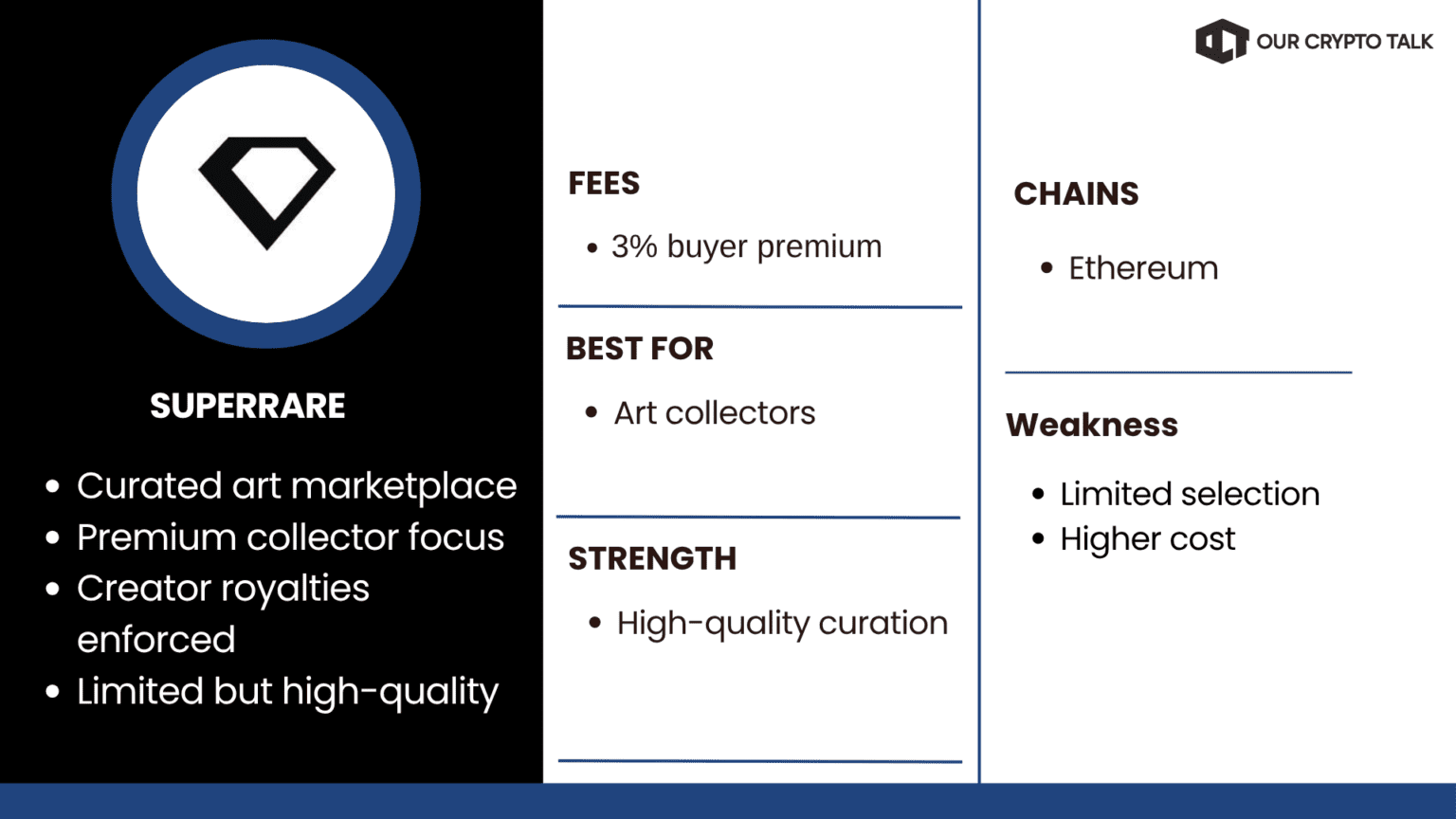
SuperRare is closer to a digital art gallery than a marketplace.
It focuses on curated, high-quality art and enforces creator royalties. This makes it attractive to serious collectors rather than traders.
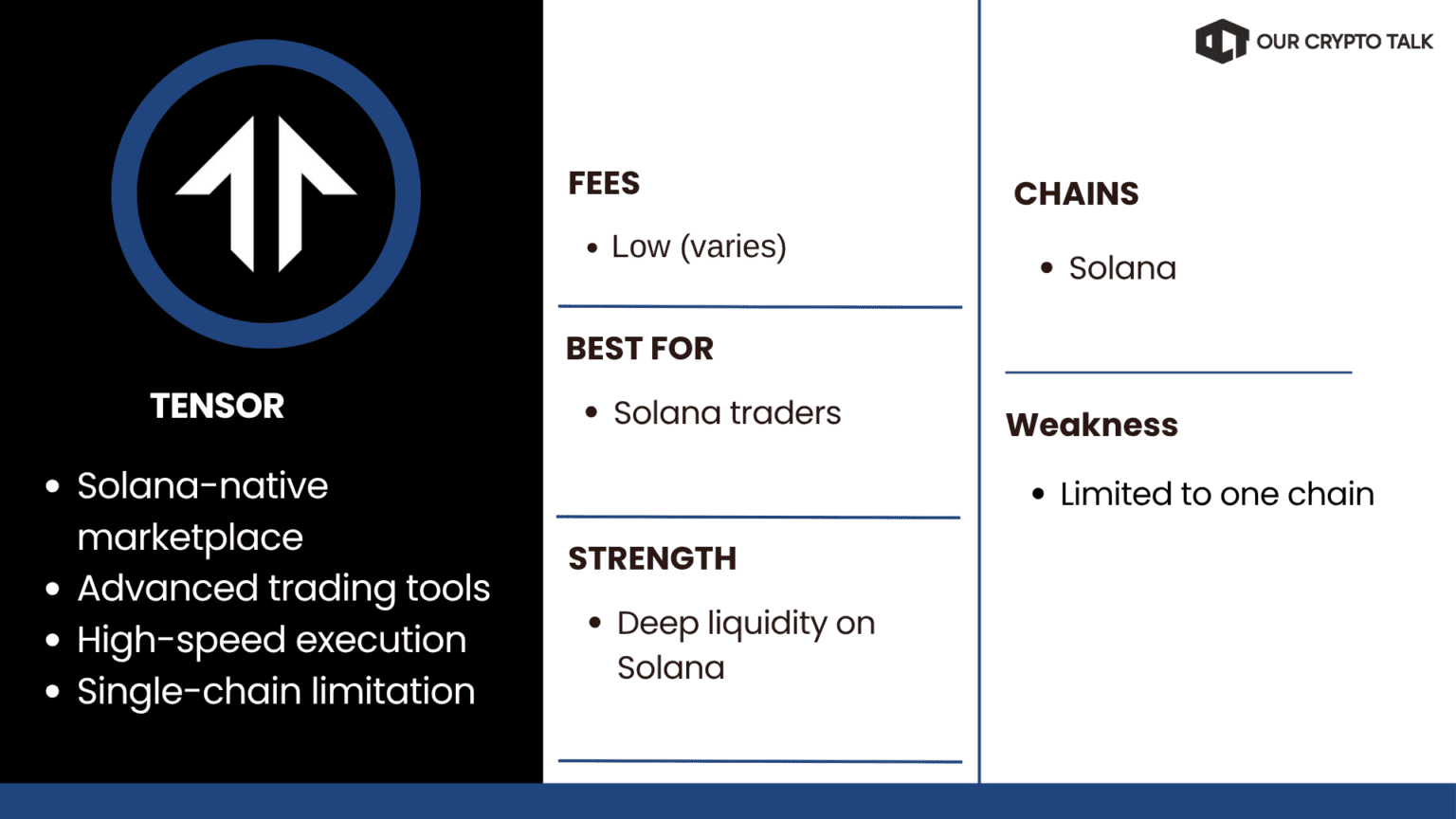
Tensor dominates the Solana NFT trading scene.
It’s designed for speed and precision, similar to Blur but within the Solana ecosystem. Advanced analytics and fast execution make it a favorite among active traders.
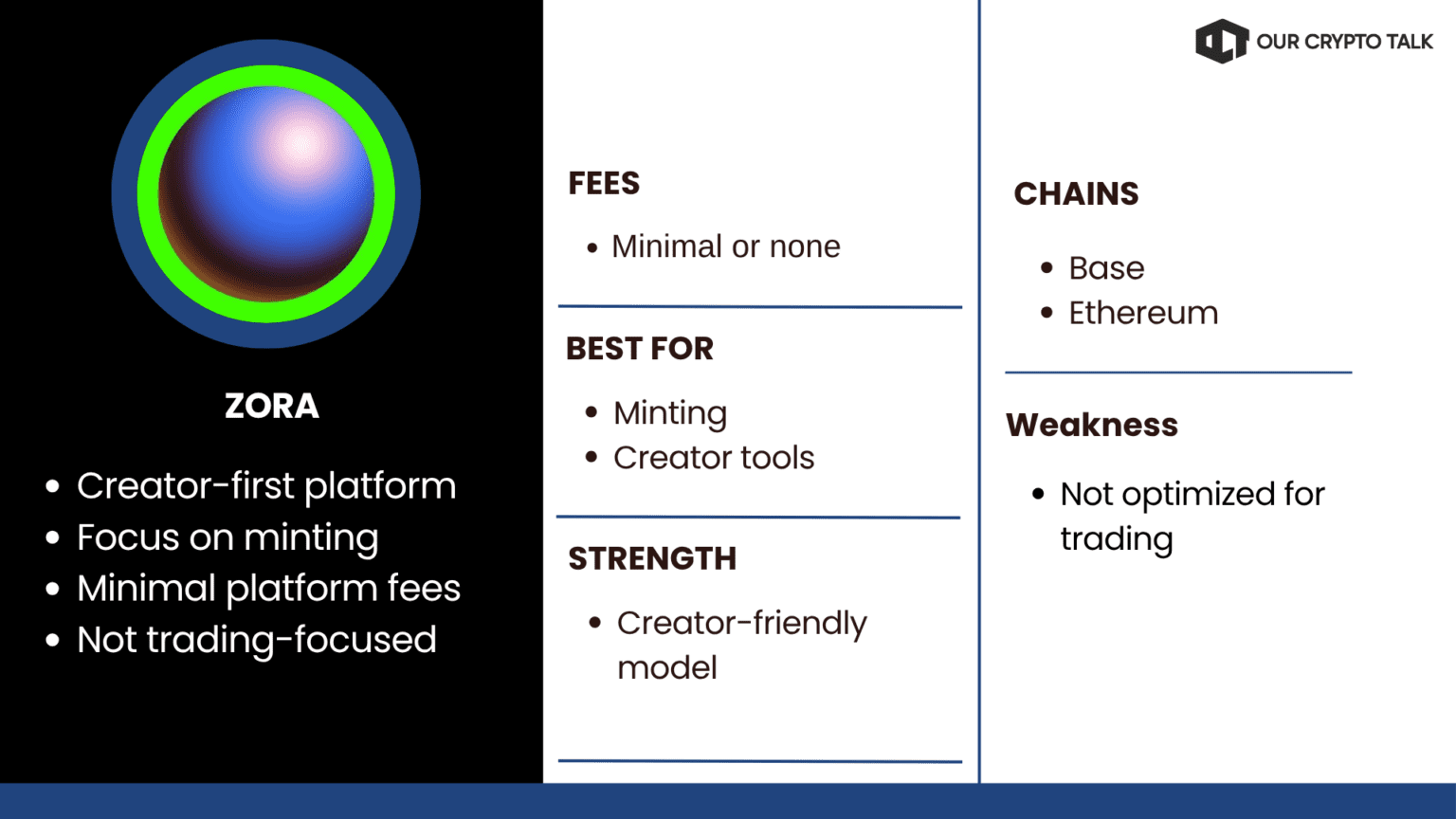
Zora is built for creators first.
It emphasizes minting, distribution, and ownership economics rather than secondary market trading. It’s widely used for experimental and community-driven projects.
Fees: Minimal or none
Chains: Base, Ethereum
Best for: Minting and creator tools
Strength: Creator-friendly model
Weakness: Not optimized for trading
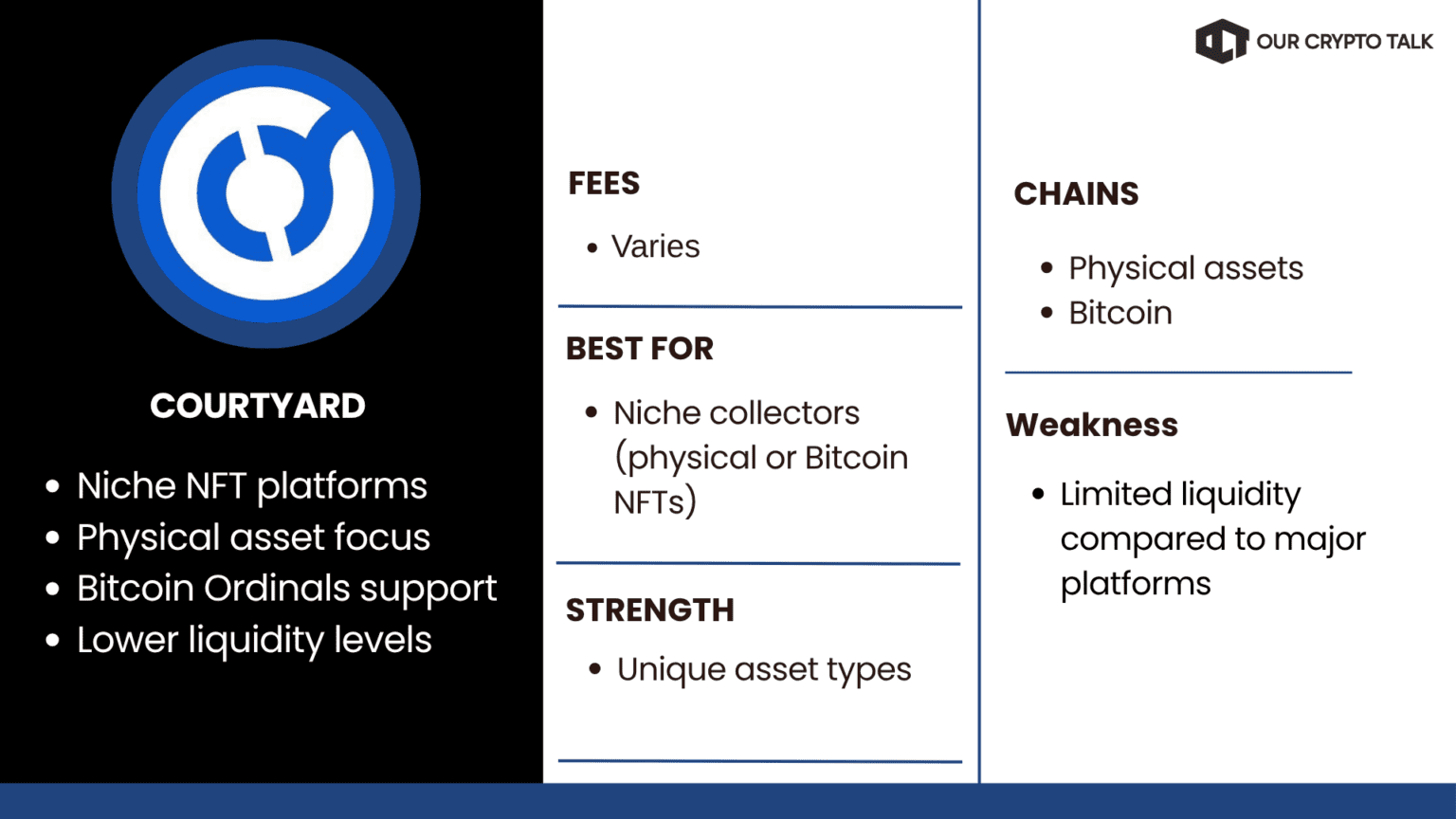
These platforms represent niche but growing segments.
Courtyard focuses on tokenized physical collectibles, linking NFTs to real-world assets. Gamma, on the other hand, specializes in Bitcoin Ordinals.
NFTs are no longer just digital art, and that shift is shaping how marketplaces evolve.
Bitcoin-native assets are growing quickly. Ordinals brought NFTs to Bitcoin, and newer protocols like Runes are expanding that ecosystem further. Platforms such as Magic Eden and Gamma are leading here, attracting users who prefer Bitcoin’s network and long-term holding approach. AI-generated NFTs are also becoming a major talking point. While creation is easier than ever, questions around originality and ownership are increasing. Marketplaces are starting to label AI-generated content, but there’s still no consistent standard. As a result, collectors are placing more importance on verified creators and provenance.
NFT financialization is gaining traction as well. Lending, borrowing, and collateralization are turning NFTs into usable assets rather than static collectibles. This is bringing in more advanced users who treat NFTs as part of a broader portfolio. At the same time, multi-chain support has become the norm. Users expect to move across Ethereum, Solana, and Bitcoin ecosystems without friction. Platforms that remain single-chain are gradually losing relevance.
Lastly, utility-driven NFTs continue to grow. Gaming assets, memberships, and loyalty programs are driving steady usage, shifting the focus away from speculation toward real use cases.
NFT marketplace platforms in 2026 show us that the market has matured. From professional trading hubs like Blur to curated art galleries like SuperRare, each platform serves a different audience. For creators, choosing the right platform means better royalties and visibility. For collectors, it’s about liquidity, security, and community.
As NFTs expand into gaming, metaverse assets, and even Bitcoin Ordinals, marketplaces will continue to set the tone for adoption and trust. Whether you’re new to NFTs or a seasoned trader, aligning with the right marketplace could define your Web3 journey.


Web3 Gaming Comeback 2026: GTA 6 Hype vs 99% Crashes
Layer 2 Projects Shutting Down: Who’s Next After Blast?
Embodied Data Pyramid and Decentralized Data Layer for Robotics
DeFi Needs Better Liquidity. Can Ramses Deliver?
Web3 Gaming Comeback 2026: GTA 6 Hype vs 99% Crashes
Layer 2 Projects Shutting Down: Who’s Next After Blast?
Embodied Data Pyramid and Decentralized Data Layer for Robotics
DeFi Needs Better Liquidity. Can Ramses Deliver?