Explore The Transparency Paradox and why privacy is becoming essential for crypto adoption and blockchain security.
The Transparency Paradox sits at the heart of crypto’s biggest challenge. In January 2025, kidnappers abducted David Balland from his home in central France. The co-founder of Ledger, a company known for keeping crypto safe, became separated from his wife as the attackers took him to an undisclosed location. When his business partners failed to meet the ransom demands quickly enough, the kidnappers severed one of his fingers and sent a video as proof.
French police rescued him within 24 hours, but the incident wasn’t isolated; it was part of a pattern that’s been accelerating all year.
Jameson Lopp, Chief Security Officer at Casa, has tracked physical attacks on crypto holders since 2014. In 2025, he logged over 70 documented cases: a 169% increase from the previous year.
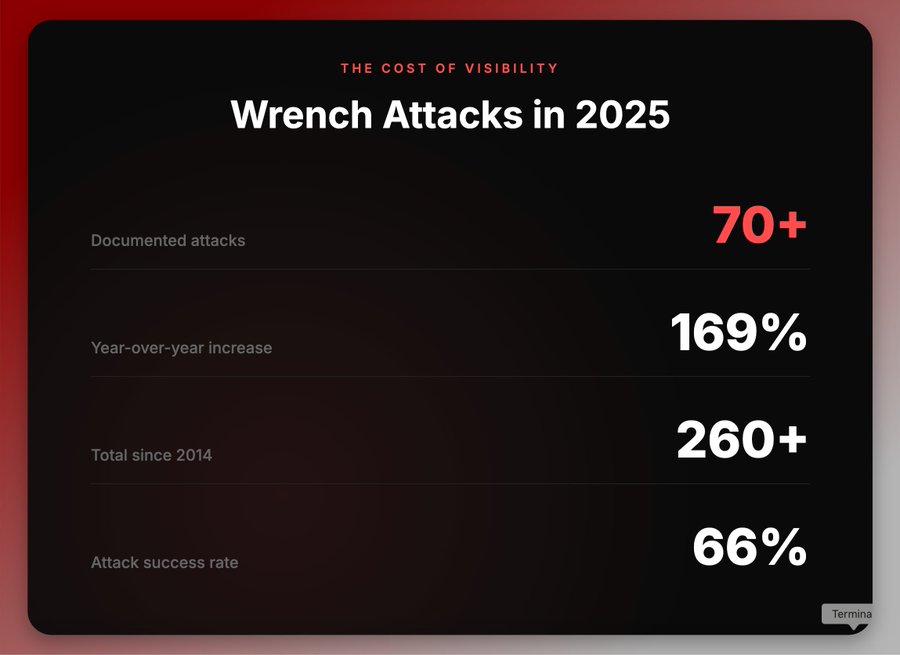
The methods vary across home invasions, kidnappings, torture, and murder, but the targeting doesn’t: attackers know who holds crypto, how much they have, and often where they live.
This isn’t a failure of security. It’s a feature of transparency.
Blockchain was designed to be trustless: no banks, no intermediaries, no permission needed. The tradeoff was radical transparency, with every transaction recorded on a public ledger that anyone can verify.
For years, the crypto industry promoted transparency as a strength. “Don’t trust, verify” became its mantra, and advocates positioned the immutable record as a source of truth that could replace institutional authority.
But somewhere along the way, that transparency turned into something else: surveillance infrastructure.
On Bitcoin and Ethereum, every transaction is visible. Wallet addresses, amounts, timestamps, token types, and complete transaction histories are all public. The only protection is pseudonymity: your wallet address isn’t your name, just a string of characters that in theory can’t be traced back to you.
In practice, that protection is paper thin.
The moment you interact with a centralized exchange, you complete a KYC check. Your wallet is now linked to your identity; not just that wallet, but every wallet it has ever transacted with. Every token you’ve received. Every protocol you’ve touched. Your entire financial history, retroactively exposed.
You don’t even need to use an exchange. Sharing your wallet on social media, posting a transaction for verification, or receiving a payment from someone who later gets doxxed can all create the link. One connection in the chain is all it takes.
The Transparency Paradox has fueled an entire industry built around blockchain surveillance. Companies like Chainalysis, TRM Labs, and Elliptic have developed sophisticated tools that trace funds across networks. Although law enforcement agencies initially adopted these platforms, exchanges, regulators, and private organizations now use them to monitor on-chain activity.
Their capabilities are extensive:
The FBI used these tools to recover $2.3 million from the Colonial Pipeline ransomware attackers. Investigators traced the Bitfinex hack for years before seizing over 90,000 BTC. The Silk Road prosecution relied heavily on blockchain analysis.
These are success stories if you’re on the right side of them. But the same tools that catch criminals also enable stalkers, extortionists, and armed robbers; the only difference is who’s doing the looking.
When Chainalysis can map your entire transaction history, so can anyone with access to their software or anyone who builds something similar. The data is public; the techniques are known. The asymmetry between watchers and watched grows wider every year.
The wrench attack epidemic isn’t random. Attackers don’t pick targets blindly; they do research. They look at on-chain data, monitor wallets that receive large inflows, track addresses that interact with high-value protocols, and cross-reference public information with blockchain activity until they have a profile.
The Transparency Paradox explains why attackers targeted David Balland. They did not target him because he was careless. They targeted him because his success was visible. The same transparency that made crypto verifiable also made him an easy target.
Institutions face the same problem from a different angle.
The Transparency Paradox becomes especially clear in institutional trading. Consider a hedge fund executing a large trade on-chain. Other market participants can watch the position build in real time, front-run the trade, analyze the strategy, and anticipate the next move. Rather than creating trust, this level of transparency makes it difficult to maintain any information advantage.
This is why serious institutional capital has been slow to move on-chain. It’s not the volatility or the regulatory uncertainty; it’s the fact that fully public ledgers expose trading intentions, competitive strategies, and client information to anyone watching.
No Fortune 500 company will conduct business on a ledger their competitors can read.
Something shifted in 2025. Privacy stopped being a niche concern and became a market signal.
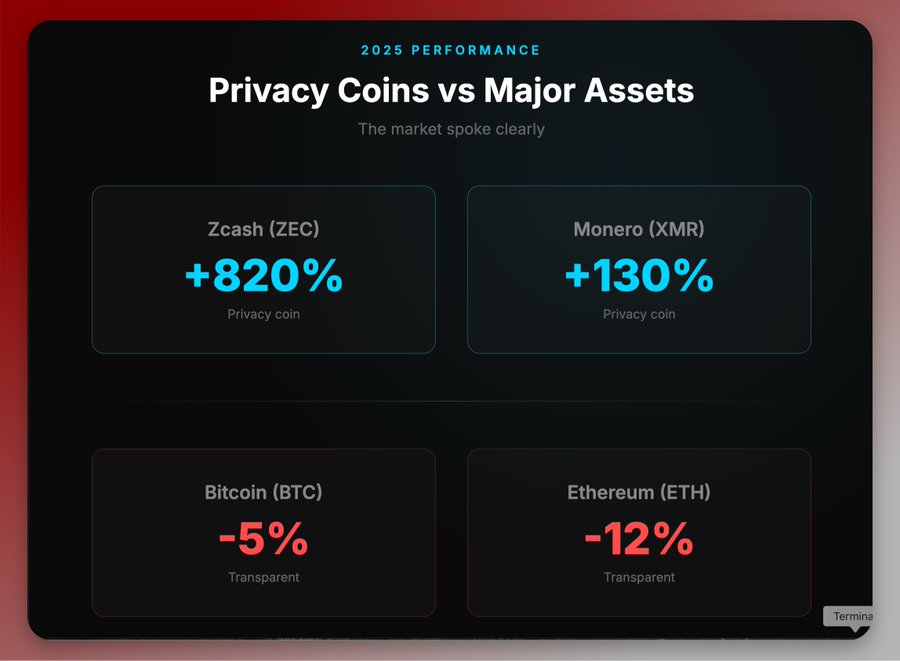
Zcash rose 820%. Monero gained 130%. Meanwhile, Bitcoin and Ethereum were down 5 to 12% on the year. The market was speaking clearly: privacy has value.
But the more significant shift was regulatory. In March 2025, the US Treasury lifted sanctions on Tornado Cash. The original designation in 2022 had been aggressive: for the first time, OFAC sanctioned not a person or company, but autonomous smart contracts. The Fifth Circuit Court of Appeals ruled this overreach; you can sanction entities, but you can’t sanction code.
The delisting reinforced a position the crypto industry had defended for years: privacy tools are not inherently criminal. They serve as infrastructure. While bad actors can misuse them, legitimate users also rely on these tools to keep their financial lives private.
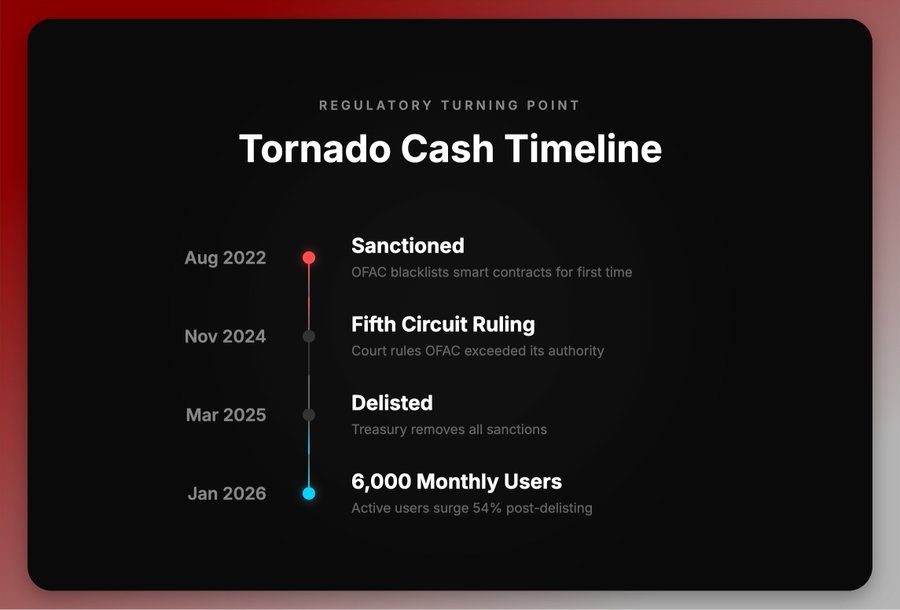
Tornado Cash usage immediately surged. Active monthly users jumped from 3,900 in December to 6,000 in January; the demand had always been there, and the legal clarity unlocked it.
In early January 2026, @a16zcrypto published their outlook for the year ahead. The headline: “Privacy will be the most important moat in crypto.
The argument, articulated by general partner @alive_eth, is structural. When blockchains compete on performance, the competition is commoditized; speed and fees can always be matched. But privacy creates lock-in. Users who have established private state on a chain can’t easily migrate. Bridging tokens is easy; bridging secrets is hard.
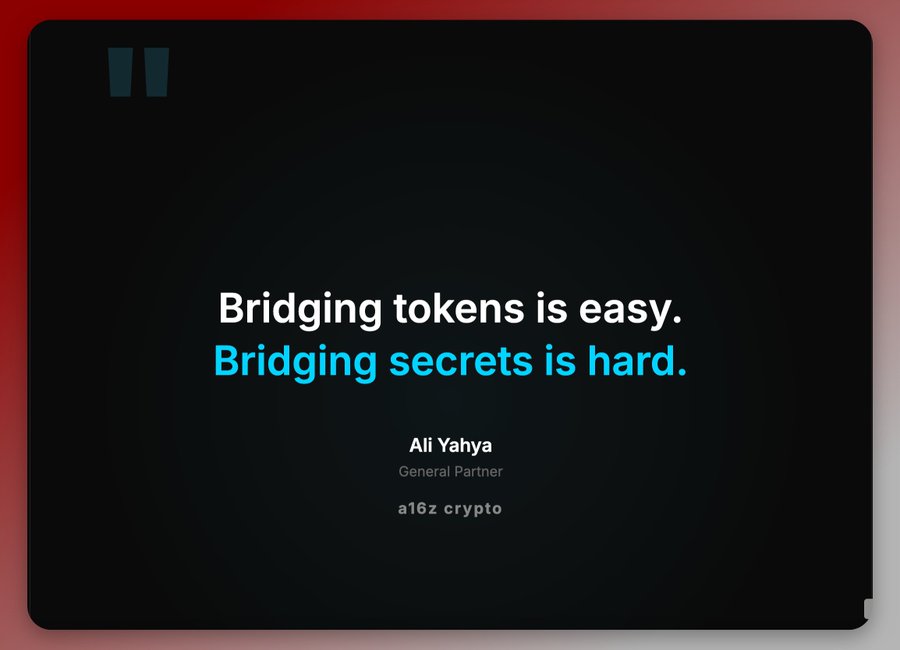
Yahya argued that private blockchains create stronger user retention because people become less willing to switch networks and risk exposing their data.
This creates winner-take-most dynamics. A handful of privacy-focused chains could end up owning the majority of serious on-chain activity, not because they’re faster or cheaper, but because they’re the only places where users can operate without exposing themselves.
The thesis flips the narrative on its head: privacy isn’t a feature for criminals; it’s the missing piece for mainstream adoption.
The major chains have noticed. Ethereum and Solana both launched significant privacy initiatives in 2025.
@VitalikButerin published a privacy roadmap calling for wallet-level integration of privacy tools, one address per application as the default, and encrypted RPC communications. The Ethereum Foundation rebranded its “Privacy and Scaling Explorations” team to “Privacy Stewards of Ethereum” and announced a goal: reduce the cost of private transactions to twice that of public ones by 2026.
Solana took a different approach. Rather than privacy, they emphasized “confidentiality,” a term chosen deliberately to signal compliance-friendliness. Their Confidential Balances feature, launched in April, uses zero-knowledge proofs to hide transaction amounts while keeping accounts visible. Auditor keys allow designated parties to decrypt when required; the design targets institutional use cases like encrypted payroll, private B2B settlements, and confidential treasury management.
Both approaches acknowledge the same reality: The Transparency Paradox has turned blockchain’s defining strength into a potential liability. The question is no longer whether the industry needs privacy, but how developers can add it without sacrificing the properties that make blockchains useful.
Blockchain promised to remove the need for trust. It delivered by making everything visible. But visibility without protection isn’t trustlessness; it’s exposure.
The Transparency Paradox is this: a system designed to eliminate intermediaries ended up creating the perfect surveillance substrate, where every transaction remains permanent, every flow stays traceable, and a single data leak can expose a user’s entire financial history.
Privacy isn’t the opposite of trust; it’s the complement. A transaction can be verified as valid without revealing who made it. Solvency can be demonstrated without exposing holdings. Participants can engage in financial systems without broadcasting their entire history to the world.
The tools to make this possible already exist: zero-knowledge proofs, homomorphic encryption, and confidential transactions. The cryptography has been ready for years; what’s changed is the recognition that privacy isn’t optional. It’s infrastructure.
The market understood this before the institutions did. The 820% move in Zcash wasn’t speculation; it was a bet that the rest of the industry would eventually catch up.
The next phase of crypto won’t revolve around faster blockchains or cheaper transactions because the industry has largely solved those challenges. Instead, privacy will shape the defining battle: who controls it, who can access it, and how developers implement it.
Some chains will build privacy at the protocol level; others will rely on application-layer solutions. Some will prioritize compliance, offering selective disclosure to regulators; others will pursue maximal privacy, betting that the demand exists.
Ideology won’t decide the winners. The approaches that attract real users and sustained adoption will come out ahead, as people gravitate toward platforms where they can operate without feeling watched.
The Transparency Paradox carries real-world consequences. David Balland’s finger isn’t growing back. The dozens of other victims from 2025’s record year of wrench attacks carry their own scars. In many cases, people have paid the cost of transparency in blood.
The question now is whether the industry will build the tools to ensure it doesn’t happen again. The technology exists, the market demand is clear, and the regulatory path has opened.

https://t.co/xHc4PRtbPv


Tokenization of RWA yields onchain might be the biggest opportunity that no one has noticed
Cold Wallet Safety 2026: Are Hardware Wallets Still Safe?
One Token, Multiple Products. Can Zylo Deliver?
The Rise of NEAR Protocol 2026: Inside the 530% Rally and the ETF
Tokenization of RWA yields onchain might be the biggest opportunity that no one has noticed
Cold Wallet Safety 2026: Are Hardware Wallets Still Safe?
One Token, Multiple Products. Can Zylo Deliver?
The Rise of NEAR Protocol 2026: Inside the 530% Rally and the ETF