
Author: Kritika Gupta
Decentralized AI networks often make the same promise: lower costs, open access, and rewards for anyone willing to contribute GPU power. The problem is not attracting hardware. The real challenge is proving that anonymous machines completed AI tasks correctly without relying on a centralized operator to verify the work.
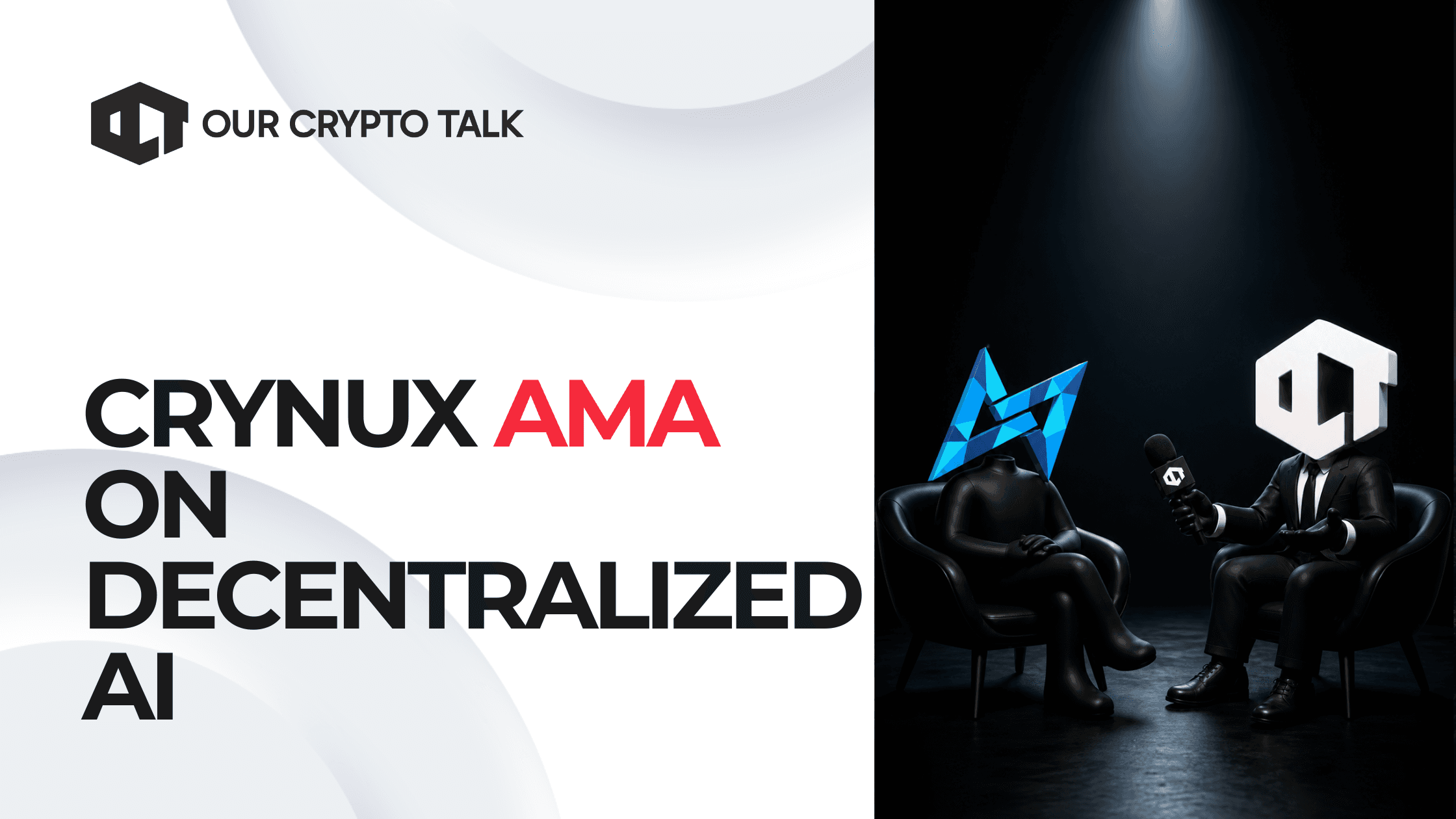
We sat down with Luke from Crynux and asked the questions that matter. Why does the industry need another decentralized compute network when projects such as Bittensor and io.net already exist? How does Crynux verify AI inference? What can users actually do on its Lithium mainnet today? And can a network of spare consumer GPUs offer a practical alternative to expensive commercial AI APIs? The conversation revealed a project that is not trying to beat OpenAI at the frontier-model game. Instead, Crynux wants to make smaller open-source models cheaper, easier to access, and genuinely decentralized.
“The biggest problem I see in AI right now is cost. Almost everyone uses AI services now, but consuming tokens from major commercial providers can become extremely expensive.
I use Cursor for AI coding. It is a very useful product and has saved me a lot of time. However, the cost is so high that I am almost afraid to check the bill. I set a daily spending limit, and I reach that limit almost every day.
The second problem is that the largest models remain closed. Major companies keep their model weights private and only provide public access through APIs. That is a reasonable commercial decision for companies trying to maximize revenue, but it limits what the wider AI industry can build.
If large models were open, developers could customize them for specific use cases. A company could deploy a model privately, connect it to internal data, and adapt it to its own business processes. You cannot do that properly when the model remains closed and the provider only gives you API access.
Those problems inspired us to build something different. Crynux is designed as a decentralized and open platform that runs open-source models on affordable edge GPUs. This reduces dependence on the compute infrastructure and proprietary models controlled by a small number of large companies.”
“The main difference is our consensus protocol.
Consensus has received less attention recently. Some people appear to think the underlying protocol does not matter as long as a project has a tradable token and can attract market attention. For a serious decentralized network, however, consensus is the first problem that must be solved.
We worked on this problem for more than six years, starting before Crynux itself existed. We tested several different approaches before reaching our current design.
We initially explored zero-knowledge proofs for machine-learning neural networks. We produced working demonstrations for small networks, but the method required far too much computation for modern large language models.
We continued iterating and eventually developed the protocol we use today, which we call vssML. It gives us the foundation required to build a genuinely decentralized AI network.
Without a robust consensus protocol, a network cannot scale securely. A project can describe a protocol in a whitepaper, but weaknesses become visible when real users and miners arrive. Some networks claim to operate through decentralized consensus while relying on centralized servers underneath. Others restrict participation through miner whitelists. Some grow quickly, only for miners to discover vulnerabilities and exploit the reward system.
We wanted Crynux to function as an open network. That is why we spent so much time solving consensus before focusing on growth. I believe vssML is the project’s most important differentiator.”
“After completing our first zero-knowledge design for neural networks, we quickly discovered that it could not scale.
We could prove a small operation, such as a 10-by-10 matrix multiplication. Modern large language models, however, contain billions of parameters. The gap was too large.
Generating a zero-knowledge proof required several orders of magnitude more computation than performing the inference itself. We concluded that current zero-knowledge systems could not prove an entire large neural network efficiently. Solving that problem would probably require a fundamentally new mathematical approach.
We then changed the question. Instead of using zero-knowledge proofs for the entire model, could we use them to protect a smaller and more manageable part of the verification process?
Crynux uses deterministic execution so the network can compare task results across GPUs. It then secretly selects a small sample of tasks for validation. Nodes do not know which tasks have been selected before they execute them.
Zero-knowledge proofs confirm that the hidden sampling process is genuine. They do not prove every operation inside the neural network. That reduces the proof workload to a size that current zero-knowledge technology can handle.
This combination of deterministic execution, secret sampling, and zero-knowledge verification became the foundation of vssML.”
“Users can participate in three main ways.
First, they can run a node. Someone with a spare supported NVIDIA GPU can install the Crynux software, contribute compute resources, and earn network rewards.
Second, users can stake tokens to an existing node. This gives people without suitable hardware a way to participate in network rewards. Instead of purchasing or renting a cloud device, they delegate their stake to a node that accepts external staking.
Third, developers and AI users can access an OpenAI-compatible API. It is designed as a drop-in alternative for applications that already use the OpenAI API format.
The complete public API service platform is not live yet. We are still building it under the name Crynux AI Services. Once launched, users will be able to purchase API access using USDT or CNX.
Developers who want to test the service before the public release can join our Discord community and request an early API key.”
“The basic concept is straightforward.
Crynux secretly selects a small portion of network tasks and assigns each selected task to three different nodes. The protocol then compares the results.
If two nodes return matching results and the third returns something different, the network can identify the outlier. The dishonest or faulty node can then be slashed.
The difficult part is stopping nodes or applications from manipulating the validation process.
If a node knew which tasks the protocol planned to validate, it could execute those tasks correctly while skipping the actual computation for every other task. The node would collect rewards without completing most of the requested work.
Crynux prevents this by hiding the sampling result until after execution. We use zero-knowledge proof technology to demonstrate that the selection process followed the protocol without revealing the selected tasks in advance.
The system therefore works like a secret spot check. Nodes must treat every task as if the network might validate it because they cannot predict which tasks will be checked.”
“Compatibility is important because it reduces the effort required to try the network.
Developers already have applications built around the OpenAI API format. They should not need to rewrite their entire stack to test Crynux. They can change the endpoint and continue using the same request structure.
We expect Crynux to offer lower prices because the network uses spare GPU capacity. However, I cannot provide exact pricing yet.
Task pricing will work more like gas fees on Ethereum than the fixed pricing model used by centralized AI providers. Users will set the amount they are willing to pay, and nodes will prioritize tasks according to price.
A user who needs an immediate result can offer a higher fee and receive faster execution. Someone running a large offline batch can submit a lower price and allow the network to complete it overnight when nodes have spare capacity.
This creates a flexible market between applications that need inference and node operators that provide compute.”
“We have spent considerable time simplifying the onboarding process.
Crynux provides pre-built software packages for Windows, Docker, Linux, macOS, and other Linux-based environments.
Starting a node involves three primary steps:
We provide step-by-step documentation, and users can ask for support through our Discord community.
Delegated staking is even simpler. A user visits the Crynux Portal, connects a wallet, and views the available nodes that accept external staking.
The portal shows information such as a node’s historical emissions and performance. The user selects a node, chooses the amount to stake, and confirms the transaction.
This allows people to participate in the network even when they do not own a suitable GPU.”
“Our next phase has both short-term and long-term goals.
In the short term, we plan to introduce two major features.
The first is multi-GPU support. This will allow one node to operate several GPUs together. Multi-GPU nodes can run larger models and support applications that require more compute than a single consumer GPU can provide.
The second is the Crynux AI Services platform. We want to launch it as quickly as possible. Once the platform is public, Crynux can serve real applications, generate task revenue, and use service demand to create economic activity around CNX.
In the longer term, we want the network to support a growing range of open-source models and applications.
Small open-source models continue to improve. We saw this directly through a Discord bot we built for our own community. We call it the Community Intern.
The bot uses our public documentation and learns from how team members answer community questions. We first deployed it around a year ago using the best open-source models available at the time. The response quality was not good enough, so we moved it to the OpenAI API.
We eventually shut that version down because processing every Discord message through a commercial API became too expensive.
After launching the mainnet, we tested the bot again using newer open-source models. The quality had improved enough to make the answers acceptable. The difference within one year was significant.
That experience suggests that smaller models will support many more applications in the future. More developers may move routine workloads away from expensive frontier-model APIs and toward platforms such as Crynux.”
“It is not a wrapper around the OpenAI API.
Crynux operates its own distributed compute network. Node miners execute the inference using their own GPU resources.
We only reproduce the format used by the OpenAI API. That compatibility allows an application built for OpenAI to switch to Crynux by changing its endpoint rather than rebuilding its integration.
The requests may look the same from a developer’s perspective, but the underlying computation comes from the Crynux node network, not OpenAI.”
“I hope Crynux will host a growing number of open-source models and provide AI services around those models.
We also want to support model creators through crypto-native infrastructure. That could include model assets, tokenization, and financial services designed for open-source AI ecosystems.
We do not plan to compete directly with OpenAI for the largest and most computationally demanding frontier models. OpenAI and other major laboratories have enormous GPU clusters. That is not the market we are trying to challenge directly.
Crynux will focus on smaller use cases and everyday applications.
A developer might still choose a major commercial API for the most complicated tasks. However, routine workloads do not always require the largest model available. Many daily applications can use smaller open-source models at a much lower cost.
Our goal is to make those models accessible through a decentralized network and allow ordinary AI workloads to run for very little money.”
“Crynux remains at an early stage.
The network connects two sides of a marketplace. Applications need AI compute, while node miners provide that compute. Before we can attract large numbers of applications, we need enough miners and GPU capacity to serve them reliably.
Our tokenomics therefore front-load incentives for node operators. Early miners receive higher rewards, while the reward rate gradually decreases as the network matures.
The goal is to encourage participants to contribute hardware while Crynux is still building its initial supply of compute.
The emissions curve also follows a longer-term sustainability model. Emissions decline quickly during the early years. The curve then gradually increases again over the following three to five years before eventually tapering off.
This gives the project more flexibility to support the network while application activity grows. Our long-term objective is to reach a point where task fees from real AI applications can sustain miners and the wider ecosystem.”
Luke focused on the shape and purpose of the emission curve during the AMA. He did not provide token allocation percentages or a dated CNX unlock schedule.
“Start a node or stake to an existing node.”


Tokenization of RWA yields onchain might be the biggest opportunity that no one has noticed
Cold Wallet Safety 2026: Are Hardware Wallets Still Safe?
One Token, Multiple Products. Can Zylo Deliver?
The Rise of NEAR Protocol 2026: Inside the 530% Rally and the ETF
Tokenization of RWA yields onchain might be the biggest opportunity that no one has noticed
Cold Wallet Safety 2026: Are Hardware Wallets Still Safe?
One Token, Multiple Products. Can Zylo Deliver?
The Rise of NEAR Protocol 2026: Inside the 530% Rally and the ETF