Discover how Apyx powers dividend-backed stablecoins using Digital Asset Treasury preferred shares, apxUSD, apyUSD, and the APYX ecosystem.

Author: Akshat Thakur
Apyx is building the first Dividend-Backed Dollar (DBD) protocol, a new type of yield-bearing stablecoin backed by real dividend income instead of Treasury bills or crypto funding rates. The protocol converts dividends from Digital Asset Treasury (DAT) preferred equity, starting with Strategy’s STRC preferred shares, into two onchain assets: apxUSD, an overcollateralized synthetic dollar designed for liquidity and collateral, and apyUSD, an ERC-4626 vault that automatically distributes the underlying dividend yield.
The opportunity is clear. Stablecoins have become one of crypto’s largest asset classes, yet most holders still earn little or no yield. Existing products either depend on low-yield government securities or more volatile strategies such as perpetual futures funding. Apyx introduces a third option by sourcing income from publicly traded preferred shares issued by crypto treasury companies. These securities generate recurring cash flows that can be streamed directly onchain while remaining backed by transparent market pricing and daily NAV reporting.
The timing also works in Apyx’s favor. Digital Asset Treasury companies expanded rapidly throughout 2025 and 2026, creating a completely new category of publicly listed crypto-backed income products. At the same time, demand for stable, double-digit yield has increased as tokenized real-world assets move into the mainstream.
Rather than building around a future narrative, Apyx already has a live product. As of July 2026, the protocol supports more than $350 million in apxUSD supply. Meanwhile, apyUSD has delivered a trailing yield above 15%. With Season 2 points running until October 11 and the APYX token launch scheduled for October 13, Apyx enters the market with working infrastructure, measurable adoption, and one of the most differentiated yield sources in DeFi.
The yield-bearing stablecoin market already has several established players. Ethena dominates crypto-native yield with USDe and sUSDe, generating returns from perpetual funding rates. Ondo focuses on tokenized Treasury products such as OUSG and USYC, offering lower-risk but lower-yield exposure. Maple, Centrifuge, Mountain Protocol, and Pendle each target different parts of the tokenized credit and yield market, but none use publicly traded Digital Asset Treasury preferred shares as their primary source of income.
That is where Apyx stands apart. Instead of relying on trading strategies or short-duration government debt, it earns dividends from exchange-listed preferred equity. Those dividends are converted into yield for apyUSD holders, while apxUSD remains an overcollateralized stable asset that can be used throughout DeFi. Daily NAV reporting, third-party attestations, and transparent pricing provide visibility that many synthetic yield protocols cannot match.
The biggest competitive advantage is not the stablecoin itself but the underlying asset. Building exposure to Digital Asset Treasury preferred shares requires institutional market access, regulatory expertise, and relationships with public companies. Those are barriers that traditional DeFi teams cannot easily overcome.
Apyx has already accumulated one of the largest positions in Strategy’s STRC preferred shares and has demonstrated operational discipline through periods of market volatility by publishing transparent updates and risk reports.
From OCT’s perspective, the protocol’s moat comes from its dividend source rather than its token design. If the Digital Asset Treasury market continues expanding, Apyx could occupy a unique position between low-yield Treasury stablecoins and higher-risk crypto-native yield products.
Apyx is led by contributors with extensive experience across both traditional capital markets and institutional crypto. The project is closely connected to DeFi Development Corp. (Nasdaq: DFDV), the first publicly traded company operating a Solana-focused Digital Asset Treasury strategy, giving the protocol direct exposure to both public markets and digital assets.
Joseph Onorati serves as a founding contributor while also leading DeFi Development Corp. as CEO. Before DFDV, he held multiple leadership positions at Kraken and founded several crypto businesses. Parker White, CFA, is another founding contributor who left his full-time executive role as COO and CIO at DFDV to focus entirely on Apyx. His background combines institutional investing with years of crypto market experience, making him one of the key architects behind the protocol’s risk framework.
John Han, CFA, contributes deep financial expertise after leadership roles at Binance, Kraken, and traditional finance institutions. Pete Humiston leads marketing and business development, while engineering is headed by Dawson Reid, whose experience spans Kraken and multiple startup ventures.
This combination gives Apyx an advantage that many RWA protocols lack. The team understands both public securities markets and DeFi infrastructure. Rather than trying to connect traditional assets to crypto for the first time, the team has already operated regulated treasury strategies and institutional crypto businesses. That experience is especially important for a protocol that manages publicly traded preferred equity. It also helps support the delivery of transparent onchain yield.

Apyx has taken a different funding path from most DeFi startups. Instead of raising large venture rounds, the project has focused on strategic capital from institutions that already operate within crypto and public markets.
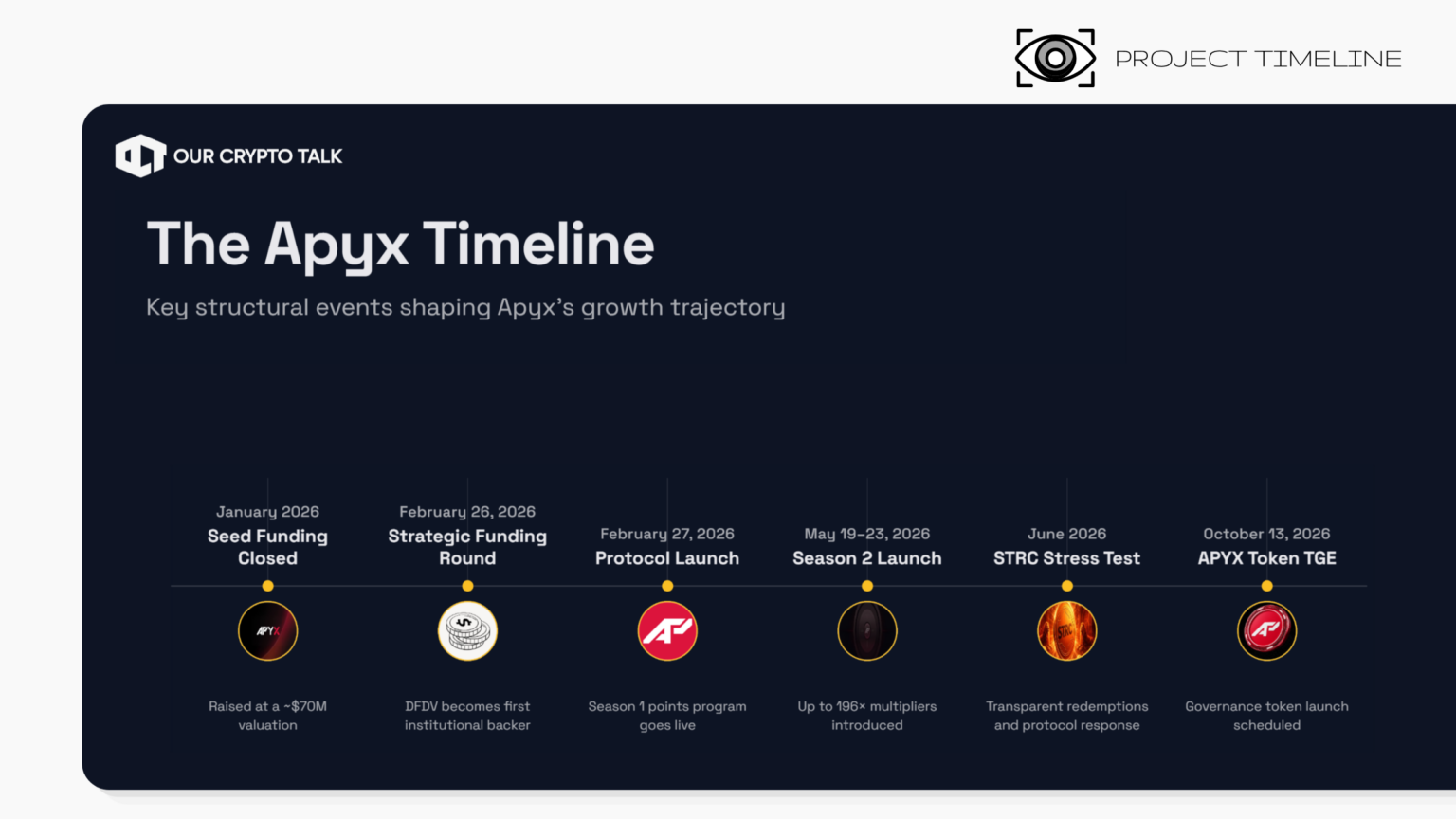
Its most significant supporter is DeFi Development Corp. (Nasdaq: DFDV), which made the protocol’s first strategic investment in February 2026. As a publicly listed company running its own Digital Asset Treasury strategy, DFDV provides more than capital. It also brings regulatory experience, institutional credibility, and long-term alignment with Apyx’s business model.
The project completed its initial seed financing in January 2026 before closing a strategic round one month later. More importantly, the token itself was intentionally structured without traditional venture capital allocations. Only 3.7% of APYX is allocated to investors, all subject to a three-year vesting schedule, removing the typical VC overhang seen in many token launches.
According to Apyx, this approach was intentional, allowing the protocol to retain greater independence while reducing pressure for aggressive token monetization.
The ecosystem surrounding Apyx also includes strategic relationships with companies such as Kraken, Anchorage Digital, Strategy, and Strive. While these partnerships vary in scope, they strengthen the protocol’s position within both institutional crypto and traditional capital markets.
Overall, Apyx’s backing emphasizes quality over quantity. Rather than relying on dozens of venture funds, it has assembled a small group of strategic partners that directly understand Digital Asset Treasuries, tokenized finance, and regulated market infrastructure. That makes the funding profile particularly well suited to the protocol’s long-term focus on dividend-backed stablecoins.
Unlike many pre-token projects, Apyx already operates a live mainnet product with hundreds of millions of dollars in user capital. The protocol is available today on Ethereum and Base, with Solana integration planned, allowing users to mint apxUSD, an overcollateralized synthetic dollar backed by publicly traded Digital Asset Treasury preferred equity.
Users can also convert apxUSD into apyUSD, an ERC-4626 vault that automatically accrues dividend income generated by the underlying preferred shares. Rather than relying on funding rates or Treasury yields, Apyx distributes real cash flows from listed securities directly to onchain users.
The protocol has already reached meaningful scale. As of July 2026, more than $351 million worth of apxUSD has been issued, making it one of the largest dividend-backed stablecoin systems in the market. apyUSD has generated a trailing yield above 15%, with management expecting a long-term sustainable range closer to 13%.
Liquidity and redemptions are fully operational. Users can redeem into USDC, while secondary liquidity exists across integrated DeFi markets. Following the STRC volatility event in June 2026, the team temporarily adjusted redemption mechanics before publishing a detailed post-mortem, strengthening confidence in the protocol’s risk management.
Transparency is another differentiator. Apyx publishes daily NAV dashboards, third-party Proof of Reserves through AccountableData, and regular attestations from Wolf & Company. Development also continues through the public GitHub repository, where the team regularly ships frontend improvements, dashboard upgrades, and protocol infrastructure.
This is not a landing page collecting points. Anyone can connect a wallet today, deposit capital, earn dividend-backed yield, and participate in the live ecosystem.
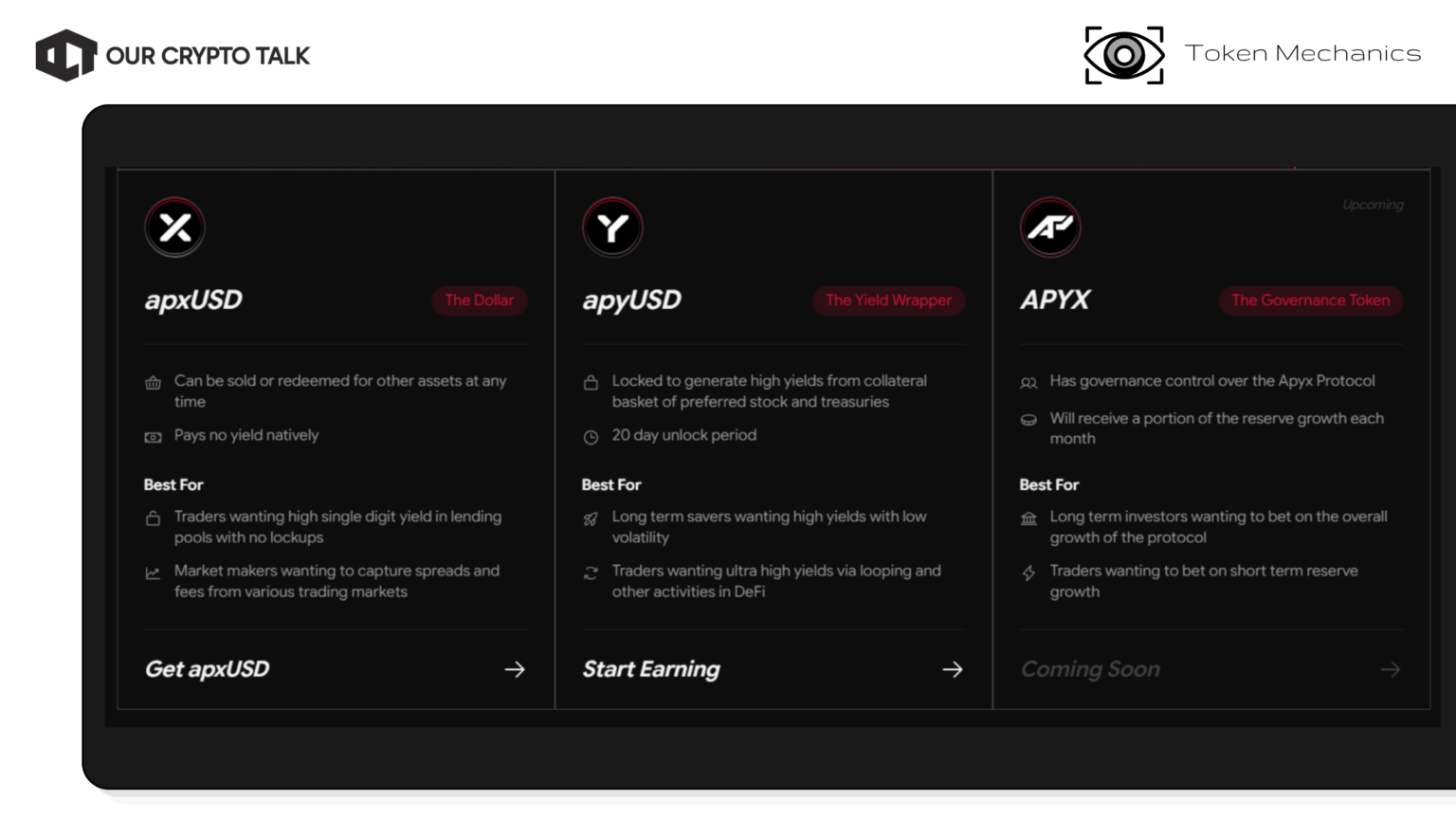
The strongest signal for Apyx is not its social following but the amount of real capital already using the protocol. More than $351 million has been deposited into apxUSD, showing users are willing to trust the dividend-backed model with significant funds.
Activity extends beyond deposits. Holders can wrap their assets into apyUSD to earn dividend income while simultaneously participating in the protocol’s Season 2 Pips campaign. Running until October 11, 2026, the program distributes 6 million APYX tokens, representing 6% of the total supply.
Unlike typical points campaigns, rewards are tied directly to deployed capital. Users receive multipliers based on how they use the protocol, with committed apxUSD positions receiving the largest boost, while Pendle yield positions, liquidity pools, and standard apxUSD holdings also qualify. Existing users from Season 1 receive additional loyalty bonuses, rewarding long-term participation instead of encouraging constant capital rotation.
Perhaps the most important proof point came during the STRC volatility event in June 2026. Instead of experiencing a mass withdrawal, Apyx maintained substantial supply while the team communicated transparently, adjusted liquidity mechanisms, and published detailed explanations after markets stabilized.
Follower counts and Discord activity matter far less than these numbers. The protocol skipped the traditional testnet farming phase and launched directly with real assets and real yield. The points campaign certainly attracts attention, but the true validation comes from hundreds of millions of dollars remaining deployed to earn dividend income rather than simply farming an airdrop.
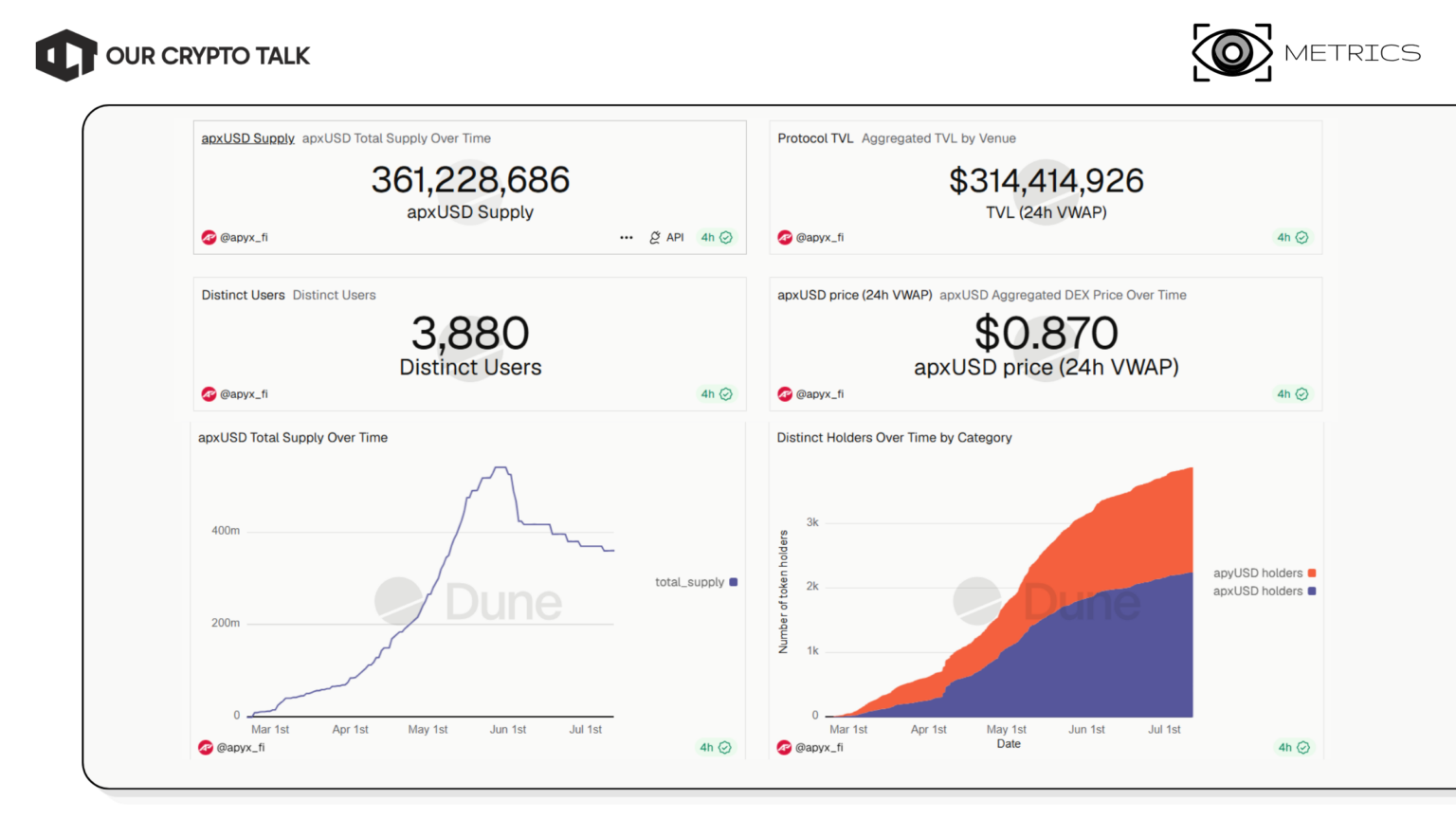
APYX is the governance token of the Apyx protocol, with its Token Generation Event (TGE) scheduled for October 13, 2026. Unlike most governance tokens, APYX is designed to capture real protocol cash flow from day one rather than relying on inflationary emissions or speculative token incentives.
The token has a fixed supply of 100 million APYX with no inflation, no future minting, and no emissions schedule. Instead of creating value through token issuance, APYX derives its value from the protocol’s growing reserve. The reserve is funded by dividend income from Digital Asset Treasury preferred equity, issuance and redemption fees, capital market activities, and gains from participating in preferred equity offerings.
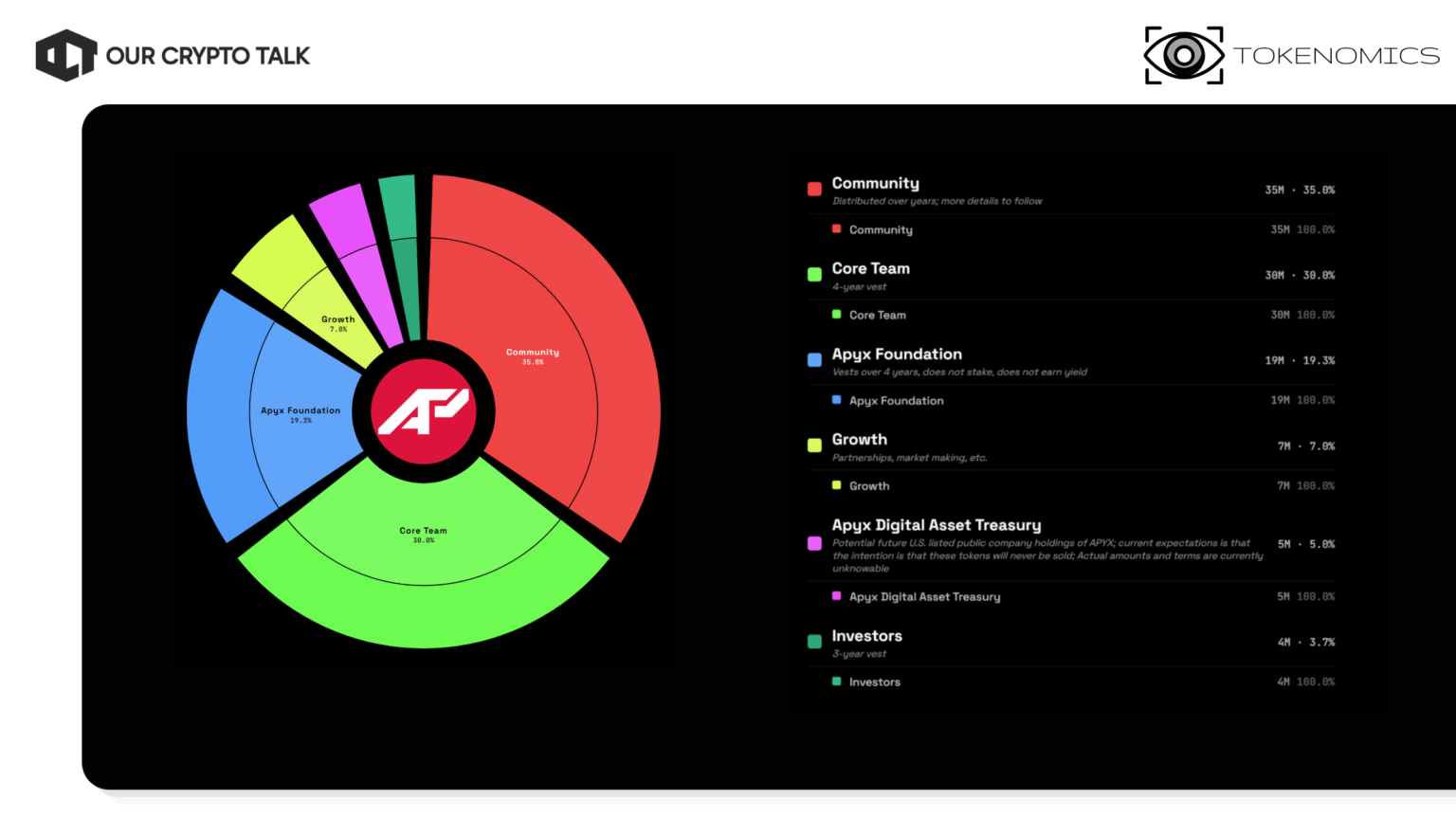
The allocation is relatively community-friendly. 35% is reserved for the community, 30% for the core team (vesting over four years), 19.3% for the Apyx Foundation (also vesting over four years and not eligible for staking rewards), 7% for ecosystem growth, 5% for the Apyx Digital Asset Treasury, and just 3.7% for investors, who are subject to a three-year vesting schedule. Notably, the project has no traditional venture capital allocation, removing the typical VC overhang seen in many token launches.
APYX holders stake their tokens to receive 50% of monthly protocol reserve growth, while the remaining 50% stays inside the protocol to strengthen overcollateralization and compound the reserve. Rewards can be claimed in either apxUSD or additional APYX, with governance able to adjust the payout ratio over time.
While the exact circulating supply at TGE has not yet been disclosed, the allocation structure is now public. Most tokens are subject to long-term vesting, including a 4-year vest for the core team and Apyx Foundation and a 3-year vest for investors, resulting in an intentionally tight launch float.
Overall, APYX has one of the more differentiated token models in the RWA sector. It combines a fixed supply, real cash flow, long-term vesting, and direct governance over protocol economics. Rather than relying on inflationary rewards, the model is designed to align token value with the protocol’s underlying economics.
The best way to gain early exposure to Apyx is through the live Season 2 Pips campaign, which runs until October 11, 2026, two days before the APYX token launch. Unlike traditional points programs, participation requires deploying real capital into a protocol that already generates yield.
The process is straightforward. Users begin by swapping stablecoins for apxUSD through the Apyx application. Holding apxUSD earns Pips while preserving liquidity, while converting to apyUSD adds exposure to the protocol’s dividend-backed yield stream.
Participants seeking larger rewards can commit apxUSD through the protocol, accept a 14-day withdrawal period, and receive the highest available reward multiplier. Additional opportunities exist across integrated protocols such as Pendle, Curve, Morpho, and Royco, where specific liquidity and yield positions earn enhanced multipliers based on capital deployed.
All rewards are tracked directly within the protocol dashboard, where Pips accumulate daily according to position size and multiplier. Users who participated during Season 1 automatically receive loyalty bonuses for maintaining their positions rather than withdrawing between campaigns.
This is not another social farming campaign built around follows and Discord activity. The highest rewards require real capital, real conviction, and acceptance of liquidity constraints. That makes the opportunity attractive for users who already believe in dividend-backed stablecoins and want to combine double-digit yield with potential governance token exposure before the October 13 TGE.
Apyx offers one of the strongest capital-efficient opportunities in the current RWA and yield-bearing stablecoin sector. However, it is not a passive airdrop farm. Users deploy real stablecoins into a protocol that already supports more than $351 million in apxUSD supply.
In return, they earn dividend-backed yields generated from publicly traded Digital Asset Treasury preferred shares. At the same time, those positions accumulate Season 2 Pips ahead of the APYX token launch.
The points program stands out because it rewards productive capital instead of social engagement. Participants earn Pips based on the value of their positions and the strategy they choose. Simply holding apxUSD or apyUSD earns rewards, while committing liquidity or using integrated protocols such as Pendle unlocks significantly higher multipliers. Unlike most points campaigns, the underlying capital continues generating a real dividend yield throughout the farming period.
There is no public presale. The only way to gain early exposure is by using the protocol today. That makes this opportunity fundamentally different from buying a token before product launch. Users are participating in an ecosystem that already generates real cash flow before governance begins.
From an expected-value perspective, the setup looks attractive for investors who already allocate stablecoins into yield strategies. Capital earns approximately 13–15% annualized yield while simultaneously qualifying for the APYX distribution. The main risks remain concentration in Strategy’s STRC preferred shares, uncertainty around the exact launch float and initial circulating supply, and the regulatory environment surrounding equity-linked stablecoins.
Overall, Apyx offers positive expected value for long-term stablecoin investors with a three to six-month horizon. Those simply chasing short-term airdrops without conviction in the underlying dividend model may find better opportunities elsewhere.
Every RWA protocol carries risks beyond smart contracts, and Apyx is no exception. The largest concern today is concentration. Although the protocol plans to diversify over time, much of its current yield comes from Strategy’s STRC preferred shares. If those dividends decline, liquidity weakens, or investor sentiment around Digital Asset Treasuries changes, protocol growth could slow significantly.
Competition is another challenge. Ethena dominates crypto-native yield products, while Ondo continues expanding institutional Treasury-backed assets. If larger players enter the dividend-backed stablecoin market with broader diversification or stronger distribution, Apyx will need to maintain its yield advantage.
Regulation also deserves close attention. Apyx sits at the intersection of stablecoins, tokenized finance, and publicly traded securities. Future SEC guidance or changes to stablecoin regulation could affect product structure, redemption mechanics, or jurisdictional availability.
Execution remains equally important. Managing daily NAV calculations, maintaining overcollateralization, supporting redemptions during equity market closures, and expanding into additional Digital Asset Treasury products all require disciplined operational management. The team handled the June 2026 STRC volatility event well, but larger scale will introduce additional complexity.
The protocol is not simply another stablecoin fork. Its competitive advantage comes from sourcing yield through dividend-paying public securities. Whether that advantage proves durable depends on diversification and execution over the next several years.
The biggest catalyst is already scheduled. APYX will officially launch on October 13, 2026, marking the transition from a yield protocol into a community-governed ecosystem.
Before then, investors should watch for the release of the initial circulating supply and full unlock schedule. The allocation table and vesting framework have already been published, but the launch float will ultimately determine early valuation and selling pressure.
Protocol expansion is another important catalyst. Today, dividend income primarily comes from Strategy’s STRC preferred shares. Adding additional Digital Asset Treasury preferred equity would diversify revenue and reduce concentration risk, making the protocol more resilient over time.
Technical expansion also matters. Solana support is expected after Ethereum and Base, opening access to a larger DeFi ecosystem and potentially increasing adoption of both apxUSD and apyUSD.
For most investors, the decision comes down to timing. Users who already believe in the dividend-backed stablecoin thesis can deploy capital today, earn real yield, and accumulate Pips before TGE. Those who prioritize certainty may prefer to wait until after launch, when tokenomics, valuation, and market pricing become fully transparent.
WATCH
Apyx has already achieved what many pre-token projects never do. It operates a live protocol managing more than $351 million in assets, delivers sustainable double-digit yield from publicly traded preferred shares, and is led by an experienced team with deep backgrounds in both institutional finance and crypto infrastructure.
The current Season 2 campaign is one of the stronger capital-weighted farming opportunities available before October’s token launch. Users can earn real dividend income while qualifying for APYX token allocations.
However, several questions remain unresolved. The protocol is still heavily concentrated in STRC, diversification is only beginning, and the exact initial circulating supply at TGE has not yet been disclosed, despite the broader tokenomics now being public.Those factors make it difficult to justify a long-term conviction rating today.
The milestone that changes the outlook is straightforward. If Apyx launches APYX with fair tokenomics, expands beyond Strategy’s preferred shares, and continues growing apxUSD supply after TGE, the project could move from WATCH to FARM or even HOLD.
Until then, Apyx looks strongest as a yield-generating protocol with an attractive pre-TGE farming opportunity. It is not yet a guaranteed long-term token investment. Participate primarily for the yield, and treat any token allocation as additional upside. Size your positions according to the concentration and regulatory risks.
Disclaimer: This is not financial advice. The information provided is for educational and informational purposes only. All investments involve risk, including the potential loss of principal. Always do your own research.
All the opinions in this article are that of the author and in no way are financial advice. Our Crypto Talk and the author always suggest you do your own research in crypto and to never take anything as financial advice that you read on the internet. Check our Terms and conditions for more info.


Tokenization of RWA yields onchain might be the biggest opportunity that no one has noticed
Cold Wallet Safety 2026: Are Hardware Wallets Still Safe?
One Token, Multiple Products. Can Zylo Deliver?
The Rise of NEAR Protocol 2026: Inside the 530% Rally and the ETF
Tokenization of RWA yields onchain might be the biggest opportunity that no one has noticed
Cold Wallet Safety 2026: Are Hardware Wallets Still Safe?
One Token, Multiple Products. Can Zylo Deliver?
The Rise of NEAR Protocol 2026: Inside the 530% Rally and the ETF