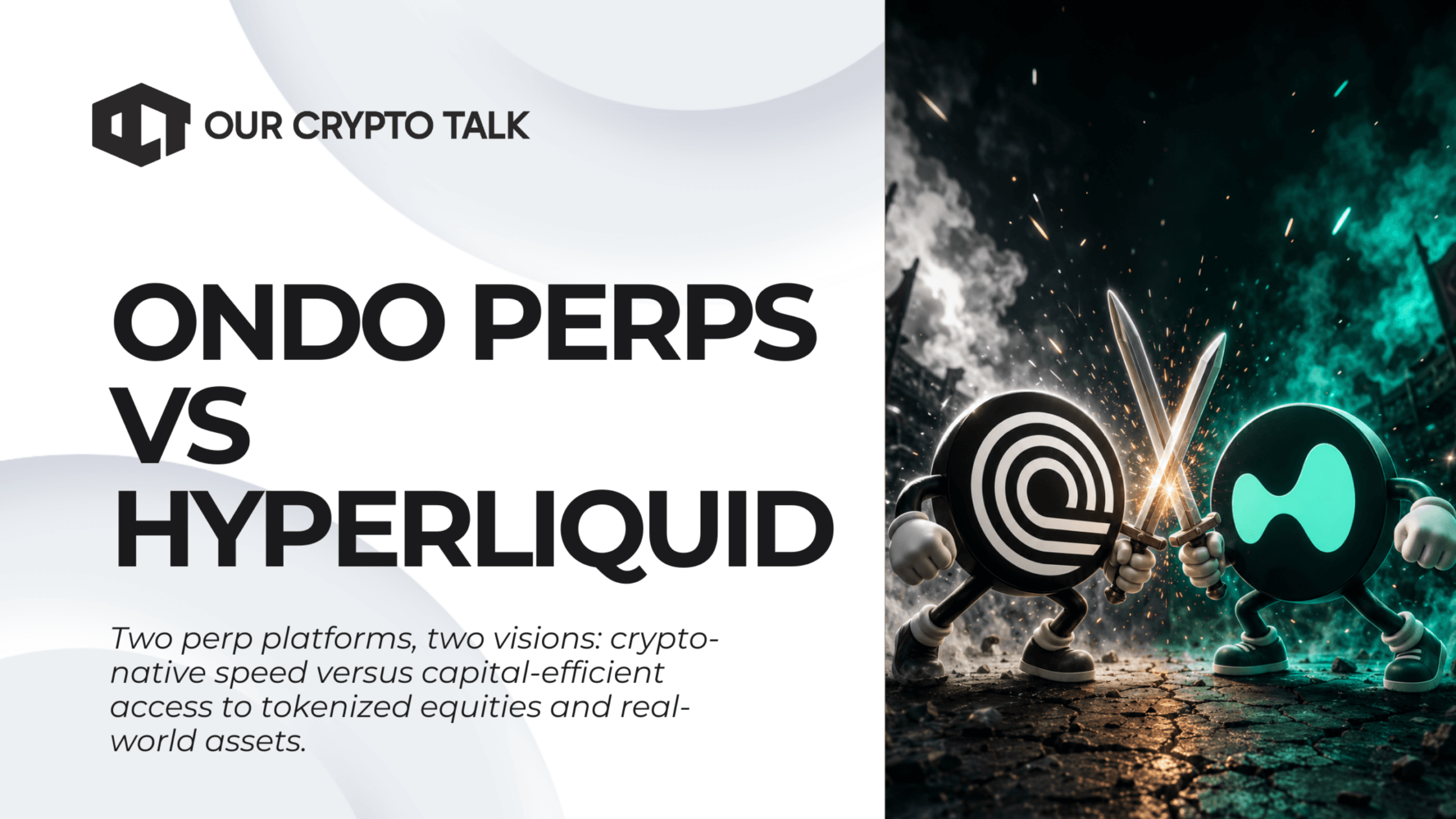
Ondo Perps vs Hyperliquid: compare collateral models, leverage, liquidity, and tokenized equity access to see which on-chain perp platform fits your trading.

Author: Kritika Gupta
On-chain perpetual trading has expanded far beyond Bitcoin and altcoins. In 2026, platforms now compete across crypto, tokenized equities, commodities, and indices. However, they use very different infrastructure and collateral models to reach those markets. This Ondo Perps vs Hyperliquid comparison examines two distinct visions for on-chain derivatives. Hyperliquid focuses on deep crypto liquidity, fast execution, and a battle-tested order book. In contrast, Ondo Perps brings tokenized stocks into leveraged trading and allows eligible non-US users to use real-world assets as collateral.
Although both platforms offer perpetual futures, they target different traders. Therefore, the most important differences involve collateral efficiency, liquidation risk, market depth, maturity, and access to tokenized assets.
On-chain perpetual futures are splitting into two distinct categories in 2026. One focuses on crypto-native speed. Hyperliquid processes more than $6.7 billion in daily volume across over 100 crypto pairs on a custom Layer 1 with sub-second finality. The other focuses on real-world asset access. Ondo Perps allows non-US traders to take leveraged positions on companies such as Apple, NVIDIA, and Tesla while using tokenized shares as collateral.
Both platforms offer the same core product: perpetual futures. However, they serve completely different markets, use different collateral models, and target different types of traders. Hyperliquid prioritizes deep crypto liquidity, fast execution, and high-volume trading. In contrast, Ondo Perps connects leveraged trading with tokenized equities and other real-world assets.
This comparison highlights the broader direction of on-chain derivatives. The sector no longer focuses only on Bitcoin, Ether, and altcoins. Instead, it now extends into equities, commodities, indices, and potentially any asset that issuers can tokenize and traders can use as on-chain collateral.
Core platform comparison across markets, collateral, execution, access, and infrastructure
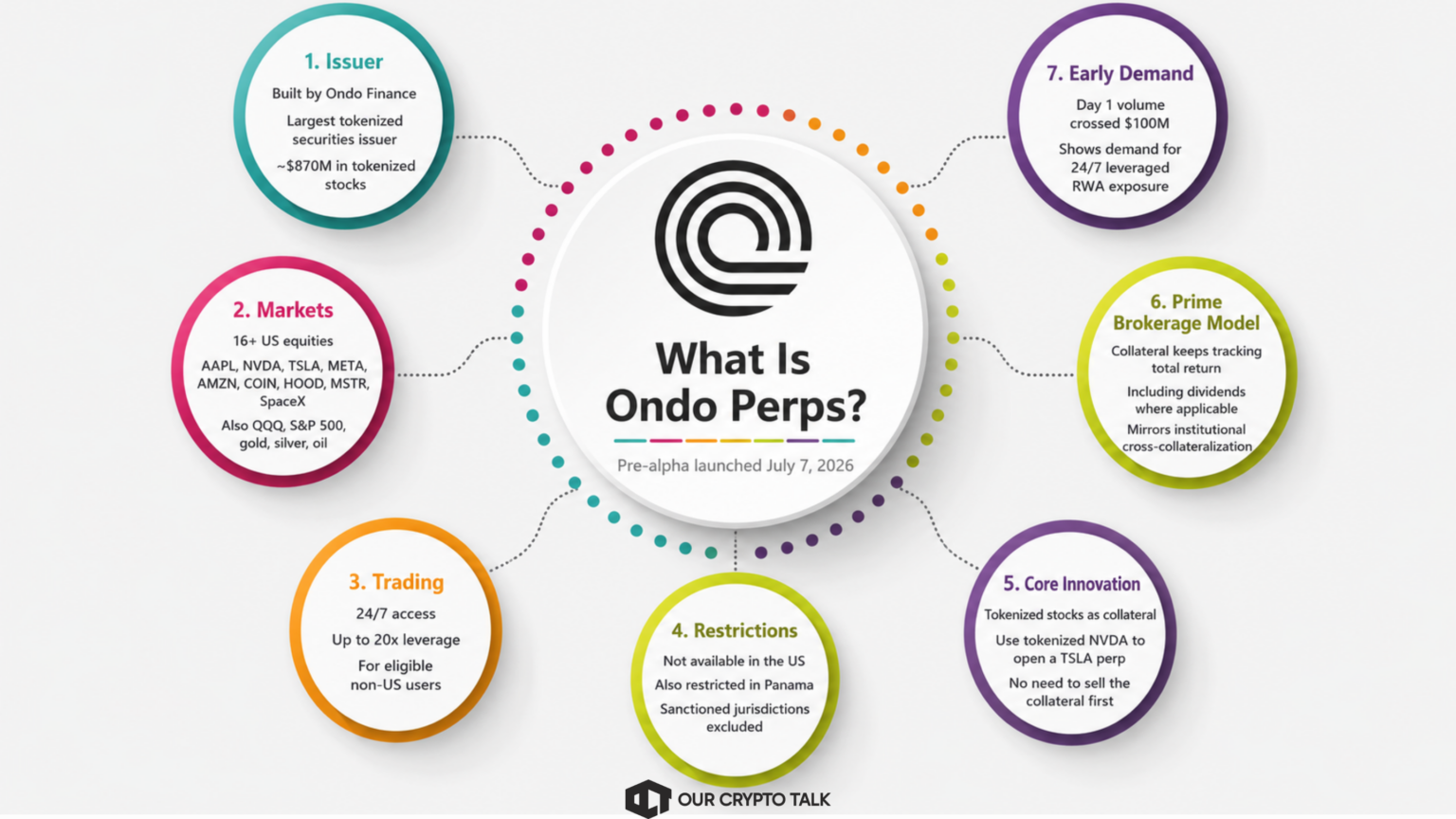
Ondo Finance launched Ondo Perps in pre-alpha on July 7, 2026. The company operates as the largest tokenized securities issuer, with approximately $870 million in tokenized stocks. While Hyperliquid built its platform around crypto-native perpetual markets, Ondo extends the same trading model to equities, indices, and commodities.
The platform supports more than 16 US equity markets, including AAPL, NVDA, TSLA, META, AMZN, COIN, HOOD, MSTR, and SpaceX-related exposure. It also offers markets tied to QQQ, the S&P 500, gold, silver, and oil. Eligible non-US traders can access these markets 24/7 with up to 20x leverage. However, Ondo Perps does not serve users in the United States, Panama, or sanctioned jurisdictions.
Tokenized stocks as collateral form the platform’s main innovation. For example, a trader holding tokenized NVDA can use it as collateral to open a leveraged TSLA position without selling the NVDA first. Meanwhile, the collateral continues to track NVIDIA’s total return, including dividends where applicable. This structure mirrors the prime brokerage model that institutional trading desks use to cross-margin existing assets while opening new positions.
Ondo Perps crossed $100 million in trading volume on its first day. Although the platform remains in its early stages, that initial activity showed clear demand for leveraged, round-the-clock exposure to tokenized real-world assets.
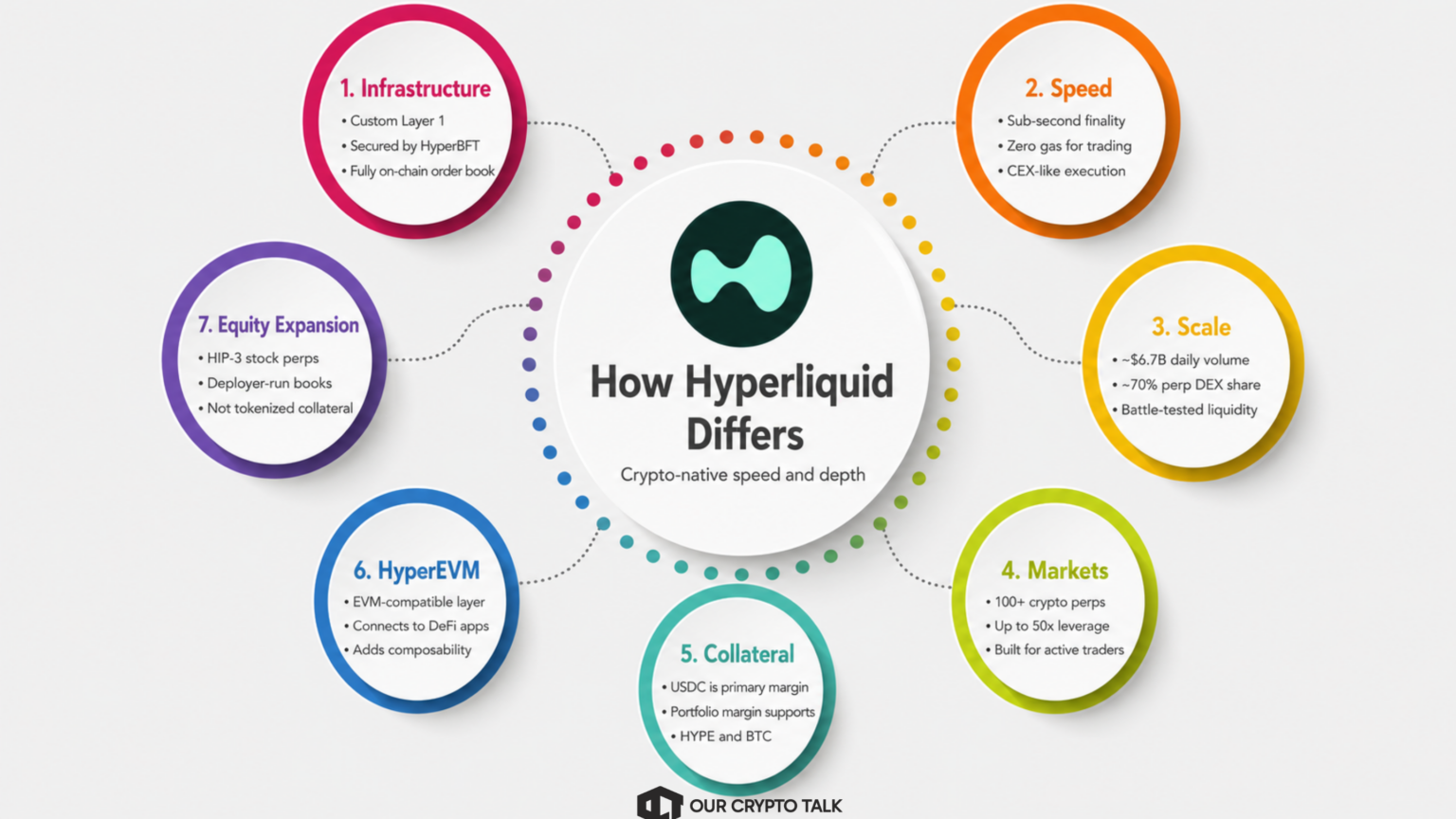
Hyperliquid operates on a custom Layer 1 blockchain secured by HyperBFT consensus. The platform combines a fully on-chain order book, sub-second finality, and zero gas fees for trading. As a result, it delivers the speed and execution quality that active crypto traders expect from a centralized exchange while keeping settlement on-chain. This infrastructure forms a key part of the Ondo Perps vs Hyperliquid comparison.
The platform processes approximately $6.7 billion in daily volume and accounts for roughly 70% of the perpetual DEX market. It supports more than 100 crypto perpetual markets and offers up to 50x leverage on selected pairs. Traders primarily use USDC as collateral, while Hyperliquid’s portfolio margin system also supports HYPE and BTC.
In addition, HyperEVM provides an EVM-compatible environment that connects Hyperliquid’s trading infrastructure with DeFi applications. Hyperliquid has also started expanding into equities through HIP-3 stock perps. However, deployers operate these markets through independent order books and margin systems. Tokenized shares do not back the positions or serve as collateral.
This distinction defines the contrast between the two platforms. Hyperliquid built its network for crypto-native speed, liquidity, and market depth before expanding into equities. In comparison, Ondo built its ecosystem around tokenized real-world assets and equity access before adding perpetual futures as an extension of its tokenization infrastructure.
The collateral structure creates one of the most important distinctions in the Ondo Perps vs Hyperliquid comparison. Ondo uses a prime brokerage-style collateral model on-chain. Suppose you hold tokenized AAPL and want to open a leveraged long position on NVDA. You can post your AAPL tokens as collateral and open the NVDA perpetual without first converting your holdings into stablecoins. Meanwhile, the tokenized AAPL continues to track the stock’s total return, including dividends where applicable.
Institutional prime brokerages use a similar cross-collateralization model. They allow trading desks to use existing equity holdings to support additional positions instead of leaving that capital idle. Ondo brings this structure on-chain, which makes the platform more capital-efficient for traders who already hold tokenized stocks and want to maintain their equity exposure.
However, this model also creates correlated liquidation risk. For example, your tokenized AAPL collateral could fall 20% while your leveraged NVDA position moves against you. In that situation, the declining collateral value and the unrealized loss on the perpetual position would increase liquidation pressure at the same time. Therefore, traders must manage both the position risk and the market risk attached to the collateral.
Hyperliquid uses a simpler crypto-native margin model. Traders primarily post USDC, although portfolio margin also supports HYPE and BTC. They can then use that collateral to trade more than 100 crypto perpetual markets. USDC generally maintains a stable value outside a depeg event, so the collateral does not add direct equity market exposure. In practical terms, the amount a trader deposits closely reflects the margin available for trading.
Hyperliquid’s HIP-3 stock perps also follow a separate structure. Deployers operate them through independent order books and margin systems rather than using tokenized stocks as collateral.
Ultimately, Ondo offers greater capital efficiency for equity holders because traders can retain their stock exposure while opening leveraged positions. However, that efficiency introduces correlated liquidation risk. Hyperliquid offers a simpler and more battle-tested margin system, but equity holders must usually convert their assets into USDC first and give up their original equity exposure. This difference, rather than market selection alone, defines the real divide between the two platforms.
Ondo and Hyperliquid do not operate as straightforward competitors. In June 2026, Ondo brought 35 tokenized assets to HyperEVM through a LayerZero-powered bridge. The integration added tokenized versions of SPY, QQQ, NVDA, TSLA, GOOGL, NFLX, BABA, and other securities to Hyperliquid’s broader ecosystem.
As a result, traders can combine Ondo’s tokenized stocks with Hyperliquid’s perpetual markets and DeFi protocols. For example, they can use the assets to construct basis trades, capture funding-rate differences, or build delta-neutral positions. Instead of simply holding a tokenized stock, traders can now integrate it into more advanced on-chain trading and yield strategies.
HyperEVM lending protocols can also support these assets. Felix, a lending platform with approximately $167 million in TVL, can integrate Ondo’s tokenized stocks into its markets. This connection could allow users to borrow against tokenized equities or use them across additional DeFi strategies without leaving the Hyperliquid ecosystem.
Therefore, Ondo Perps competes with Hyperliquid in the perpetual futures market while Ondo simultaneously builds on Hyperliquid’s infrastructure in the RWA market. The two platforms act as rivals at one layer and collaborators at another. That relationship makes the comparison more interesting than a simple Ondo-versus-Hyperliquid debate.
Hyperliquid currently operates at a much larger scale than Ondo Perps. It processes approximately $6.7 billion in daily volume, while Ondo Perps records roughly $70 million to $100 million. That creates a gap of around 100x, although the platforms remain at very different stages of development.
Hyperliquid launched in 2023 and has operated through several volatile market events. Its infrastructure can reportedly handle more than 200,000 transactions per second, while its broader ecosystem holds over $400 million in TVL. By comparison, Ondo Perps launched in July 2026 and remains in pre-alpha. It currently offers fewer markets, lower liquidity, and a much shorter operating history.
Best platform by trading use case
Furthermore, Hyperliquid has already tested its liquidation engine under extreme market pressure. During one major event, the platform processed approximately $19 billion in liquidations. Ondo Perps has not yet faced a comparable stress event, so traders still lack evidence of how its collateral and liquidation systems will perform during a severe market downturn.
However, comparing volume alone would be unfair at this stage. Hyperliquid has had several years to build liquidity, attract market makers, and refine its infrastructure. A more useful comparison focuses on architecture and long-term vision. In that sense, Ondo Perps resembles Hyperliquid in early 2023: a new product entering the market with a different thesis about what on-chain derivatives should become.
Ondo Perps and Hyperliquid serve different trading priorities, so the right choice depends on the markets you trade and the collateral you already hold. Hyperliquid fits crypto-native traders who prioritize deep liquidity, fast execution, broad altcoin coverage, and a liquidation system tested across multiple market cycles. Ondo Perps fits eligible non-US traders who want leveraged exposure to equities, indices, and commodities while keeping tokenized stocks as collateral.
For crypto perpetuals, Hyperliquid remains the stronger option because it offers greater market depth, more pairs, and mature infrastructure. However, Ondo Perps provides a more differentiated product for traders who already hold tokenized equities. Its collateral model allows them to open new leveraged positions without first selling their stock exposure or converting everything into stablecoins.
Traders who want stock perpetuals with stablecoin margin should compare both platforms contract by contract. Liquidity, funding rates, leverage limits, and available markets can vary. Meanwhile, traders who move between crypto and equity narratives may find that the platforms work better together than as substitutes.
Hyperliquid answers “where do I trade crypto perps with the best execution?” Ondo Perps answers “how do I get leveraged equity exposure without leaving crypto?” Most active traders will eventually use both.
The Ondo Perps vs Hyperliquid comparison reflects two different visions for on-chain derivatives. Hyperliquid starts with crypto-native execution and extends its infrastructure into equities through HIP-3. Ondo starts with tokenized real-world assets and extends that ecosystem into leveraged perpetual trading.
Today, Hyperliquid leads in liquidity, market coverage, operating history, and proven execution under pressure. Ondo Perps remains much earlier, but its tokenized stock collateral model introduces a form of capital efficiency that standard stablecoin-margin platforms cannot offer. That advantage also brings additional risk because both the collateral and the leveraged position can move against the trader simultaneously.
Therefore, traders should not treat this comparison as a simple winner-versus-loser debate. Hyperliquid provides the stronger venue for crypto perpetuals, while Ondo Perps creates a new route into 24/7 leveraged equity and commodity markets. As tokenized assets gain wider adoption, the boundary between crypto trading and traditional market exposure will continue to narrow.
erpetual futures carry significant risk of rapid loss. Leveraged positions can be liquidated quickly. Tokenized stock collateral introduces additional correlated risk. This is a comparison of platform architectures, not a recommendation to trade on either. Do your own research.


Tokenization of RWA yields onchain might be the biggest opportunity that no one has noticed
Cold Wallet Safety 2026: Are Hardware Wallets Still Safe?
One Token, Multiple Products. Can Zylo Deliver?
The Rise of NEAR Protocol 2026: Inside the 530% Rally and the ETF
Tokenization of RWA yields onchain might be the biggest opportunity that no one has noticed
Cold Wallet Safety 2026: Are Hardware Wallets Still Safe?
One Token, Multiple Products. Can Zylo Deliver?
The Rise of NEAR Protocol 2026: Inside the 530% Rally and the ETF