Explore The DATA Foundation, Kled, and Trace to see how AI training data, provenance, licensing, and the DATA token work together.

Author: Akshat Thakur
The DATA Foundation is building an onchain trust layer for AI training data. Its purpose-built Layer 1, the DATA Network, lets people contribute real-world data while creating immutable records for ownership, consent, licensing, quality, and payments.
The problem is simple. AI companies are running out of high-quality training data. Public internet data has become less useful, copyright lawsuits are increasing, and AI labs need datasets they can legally use and verify. DATA solves this by combining programmable licensing, public provenance records through Trace, and Kled, a marketplace where contributors voluntarily share data for compensation.
Why now? AI has shifted from needing more data to needing better data. Companies increasingly care about where training data comes from and whether they have permission to use it. At the same time, blockchain infrastructure has matured enough to support transparent licensing and provenance.
DATA is not launching into an uncertain market. It is repurposing Story Protocol’s proven IP infrastructure for AI data, while Kled has already registered more than 1.5 billion human-contributed records and processes over 5 million new uploads every day.
The AI data market already has several established players.
Centralized platforms like Scale AI, Appen, and Surge AI dominate enterprise data labeling and annotation. Ocean Protocol and similar Web3 projects focus on decentralized data marketplaces. Storage networks like Filecoin and Arweave secure data permanently but do not solve ownership, licensing, or contributor payments.
Most competitors only solve one part of the problem. They help source data, store data, or sell data. Very few provide verifiable provenance, contributor consent, programmable licensing, and transparent payment in one system.
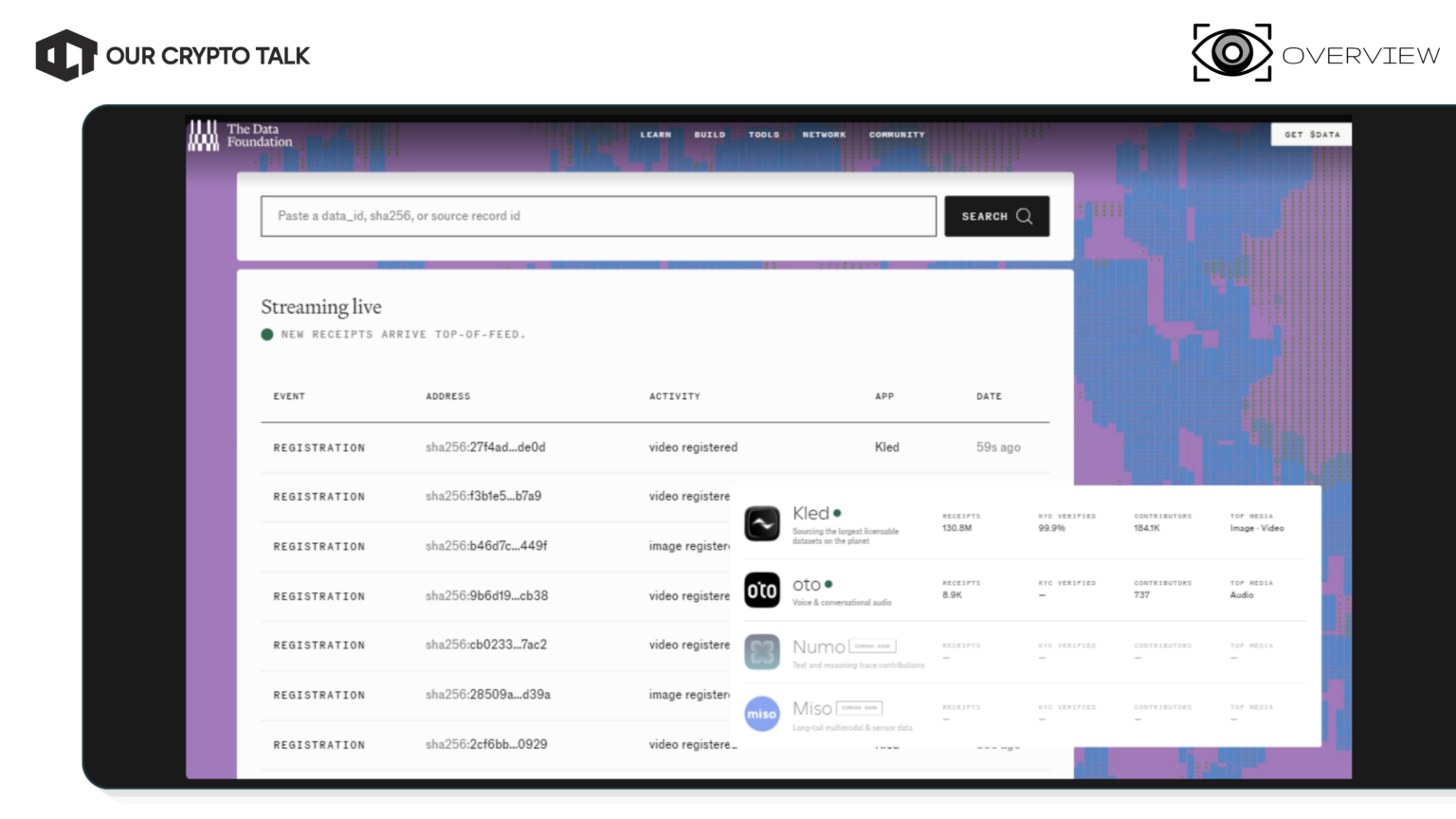
DATA combines all of these pieces into a single stack. Trace records immutable proof of where data came from, who owns it, what license applies, and whether contributors were paid. Kled supplies over 1.5 billion opt-in records from more than 99.9% KYC-verified contributors. The DATA Network connects everything through programmable licensing and payments.
OCT’s verdict: this is real, not cope.
The biggest advantage is combining Story Protocol’s licensing infrastructure with Kled’s large, real-world data inventory. Centralized platforms cannot easily introduce transparent onchain rights management, while decentralized marketplaces still struggle to source quality human data at scale. DATA enters the market with both infrastructure and supply already in place.
The leadership combines blockchain infrastructure experience with large-scale AI data operations.
Andrea Muttoni serves as CEO of The DATA Foundation. Before this role, he led the Story Foundation and previously worked at Dapper Labs, where he focused on developer relations and ecosystem growth. He has led the transition from Story Protocol’s programmable IP network toward AI data infrastructure.
Avi Patel, founder and CEO of Kled, joined as Chief Data Officer while continuing to lead Kled. His team has built one of the world’s largest opt-in human data marketplaces, with more than 1.5 billion records, millions of dollars paid to contributors, and leading positions across multiple app stores.
The wider engineering team comes from Story Protocol, which already built licensing infrastructure, smart contracts, and the underlying Layer 1. Rather than assembling a new team around an AI narrative, DATA is extending technology that already exists into a larger market.
For this category, the experience fits well. The team understands blockchain infrastructure, digital rights, and large-scale data marketplaces.

DATA inherits one of the strongest funding profiles in crypto infrastructure.
Before becoming The DATA Foundation, Story Protocol raised roughly $140 million from leading investors, with a16z crypto leading the funding rounds. Poseidon, the ecosystem’s AI data processing layer, later raised another $15 million in seed funding led by a16z. Kled also secured venture funding before joining the DATA ecosystem.
This is not an early-stage project searching for product-market fit. The funding originally supported Story Protocol’s programmable IP vision and now provides the runway to expand into AI data infrastructure.
The combination of a16z’s backing, Story’s existing technology, and Kled’s operating business gives DATA both financial resources and real-world distribution. It reduces execution risk compared to many AI infrastructure projects that still rely entirely on future fundraising or partnerships.
From OCT’s perspective, this is one of the stronger institutional backing profiles in the AI infrastructure sector. It combines experienced investors, proven technology, and an existing marketplace instead of betting solely on future adoption.
Yes. The DATA Foundation already operates live infrastructure with real data flowing through the network.
The DATA Network, formerly Story Network, is live. Trace is available today as a public provenance explorer, while Kled already uses the network to register and license human-generated data.
Users can interact with both products today.
Trace creates immutable onchain receipts for every dataset. Each receipt records the content hash, ownership, consent, licensing terms, payment status, and timestamps. AI companies can verify provenance without accessing the underlying data.
Kled is the largest opt-in human data marketplace connected to the network. Contributors upload images, videos, audio, and other real-world content. Every submission is registered onchain, and contributors receive stablecoin payments when their data is licensed.
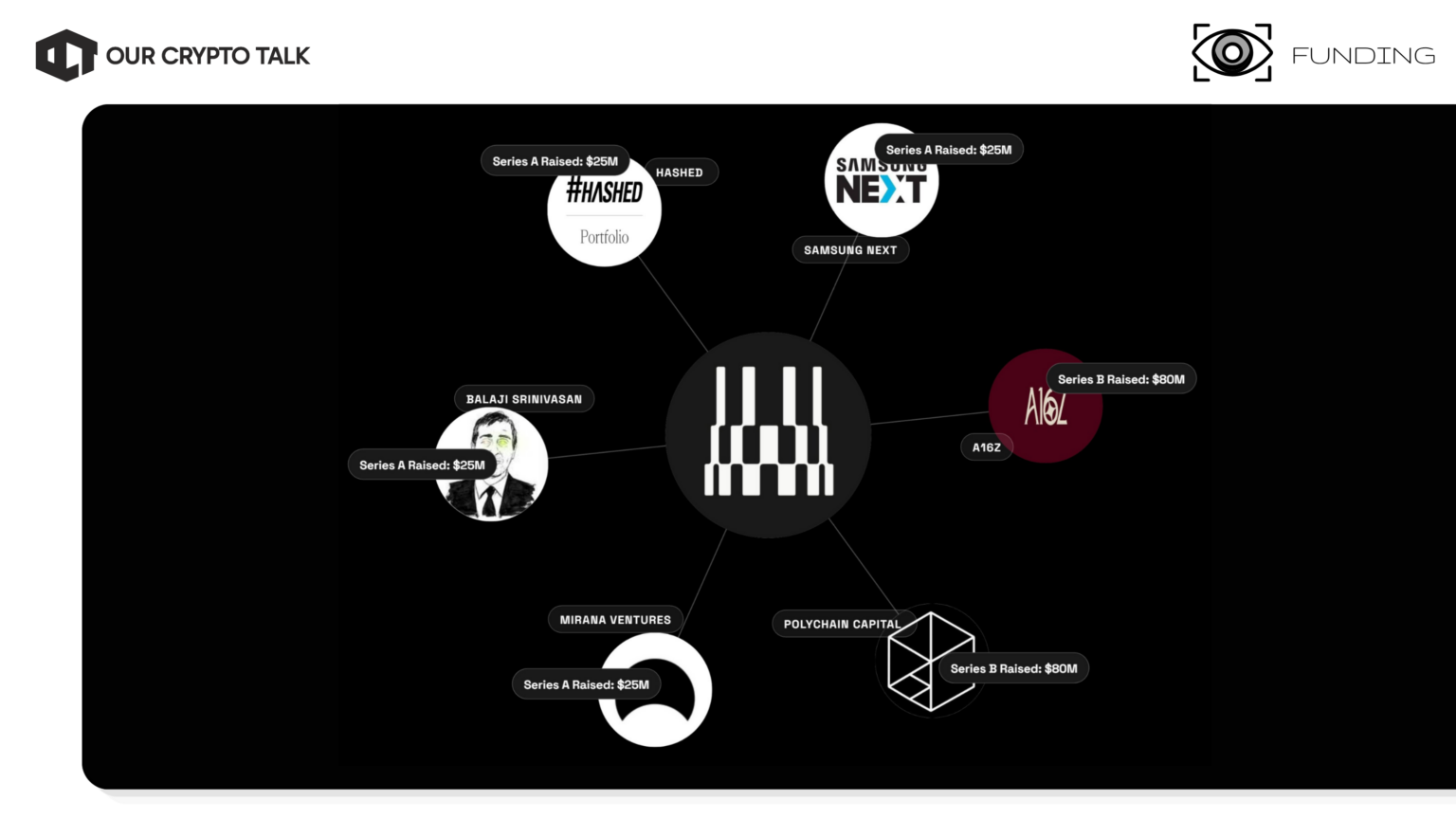
Current network metrics show meaningful adoption:
Kled has grown even larger:
Developers can also build using the protocol SDKs, Trace APIs, and Confidential Data Rails. This is production infrastructure with active users, not a whitepaper or testnet.
The strongest signal is not social engagement. It is the amount of real data entering the network.
Kled has already registered more than 1.5 billion human-contributed records. Contributors upload over 5 million new records every day. Millions of dollars have already been paid to users for licensed data.
The protocol itself has processed:
Quality matters as much as quantity. Around 99.9% of Kled contributors complete KYC before participating. Contributors must create original content instead of completing simple social tasks. That makes participation difficult to fake and creates meaningful supply.
Social metrics deserve less attention. Large follower counts or engagement numbers say little about whether AI companies actually need the data.
The biggest positive is inventory. Few decentralized networks can match this scale of verified human-generated data.
The biggest question is demand. Upload volume proves contributors are participating. It does not yet prove AI companies will license data at the scale needed to build a dominant business. That will be the metric to watch over the next year.
DATA is the native utility token of the DATA Network. It replaced the former IP token through a 1:1 migration.
The supply structure remains largely unchanged from Story Protocol.
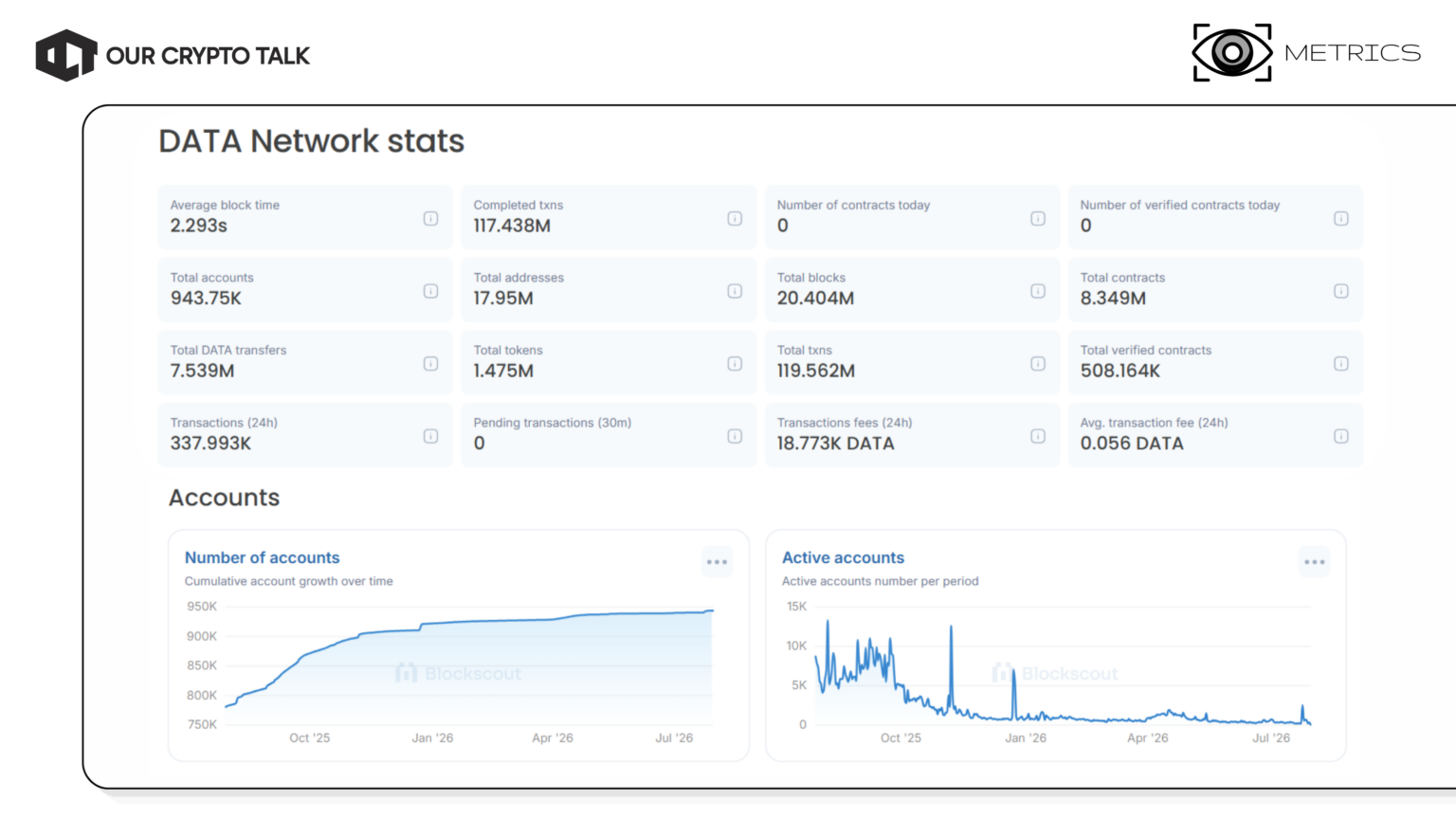
Current allocation is approximately:
Current circulating supply sits around 35% to 40% of the total supply, making it healthier than many recent low-float launches.
DATA is more than a governance token.
It pays gas fees across the network. Every receipt, licensing transaction, provenance record, and application interaction consumes DATA. Builders also use the token when integrating licensing, payments, and data infrastructure into their applications.
As network usage grows, demand for DATA should increase alongside transaction activity.
Most insider allocations follow multi-year vesting schedules, similar to other a16z-backed infrastructure projects. Investors should still monitor future unlocks because large team and backer distributions remain a long-term supply risk.
Overall, the token structure benefits from an existing live network instead of launching before product-market fit.
The traditional “farm points before TGE” phase has already passed. The network is live, and the best opportunities now come from real participation.
The simplest path is contributing data through Kled. Users upload original images, videos, audio, or other human-generated content. Contributors receive stablecoin payments whenever their data is licensed, while every submission creates a permanent onchain record.
Builders can integrate Trace into their own applications to verify provenance, ownership, and licensing. The protocol also supports Confidential Data Rails for developers building AI data products.
Holding DATA provides exposure to network growth because it serves as the gas token for every transaction, receipt, and licensing event.
This is not another social farming campaign. There are no simple tasks that generate outsized rewards.
The strongest edge belongs to people who can contribute valuable datasets, build applications on the protocol, or help AI companies source verified training data.
Unlike many AI projects, the incentive here comes from real commercial activity instead of temporary points campaigns. As more AI companies adopt provenance tracking and licensed datasets, early contributors and builders stand to benefit the most.
Here’s the rewritten version in the same style as your previous articles. Short paragraphs, active voice, no bold text inside the body, no em dashes, and each section stays well under 300 words.
The DATA Foundation is not another points farm. The biggest opportunity comes from contributing valuable AI training data through Kled or owning DATA as the gas token of a network already processing real activity.
Unlike most AI projects, the network already has live infrastructure, real contributors, and commercial payments.
There is no large points campaign rewarding simple social tasks.
The closest equivalent is Kled. Contributors upload original images, videos, audio, and other real-world content. They receive stablecoin payments when their data is licensed, and every submission creates a permanent onchain receipt.
Similar AI data marketplaces have paid active contributors anywhere from a few hundred dollars to several thousand dollars per month, depending on data quality and demand.
This is not passive income. Contributors must create original content, complete KYC, and consistently supply useful datasets.
DATA already trades following the automatic migration from IP.
The network already supports:
That gives investors exposure to an operating network instead of a pre-product narrative.
The biggest upside comes if AI companies increasingly adopt licensed, provenance-tracked datasets.
The biggest risk is commercialization. Inventory alone does not generate revenue. The network still needs large AI customers to consistently license data.
Overall, DATA offers attractive long-term potential for investors who believe verifiable AI data will become critical infrastructure. It is far less attractive for traders looking for quick speculation or easy farming opportunities.
The technology is real. The biggest risks come from execution rather than product development.
Competition remains intense. Scale AI, Appen, and other enterprise data providers already have deep relationships with AI companies. DATA must prove that transparent provenance creates enough value for customers to switch.
Demand is another unknown. Kled has already built one of the world’s largest human data inventories, but AI companies still need to license that data at meaningful scale.
Regulation could become another obstacle. Privacy laws, copyright litigation, AI regulations, and cross-border data rules continue to evolve. While onchain licensing improves transparency, it cannot eliminate legal risk.
Quality control also matters. The network must continue filtering synthetic, duplicated, or low-quality content while rewarding genuine contributors. If data quality declines, demand will follow.
Kled currently provides most of the network’s inventory. That creates concentration risk. Expanding beyond a single marketplace will make the ecosystem more resilient over time.
The project is not simply another blockchain pivot. Story Protocol already built the licensing infrastructure. The challenge now is proving businesses will pay for it.
The Story-to-DATA transition is complete. Future growth now depends on adoption rather than rebranding.
The biggest catalyst will be commercial licensing agreements with major AI companies. Public confirmation that leading AI labs are sourcing data through the network would significantly strengthen the investment case.
Several product launches could also expand adoption:
Investors should also watch contributor payouts. Growing stablecoin payments would indicate increasing commercial demand rather than simple inventory growth.
Network activity is another key metric. More licensing transactions, receipts, and gas consumption would strengthen DATA’s value proposition as the network token.
For investors, the decision is straightforward.
Buy today if you believe AI companies will increasingly pay for transparent, consented datasets.
Wait if you want clearer evidence that inventory is converting into recurring licensing revenue.
WATCH
The DATA Foundation already operates a live Layer 1, a working provenance platform, and one of the largest opt-in human data marketplaces in the industry.
The ecosystem has registered more than 1.5 billion records, processes over 5 million daily uploads, and has generated more than 135.8M onchain receipts. It also benefits from experienced leadership and approximately $140 million in backing led by a16z.
Those are meaningful advantages.
The missing piece is commercialization.
The project must prove that AI companies consistently license this data at scale. Until that happens, the investment thesis depends more on future demand than current revenue.
The milestone that changes the rating is clear.
Large commercial licensing agreements, rising contributor payouts, and sustained growth in network activity would demonstrate that provenance has become essential infrastructure for AI.
If those metrics accelerate, DATA could move from WATCH to FARM or even HOLD.
For now, it remains one of the more credible AI infrastructure projects, but investors should watch revenue growth as closely as data growth.
All the opinions in this article are that of the author and in no way are financial advice. Our Crypto Talk and the author always suggest you do your own research in crypto and to never take anything as financial advice that you read on the internet. Check our Terms and conditions for more info.


Tokenization of RWA yields onchain might be the biggest opportunity that no one has noticed
Cold Wallet Safety 2026: Are Hardware Wallets Still Safe?
One Token, Multiple Products. Can Zylo Deliver?
The Rise of NEAR Protocol 2026: Inside the 530% Rally and the ETF
Tokenization of RWA yields onchain might be the biggest opportunity that no one has noticed
Cold Wallet Safety 2026: Are Hardware Wallets Still Safe?
One Token, Multiple Products. Can Zylo Deliver?
The Rise of NEAR Protocol 2026: Inside the 530% Rally and the ETF