Consensus Mechanisms: Beyond PoW and PoS in 2025
Explore the evolution of consensus mechanisms in 2025, beyond Proof of Work and Proof of Stake, for faster, greener, and secure blockchains.
 Chirag Sharma
Sep 4, 2025, 8:49 AM UTC

Author: Chirag Sharma
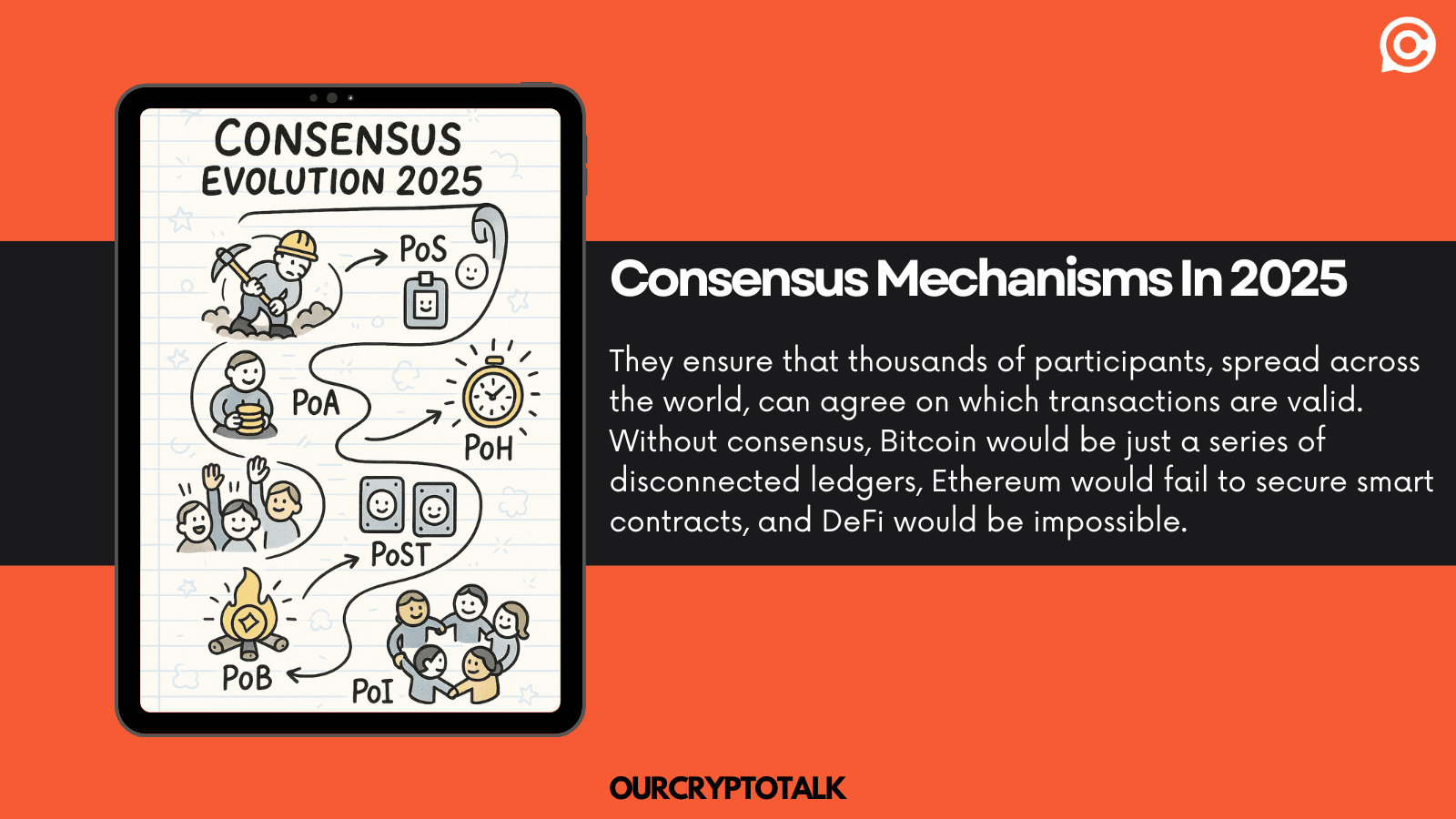
Consensus mechanisms are the silent engines of blockchain technology. They ensure that thousands of participants, spread across the world, can agree on which transactions are valid without a central authority. Without consensus, Bitcoin would be just a series of disconnected ledgers, Ethereum would fail to secure smart contracts, and decentralized finance would be impossible.
For more than a decade, the story of consensus has been dominated by two heavyweights: Proof of Work (PoW) and Proof of Stake (PoS). PoW, the mechanism behind Bitcoin, relies on computational power to secure the network. PoS, which Ethereum transitioned to in 2022, uses staked assets to achieve consensus with greater efficiency. Together, they shaped the foundation of decentralized systems.
But in 2025, the blockchain world looks very different. The demand for scalability, sustainability, and real-world utility has pushed developers far beyond these original models. PoW is criticized for its staggering energy consumption—comparable to entire countries—while PoS often concentrates power in the hands of wealthy stakers. The result has been a wave of innovation, spawning new “Proof of” variants designed to solve these problems.
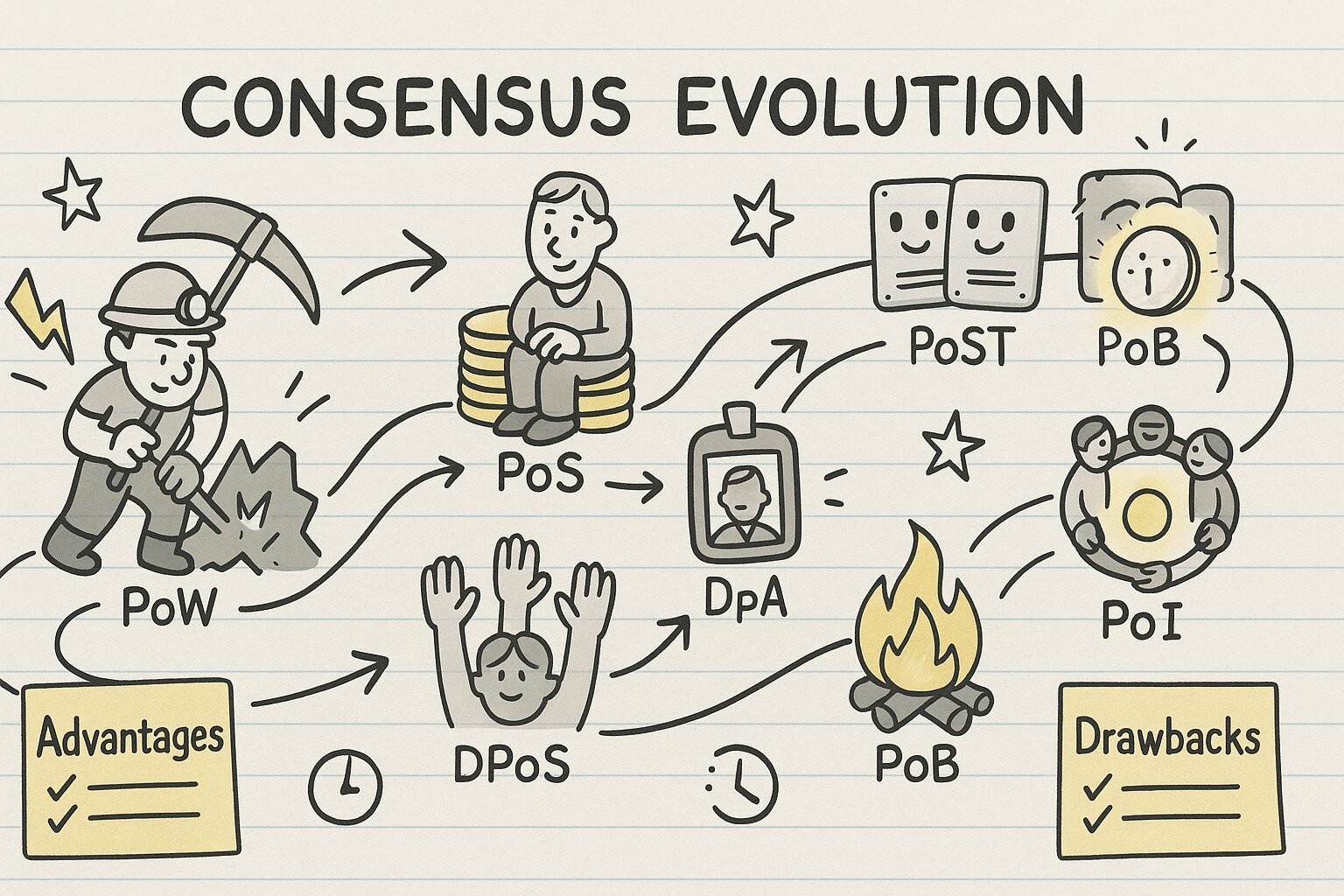
From identity-based models like Proof of Authority to novel approaches like Proof of History, these mechanisms are redefining what’s possible in decentralized networks. This article explores how consensus has evolved, the strengths and weaknesses of each model, and why they matter for developers, investors, and the future of Web3.
Legacy Models: Proof of Work and Proof of Stake
To understand the new wave of consensus mechanisms, it’s important to revisit the original designs.
Proof of Work (PoW), introduced by Bitcoin in 2009, was revolutionary. It secured the network by requiring miners to solve cryptographic puzzles. The “work” was computational effort, and the reward was freshly minted Bitcoin. PoW proved that decentralized money was possible. But as the network grew, so did its energy demands. By 2025, Bitcoin consumes as much electricity as a mid-sized nation. The model is secure and battle-tested, but its scalability is limited, and environmental critics remain vocal.
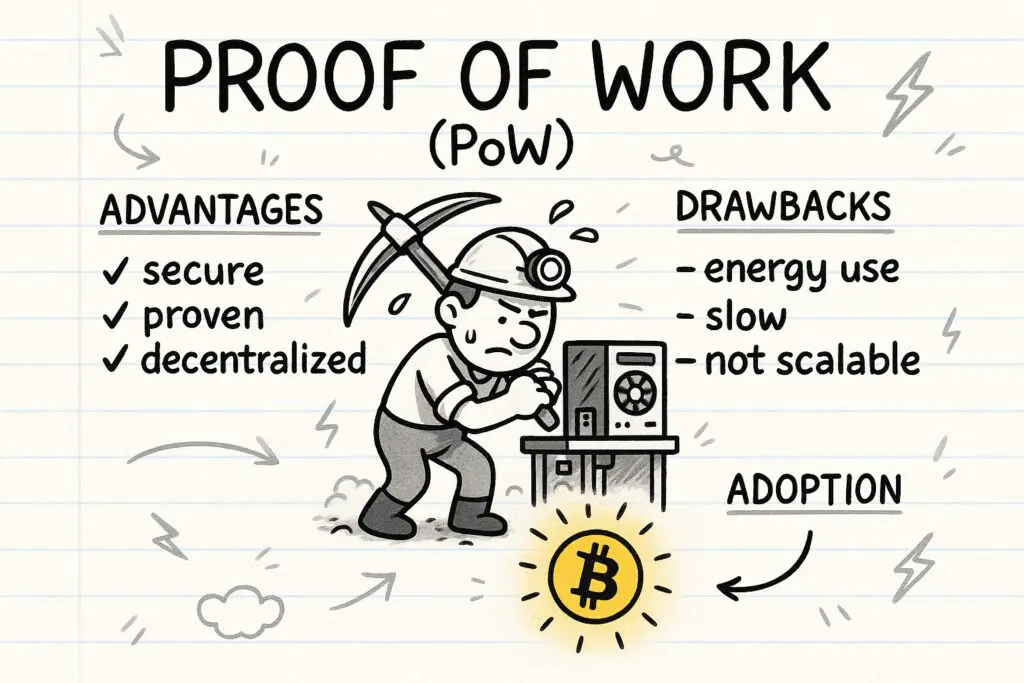
Proof of Stake (PoS) emerged as the greener alternative. Instead of burning electricity, validators lock up tokens to secure the network. Ethereum’s 2022 merge to PoS validated the model at scale, reducing energy usage by over 99%. PoS allows faster block finality and lower barriers for validators. Yet it introduces new challenges: those with larger stakes wield disproportionate influence, leading to concerns over centralization. Moreover, staking pools often resemble the same financial intermediaries blockchain was meant to disrupt.
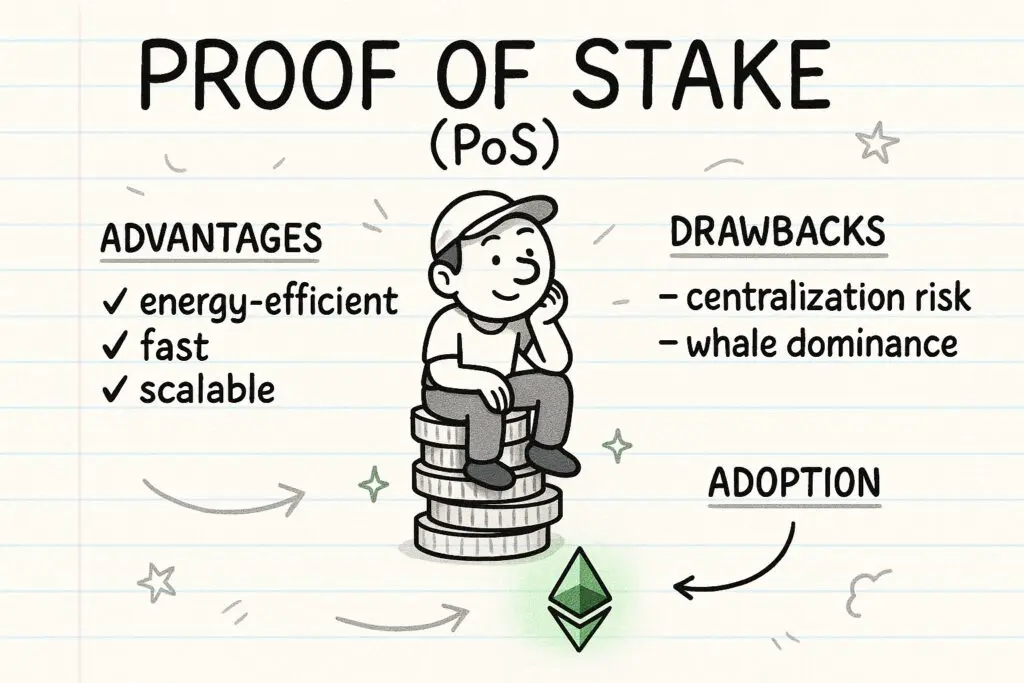
Both PoW and PoS remain pillars of blockchain, but their trade-offs created the need for innovation. Developers began asking: Can consensus be both decentralized and efficient? Can it scale to global levels without environmental costs? Those questions sparked the rise of alternative mechanisms.
Proof of Authority (PoA): Building Trust Through Verified Identities
One of the most striking departures from PoW and PoS is Proof of Authority (PoA). Instead of relying on computational effort or token stakes, PoA networks place trust in pre-approved validators whose real-world identities are known.
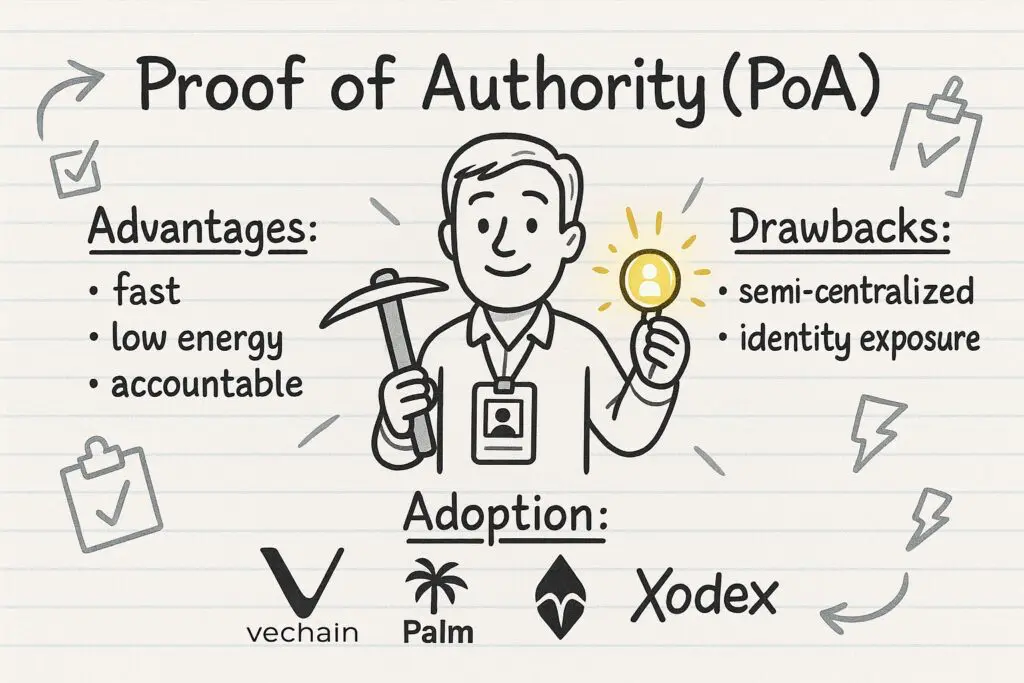
In PoA, validators are vetted before joining the network. They must not only commit assets as collateral but also put their reputations on the line. Blocks are proposed in a rotating schedule, ensuring rapid confirmations. If a validator misbehaves, the punishment is severe: loss of staked assets, removal from the validator set, and reputational damage. This traceability makes malicious behavior less likely.
Advantages:
- Speed and efficiency: PoA networks can achieve thousands of transactions per second.
- Energy-friendly: Unlike PoW, PoA requires no heavy computation.
- Near-instant finality: Confirmations are quick, ideal for supply chains or enterprise use.
Drawbacks:
- Semi-centralization: With only a small group of validators, collusion is possible.
- Loss of anonymity: Validators must reveal their identities, deterring privacy-focused users.
- Regulatory alignment: While attractive for compliance, it strays from crypto’s decentralized ethos.
Real-world adoption in 2025: VeChain has become the flagship PoA blockchain, powering supply chains for luxury goods, automotive parts, and pharmaceuticals. Palm Network leverages PoA for NFT infrastructure, while Xodex prioritizes accountability and speed. As regulators demand greater transparency, PoA offers a bridge between crypto and traditional enterprises, especially in sectors like logistics and healthcare.
PoA illustrates that consensus doesn’t always need to maximize decentralization. For permissioned or enterprise blockchains, accountability and throughput take precedence, and PoA delivers both.
Delegated Proof of Stake (DPoS): Empowering Community Governance
If PoA prioritizes identity, Delegated Proof of Stake (DPoS) focuses on democracy. It builds on PoS by introducing elections. Instead of every token holder validating directly, participants vote for a select group of “delegates” who handle block production.
How it works:
- Token holders stake their assets and use voting power proportional to their holdings.
- The elected delegates (typically 21 to 101) take turns validating blocks.
- Delegates earn rewards and often share them with voters, incentivizing participation.
- If a delegate fails to perform or acts dishonestly, the community can quickly vote them out.
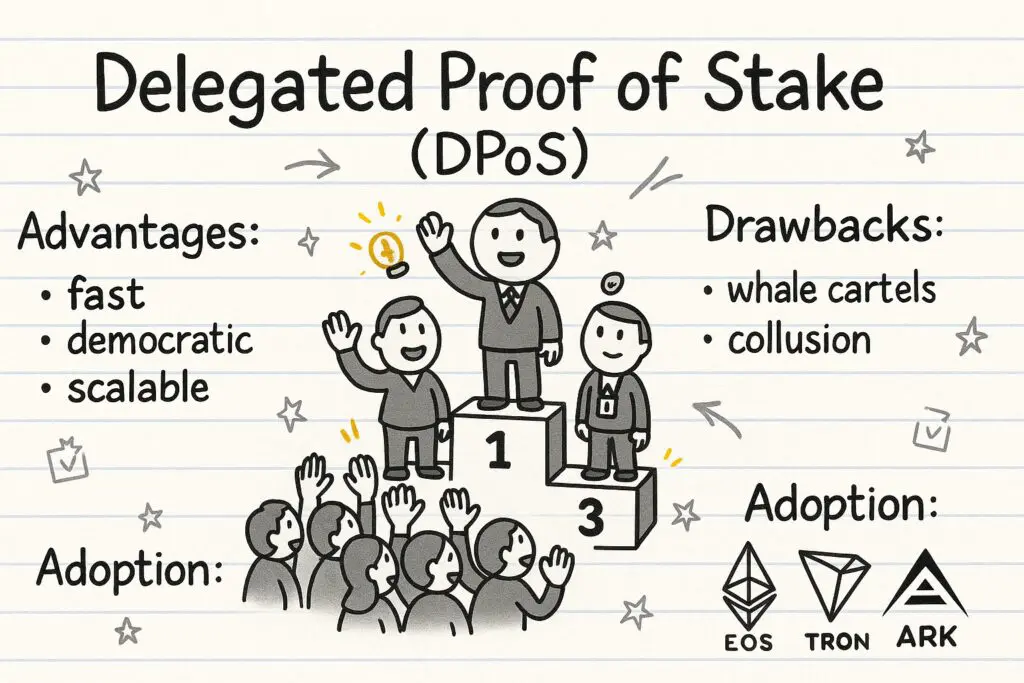
Advantages:
- High throughput: With fewer active validators, block times are short and transaction speeds are high. EOS, for instance, claims over 4,000 TPS.
- Energy-efficient: Like PoS, it avoids wasteful computation.
- Community-driven: Voters can hold delegates accountable.
Drawbacks:
- Centralization risk: Wealthy stakers (or “whales”) can dominate elections, leading to cartels.
- Security concerns: If delegates collude, they could compromise the network.
- Governance fatigue: Voter apathy may result in entrenched delegates.
Examples in 2025: EOS continues to showcase DPoS for high-performance decentralized applications. Tron employs it for entertainment and DeFi ecosystems. Ark uses DPoS to enable interoperability across blockchains. In 2025, developers are experimenting with hybrids, mixing DPoS with AI-driven delegate selection to minimize collusion risks.
DPoS stands out for bringing a political dimension into consensus. It mirrors representative democracy, where citizens elect leaders to act on their behalf. The model is fast, efficient, and inclusive—when the community actively participates. However, it raises questions about whether blockchain democracy can avoid the same pitfalls as real-world politics.
Proof of History (PoH): Revolutionizing Time in Blockchain
Among the most innovative consensus breakthroughs of the last decade is Proof of History (PoH), pioneered by Solana. Instead of treating time as something external to the blockchain, PoH weaves it directly into the ledger.
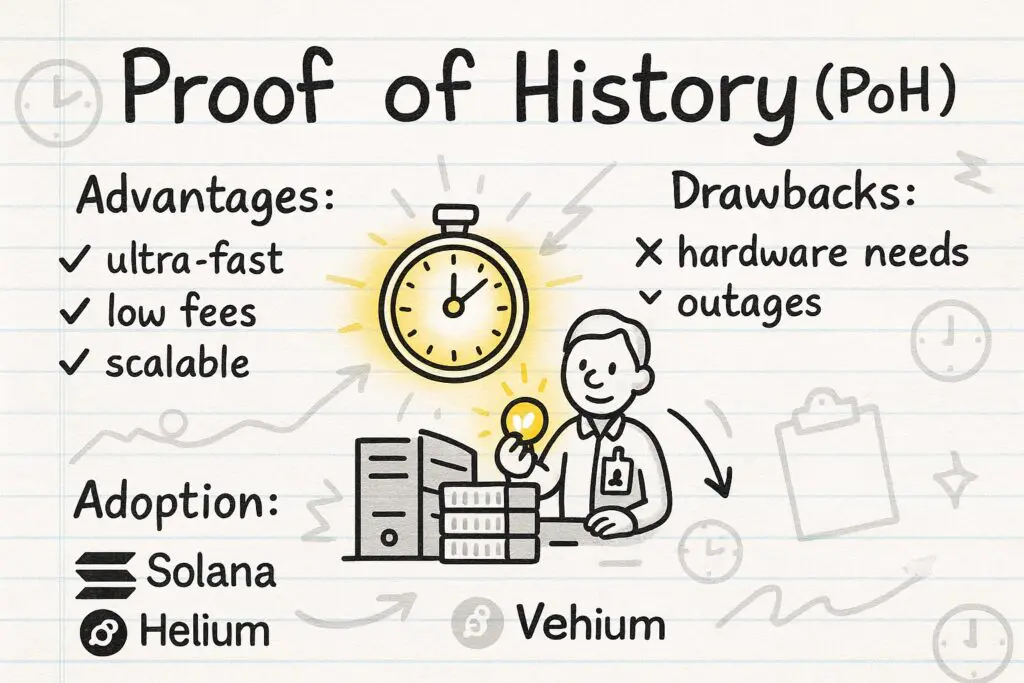
The mechanism relies on a verifiable delay function (VDF). Validators run a continuous cryptographic hash function that generates a sequence of outputs, each proving that a certain amount of time has passed. These cryptographic “ticks” create a timestamped record that transactions can be slotted into, ensuring a provable order without requiring network-wide agreement at every step.
Combined with Proof of Stake, PoH enables extreme scalability. Solana boasts throughput exceeding 65,000 transactions per second, with fees often below a fraction of a cent. Finality is near-instant, and applications from gaming to AI-driven oracles benefit from the speed.
Advantages:
- Unmatched scalability: Parallel processing makes the network extremely fast.
- Cost efficiency: Ultra-low fees open the door to microtransactions.
- Energy efficiency: Lighter than PoW, better suited for Web3 mass adoption.
Drawbacks:
- Complexity: PoH requires powerful hardware, raising barriers for validators.
- Network outages: Solana has historically struggled with downtimes, often tied to its ambitious architecture.
- Centralization risk: Hardware requirements can discourage smaller participants.
Adoption in 2025: Solana has established itself as Ethereum’s main challenger, powering DeFi platforms, NFT marketplaces, and Web3 games. The Helium network leverages Solana’s PoH to manage IoT devices at scale, showing how consensus tied to time can extend into real-world use cases. Going forward, integrations with zero-knowledge proofs could strengthen privacy while maintaining speed.
Proof of Space and Time (PoST): Turning Storage into Security
While PoH ties consensus to time, Proof of Space and Time (PoST), sometimes called Proof of Capacity, anchors it to storage. Instead of burning energy on computations, miners allocate unused hard drive space to the network.

Participants “plot” their drives with cryptographic data. When a block challenge arises, the system scans these plots to find the closest solution. The miner with the best match earns the right to validate the block. To prevent cheating, PoST introduces a time component, ensuring that participants cannot recompute plots on the fly.
Advantages:
- Eco-friendly: Far less energy-intensive than PoW, leveraging existing hardware.
- Inclusive: Anyone with spare disk space can contribute, broadening participation.
- Alignment with storage demand: Ideal for decentralized data-heavy applications.
Drawbacks:
- Storage centralization: Operators with massive server farms can dominate.
- Plotting overhead: Preparing drives requires time and resources.
- Attack surfaces: Vulnerable to grinding attacks if protocols aren’t carefully designed.
Adoption in 2025: Chia Network has championed PoST as a “green crypto,” aligning with environmental goals. Burstcoin remains a historic example, while new entrants experiment with tying storage farming to decentralized cloud solutions. With data volumes exploding in the AI era, PoST positions itself as a sustainable consensus that doubles as infrastructure for storage-focused projects.
In a world where sustainability and efficiency dominate the conversation, PoST has become one of the most appealing alternatives for builders seeking environmentally conscious blockchains.
Proof of Burn (PoB): Sacrificing Tokens for Network Loyalty
Consensus doesn’t always require computation or storage. Sometimes, it relies on sacrifice. Proof of Burn (PoB) is built around the idea that validators demonstrate commitment by permanently destroying tokens.
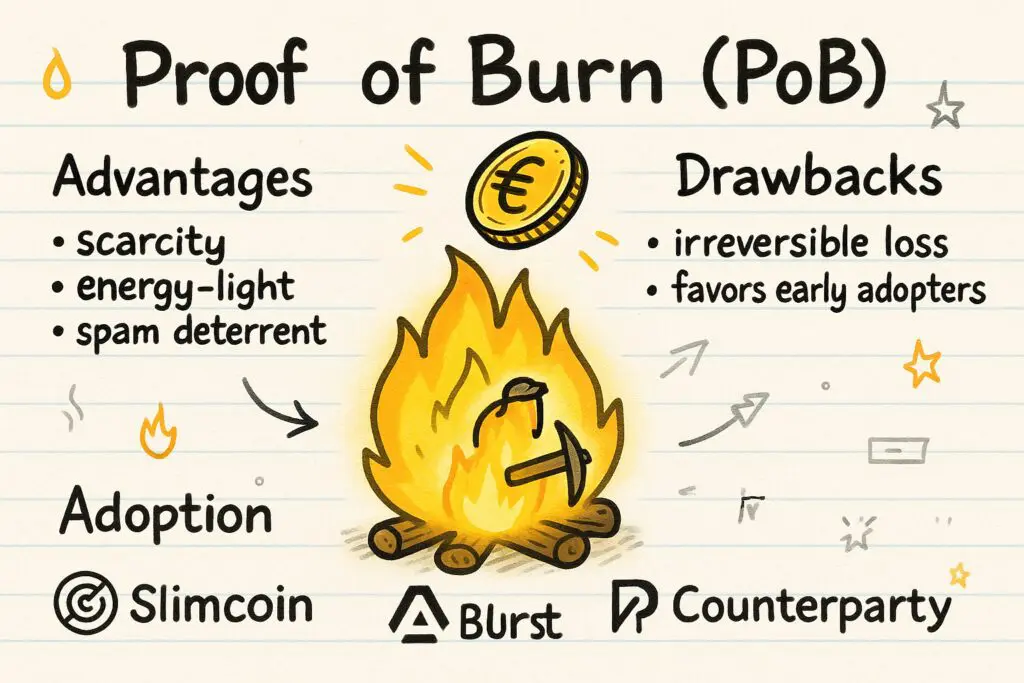
Participants send tokens to an irretrievable address, effectively removing them from circulation. In return, they receive mining or validation rights proportional to their sacrifice. The logic is simple: anyone willing to burn tokens today signals loyalty to the network’s future.
Advantages:
- Scarcity creation: By reducing circulating supply, PoB can boost token value.
- Energy-efficient: Unlike PoW, it wastes no computational power.
- Spam prevention: The cost of burning deters frivolous or malicious activity.
Drawbacks:
- Irreversible loss: Many investors hesitate to destroy assets.
- Wealth bias: Early adopters benefit disproportionately by burning tokens when prices are low.
- Limited adoption: Outside of niche use cases, PoB struggles to scale.
Adoption in 2025: Slimcoin and Counterparty were among the first to experiment with PoB. Today, newer projects use it during token migrations or chain launches, converting short-term speculation into long-term commitment. DeFi platforms have also embraced variations, where yield farming includes burn mechanics to maintain sustainable tokenomics.
PoB highlights a philosophical angle of consensus: sometimes, trust in a system is best proven by sacrifice. It turns short-term cost into long-term alignment, though its adoption remains selective.
Proof of Importance (PoI): Valuing Network Contributions
While most consensus mechanisms reward wealth or resources, Proof of Importance (PoI) introduces a more holistic model. It considers how much participants actually contribute to the network.
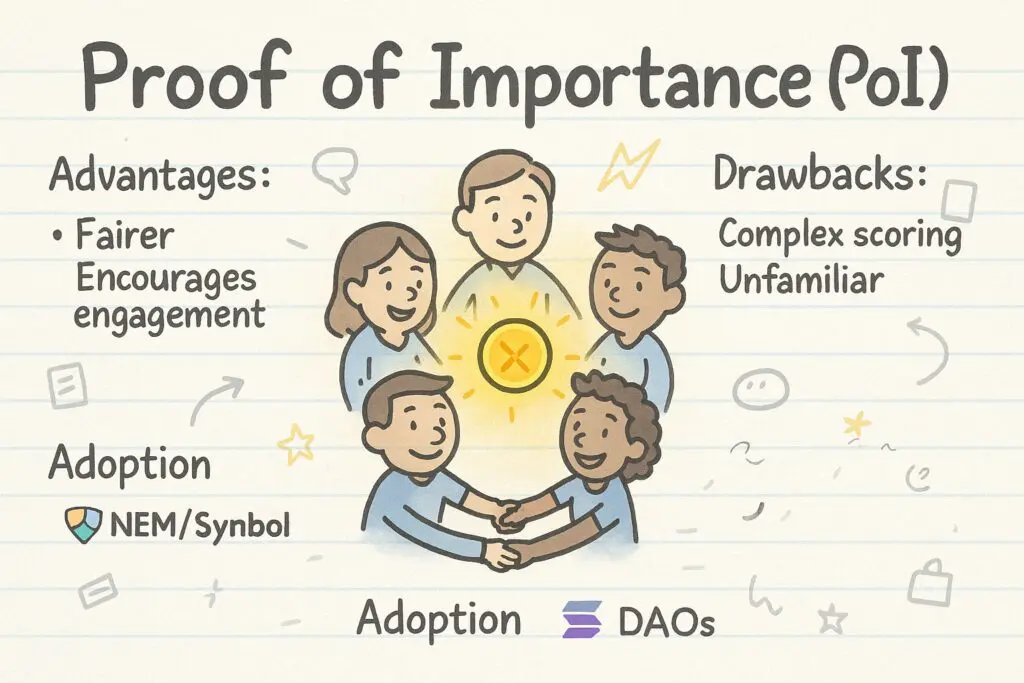
Originally introduced by NEM (now Symbol), PoI calculates an “importance score.” This score factors in not just the amount of tokens staked, but also transaction frequency, transaction size, and even community engagement. Inactive holders are penalized, while active participants gain higher chances of validating blocks.
Advantages:
- Fairer distribution: Rewards those who actively use the network, not just those who hoard tokens.
- Encourages engagement: Promotes transaction activity and ecosystem growth.
- Energy-efficient: Similar to PoS but with added social value.
Drawbacks:
- Complex scoring: Algorithms can be gamed or biased.
- Limited familiarity: PoI is less widely understood, slowing adoption.
- Measurement challenges: Defining meaningful activity isn’t always straightforward.
Adoption in 2025: Community-driven projects have embraced PoI as a way to reward genuine participation. NEM remains the pioneer, while smaller DAOs experiment with combining PoI metrics with governance tokens. As decentralized communities become more sophisticated, PoI’s blend of economics and reputation systems could evolve into a core feature of Web3.
In essence, PoI represents a cultural shift. Instead of privileging raw capital or infrastructure, it rewards activity and engagement. It is less about what you hold, and more about what you contribute.
Beyond the Basics: Hybrids and Niche Consensus Mechanisms
By 2025, it’s clear that no single consensus model solves every problem. That’s why hybrid and niche approaches have gained traction. They combine elements from multiple mechanisms, balancing decentralization, efficiency, and security.
Proof of Activity (PoA) is one example. It merges Proof of Work and Proof of Stake. Miners still perform the initial PoW step, but block validation is completed by randomly selected PoS validators. This reduces the energy footprint while retaining PoW’s proven security.
Practical Byzantine Fault Tolerance (pBFT), though older, has thrived in enterprise settings. It ensures agreement even if some validators act maliciously, making it ideal for private blockchains where participants are known.
Proof of Elapsed Time (PoET) introduces randomness by leveraging trusted execution environments (TEEs). Validators wait a randomly assigned period before proposing a block, ensuring fairness while consuming minimal resources.
Proof-of-SQL, developed by Space and Time, takes a unique approach: it verifies database queries in real time, merging blockchain with off-chain data. As AI, big data, and decentralized apps intersect, this kind of consensus becomes critical.
The rise of hybrids highlights an important truth: consensus is no longer just about choosing one model. It’s about tailoring the mechanism to the application.
Risks and Challenges Ahead
Despite rapid innovation, consensus mechanisms face persistent challenges.
- Centralization creep: Whether through wealthy stakers in PoS, storage farms in PoST, or identity-limited validators in PoA, concentration of power remains a threat.
- Regulatory scrutiny: Identity-based models like PoA may appease regulators but compromise decentralization, while anonymous models face compliance hurdles.
- Hardware barriers: PoH and similar mechanisms demand powerful infrastructure, excluding smaller participants.
- Economic inequalities: Models like PoB and DPoS can favor early adopters or wealthy stakeholders.
- Network security: Every new mechanism opens new attack vectors, from grinding attacks in PoST to delegate collusion in DPoS.
Balancing efficiency with decentralization is a constant struggle. The question for 2025 and beyond isn’t whether new consensus mechanisms will emerge—they will. The challenge is ensuring they remain secure, fair, and scalable under real-world conditions.
The Future Outlook: Consensus in the Age of Web3
Looking forward, consensus will evolve alongside blockchain’s expanding role in society.
- AI-integrated governance: Hybrid systems may use AI to dynamically adjust validator selection, reducing collusion and optimizing performance.
- Cross-chain consensus: As interoperability becomes critical, consensus may extend across multiple blockchains, ensuring shared security.
- ZK-enhanced models: Zero-knowledge proofs could layer privacy onto fast mechanisms like PoH, combining speed with confidentiality.
- DePIN and RWAs: Decentralized infrastructure (DePIN) and real-world assets (RWAs) need consensus tailored to physical-world activity, like sensor verification or legal contracts.
- Specialized designs: Algorand’s Proof of Weight and Nominated Proof-of-Liquidity (NPOL) from Taker exemplify consensus tailored for liquidity or AI-driven apps.
Consensus is no longer just technical plumbing—it’s becoming a driver of economic models, governance structures, and regulatory negotiations. The explosion of “Proof of” systems shows how blockchains are adapting to a wider digital economy.
TLDR
- Consensus mechanisms are the backbone of blockchain, ensuring networks agree on transactions without central control.
- Proof of Work (PoW) and Proof of Stake (PoS) built the foundation, but 2025 demands faster, greener, and more inclusive systems.
- New models like PoA, DPoS, PoH, PoST, PoB, and PoI each tackle unique challenges—speed, energy use, fairness, or transparency.
- Hybrids and niche models (PoET, pBFT, Proof-of-SQL) highlight that consensus is increasingly application-specific.
- Risks remain: centralization, regulation, hardware demands, and attack surfaces.
- The future lies in hybrid systems, AI integration, ZK privacy, and consensus tailored to DePIN and RWAs.
Frequently Asked Questions
What are consensus mechanisms in blockchain?
Why did Proof of Work dominate early blockchain history?
How does Proof of Stake differ from Proof of Work?
What makes Proof of Authority unique?
Why is Solana’s Proof of History important?
Is Proof of Space and Time eco-friendly?
What are the main risks of new consensus mechanisms?
What’s next for consensus mechanisms after 2025?
Conclusion
Consensus has always been the beating heart of blockchain. From the energy-intensive resilience of Proof of Work to the efficiency of Proof of Stake, each mechanism represents a milestone in decentralization’s journey. But 2025 marks a turning point.
Proof of Authority builds bridges with enterprises. Delegated Proof of Stake experiments with blockchain democracy. PoH reinvents time itself. Proof of Space and Time taps into storage as a resource. Proof of Burn and Proof of Importance bring fresh perspectives on commitment and participation. Together, they show that consensus is no longer a single choice—it’s an ecosystem of solutions.
The future is hybrid, adaptive, and deeply tied to real-world needs. Whether through AI-enhanced governance, zero-knowledge integrations, or mechanisms designed for RWAs and DePIN, consensus will continue to evolve. Investors, developers, and communities that understand these shifts will be better equipped to thrive in the next wave of crypto adoption.
Consensus isn’t just about securing transactions anymore. It’s about shaping the foundation of a decentralized, sustainable, and interconnected digital economy.
In this article
Legacy Models: Proof of Work and Proof of StakeProof of Authority (PoA): Building Trust Through Verified IdentitiesDelegated Proof of Stake (DPoS): Empowering Community GovernanceProof of History (PoH): Revolutionizing Time in BlockchainProof of Space and Time (PoST): Turning Storage into SecurityProof of Burn (PoB): Sacrificing Tokens for Network LoyaltyProof of Importance (PoI): Valuing Network ContributionsBeyond the Basics: Hybrids and Niche Consensus MechanismsRisks and Challenges AheadThe Future Outlook: Consensus in the Age of Web3TLDRFrequently Asked QuestionsConclusion