Hydration (HDX) Review: Is HDX Worth Buying in 2026?
Hydration (HDX) review covering its Omnipool, tokenomics, DeFi products, risks, competitors, and whether HDX is worth buying in 2026.


Author: Akshat Thakur
Why Cross-Chain Liquidity and Omnipool DeFi Protocols Are Hard to Get Right
Building a DeFi protocol around cross-chain liquidity is difficult. The challenge is not simply creating an efficient AMM. A project must attract enough liquidity, trading volume, and lending activity to make the system useful without relying permanently on token incentives.
Capital efficiency creates another trade-off. Single-sided liquidity and concentrated multi-asset pools can make capital more productive, but they also introduce risks that users may not fully understand. Impermanent loss, liquidation risk, and complex pool mechanics can make participation harder.
Cross-chain infrastructure adds another layer of risk. Hydration operates as a Polkadot parachain, so it depends partly on the wider Polkadot ecosystem and cross-chain infrastructure. Bridges can also introduce additional security and operational risks. A routing partner shutting down can force liquidity providers and users to migrate to a different system.
Stablecoin and lending products create further challenges. HOLLAR needs sufficient collateral and demand to remain useful, while the money market must maintain healthy liquidity during volatile conditions. TVL can also move quickly when incentives change or large positions leave.
This is why calling Hydration the “Polkadot Uniswap” misses the bigger picture. Its Omnipool, lending market, stablecoin, and yield products form a broader system. The real test is whether these products generate sustainable trading volume, lending activity, and fees after incentives decline.
Hydration’s specialization gives it a clear role within Polkadot. Whether that role becomes durable depends on real usage.
What Is Hydration?
Hydration is a Polkadot parachain focused on decentralized trading, lending, stablecoins, and cross-chain liquidity. It was previously known as HydraDX before the community approved the Hydration rebrand in 2024.
The protocol’s core product is the Omnipool. Instead of creating separate liquidity pools for every trading pair, it brings multiple assets into a single liquidity hub. This can reduce routing complexity and improve capital efficiency.
Hydration has expanded beyond trading. Its ecosystem now includes a money market, the HOLLAR over-collateralized stablecoin, and GIGA products designed to package different sources of yield. GIGAHDX also allows users to stake HDX while retaining a liquid representation that can be used elsewhere in the protocol.
Hydration was developed by Galactic Council, with co-founders including Jakub Greguš and Jakub Pánik. The project has been building within the Polkadot ecosystem since its early parachain launch.
Activity has fluctuated significantly. TVL reached roughly $350 million in October 2025 before falling during the broader market downturn. Recent data puts Hydration’s TVL near $57 million, while 30-day trading volume is around $71 million.
Hydration is therefore best viewed as a broader DeFi hub for Polkadot rather than simply another decentralized exchange.
How Hydration Works
Hydration’s main liquidity venue is the Omnipool. Users can deposit supported assets into the pool and trade against other assets through its hub-based routing system. This reduces the need for separate liquidity pools for every trading pair.
The protocol also operates a money market where users can lend and borrow assets. HOLLAR provides an over-collateralized stablecoin that users can mint against eligible collateral.
GIGA products add another layer. These tokens package different yield strategies into composable assets. GIGAHDX represents staked HDX and can also be used as collateral for HOLLAR borrowing. Users can therefore stake HDX while retaining a liquid position within the wider Hydration ecosystem.
The protocol generates revenue primarily from trading fees and lending activity. Fees are distributed across liquidity providers, stakers, referrers, and the treasury according to protocol rules.
Cross-chain access has also become an important part of the system. Hydration previously relied on Moonbeam Routed Liquidity, but accelerated a native Wormhole integration in 2026 after Moonbeam announced plans to stop producing blocks. The transition allows assets to continue moving between supported ecosystems.
The model is designed around one idea: keep trading, lending, stablecoin borrowing, and yield strategies within the same liquidity hub. The challenge is maintaining enough activity across all of these products to generate sustainable fees.
Technology and Architecture
Hydration is a Substrate-based Polkadot parachain built around the Omnipool. Its main difference from traditional AMMs is the use of a shared multi-asset liquidity pool instead of relying primarily on separate token pairs.
Users can provide a single supported asset to the Omnipool. The protocol then routes trades through the shared liquidity structure. Stableswap and isolated pools operate alongside it when different liquidity or pricing assumptions are required.
The money market adds lending and borrowing functionality to the same ecosystem. HOLLAR uses over-collateralization to support its stablecoin model, while its stability mechanism is designed to help maintain the peg.
GIGA products make Hydration’s yield strategies more composable. GIGAHDX is particularly important because it represents staked HDX while remaining usable as collateral within the protocol. This allows users to combine staking and lending strategies rather than keeping capital locked in a single function.
Cross-chain infrastructure changed significantly in 2026. Hydration moved away from Moonbeam Routed Liquidity and accelerated its native Wormhole integration. The change reduces reliance on a routing system that is being discontinued and keeps cross-chain asset movement operational.
Hydration also continues to develop treasury strategies and revenue-tracking tools.
Compared with other Polkadot DeFi platforms, Hydration aims to serve as a broader liquidity hub rather than a single-purpose application. Its architecture is built around capital efficiency and composability. The key question is whether that design can attract durable liquidity and trading activity without depending heavily on incentives.
Team & Backers
Hydration is developed by Galactic Council through Intergalactic Limited (IGL). Its public co-founders are Jakub Greguš and Jakub Pánik. Greguš is also associated with Zee Prime Capital, which incubated the original HydraDX project.
The team has spent years building Substrate-native DeFi rather than pursuing a short-term token launch. Early support came through the HydraDX incubation and its Polkadot crowdloan, which helped secure a parachain slot.
Hydration also relies heavily on on-chain governance. HDX holders vote on listings, protocol parameters, treasury strategies, and staking changes. Governance has already approved major decisions, including the Hydration rebrand, the reduction of maximum supply, GIGAHDX, and treasury deployments.
The protocol has also developed relationships across the Polkadot ecosystem. In 2026, it accelerated a native Wormhole integration after Moonbeam Routed Liquidity was discontinued. Treasury strategies have also involved external managers for certain reserve assets.
Hydration follows a more bootstrap-oriented model than heavily VC-backed DeFi protocols. Its funding and growth have involved LBP participants, crowdloan contributors, strategic allocations, treasury resources, and protocol revenue.
That model gives token holders more influence over product direction. It also comes with trade-offs. Hydration has less marketing reach and thinner centralized exchange coverage than larger DeFi protocols.
Hydration Tokenomics (HDX)
HDX is the native token of the Hydration parachain. Governance reduced its original 10 billion maximum supply to 6.5 billion through a supply burn.
Around 5.92 billion HDX currently circulates, representing roughly 91% of the maximum supply. Total supply is near 6.42 billion. At recent prices around $0.008, market capitalization sits around $50 million.
The protocol does not rely on a traditional inflationary reward model. Staking rewards and treasury activity are instead intended to come from protocol fees, protocol-owned liquidity, and buybacks.
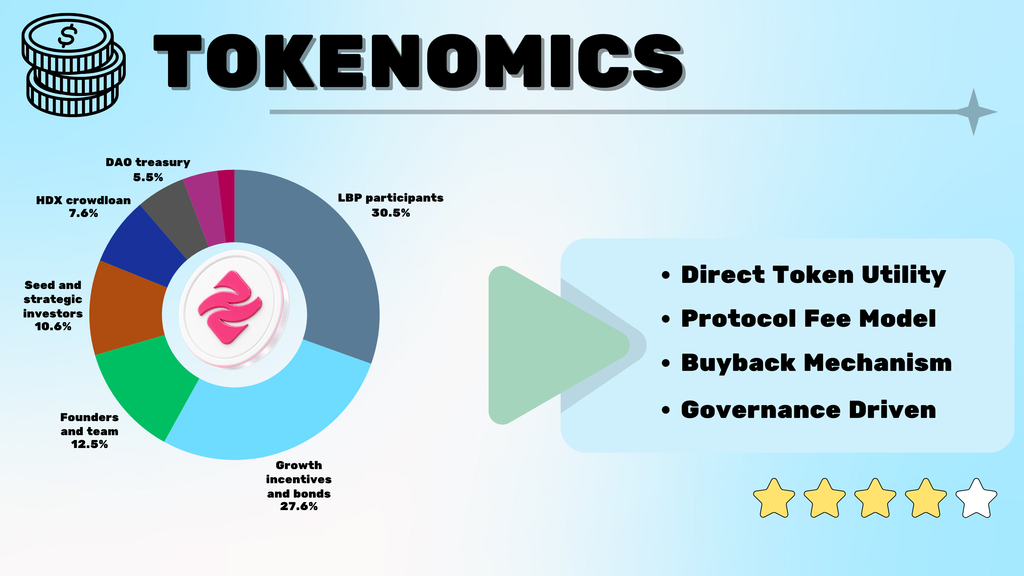
Against the 6.5 billion cap, the approximate allocation is:
Most major vesting schedules have already finished. Seed allocations ended in 2023, strategic allocations in 2024, and team vesting around February 2025.
The remaining supply risk comes mainly from treasury and growth allocations. Governance can deploy these tokens for incentives, liquidity, or other ecosystem purposes. Buybacks can offset some of that pressure, but they are not a guaranteed permanent source of demand.
HDX also has direct utility. Holders use it for governance and staking. GIGAHDX represents staked HDX and can also be used as HOLLAR collateral.
Ultimately, token value depends on whether trading, lending, HOLLAR, and other protocol activity generate enough fees to make buybacks and staking rewards meaningful against the large circulating supply.
Is Hydration Safe?
Hydration has accumulated a substantial audit history across its main products. Runtime Verification reviewed the Omnipool implementation, while BlockScience examined its economic and mathematical design. Other reviews have covered the money market, HOLLAR Stability Module, stablepools, EVM components, oracles, and circuit breakers.
The project also operates a bug bounty and uses controls such as listing caps, rate limits, and circuit breakers. Public reporting has not highlighted a major core-protocol exploit or drain comparable with some large Ethereum DeFi incidents.
That does not make Hydration low-risk.
The Omnipool concentrates many assets in one liquidity system. A bad listing, oracle failure, or toxic asset could therefore have broader consequences. Lending introduces liquidation and oracle risks, while HOLLAR carries the usual risks of a crypto-collateralized stablecoin.
Cross-chain infrastructure is another consideration. In 2026, Hydration had to replace Moonbeam Routed Liquidity after Moonbeam moved toward shutdown. The protocol migrated roughly $13 million through its new Wormhole infrastructure. The funds were reported as safe, but the episode demonstrated the operational risks involved in cross-chain dependencies.
Hydration also remains dependent on Polkadot’s shared security, XCM, collators, and governance.
Overall, Hydration has a stronger audit record and more mature infrastructure than many small-cap DeFi protocols. It is still not risk-free. Omnipool concentration, lending liquidations, HOLLAR’s peg, bridges, and governance remain active risk surfaces.
Hydration vs Competitors
Hydration is built as a broader DeFi hub on Polkadot. Its Omnipool handles multi-asset trading, while the same parachain supports lending, HOLLAR, and GIGA yield products.
Hydration vs DeFi Competitors
| Project | Use Case | Chain | Product Status | Token Utility |
|---|---|---|---|---|
|
| Multi-asset Omnipool DEX, lending, HOLLAR, GIGA yield | Polkadot parachain | Live full stack; GIGAHDX and Wormhole live in 2026 | Governance, GIGAHDX staking, fee buybacks |
|
| Polkadot DeFi hub: DEX, liquid staking, historical stablecoin stack | Polkadot parachain | Live but much reduced activity versus earlier years | Governance and ecosystem token |
|
| Liquid staking and cross-chain LSTs | Polkadot / related | Live LST-focused products | Staking and governance |
|
| General-purpose AMM and DEX routing | Ethereum and many L2s | Mature, dominant spot DEX | Governance; fee switch remains a policy debate |
|
| General-purpose lending markets | Ethereum and many chains | Mature multi-chain money market | Governance, safety module, revenue linkage |
The scale difference is significant. Uniswap and Aave operate with vastly deeper liquidity and broader user bases. Within Polkadot, however, Hydration has a stronger position than smaller DeFi parachains such as Acala.
The more relevant question is whether Hydration can remain the default liquidity hub for Polkadot. Its Omnipool, lending market, stablecoin, and yield products give it a broader proposition than a single-purpose DEX.
Strengths & Risks
The Omnipool is Hydration’s clearest advantage. Single-sided liquidity and one-hop routing can make capital more efficient than fragmented pair pools. That matters in a smaller ecosystem where liquidity cannot easily be spread across hundreds of markets.
Hydration also offers more than swaps. Lending, HOLLAR, GIGA products, and GIGAHDX give users additional reasons to keep capital within the ecosystem. The protocol also generates fees and conducts buybacks, rather than relying entirely on new token emissions.
GIGAHDX connects staking, governance, and HOLLAR collateral into one position. The 2026 Wormhole migration also showed that the team could respond when its previous cross-chain routing infrastructure was being discontinued.
The risks are equally clear. Hydration’s TVL fell sharply from its roughly $350 million 2025 peak. Current DEX TVL and fee generation remain much lower. With around 5.9 billion HDX already circulating, the token needs meaningful protocol activity for fee-funded mechanisms to have a material impact.
Competition is another issue. Ethereum, Solana, and Base host much deeper DeFi markets. Hydration remains closely tied to Polkadot activity, XCM flows, and external capital entering the ecosystem.
HOLLAR, Omnipool listings, treasury strategies, and cross-chain infrastructure also create additional execution risks.
The product is relatively complete for a Polkadot DeFi protocol. The economic scale remains much smaller than the largest DeFi markets.
Should You Buy HDX?
For builders, Hydration makes sense if you need Polkadot-native liquidity, lending, staking, or stablecoin infrastructure. The broader protocol stack is arguably more important than HDX’s role as a trading asset.
For short-term traders, TVL recovery, HOLLAR demand, GIGAHDX activity, Wormhole flows, and broader Polkadot momentum are worth watching. Thin liquidity can also make price movements sharper in both directions.
For long-term investors, the key metric is fee generation relative to circulating supply. Rising volume and sustained buybacks would strengthen the token thesis. Falling activity would weaken it.
So, is Hydration worth buying? It depends on whether you want exposure to the Polkadot DeFi ecosystem and believe Hydration can maintain its position as its primary liquidity hub.
HDX should be treated as a high-risk ecosystem bet, not as a substitute for larger DeFi assets.
Final Verdict: Is Hydration a Buy in 2026?
Hydration has built one of the more complete DeFi stacks in the Polkadot ecosystem. Its Omnipool, lending market, HOLLAR, GIGA products, and 2026 infrastructure upgrades give it a clear differentiation.
The main issue is scale. TVL, volume, and fee generation remain well below the 2025 peak, while competition from larger chains remains intense.
The next phase depends on whether Hydration can turn its product advantage into sustained liquidity, trading activity, and protocol revenue. If that happens, HDX has a stronger fundamental case. If activity remains cyclical, the token will continue to carry the risks of a smaller ecosystem asset.
Frequently Asked Questions
What is Hydration?
How does Hydration work?
What is GIGAHDX and the 2026 Wormhole integration?
What is HDX used for?
Is Hydration safe?
How is Hydration different from other DEXs?
Is HDX a good investment?
In this article
Why Cross-Chain Liquidity and Omnipool DeFi Protocols Are Hard to Get RightWhat Is Hydration?How Hydration WorksTechnology and ArchitectureTeam & BackersHydration Tokenomics (HDX)Is Hydration Safe?Hydration vs CompetitorsStrengths & RisksShould You Buy HDX?Final Verdict: Is Hydration a Buy in 2026?