Delta Liquidity ($DELTA) Review: Is DELTA Worth Buying in 2026?
Delta Liquidity review 2026: Explore its tokenomics, products, risks, competitors, and whether DELTA is worth buying.


Author: Akshat Thakur
Why Liquidity Infrastructure on New L2s Is Hard to Get Right
Liquidity infrastructure on a new L2 faces a basic problem: keeping capital around after the launch incentives disappear.
New chains can attract large amounts of TVL during the initial hype cycle. That liquidity can leave just as quickly when rewards fall or trading activity slows. Thin pools then create higher slippage, while token projects struggle to maintain useful market depth.
Concentrated liquidity adds another challenge. LPs can earn more fees when positions are placed efficiently, but managing ranges requires active decisions. Poor positioning can leave liquidity exposed to adverse price movements or reduce fee generation.
The bigger test is revenue. Incentives can make a protocol look active for a while. Sustainable infrastructure needs traders to generate real fees and projects to keep using the liquidity tools after the launch period.
Delta targets this problem on Robinhood Chain. It does not try to replace Uniswap. Instead, it provides tools for staking liquidity, managing concentrated positions, and recycling collected fees back into pool depth.
That distinction matters. Calling Delta the “Robinhood Uniswap” would miss its actual role. Uniswap provides the underlying trading pools. Delta sits on top of them and manages liquidity around those pools.
The model is straightforward. More trading should create more fees. More fees can then support deeper liquidity. The question is whether Robinhood Chain can maintain enough trading activity for that cycle to continue after the current launch environment cools.
What Is Delta Liquidity?
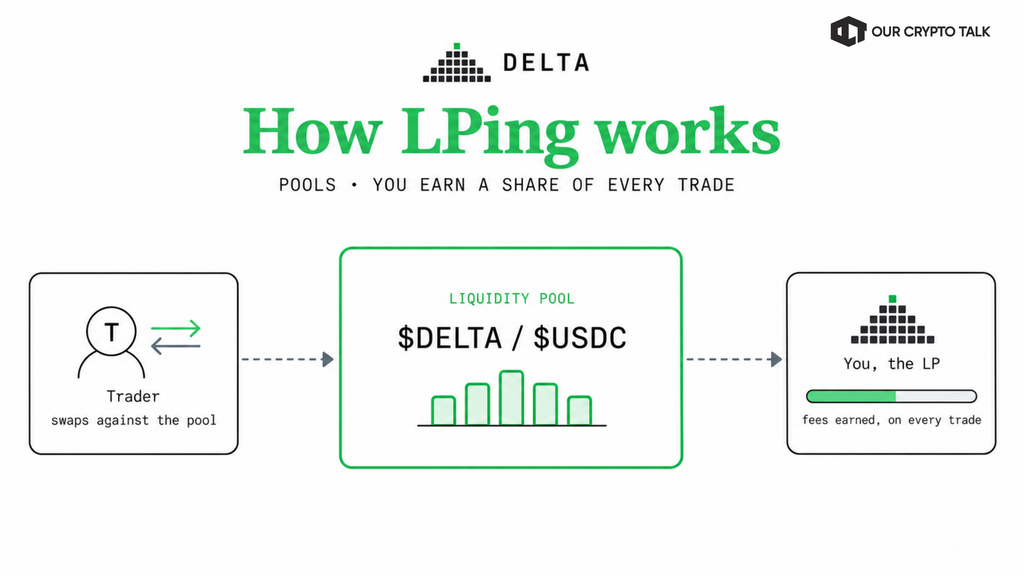
Delta Liquidity is a liquidity infrastructure protocol built on Robinhood Chain. It allows users to stake liquidity and earn a share of trading fees generated by underlying Uniswap pools.
The protocol has two main products, Stakes and Router. Pools provides tools for creating shaped concentrated-liquidity positions.
Delta launched through the Pons launchpad on July 31, 2026. Its token, DELTA, has a fixed supply of 1 billion. The contract does not mint additional tokens. A 100 million DELTA reserve, representing 10% of supply, is locked until January 2027.
Unlike traditional liquidity-mining protocols, Delta does not rely on newly minted tokens for user rewards. Rewards come from actual trading fees. The protocol takes a 1% cut of collected stake fees as its stated revenue.
Early September figures show roughly $1.95 million in TVL on the official app, more than $2.32 million in reported fees earned by users, and over 14,000 positions. DefiLlama reports a lower TVL figure because its methodology focuses on assets held directly by Delta contracts rather than user-owned Uniswap positions.
Delta is therefore best understood as an LP management and fee-recycling layer. Its success depends heavily on the amount of trading activity taking place on Robinhood Chain.
How Delta Liquidity Works
Delta allows users to deposit one or both assets into a Stake or create a shaped liquidity position through Pools.
The underlying trades take place through Uniswap pools. Traders pay swap fees, and eligible Delta stakers receive a share of those fees in WETH. Rewards are streamed over roughly seven days rather than being distributed entirely at once.
Users can claim, compound, or withdraw their rewards. There are no lockups.
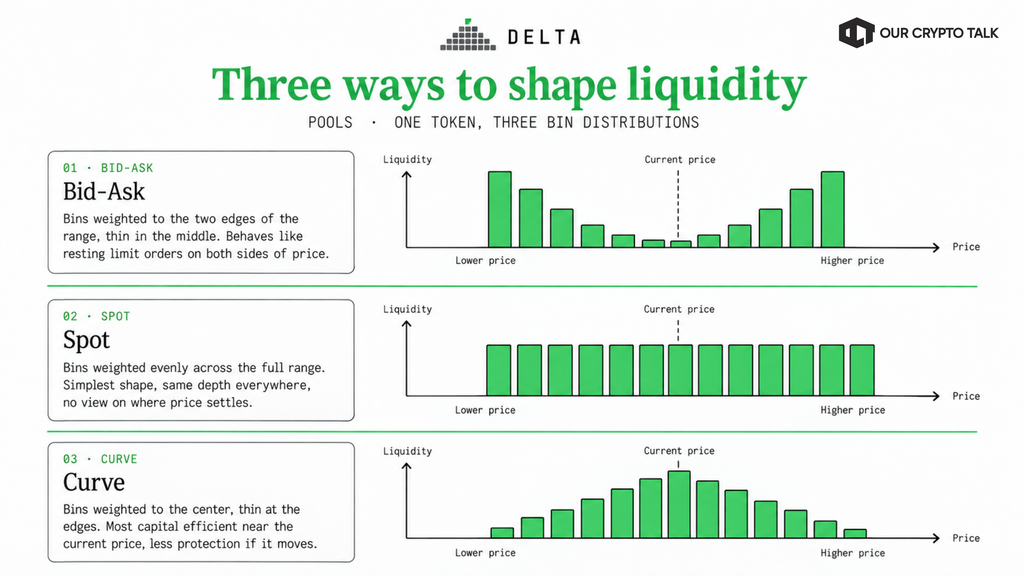
Pools takes a more active approach. Users can create concentrated positions using different distributions across the price range. Positions remain standard Uniswap v3 or v4 positions and are held in the user’s wallet.
Projects can use Delta’s Router to recycle collected fees into liquidity. Operators set a budget and choose a trigger. This can be time-based, such as every 10 minutes to two hours, or tied to market-cap milestones.
The Router can then convert fees into additional pool liquidity. Projects can choose different custody arrangements, including locked, burned, or operator-held liquidity.
This creates Delta’s main feedback loop. Trading generates fees. Fees can then be redirected into liquidity rather than sitting idle.
Early activity suggests the model is gaining traction on a chain-native basis, with thousands of positions and millions of dollars in reported user-earned fees. But Delta’s own revenue remains tied to trading activity because its stated protocol cut is only 1% of collected stake fees.
If Robinhood Chain volume falls, both user rewards and protocol revenue fall with it.
Technology and Architecture
Delta is deployed on Robinhood Chain, an Arbitrum Orbit-based Layer 2. It does not operate as a replacement for Uniswap. Instead, it provides an additional liquidity-management layer around Uniswap v3 and v4 pools.
Stakes provide the passive option. Users deposit liquidity and receive a share of the fees generated by the underlying pools.
Pools focuses on concentrated liquidity. Users can create shaped positions across different price ranges instead of relying on a simple full-range position. Delta also supports single-sided deposits by converting the deposited asset into the required position structure.
Router handles fee recycling. Projects can establish schedules or market-cap triggers that automatically redirect collected fees into additional liquidity. The aim is to turn trading fees into deeper market depth.
The protocol’s native AMM is not yet the live trading venue. It was still described as being in testing and audit stages in late August 2026. Omni-chain liquidity is also a longer-term objective rather than a current feature.
Delta’s architecture therefore remains closely connected to Uniswap and Robinhood Chain. That creates both an advantage and a dependency. Delta can benefit from existing Uniswap liquidity infrastructure, but it also inherits risks associated with the underlying pools, the L2, and the broader Robinhood Chain ecosystem.
The model is more comparable to an LP manager than a standalone DEX. Its main selling point is fee-based liquidity management rather than token emissions. The important question is whether trading volume remains strong enough to make that model sustainable.
Team & Backers
Delta Liquidity is run by a small public-facing team rather than a large foundation. The main names appearing in official materials are Omen (@omen_xbt), who focuses on token management, business development, and partnerships; Scoopz (@shcoopzy), who handles smart contracts, infrastructure, and security; and TheVs (@TheVsCrypto), who leads product and strategic direction with a background in liquidity provision. Kris (@krisquant) also appears around Delta Academy education, although this is an adjacent role rather than a core protocol position.
As of mid-2026, Delta described itself as self-funded with no external investors. There is no disclosed seed round, named VC syndicate, or large institutional treasury allocation.
The bootstrap model has both advantages and risks. There are fewer known private allocations that could create near-term unlock pressure, and the team has more independence over product decisions. At the same time, Delta has less formal operational redundancy and external oversight than larger, institutionally backed protocols.
The team structure is therefore an important part of the risk profile. Delta is earlier and leaner than established liquidity protocols, so users should weigh the team’s public track record, security work, and execution alongside the product metrics.
Delta Liquidity Tokenomics (DELTA)
DELTA has a fixed maximum and total supply of 1 billion tokens. It launched through the Pons launchpad on Robinhood Chain on July 31, 2026. Public materials state that the contract cannot mint additional tokens and that no tokens have been burned.
The main supply split is straightforward. Around 900 million DELTA entered circulation at launch, while a 100 million token reserve, equal to 10% of total supply, is locked until January 2027.
At early September prices of roughly $0.0115 to $0.012, DELTA has a market cap and FDV of approximately $11.5 million to $12 million. The small gap between the two reflects the fact that most of the supply is already circulating. DELTA reached an ATH near $0.035 on August 30 before pulling back sharply.
There is no traditional investor allocation table or private-sale vesting schedule publicly disclosed. The January 2027 reserve unlock is the main known supply event. It would add another 100 million DELTA to the market, equal to 10% of maximum supply.
High circulation reduces the risk of repeated monthly unlocks, but it also leaves a large liquid float in the market. With relatively thin liquidity, holder distribution can have a meaningful effect on price.
DELTA’s current utility is also more limited than the protocol’s product suite. Users earn WETH from actual swap fees rather than DELTA emissions. Delta takes a 1% cut of collected Stake trading fees, creating a direct protocol revenue line.
However, investors should not yet treat DELTA as a direct claim on that revenue. Public materials indicate that the team is still formalizing the token’s longer-term economic role, including how protocol revenue may benefit holders. Until the team publishes and implements those mechanics, the token’s value largely depends on continued Robinhood Chain trading activity, adoption of Delta’s products, and future token utility.
Is Delta Liquidity Safe?
Delta designs its products around self-custody. Pool positions use standard Uniswap v3 or v4 positions that remain in the user’s wallet, while Stake withdrawals return assets to the depositing wallet. Users can inspect the contracts on-chain because Delta deploys them on Robinhood Chain.
The main limitation is the protocol’s short operating history. Delta’s native AMM was still in internal testing and audit stages in late August 2026, with external audits planned afterward. A widely published third-party audit report for the live Delta Liquidity contracts has not been independently verified for this review.
That distinction matters. A statement that audits are planned or underway is different from having a public audit report that users can inspect.
No major core-protocol exploit has prominently affected Delta Liquidity on Robinhood Chain. However, this does not mean that Delta Liquidity has an unblemished security record. Unrelated projects using the Delta name, including DeltaPrime, have experienced separate security incidents on other chains.
The main risks remain smart-contract bugs, dependence on Uniswap pools, Robinhood Chain’s early-stage infrastructure, Router and oracle assumptions, limited early Stake TVL, and the small pseudonymous team.
Self-custody removes some custodial risk, but it does not eliminate smart-contract, liquidity, or L2 risks. Delta is therefore better viewed as an early-stage liquidity protocol with meaningful security dependencies rather than a battle-tested DeFi primitive. Users should verify contracts on-chain, monitor public audit releases, and size exposure accordingly.
Delta Liquidity vs Competitors
Delta Liquidity is an early liquidity-staking and fee-routing layer built for Robinhood Chain. It is better compared with Uniswap, automated Uniswap LP managers, and shaped-liquidity platforms such as Meteora than with mature multi-chain DEXs.
Delta Liquidity vs Competitors
| Project | Use Case | Chain | Product Status | Token Utility |
|---|---|---|---|---|
 Delta Liquidity
| Stake pool LP for real swap fees; route project fees back into depth; shaped concentrated positions | Robinhood Chain | Stakes, Router, Pools live; native AMM in testing | Token live; full value-accrual design still being formalized |
|
| General-purpose AMM and routing | Ethereum, L2s, Robinhood Chain | Mature v3/v4 | Governance; fee-switch policy remains separate from LP tools |
|
| Automated range management on Uniswap positions | Multi-chain EVM | Mature vault products | Usually protocol token plus vault fees |
|
| Shaped / DLMM liquidity and launch-adjacent LP tools | Solana | Live and widely used | Protocol token tied to LP and launch infrastructure |
Uniswap is the underlying venue Delta builds around. Meteora is the closer product comparison because both focus on making concentrated liquidity easier to use and connecting it with token-launch workflows.
Delta’s main advantage is timing. Robinhood Chain is still developing its native DeFi ecosystem, leaving room for specialized infrastructure. The main gap is scale. A few million dollars of TVL and a 1% protocol fee are still small compared with established liquidity platforms.
Strengths & Risks
Delta has working products rather than a roadmap alone. Stakes distribute WETH generated from actual swap fees, while Router gives projects a way to recycle collected fees into deeper liquidity. Pools also simplifies shaped concentrated positions on Uniswap.
The official app reports thousands of positions and more than $2 million in user-earned fees within weeks of launch. The self-funded structure also means there is no large disclosed private-sale allocation creating immediate unlock pressure.
If Robinhood Chain maintains strong DEX and launchpad activity, Delta could become a useful specialist layer for projects that need deeper and more actively managed liquidity.
But the protocol is only few weeks old. Around $2 million of app-reported TVL and a 1% fee take remain small relative to an $11–12 million token valuation. Protocol-custodied TVL is lower, highlighting the difference between Delta-managed assets and activity taking place through user-owned Uniswap positions.
DELTA also reached roughly $0.035 before a sharp pullback, showing how quickly price can move ahead of fundamental usage. The 100 million DELTA reserve unlock in January 2027 adds another known supply event.
The native AMM is not yet live, while competing LP managers could enter the same market. More importantly, Delta remains dependent on Robinhood Chain volume. If launchpad activity fades, fee-funded rewards and protocol revenue will fall with it.
The same facts support both cases. Delta has real products and fee activity, but its economic base remains early.
Should You Buy DELTA?
For builders and developers, Delta may be worth considering if you are launching or managing tokens on Robinhood Chain. Stakes, Pools, and Router provide practical liquidity tools, although the product has a longer track record than the token itself.
For short-term traders, DELTA is best treated as a high-volatility microcap. Chain-wide volume, Pons activity, Uniswap flows, and announcements around the native AMM or tokenomics could influence price. Thin liquidity also means position sizing matters.
For long-term investors, the better approach is to watch the metrics before treating DELTA as a core holding. Stake TVL, routed liquidity, protocol fees, public security audits, and the January 2027 reserve unlock are the key checkpoints.
The token’s longer-term case also depends on clearer utility. Until the team publishes and implements the planned tokenomics, DELTA remains primarily a bet on continued Robinhood Chain activity and Delta’s ability to become a leading liquidity layer.
Overall, DELTA fits a higher-risk, speculative allocation rather than a conventional core DeFi position. The product has genuine early usage, but the valuation still needs sustained growth in liquidity and fee generation to support it.
Final Verdict: Is Delta Liquidity a Buy in 2026?
Delta has a working product, real fee generation, and a clear niche on Robinhood Chain. That gives it a stronger foundation than a token built mainly around future promises.
The investment case is still early. Protocol revenue remains small, the token has already experienced significant volatility, the protocol has a limited security history, and the team plans to unlock 100 million DELTA tokens in January 2027. The native AMM and broader token value-accrual model also remain works in progress.
For now, DELTA is best viewed as a speculative infrastructure play on the continued growth of Robinhood Chain liquidity. Its upside depends on the chain maintaining meaningful trading activity and Delta converting that activity into sustained TVL, fees, and eventually stronger token utility.
The product shows promise, but the market still needs more evidence before we can consider DELTA a mature liquidity-infrastructure token.
Frequently Asked Questions
What is Delta Liquidity?
How does Delta Liquidity work?
What is the DELTA token?
Is Delta Liquidity safe?
Does Delta Liquidity compete with Uniswap?
How does Delta Liquidity generate revenue?
Is DELTA a good investment in 2026?
In this article
Why Liquidity Infrastructure on New L2s Is Hard to Get RightWhat Is Delta Liquidity?How Delta Liquidity WorksTechnology and ArchitectureTeam & BackersDelta Liquidity Tokenomics (DELTA)Is Delta Liquidity Safe?Delta Liquidity vs CompetitorsStrengths & RisksShould You Buy DELTA?Final Verdict: Is Delta Liquidity a Buy in 2026?