The Standard Reserve Review: Is STANDARD Worth Buying?
The Standard Reserve review 2026: Explore its monetary model, tokenomics, risks, competitors, and whether STANDARD is worth buying.


Author: Akshat Thakur
Why Onchain Monetary Experiments Are Hard to Get Right
Most reflexive monetary systems look strongest when capital is flowing in. The harder test starts when users want to exit.
Fixed emissions can keep adding supply while demand falls. Reserve-backed models can also struggle if trading fees never become enough productive assets to support the system. Thin liquidity makes large exits even more damaging, turning ordinary selling into sharp price moves.
Olympus-style reflexivity showed the same problem. When inflows are strong, rising liquidity and treasury assets can reinforce demand. When those inflows reverse, the same mechanism can work in the opposite direction.
The Standard Reserve takes a different approach. Instead of using a fixed emission schedule, its policy responds to net ETH flow through a single ETH/STANDARD Uniswap v4 pool.
Calling it an “onchain Fed” is useful only as a shorthand. A central bank has a balance sheet, lender-of-last-resort powers, and political authority. The Standard Reserve has code, liquidity, and the capital users choose to keep in the system.
Its model is therefore a focused monetary experiment. One currency, one market, one primary signal, and policy rules enforced by smart contracts.
What Is The Standard Reserve?
The Standard Reserve is an experimental decentralized reserve protocol built around a single ETH/STANDARD Uniswap v4 market. Its monetary policy responds to net ETH flow through that pool.
The project was created by the pseudonymous developer 0xBeans and launched on Robinhood Chain around mid-September 2026. The system began with a Genesis Charter mint and opened STANDARD trading around September 14–15.
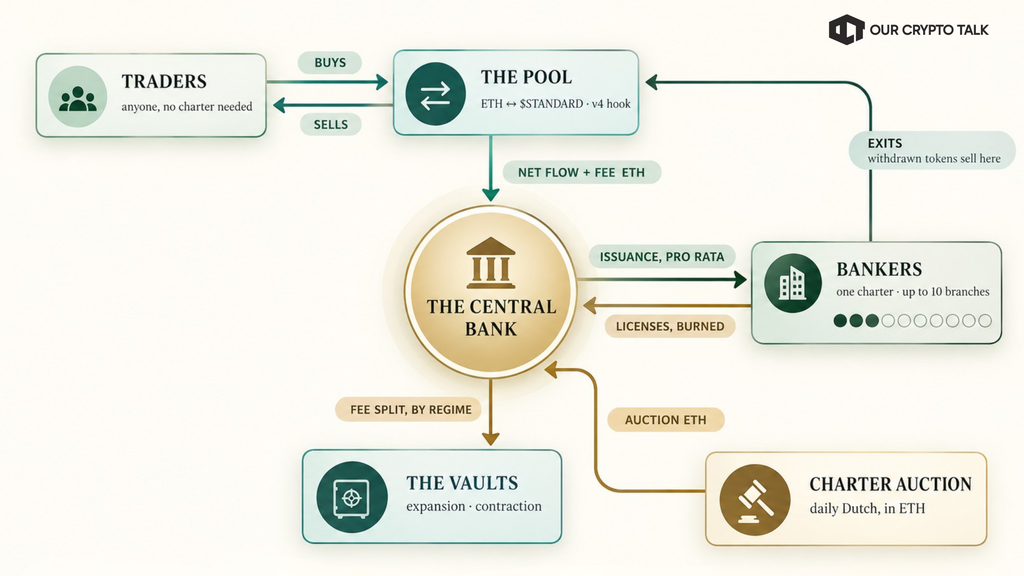
The main components are STANDARD, an ERC-20 with an initial 1 billion token hard cap, a canonical hooked Uniswap v4 ETH/STANDARD pool, central bank contracts containing the protocol’s monetary policy, Charters that act as soulbound banking licenses, Branches that determine a Charter’s share of issuance, and expansion and contraction vaults.
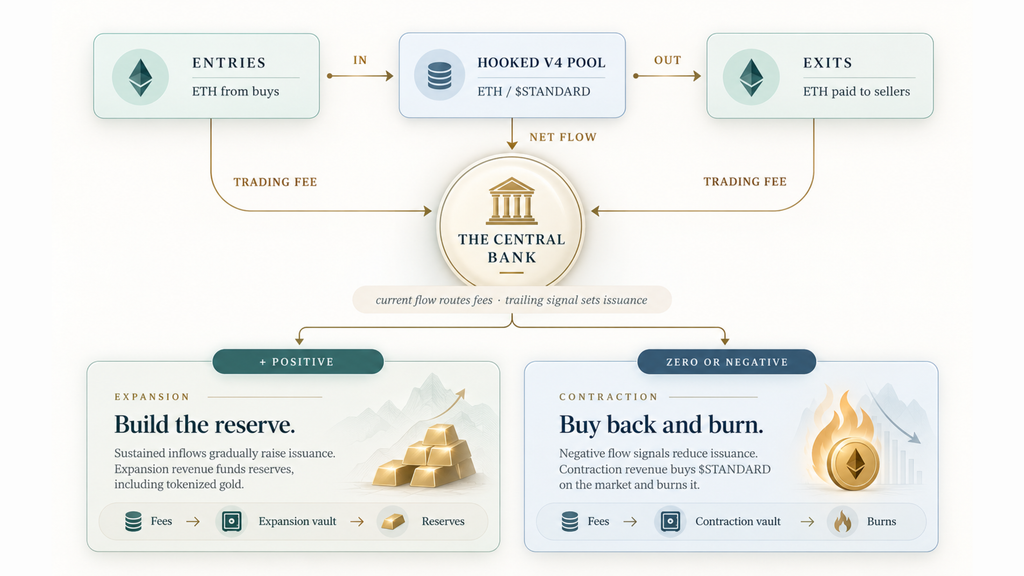
The monetary system has two broad regimes. When net ETH flow is positive, the protocol can increase issuance and direct fees toward reserves and protocol-owned liquidity. When flow turns negative, issuance is reduced and more fees are directed toward STANDARD buybacks and burns.
The initial launch generated significant activity. The Genesis mint of 1,000 Founding Charters raised roughly 583.6 ETH, worth around $1.47 million at the time. STANDARD’s market cap briefly reached the $43 million range.
By late September, dashboards showed roughly 14.4 million STANDARD burned, more than 2,300 active Branches, and nearly all Genesis Charters still active.
The Standard Reserve is best understood as a flow-driven monetary experiment rather than a conventional DeFi token. Its longer-term durability depends on what happens when launch-driven demand and Charter activity cool down.
How The Standard Reserve Works
STANDARD trades against ETH through the protocol’s canonical Uniswap v4 pool. A custom hook tracks net ETH flow during each roughly three-day epoch, and that reading determines the current monetary regime.
During expansion, positive net ETH flow allows a higher issuance multiplier. A larger share of protocol fees is directed toward the expansion vault, which can be used to acquire reserve assets such as tokenized gold and build protocol-owned liquidity.
During contraction, issuance is reduced. More fees are directed toward the contraction vault, which is used for STANDARD buybacks and burns.
Charter holders operate within this system. A Charter is a soulbound NFT license, and each Charter can support up to 10 Branches. Branches share daily issuance equally.
Opening additional Branches requires expansion licenses purchased in STANDARD and burned. Closing a Branch retires the Branch. The holder receives accumulated STANDARD after a dynamic exit fee, while the retired Branch permanently loses its future share of issuance.
This creates an important difference from simply holding STANDARD. The token itself does not automatically generate Branch issuance. Users need to operate a Charter to participate in the emission system.
The protocol also uses delayed accrual. Branch balances accumulate inside the system and are minted when users withdraw. The design aims to make immediate extraction more expensive because taking profits also removes future earning capacity.
Trading fees, license purchases, exit fees, and buybacks all affect supply. Since launch, the system has entered both contraction and expansion readings, accumulated ETH in its vaults, opened more than 2,300 Branches, and burned more than 14.4 million STANDARD.
The system is active. The bigger test is whether the same economic activity continues after the initial Charter launch period.
Technology & Architecture
The Standard Reserve deliberately keeps its architecture narrow. Instead of operating multiple markets or a broad DeFi suite, its monetary policy is built around one ETH/STANDARD Uniswap v4 pool.
The Uniswap v4 hook tracks net ETH flow and acts as the primary policy signal. The central bank contracts contain roughly 4,000 lines of immutable policy logic that determine issuance and fee routing.
STANDARD initially had a 1 billion token cap, with 100 million allocated to protocol-owned liquidity at genesis. The remaining supply represents an issuance budget rather than an immediately circulating float. Permanent burns reduce the maximum supply over time.
Charter NFTs function as banking licenses, allowing users to operate Branches. Branches determine issuance participation, while expansion licenses require STANDARD burns and withdrawals retire Branches.
The expansion and contraction vaults handle different sides of the monetary system. Expansion fees can support reserves and protocol-owned liquidity, while contraction fees are directed toward buybacks and burns.
The core system was live at launch, including the pool, hook, token, Charters, Branches, auctions, and expansion/contraction mechanisms. S-Bill staking was described as a future feature rather than part of the core launch architecture.
The model differs from a typical algorithmic stablecoin because STANDARD does not target a soft peg. It also differs from Olympus-style reserve currencies because issuance responds to market flow rather than following a fixed schedule.
The trade-off is concentration. One pool makes the policy system easier to understand and keeps the architecture focused, but it also creates a major dependency on that pool’s liquidity, the hook’s execution, and continued ETH inflows.
The Standard Reserve is therefore less about building a broad DeFi ecosystem and more about testing whether monetary policy can be encoded directly into market mechanics.
Team & Backers
The main publicly identified builder behind The Standard Reserve is 0xBeans, a pseudonymous developer. Public material also connects the design to earlier experimental work such as Bear Bonds, an ETHGlobal-era mechanism focused on exit dynamics.
The project takes a code-first approach. Its public identity is built around the whitepaper, immutable monetary-policy contracts, and onchain parameters rather than a large executive team or foundation structure.
Genesis Charter proceeds were stated to allocate 0% to the team, with ETH directed toward initial liquidity and protocol vaults. The ongoing fee structure is different. After launch, the steady-state model has been described as directing 70% of trading-tax and related ETH revenue to the active vault, 15% toward protocol-owned liquidity or buybacks, and 15% to the team. The team share is tunable but capped under the stated policy.
That distinction matters. There was no team allocation from the Genesis mint, but the team can receive a continuing share of protocol revenue as the system operates.
No major institutional VC round is verified in the public material reviewed here. The project also referenced Uniswap Foundation support for audit work before launch. That represents ecosystem support for security research rather than a traditional equity or token financing round.
The structure gives 0xBeans tight control over an experimental system, but it also creates key-person and accountability risks. With a pseudonymous builder, a new L2, and relatively young monetary contracts, execution risk remains an important part of the Standard Reserve thesis.
The Standard Reserve Tokenomics (STANDARD)
STANDARD is an ERC-20 with an initial 1 billion token hard cap. At genesis, 100 million STANDARD was created as protocol-owned liquidity and locked into the canonical Uniswap v4 ETH/STANDARD pool. Those tokens are not intended to function as freely deployable team inventory.
The remaining 900 million represents an issuance budget for Branch earnings rather than a pre-mined liquid supply.
After roughly two weeks of live trading, dashboards showed around 88 million STANDARD in effective circulating supply and approximately 14.4 million tokens permanently burned. Because burns reduce the ceiling, the maximum supply had already fallen below the original 1 billion.
There is no traditional VC allocation table or monthly vesting schedule. The key supply categories are the 100 million genesis POL allocation, the 900 million Branch issuance budget, and the tokens permanently removed through burns.
STANDARD does not simply enter wallets according to a calendar. Branch balances accrue inside the system and are primarily minted when a banker retires a Branch and withdraws the accumulated balance.
That makes withdrawals an important part of the token’s supply dynamics. Bankers can mint accrued STANDARD when exiting, while paying a dynamic exit fee that increases with broader withdrawal pressure.
Expansion licenses also require STANDARD to be purchased and burned. More Branches can therefore increase the number of participants while simultaneously removing tokens from supply.
Protocol economics are based primarily on ETH generated from trading taxes and Charter auctions when enabled, alongside STANDARD burns from licenses and exit mechanics. Under the stated steady-state structure, most ETH is directed toward the active expansion or contraction vault, with additional allocation toward protocol-owned liquidity or buybacks and 15% to the team.
Is The Standard Reserve Safe?
The Standard Reserve presents security as a work in progress rather than a solved problem. Before launch, the project stated that two audits had found zero critical vulnerabilities and that reports would be made public. It also referenced Uniswap Foundation support for audit work.
Smart-contract risk remains significant. The protocol depends on a custom Uniswap v4 hook, several interconnected contracts, and monetary-policy logic that is relatively new. A flaw in flow accounting, fee routing, or Branch accounting could affect the same pool that determines the system’s monetary regime.
Economic risk may be even more important. The system is deliberately reflexive. Negative ETH flow reduces issuance and redirects fees toward buybacks, but the protocol cannot force new buyers into the market.
Exit fees increase as withdrawal pressure rises, which is designed to discourage rapid runs. However, large-scale Branch closures can still introduce newly minted STANDARD into the liquid market. The single-pool structure also means liquidity conditions can change quickly during periods of heavy selling.
The ongoing 15% team share of steady-state revenue is another factor to consider. The Genesis mint allocated 0% to the team, but the operating protocol does provide a continuing revenue share.
No major post-launch exploit was prominently reported during the review window. However, the live history is measured in weeks rather than years, so that record provides limited evidence about long-term security.
The Standard Reserve is therefore an experimental monetary system with meaningful smart-contract, liquidity, economic, and key-person risks. Its security profile should be evaluated through the deployed contracts and actual audit reports rather than launch claims alone. Users should size exposure accordingly and treat sustained negative ETH flow as a core stress scenario built into the system.
The Standard Reserve vs Competitors
The Standard Reserve is a flow-driven monetary experiment built around one market, with Charters and Branches forming its participation layer. It is not a conventional stablecoin, lending protocol, or multi-market DeFi platform.
The Standard Reserve vs Competitors
| Project | Use Case | Chain | Product Status | Token Utility |
|---|---|---|---|---|
|
| Closed onchain monetary system; net ETH flow sets expansion/contraction | Robinhood Chain | Live since mid-Sep 2026 | Currency of the economy; license burns; Branch issuance claim |
|
| Reserve currency / bonding with treasury-backed reflexivity | Mostly Ethereum historically | Mature or wound down depending on instance | Governance, staking, bonding claims |
|
| Trading plus custom hook logic (taxes, routing, LP rules) | Multi-chain EVM | Live as a design pattern, not one product | Pair asset and fee-sharing rules |
|
| Soft-peg algos, RWA-backed reserves, or treasury DAOs | Multi-chain | Mixed maturity | Stability, yield, or governance claims |
Olympus-style systems generally relied on treasury bonding and substantial emissions. Uniswap v4 hook projects can introduce custom trading and fee mechanics without creating a complete monetary system.
The Standard Reserve combines several mechanisms into one design. The canonical pool acts as the policy signal, Charters function as banking licenses, Branches determine issuance participation, and exits permanently remove future earning power.
That makes the protocol more specialized than a typical reserve token, but also more experimental. Its success depends heavily on the behavior of one market and the continued demand for its banking system.
Strengths & Risks
The Standard Reserve has a coherent mechanism. Monetary policy responds to net ETH flow instead of relying on a fixed emission schedule. Genesis protocol-owned liquidity provides a permanent base, while license purchases burn STANDARD.
Exit fees also increase when withdrawal pressure rises, creating an economic incentive against rapid exits. Early activity shows that the system has attracted real capital, with hundreds of ETH raised through Charters, more than $40 million in reported day-one volume, growing holder activity, vault ETH accumulation, and more than 10 million STANDARD permanently burned.
If these mechanisms continue working across different market conditions, the flow-based model could address some of the weaknesses seen in fixed-emission reserve experiments.
The biggest limitation is the short operating history. The protocol has not yet experienced a prolonged period of negative ETH flow, so its contraction mechanics remain largely untested under sustained stress.
The entire system also depends on one Uniswap v4 pool and continued demand for Charters and Branches. If participation falls, STANDARD can lose the economic activity that supports the broader monetary system.
The 15% team share of ongoing revenue is another permanent deduction from the protocol’s fee flow. Reflexivity also works in both directions. Strong inflows can increase issuance and reinforce demand, while sustained outflows can reduce issuance without necessarily preventing new STANDARD from entering the market through Branch withdrawals.
Early market activity may therefore reflect launch attention and Charter speculation as much as durable monetary demand.
Both interpretations fit the current evidence. The mechanism is distinctive, but the track record is still short.
Should You Buy STANDARD?
For builders and developers, The Standard Reserve is worth studying if you are interested in Uniswap v4 hooks, onchain monetary policy, or mechanisms that make exits economically costly. It remains an early, chain-specific experiment rather than established infrastructure.
For short-term traders, the key variables are net ETH flow, the current monetary regime, vault balances, and Charter auction activity. STANDARD should not be treated like a liquid large-cap token. Traders also face pool taxes, changing liquidity conditions, and sharp narrative reversals.
Charter operators have a different risk profile. Their returns depend on Branch issuance, while withdrawals can trigger exit fees and permanently remove future issuance rights.
For long-term investors, the important evidence is still ahead. Sustained positive ETH flow, solvent exits during negative regimes, continued reserve accumulation, and demand beyond the Genesis Charter launch would provide stronger evidence of durability.
Until those conditions are demonstrated across multiple market regimes, STANDARD is better viewed as a high-risk monetary experiment than a core portfolio asset.
Final Verdict: Is The Standard Reserve a Buy in 2026?
The Standard Reserve is a distinctive policy-as-code experiment with real early trading activity, permanent protocol-owned liquidity, and meaningful STANDARD burns.
The investment case remains tied to sustained ETH inflows, Charter demand, and the ability to process exits without destabilizing the system. Its two-week-plus track record is not enough to establish how the mechanism performs through a prolonged contraction.
STANDARD therefore fits a high-risk speculative category rather than a mature reserve asset. The mechanism is interesting, but its long-term value depends on whether the closed monetary system can keep attracting capital after the launch phase.
Frequently Asked Questions
What is The Standard Reserve?
How does The Standard Reserve work?
What are Charters and Branches?
What is STANDARD used for?
Is The Standard Reserve safe?
How is The Standard Reserve different from typical algorithmic tokens?
Is STANDARD a good investment?
In this article
Why Onchain Monetary Experiments Are Hard to Get RightWhat Is The Standard Reserve?How The Standard Reserve WorksTechnology & ArchitectureTeam & BackersThe Standard Reserve Tokenomics (STANDARD)Is The Standard Reserve Safe?The Standard Reserve vs CompetitorsStrengths & RisksShould You Buy STANDARD?Final Verdict: Is The Standard Reserve a Buy in 2026?