Minara AI Review: Is Minara Worth Buying in 2026?
Minara AI review 2026: Explore its AI trading features, revenue, token status, risks, competitors, and whether Minara is worth buying.


Author: Akshat Thakur
Why AI Trading Agents Are Hard to Get Right
Most AI-in-crypto products fail at the same four points. Chat does not become a real order. The model relies on stale information instead of live market data. Revenue depends more on token speculation than subscriptions or trading fees. Funds can also sit behind a custodial system that looks simple until users want to withdraw.
Hallucination is a serious problem when AI is connected to financial execution. A general chatbot can produce an incorrect funding rate, contract address, or liquidation price. If that information feeds into a trade, the mistake has a real cost.
There is also a gap between an AI trading product’s launch and sustained usage. Many apps attract early attention but struggle to keep users active once the novelty fades. Traders already have charts, exchanges, and perpetual terminals they know how to use.
The harder problem is execution. Routing orders across venues while accounting for size, leverage, liquidity, and risk limits requires more than a polished chat interface. Calling these products “ChatGPT for trading” misses that distinction.
Minara targets this gap with a finance-focused AI agent that combines market research with execution across crypto, perpetuals, tokenized assets, and other markets. Its long-term value depends on whether users actually trade through the platform and generate recurring revenue.
What Is Minara?
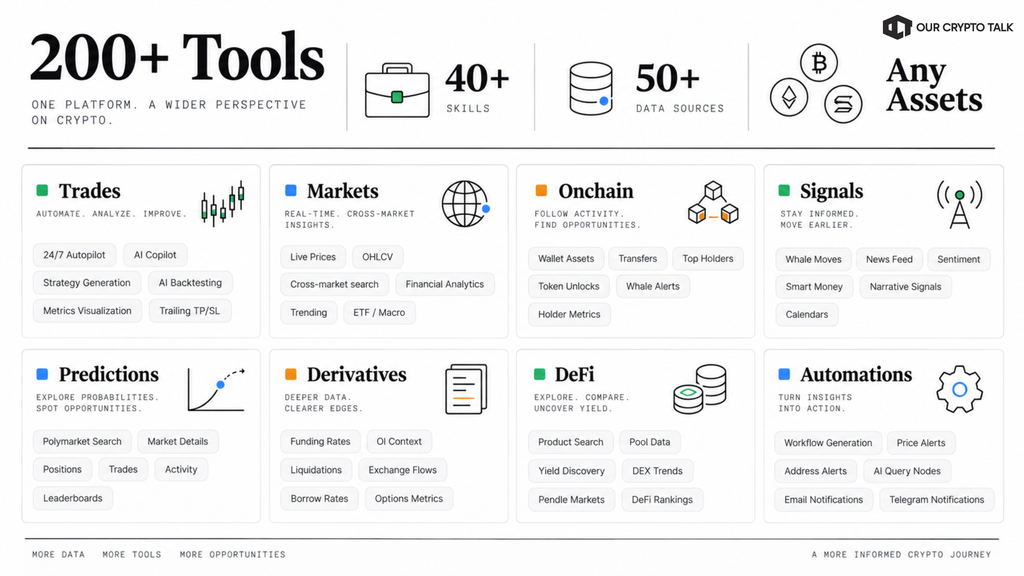
Minara is an AI trading and research platform that describes itself as a personal AI CFO. It combines live market analysis with trade execution across crypto, perpetuals, tokenized stocks and commodities, DeFi, and prediction markets.
The company was formed around 2024 by the team behind NFTGo. CEO Lowes Yang co-founded NFTGo, an NFT analytics platform that built a large global user base and previously received backing from Circle Ventures. Minara launched its beta in August 2025 and went public in January 2026, including a #1 Product of the Day result on Product Hunt.
Unlike many AI wrappers, Minara has generated measurable trading activity. Recent DefiLlama data shows roughly $35.7 million in 24-hour perp volume, $271 million over seven days, $1.12 billion over 30 days, and about $5.8 billion cumulatively. Thirty-day fees are around $170,000, with cumulative fees near $1.31 million ( Sept 14 ).
Most recent perp volume comes through Lighter, with a smaller share routed through Hyperliquid. Minara also offers paid plans, starting with a free tier and extending to paid options such as Lite at around $19 per month.
The product expanded during 2026. Autopilot manages automated strategies, Strategy Studio lets users build strategies, and Wizard provides a marketplace where creators can earn a share of followers’ realized profits. Minara Harness, launched in September 2026, extends the platform toward a broader agent environment for research and managed runs. Agent API and x402 provide infrastructure for external applications.
There is no confirmed official Minara tradable token at the time of this review. Points and reward campaigns have created speculation around a potential future token, but any unofficial ticker should be treated as unverified.
For now, Minara is best evaluated as an execution-connected financial AI platform. Usage, fees, product adoption, and custody design matter more than token speculation.
How Minara Works
Users interact with Minara through chat. Its finance-focused DMind model combines live prices, on-chain information, and other market data to provide analysis. After reviewing the recommendation, users can approve trades through a selected wallet or sub-wallet.
Execution spans multiple venues. Crypto spot trading covers several EVM networks and Solana, while perpetuals can route through Lighter or Hyperliquid depending on the active perp wallet. Tokenized stocks and commodities are available through perp markets, while prediction markets are supported through the Hyperliquid route.
Autopilot runs strategies through bounded sub-wallets. Users define parameters such as venue, leverage, and operating limits before starting. Each run maintains its own equity, positions, and stop state.
Strategy Studio and Wizard add a creator layer. Strategy authors can publish strategies for other users to import into Autopilot. Creators receive a share of realized profits, settled weekly, and do not earn a share during losing periods.
Minara also provides an Agent API for external applications. Developers can access chat, swap, perp-suggestion, and related functions and pay through API keys or x402. This gives Minara a path beyond the consumer-facing chat interface.
The platform’s growth is increasingly visible through trading volume and fee generation. Lighter has become the dominant venue in recent volume splits, while the product has expanded from chat into Autopilot, Wizard, Harness, and API infrastructure.
Minara is therefore more than a signal bot, but it remains an interface built on top of external trading venues. Liquidation, funding, order-book, and venue risks ultimately remain tied to Lighter and Hyperliquid.
Technology & Architecture
Minara’s core model layer is DMind, an open-source research effort focused on financial and Web3 data. The system can route workloads across DMind models and general-purpose models such as Claude or GPT. Smaller models handle tasks such as safety checks and private research, while larger models handle more complex reasoning.
The platform pulls live information from more than 40 data providers covering prices, on-chain activity, fundamentals, and sentiment. This live-data layer is important because financial execution cannot rely solely on a model’s static training data.
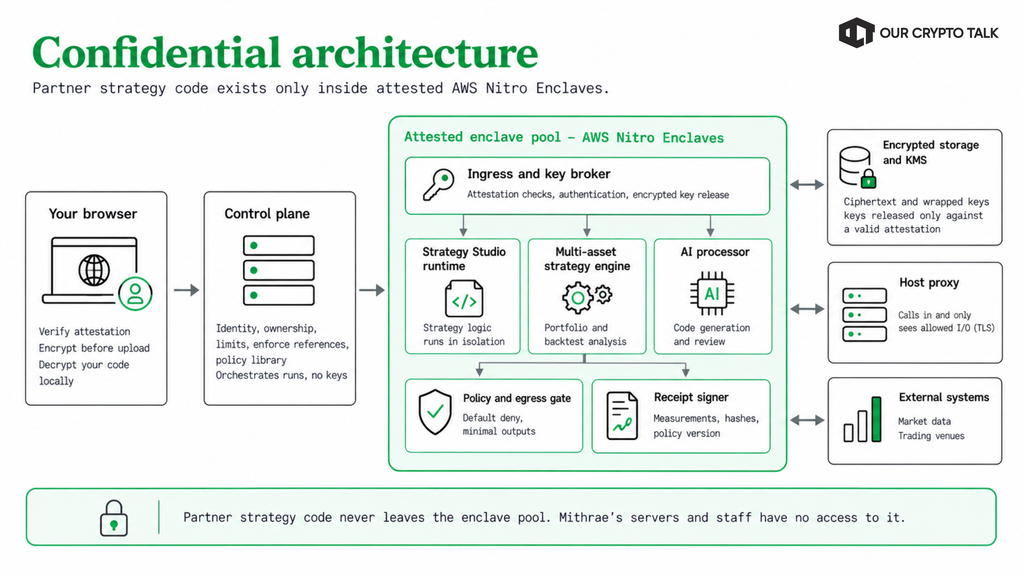
Minara also uses account abstraction and gas abstraction to simplify wallet management. The platform presents its wallet architecture as non-custodial, and users can export their keys. However, perp wallets remain tied to the underlying venues. Self-custody therefore reduces custodial dependence without removing venue, key-management, or execution risk.
Spot trading spans multiple EVM networks and Solana. Perpetuals currently operate through Lighter and Hyperliquid, giving Minara access to existing order-book infrastructure rather than requiring it to operate its own exchange.
The live product stack includes chat research and manual execution, Autopilot, Strategy Studio, Wizard, Lighter and Hyperliquid routing, and the Minara Harness agent environment.
Broader asset and venue coverage, deeper agent-to-agent monetization, and formal token economics remain areas of expansion.
Compared with a generic chatbot, Minara is directly connected to market data, trading venues, wallets, and risk controls. Its differentiation is therefore execution and venue coverage rather than a proprietary trading engine.
The architecture makes Minara an execution-connected financial AI platform. The next test is whether chat-to-order activity, automated strategies, and agent infrastructure can continue generating meaningful fees as the initial product cycle matures.
Team & Backers
Minara’s public face is co-founder and CEO Lowes Yang. He has been involved in crypto since 2017 and previously co-founded NFTGo, an NFT analytics platform that grew to a large global user base.
That background matters because Minara was not built from scratch as a generic AI chatbot. The team already had experience building crypto data products and understanding how users research markets.
Operations are described as Boston-based with a presence in Singapore. The model layer is supported by DMind AI, an open-source research organization focused on financial and Web3 models, benchmarks, and tools. Minara can route work across DMind models and general-purpose models rather than relying on a single closed model.
Circle Ventures is the most notable institutional name connected to the team’s previous work. Circle’s earlier investment in NFTGo provides relevant context, while Minara’s public materials also describe the company as backed by Circle.
This should not be interpreted as Circle guaranteeing Minara’s trading performance or confirming a Minara token investment. The stronger takeaway is that the team has an established crypto operating history and institutional connections.
Minara still needs to prove the new product on its own merits. NFTGo provides useful background, but sustained trading volume, fees, and user retention will matter more for Minara’s long-term prospects.
Minara Tokenomics
There is no official live Minara token at the time of this review. No confirmed protocol ticker, circulating supply, allocation table, or token-based fee mechanism is currently available.
Instead, Minara has operated a points-style program called Spark of MINARA. Official posts describe a 1 billion hardcap with epoch-based emissions that decrease over time. Earning mechanisms include subscriptions, trading activity, and content participation.
Third-party airdrop coverage has also referenced Sparks, PASS campaigns, and Gen-0 NFT whitelist opportunities. These should not be treated as confirmed token allocations. Until Minara publishes a token contract, allocation structure, and conversion mechanism, Sparks remain campaign points rather than circulating assets.
There are therefore no disclosed token unlocks or vesting schedules. The main future risk is potential dilution if points or campaign rewards are eventually converted into a tradable token. Users farming these programs should assume that conversion terms could change or that no token may ultimately launch.
Minara already has a business model without a token. Revenue comes from subscriptions, trading and perp activity, Wizard’s profit-sharing marketplace, Agent API usage, x402 payments, and launchpad-related fees through minara.fun on Arc.
DefiLlama’s Minara AI Perps data has shown significant trading volume and fee generation, indicating that revenue can exist independently of token speculation.
A future token could add utility, but there is currently no confirmed mechanism connecting Minara’s business revenue to token holders. Until that changes, DELTA-style or other cash-flow valuation models should not be applied to a nonexistent Minara token.
Is Minara Safe?
Minara’s documentation describes account-abstraction wallets with on-chain verification. Funding wallets are smart-contract accounts, while perp wallets are tied to Lighter or Hyperliquid. Users can export their controlling key and interact with the wallet outside Minara.
However, this is not identical to a self-custodied wallet where the user personally signs every transaction. Minara’s security documentation states that it generates and operates the controlling key within the authorized scope so features such as Autopilot can execute trades. Key protection has involved infrastructure such as AWS KMS, with earlier architecture also referencing Privy, TEE, and multi-party signing.
Minara says it cannot move funds outside the authorized scope or lend user assets. Even so, enabling Autopilot gives the system permission to execute trades until the user stops the run.
There are also practical deposit risks. Perpetual wallets use USDC on Arbitrum, and incorrect networks or assets may not appear in the interface and could require key export for recovery. Lighter and Hyperliquid also have their own transfer and withdrawal mechanics.
Trading risk is separate from wallet security. Perpetual positions can be liquidated, tokenized stock and commodity products are derivatives rather than the underlying assets, and AI-generated analysis can be wrong. Autopilot can also lose money within the limits configured by the user.
Minara announced a SlowMist security review in December 2025 and said identified issues were addressed. Users should still check the current security documentation and report before depositing significant funds, particularly because the wallet architecture has evolved.
No major Minara-specific exploit was prominently identified during the review period. That does not eliminate smart-contract, key-management, venue, AI-model, or user-error risks.
Overall, Minara offers more user control than a conventional custodial AI trading account, but it still requires trust in its execution infrastructure. It is best approached with small initial positions, clearly configured Autopilot limits, and careful attention to the underlying trading venues.
Minara vs Competitors
Hyperliquid and Lighter provide the underlying trading infrastructure that Minara connects to. A generic chatbot can explain market conditions but does not natively provide the same execution workflow.
Minara vs Competitors
| Project | Market Cap or Funding Signal | Use Case | Execution Venues | Product Status | Revenue Model | Token Utility |
|---|---|---|---|---|---|---|
|
| No official token; Circle-adjacent backing via the NFTGo team and public Circle association | AI research, Autopilot, Wizard strategies, multi-asset execution | Lighter and Hyperliquid perps; multi-chain spot; prediction markets on supported paths | Public since Jan 2026; Harness and Wizard live in 2026 | Subscriptions, perp/trading fee cut, Wizard profit-share, API / x402, minara.fun fees | None live; Sparks and campaigns are unconfirmed future claims |
|
| Large live crypto market cap versus any Minara rumor | Native on-chain perps venue and trading UI | Itself | Mature crypto perp L1 | Trading fees | Live venue token with fee linkage |
|
| Venue / ecosystem token value depends on listing status; treated here as the zk perps exchange Minara routes to | zk-rollup crypto perps order book | Itself | Live perp DEX used by Minara for most recent volume | Trading fees | Venue-level token utility, not Minara equity |
|
| Live crypto market caps in the agent-launch category | On-chain AI agents, agent tokens, and agent commerce | Mixed DEXs and agent rails | Live crypto-native agent stack | Launch, swap, and agent-usage fees | Agent and protocol tokens are already trading |
Minara is trying to occupy the layer between those two experiences. Its advantage depends on whether traders find chat, Autopilot, and strategy tools useful enough to avoid using the underlying venue interfaces directly.
Strengths & Risks
Minara has a live product and measurable trading activity. It launched publicly in January 2026 after a beta period, while DefiLlama shows roughly $1.12 billion in 30-day perp volume and around $5.8 billion cumulatively. Thirty-day fees are around $170,000.
The team also has previous crypto product experience through NFTGo. Minara’s Circle-backed positioning provides additional institutional context, while DMind gives the platform a finance-focused model layer rather than relying solely on a general-purpose chatbot.
Product development has continued through 2026. Harness expands Minara toward an agent environment, while Wizard adds a creator marketplace. Subscriptions, trading activity, API usage, and launch fees also provide revenue without requiring a token.
The strongest part of the thesis is therefore the business, not token speculation.
But there is still no confirmed Minara token. Sparks, PASS campaigns, and potential airdrops do not represent equity or a tradable asset.
The product also carries risks beyond those of a standard research chatbot. AI can misread market conditions, while perpetuals add liquidation and funding risk. Minara depends on Lighter, Hyperliquid, Arbitrum deposits, and its wallet infrastructure.
Competition is another challenge. Native trading venues already provide direct access to liquidity, while general AI chatbots remain strong research alternatives. Other AI trading products can also compete for the same users.
Subscription revenue may weaken during quieter markets, and points campaigns can create activity that does not translate into long-term users. A future Minara token may also fail to capture the company’s existing revenue.
The product is further along than many AI-crypto projects. The investable asset, however, does not exist yet.
Should You Buy Minara?
For builders and developers, Minara may be worth exploring if you need an Agent API, x402 payments, or an interface that combines financial research with execution. The live documentation and supported venues matter more than any rumored token.
For traders, the product itself can be tested with controlled capital. Autopilot and Wizard introduce additional automation and strategy risks, so users should avoid treating them as guaranteed sources of returns.
For long-term investors, the key event is a potential future token launch. There is currently nothing to buy that can be verified as the official Minara token. A credible investment case would require a confirmed contract, supply, allocation, vesting schedule, utility, and clear rules around any relationship between platform revenue and token holders.
Until those details exist, Minara is better evaluated as a growing software business than as a crypto asset.
For the keyword “is Minara worth buying,” the answer depends on what is being bought. The product may be worth using. An unofficial Minara ticker is not worth treating as a legitimate investment.
Final Verdict: Is Minara a Buy in 2026?
Minara is one of the more developed AI trading products in the current market. It has real perp volume, measurable fees, subscription revenue, an experienced crypto team, and a growing execution stack.
The main limitation is simple: there is no confirmed token. That makes traditional token analysis impossible and leaves users speculating if they buy an unofficial ticker.
For now, Minara is a product worth watching and potentially using, not a coin to buy. If a token launches, its supply, utility, allocation, and connection to platform revenue will determine whether the investment case matches the strength of the underlying product.
Minara is an AI interface and execution layer rather than an L1 or standalone DEX. Its closest comparisons are research-only AI tools, the perp venues it connects to, and other AI trading platforms.
Frequently Asked Questions
What is Minara?
How does Minara work?
What is Minara Harness?
Is there a Minara token?
Is Minara safe?
How is Minara different from ChatGPT?
Is Minara a good investment?
In this article
Why AI Trading Agents Are Hard to Get RightWhat Is Minara?How Minara WorksTechnology & ArchitectureTeam & BackersMinara TokenomicsIs Minara Safe?Minara vs CompetitorsStrengths & RisksShould You Buy Minara?Final Verdict: Is Minara a Buy in 2026?