Top 10 Bitcoin Layer 2 projects ranked by TVL in 2026. Compare Lightning, Stacks, Rootstock, and 7 more Bitcoin L2s with on-chain data.

Author: Kritika Gupta
Bitcoin just crossed one of its biggest supply milestones. Bitcoin Layer 2 projects are rapidly transforming the network from a passive store of value into an active financial ecosystem. The network mined its 20 millionth coin on March 9–10, 2026, which means more than 95% of the eventual 21 million BTC supply is already in circulation. That milestone sharpens the question around Bitcoin’s next phase. Not whether BTC works as a store of value. That case is already mature. The real question now is utility: what can holders actually do with Bitcoin without leaving the Bitcoin stack?
That is where Bitcoin Layer 2s enter the picture. Bitcoin’s base layer remains deliberately slow and conservative. It prioritizes security, settlement finality, and decentralization over throughput. Bitcoin L2s and sidechains try to extend that foundation by moving activity off the base chain, then anchoring, settling, or deriving security from Bitcoin in different ways. The result is a broader Bitcoin economy: instant payments on Lightning, BTC-backed DeFi on Stacks, EVM-style applications on Rootstock and BOB, and newer rollup-style designs such as Citrea.
Bitcoin’s Layer 1 was never designed for high-throughput applications. It processes roughly 7 transactions per second (TPS) with an average 10-minute block time, and during periods of heavy demand, transaction fees can rise sharply. These are not flaws in the protocol. They are deliberate tradeoffs that prioritize decentralization, censorship resistance, and long-term security. This conservative design is exactly why Bitcoin has remained the most secure monetary network for over 15 years.
However, these same design choices create clear scalability limits. For comparison, Bitcoin handles ~7 TPS, while Visa can process up to ~65,000 TPS at peak capacity. That gap makes global payments, micropayments, DeFi, NFTs, and real-time applications difficult to support directly on Bitcoin’s base layer. If every transaction had to settle on Layer 1, costs and confirmation times would make everyday usage impractical at scale.
This is where Bitcoin scaling solutions become essential. Layer 2 networks process most transactions off-chain or on secondary layers, then periodically settle or anchor the final state back to Bitcoin. This approach preserves Bitcoin’s core security guarantees while dramatically improving speed, cost efficiency, and functionality. Solutions like Lightning Network focus on instant payments, while smart contract layers such as Stacks and Rootstock enable lending, trading, and programmable finance. In effect, Layer 2 bridges the gap between Bitcoin’s security-first design and the demands of global-scale financial infrastructure.
This Bitcoin layer 2 projects ranking is built on objective, on-chain metrics rather than narrative, token price, or short-term hype cycles. The primary ranking factor is Total Value Locked (TVL), sourced from DeFiLlama’s Bitcoin L2 and sidechain categories as of late March 2026. TVL reflects capital actively deployed in DeFi applications such as lending, DEX liquidity, and yield strategies. It is the clearest proxy for real economic activity on a network. Lightning Network is the only exception. It does not use smart-contract TVL, so we rank it using channel capacity (liquidity locked in payment channels) as its closest equivalent.
The second criterion is transaction throughput and real usage. This includes daily transaction counts, active addresses, and estimated throughput capacity depending on architecture. Lightning dominates in raw payment throughput with near-instant settlement and high-frequency usage. Smart-contract Bitcoin layers such as Stacks, Rootstock, and EVM-compatible chains are evaluated based on DeFi transaction volume, DEX activity, and network usage patterns rather than theoretical TPS claims. The goal is to capture actual usage, not just design capacity.
The third factor is developer activity and ecosystem depth. We assess the number of live protocols, GitHub commits, tooling maturity, and overall builder momentum. A chain with high TVL but low developer activity often signals unsustainable capital inflows. Conversely, strong developer activity with lower TVL can indicate early-stage growth potential. This balance helps distinguish between temporary liquidity spikes and networks building durable Bitcoin-native ecosystems.
We included only networks that build on, anchor to, or settle back to Bitcoin. That means BTC or BTC-pegged assets (such as sBTC, RBTC, or LBTC) are central to the system, and the network derives security, data availability, or finality from Bitcoin in some form. Ethereum L2s such as Arbitrum, Optimism, and Base are excluded from this list. They belong to a different stack and are covered separately in our Ethereum scaling guide: Ethereum Layer 2 Scaling Guide.
For a Bitcoin layer 2 TVL ranking, the order needs one correction before we start: your suggested list is no longer current on a strict late-March 2026 DeFi TVL basis. BSquared now ranks above Merlin, BOB, Citrea, and BEVM, while Liquid remains strategically important but not a top DeFi TVL chain because its strength is fast settlement, confidential transfers, and asset issuance rather than DeFi lockups. Lightning is also a special case. It is ranked here first because it is still the most widely used Bitcoin scaling network, but its capital metric is channel capacity, not smart-contract TVL.
Bitcoin Layer 2 TVL ranking and ecosystem positioning (March 2026)
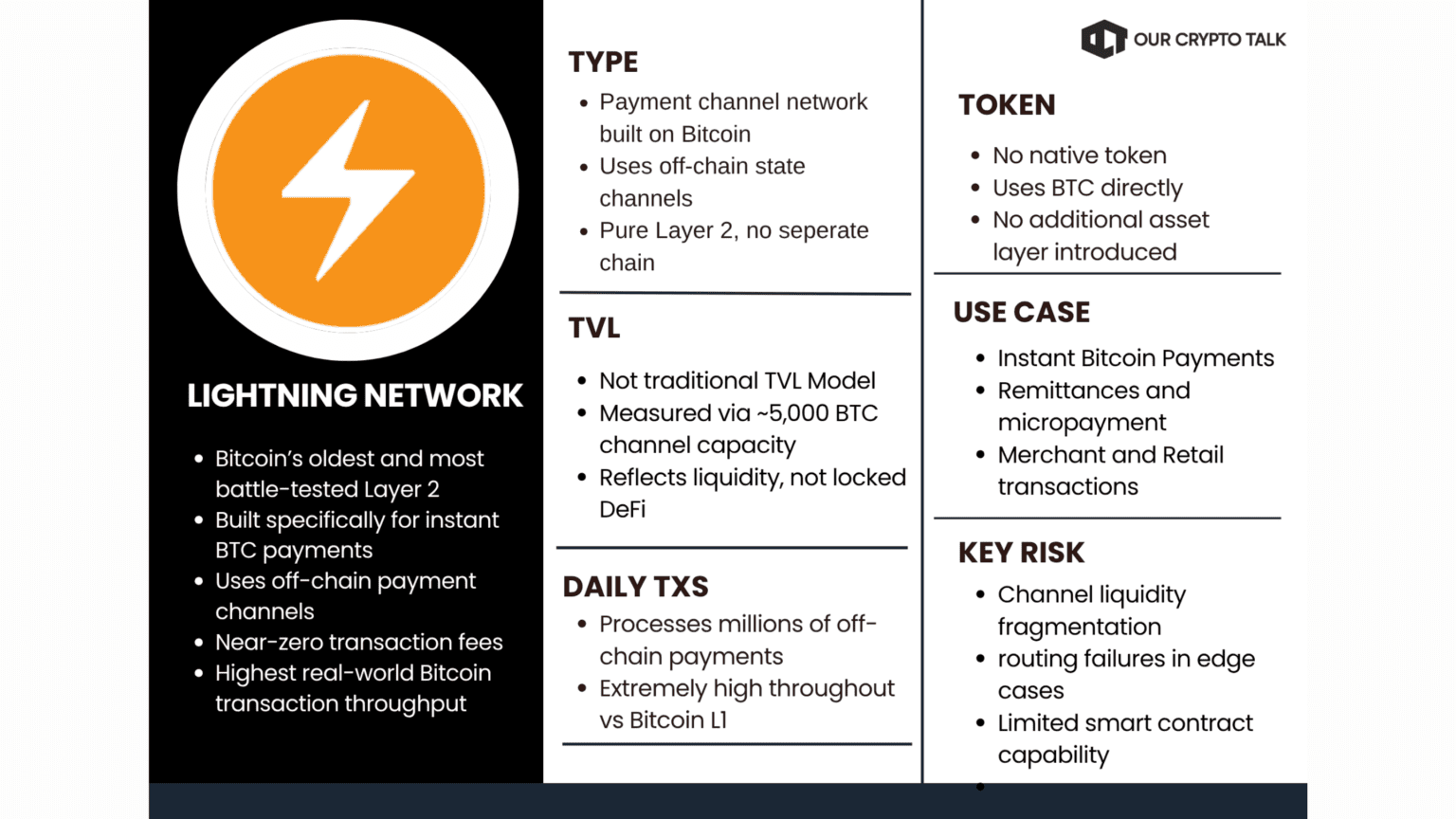
Lightning is the most mature of all Bitcoin Layer 2 projects. It uses payment channels to enable instant, low-cost BTC transfers off-chain, settling back to Bitcoin when channels close. It is a network of payment channels built on Bitcoin multisig contracts, letting users transact off-chain and only touch Bitcoin L1 when channels are opened or closed. That keeps Lightning narrowly focused, but extremely effective at what it does: fast BTC payments.
It does not use DeFi TVL in the same way that Stacks or Rootstock do. The right metric is channel capacity, and public capacity was roughly 4,965 BTC in the latest Glassnode snapshot. That is why Lightning has to be handled differently in any Bitcoin layer 2 TVL ranking. Comparing its capacity directly to DeFi smart-contract TVL would be misleading.
Lightning’s 2026 story is about maturity, not novelty. The network has better wallet UX, broader merchant tooling, and more institutional comfort than in earlier cycles. It still does not offer general-purpose smart contracts, and that is fine. It was never built to be a Bitcoin DeFi chain.
Its best use case remains everyday Bitcoin payments, remittances, micropayments, and exchange transfers. If the question is how to make BTC spendable at scale, Lightning is still the strongest answer in the Bitcoin stack.
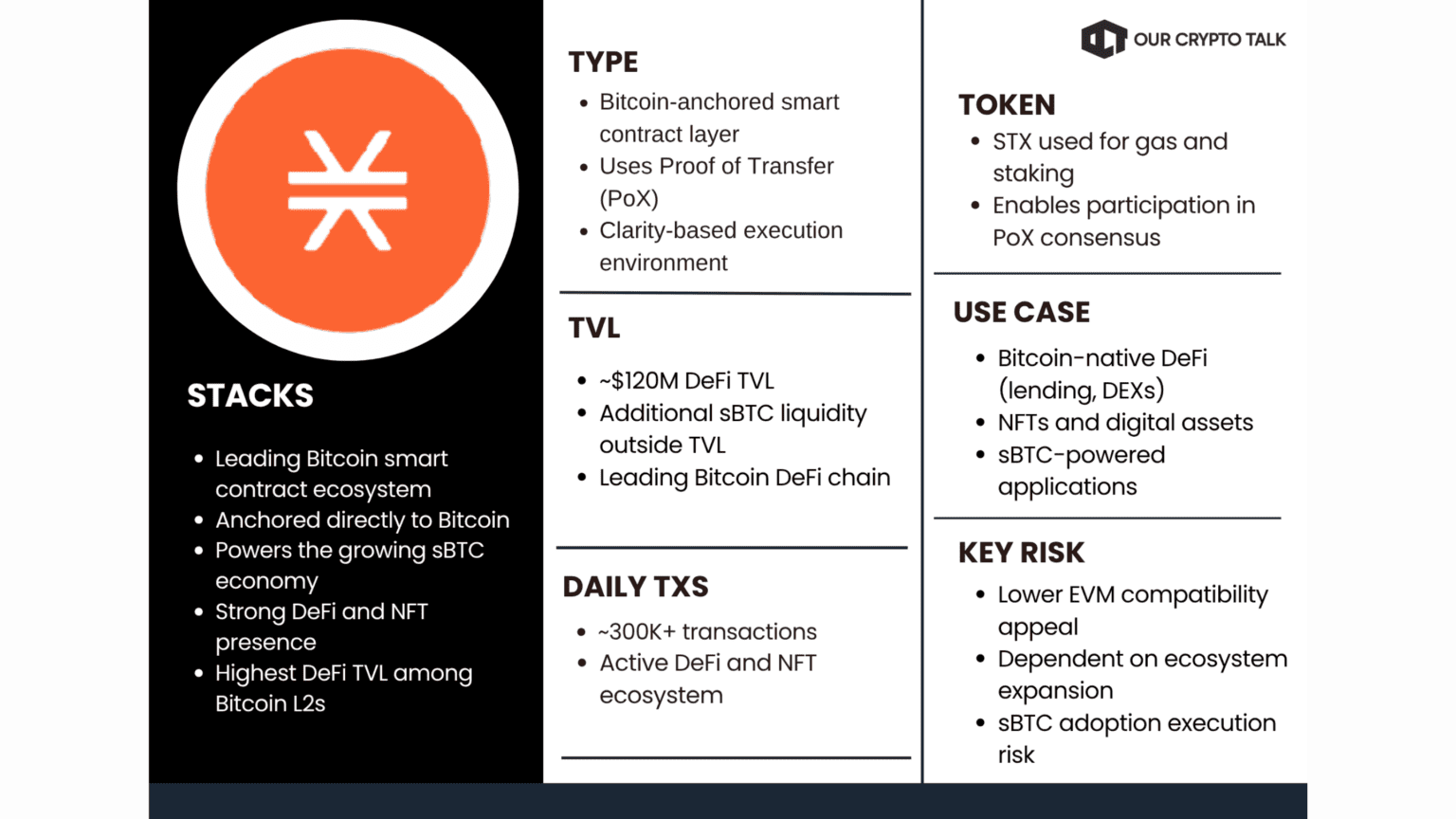
Stacks is the current leader in Bitcoin DeFi by tracked chain TVL. DeFiLlama shows $119.93 million in DeFi TVL on Stacks, with $36.7 million in stablecoins and nearly $398,000 in 24-hour DEX volume. That makes it the clearest smart-contract leader in the Bitcoin-native field right now.
Architecturally, Stacks is not an EVM sidechain. It is a Bitcoin-anchored smart-contract layer that uses Clarity and ties its history to Bitcoin. Its big unlock has been sBTC, the Bitcoin-backed asset that gives the network a more direct BTC liquidity path. The Stacks ecosystem’s own Q1 2026 snapshot says sBTC TVL reached $545 million, showing how much capital is forming around the broader network even beyond DeFiLlama’s chain TVL figure.
The major 2026 milestone is that Stacks has moved from promise to actual BTCFi infrastructure. The Nakamoto-era improvements and sBTC rollout have made the chain more credible as a place to lend, trade, and deploy Bitcoin capital rather than just talk about it. STX remains the network token and is used for gas and network participation.
Stacks’ best use case is Bitcoin-native DeFi. If users want smart contracts, lending markets, DEX activity, and yield strategies around BTC while staying inside a Bitcoin-anchored environment, Stacks is the strongest live option today.
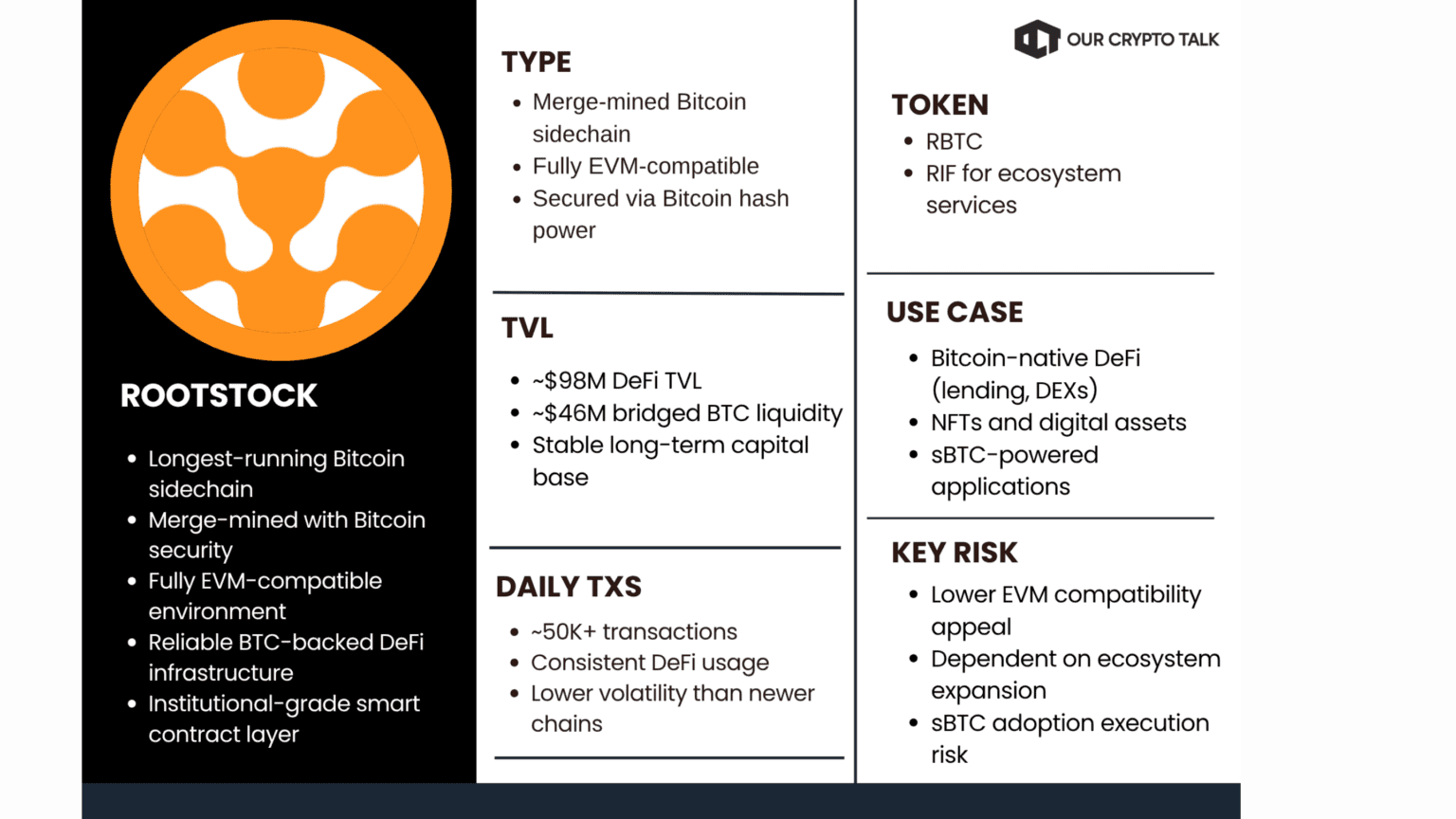
Rootstock is the most established EVM-style Bitcoin sidechain in the market. DeFiLlama shows $97.97 million in DeFi TVL and $46.13 million in bridged TVL, which keeps it firmly in second place among smart-contract-oriented Bitcoin networks by current TVL.
Its architecture is straightforward and still compelling. Rootstock is a Bitcoin sidechain secured through merged mining, which means Bitcoin miners can mine Rootstock alongside Bitcoin because both use SHA-256. That gives Rootstock one of the cleanest security narratives among Bitcoin sidechains while also remaining EVM-compatible for developers.
The 2026 milestone here is steadiness. Rootstock is not the loudest Bitcoin L2, but it continues to offer a live environment for BTC-backed DeFi, stablecoins, and smart contracts without relying on hype. The key token in its ecosystem is RIF, though BTC-linked assets like RBTC remain central to how users actually interact with the network.
Its best use case is for users and developers who want Bitcoin-secured EVM execution. Rootstock makes the most sense for lending, stablecoins, and familiar Solidity-style app design around Bitcoin collateral.
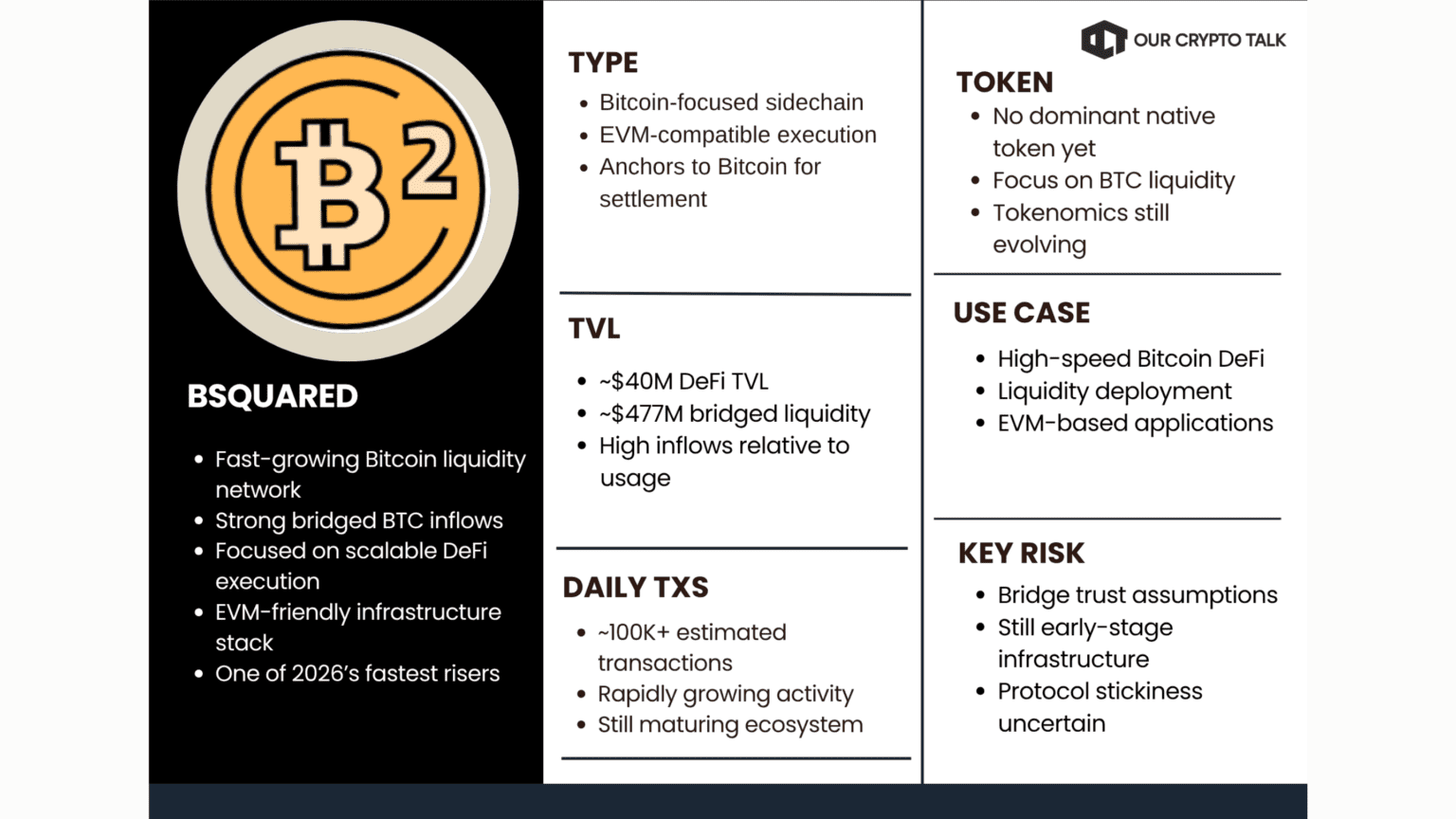
BSquared is one of the biggest climbers in the current Bitcoin layer 2 TVL ranking. DeFiLlama shows $39.78 million in DeFi TVL, but the more striking figure is $477.32 million in bridged TVL. That tells you the capital base has arrived faster than the application layer.
That gap matters. BSquared clearly has meaningful Bitcoin-linked liquidity, but it still needs deeper DeFi utilization to prove that those inflows are durable and productive rather than just transient bridge deposits. In that sense, BSquared is one of the more important networks to watch over the rest of 2026.
The chain’s 2026 milestone is simple: it has broken into the top tier of Bitcoin-sidechain TVL screens. That alone makes it impossible to exclude from a serious list of the best Bitcoin L2 networks, even if it is still behind Stacks and Rootstock in DeFi maturity.
Its best use case is high-speed Bitcoin-linked DeFi in an EVM-friendly environment, especially for users who care about access to bridged BTC liquidity and are comfortable using newer infrastructure.
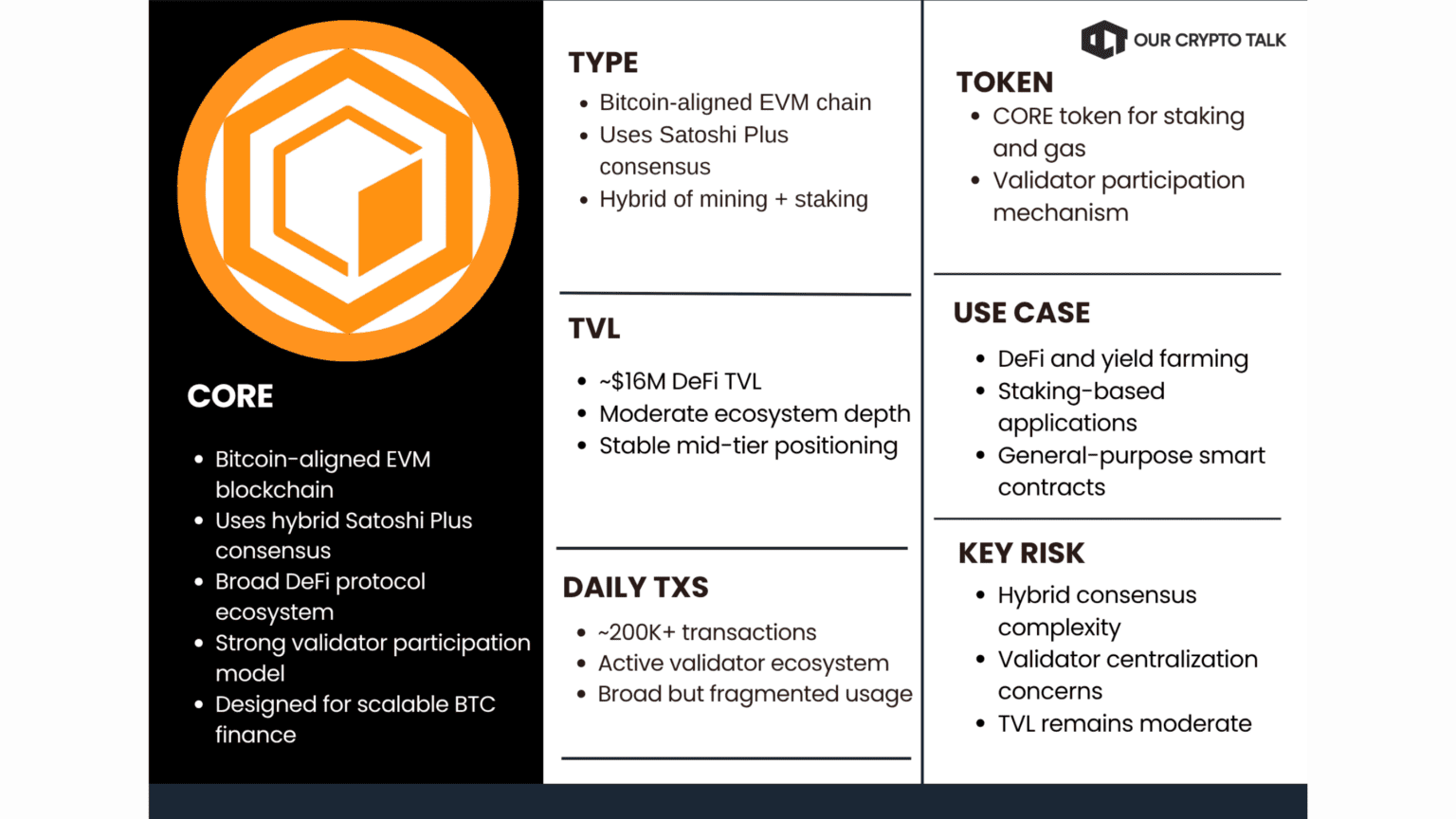
Core sits in the middle tier of Bitcoin Layer 2 projects. It uses a hybrid consensus model combining Bitcoin mining, staking, and validator participation. DeFiLlama shows $16.22 million in TVL, which places it ahead of Merlin and BOB on current chain TVL, even if it gets less attention in Bitcoin-native discussions than Stacks or Rootstock.
Its architecture is different from a pure rollup or a classic federated sidechain. Core uses Satoshi Plus, a hybrid design that combines Bitcoin mining power, BTC holder participation, and CORE staking to elect validators for an EVM-compatible chain. In other words, it is trying to build a Bitcoin-aligned smart-contract chain without pretending to inherit Bitcoin security in the same direct way Lightning does.
The 2026 milestone for Core is continued ecosystem persistence. The network has not won the Bitcoin DeFi narrative, but it has kept enough live activity and protocol surface area to remain relevant. The native token is CORE, which is used in validator and staking mechanics.
Its best use case is broader EVM-style DeFi and yield applications for users who want Bitcoin-aligned branding and BTC-linked participation but are comfortable with a more hybrid trust and consensus model.
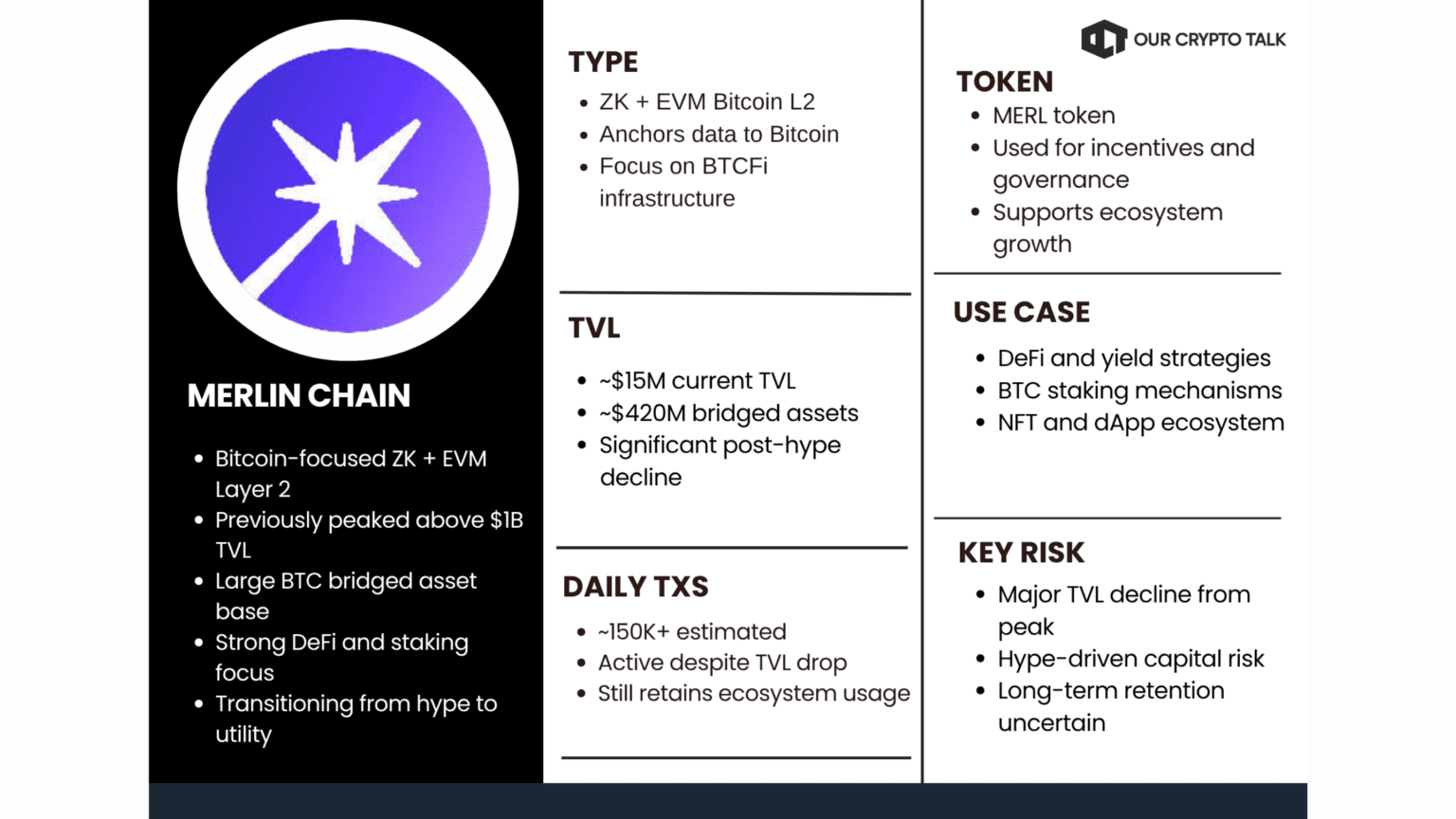
Merlin Chain represents the volatility within Bitcoin Layer 2 projects. Today, DeFiLlama shows about $15.0 million in DeFi TVL, while bridged TVL remains much higher at $420.27 million. That means there is still a meaningful pool of Bitcoin-linked capital around Merlin, even though its DeFi usage is far below the levels seen during its 2024 breakout phase.
Architecturally, Merlin is an EVM-compatible Bitcoin-focused chain with Bitcoin anchoring and a strong emphasis on bridging BTC liquidity into a programmable environment. The pitch has always been speed, compatibility, and easy access to BTCFi.
Its 2026 milestone is less about expansion and more about transition. Merlin is no longer the face of Bitcoin L2 TVL mania. It is now trying to prove it can convert a large bridged asset base into sustainable DeFi usage. The network token is MERL.
Its best use case remains EVM-based DeFi, trading, and BTC-linked liquidity deployment. But on current data, Merlin is no longer the leader. It is a second-tier contender trying to rebuild around real usage rather than momentum.
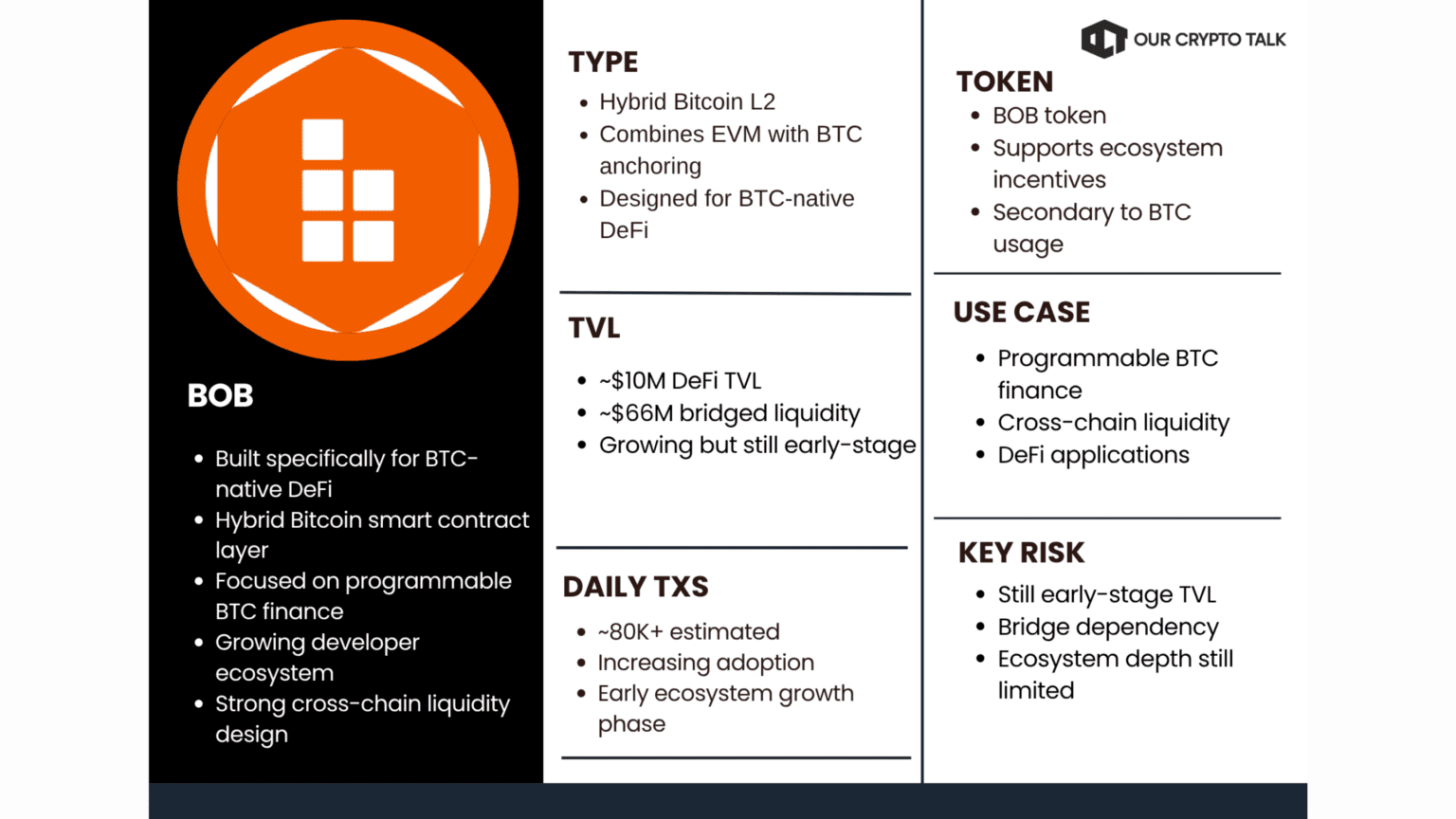
BOB, short for Build on Bitcoin, currently holds $10.17 million in DeFi TVL and $66.16 million in bridged TVL. Those are not top-tier numbers, but they are real enough to keep BOB in the serious part of the Bitcoin DeFi conversation.
The project describes itself as a hybrid chain that combines Bitcoin security ambitions with EVM compatibility and DeFi functionality. That framing matters because BOB is not just trying to be another generic rollup. It is explicitly positioning itself as a Bitcoin-first programmable environment.
Its 2026 milestone is ecosystem hardening. BOB has raised capital, shipped infrastructure, and kept a measurable BTC-linked DeFi base onchain. It is still small relative to the leaders, but it has enough traction to matter. The network also has a token, BOB, though the bigger strategic point is its Bitcoin-centric app thesis.
Its best use case is programmable finance around Bitcoin collateral, especially for users who want an EVM environment but prefer a chain that is explicitly designed around BTC liquidity rather than general-purpose alt-L2 positioning.
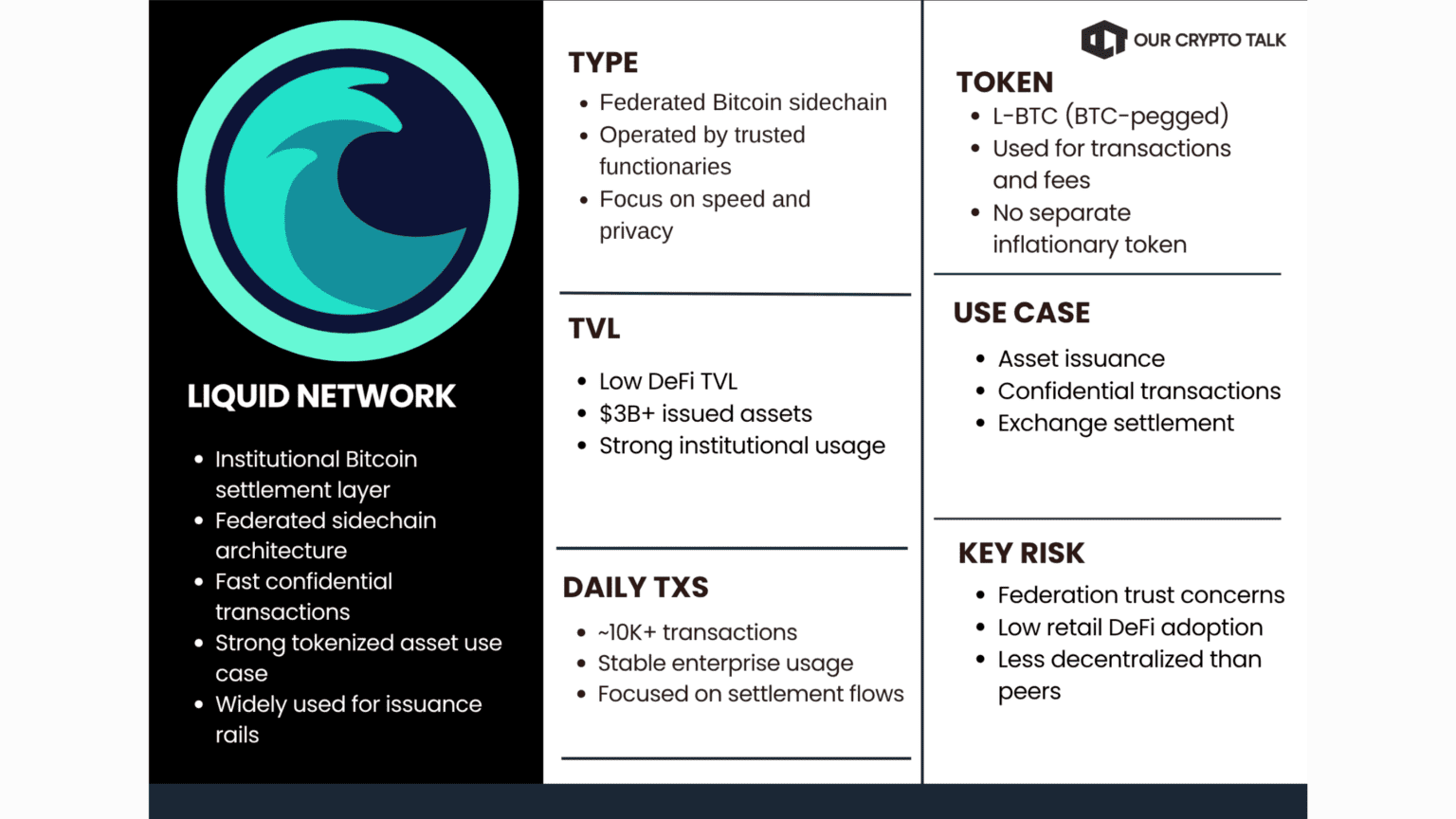
Liquid differs from most Bitcoin Layer 2 projects. It is a federated sidechain focused on confidential transactions and asset issuance rather than DeFi TVL. Officially, Liquid is a Bitcoin layer-2 focused on fast, confidential bitcoin payments and secure asset issuance. That means it matters more as a financial rail than as a high-TVL DeFi chain.
Its architecture is a federated Bitcoin sidechain. That makes it more permissioned than Lightning or a trust-minimized rollup design, but it also makes it highly practical for exchange settlement, asset issuance, stablecoins, and privacy-sensitive transfers. Confidential transactions are central to the Liquid pitch.
Liquid’s 2026 milestone is continued relevance in Bitcoin capital markets rather than a DeFi breakout. The network remains one of the clearest answers to the question of how Bitcoin can support tokenized assets and faster settlement rails without moving onto Ethereum. Liquid Bitcoin, or L-BTC, is the core asset representation rather than a separate native gas token story.
Its best use case is confidential high-value transfers, exchange and treasury settlement, and issuance of Bitcoin-linked financial assets. If the ranking were based on Bitcoin financial infrastructure rather than DeFi TVL, Liquid would sit much higher.
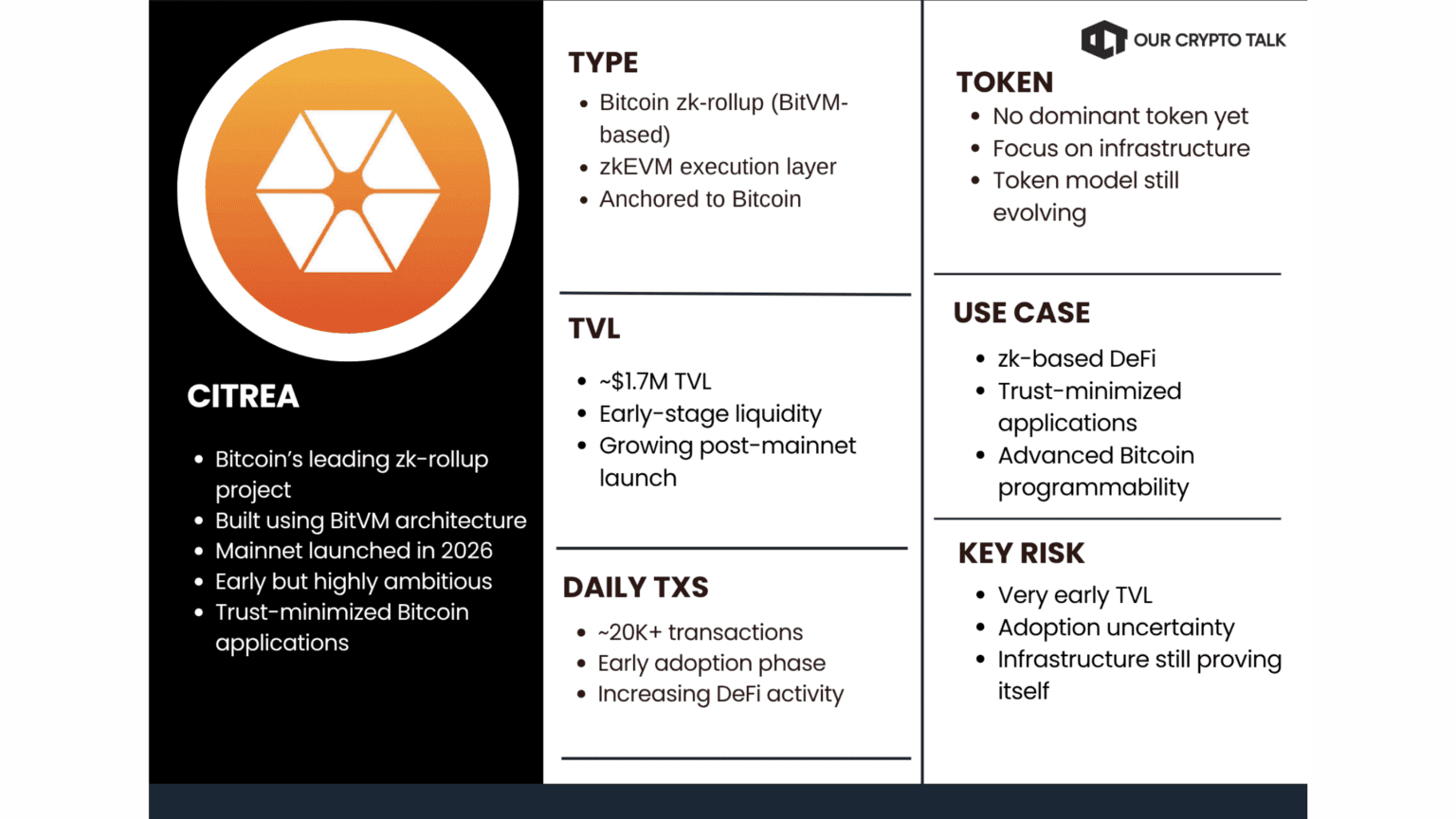
Citrea is the most technically ambitious project in the lower half of the ranking. DeFiLlama shows $1.72 million in TVL, which is still small, but the chain is live and already showing $502,187 in 24-hour DEX volume.
Its architecture is the real draw. Citrea positions itself as a Bitcoin-native application layer with a zk-rollup style design, and its bridge roadmap is tied to BitVM2-based Clementine mechanics. That makes it one of the few projects trying to push Bitcoin toward a more trust-minimized programmable future without simply copying Ethereum’s stack.
The major 2026 milestone is clear and recent: Citrea mainnet went live on January 27, 2026. That means it has moved from whitepaper and devnet rhetoric into actual market execution. There is no major token story that dominates the thesis yet; the bigger point is infrastructure and application rollout.
Its best use case is early-stage Bitcoin-native lending, trading, and settlement for users who want exposure to the most forward-leaning rollup thesis in the Bitcoin ecosystem. It is early, but it is one of the most important projects to watch.
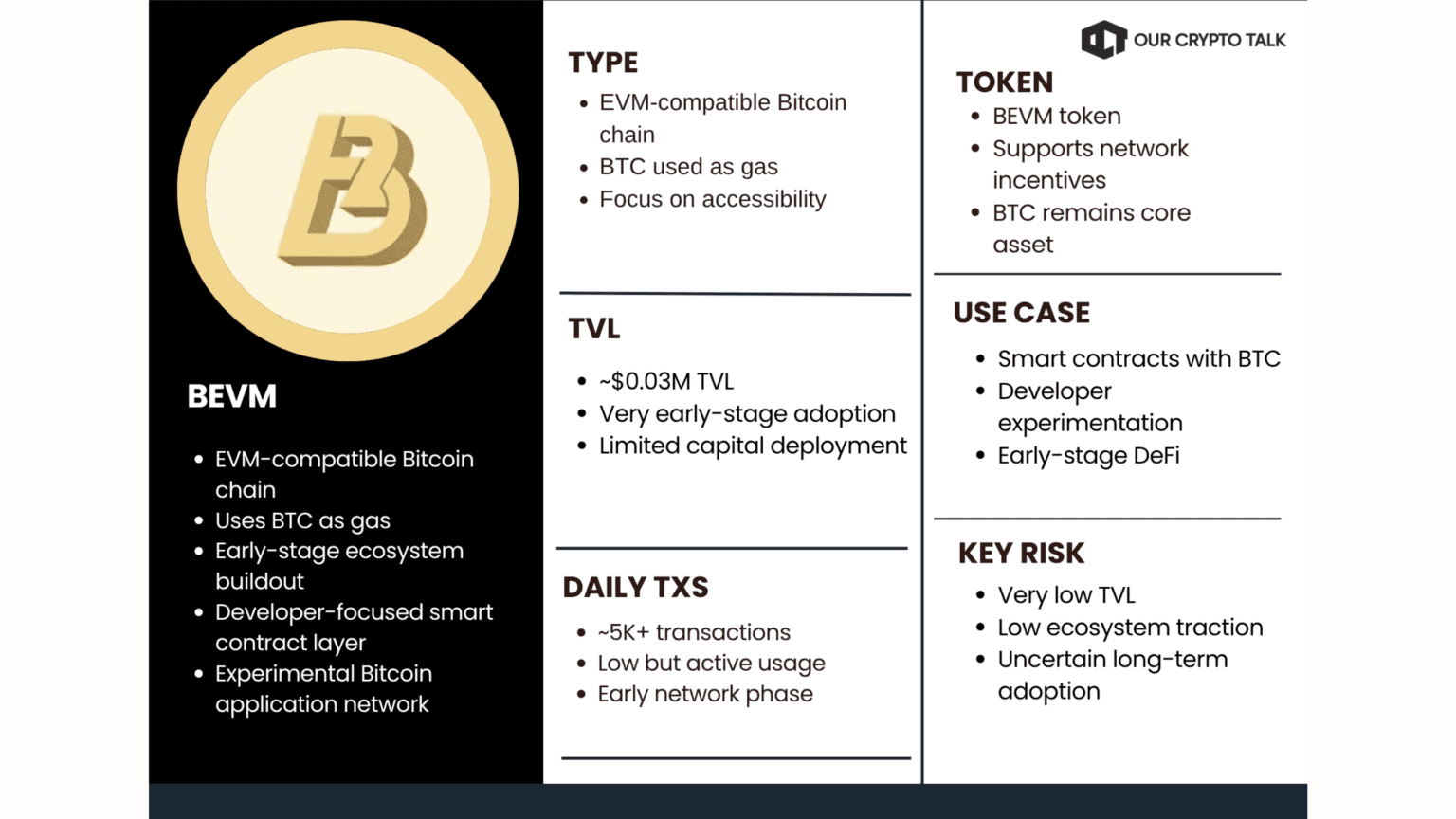
BEVM makes the top 10 mostly because the Bitcoin L2 field is still fragmented and because it remains an active EVM-compatible Bitcoin chain. But the current DeFi footprint is very small. DeFiLlama shows only $33,662 in TVL.
Its architecture is more straightforward than Citrea’s. BEVM is an EVM-compatible Bitcoin-focused chain that markets BTC as gas, which is a useful design choice for users who want Bitcoin branding and familiar EVM tooling in one environment.
The 2026 milestone is less about adoption and more about survival and continued ecosystem presence. BEVM has funding behind it, but the onchain TVL suggests it has not yet converted the early narrative into sustained capital formation.
Its best use case is simple smart-contract experimentation and BTC-centric EVM deployment. But on current numbers, it is clearly a bottom-tier entry in the ranking, not a leader.
The Bitcoin L2 ecosystem has gone through one of the fastest capital expansion cycles in crypto. In 2024, total Bitcoin Layer 2 TVL crossed ~30,000 BTC (≈$3B), representing roughly 600% growth within that year alone as BTCFi narratives took hold.
Below is a project-level comparison using early 2024 snapshots (peak or early-cycle data where available) versus late March 2026 DeFiLlama figures.
Relative positioning of Bitcoin Layer 2 TVL growth: Jan 2024 vs Mar 2026
The first phase of Bitcoin L2 growth was driven by Ordinals and BRC-20 tokens, which introduced native programmability and asset issuance directly on Bitcoin. This created the first real demand for scaling layers that could support tokens, NFTs, and higher transaction throughput. Merlin Chain’s surge to nearly $1B TVL in April 2024 is a direct example of how quickly capital rotated into this narrative.
The second driver was the emergence of BTCFi infrastructure, especially on Stacks. The introduction of sBTC and Bitcoin-backed DeFi primitives shifted the narrative from speculation to utility. Instead of bridging BTC to Ethereum, users could deploy capital inside Bitcoin-native environments. This marked the transition from “token experimentation” to “financial applications built on Bitcoin.”
The third layer of growth came from institutional and infrastructure interest. Reports highlight that Bitcoin L2s are unlocking “trillions in latent BTC value” by enabling lending, yield, and programmable finance directly on Bitcoin.At the same time, new entrants such as BSquared, Core, and BOB attracted capital through EVM compatibility and easier developer onboarding, accelerating ecosystem expansion.
The key insight is that Bitcoin L2 growth is cyclical, not linear. 2024 was an explosive expansion phase, driven by new primitives and speculative inflows. By 2025–2026, the market entered a consolidation phase, where TVL declined across many chains but infrastructure quality improved and ecosystems diversified.
That matters. A simple snapshot in 2026 might suggest stagnation or decline. The full timeline shows something different:
In other words, this is not a collapse. It is market selection.
The broader trajectory suggests Bitcoin L2s are moving from narrative-driven TVL to utility-driven adoption. Payments are consolidating on Lightning. DeFi is concentrating around Stacks and a few EVM chains. New architectures like Citrea are pushing toward trust-minimized rollups.
Relative positioning of Lightning Network versus Bitcoin smart contract Layer 2 models
Bitcoin Layer 2 projects are no longer a side narrative. They are the next phase of Bitcoin itself. As more than 95% of BTC supply is already mined, the focus has shifted from accumulation to utilization. The question is no longer whether Bitcoin works. It is how far its utility can expand without compromising the properties that made it valuable in the first place.
This ranking of Bitcoin Layer 2 Projects shows a fragmented but maturing landscape. Lightning Network dominates payments, offering speed and scale that Bitcoin L1 cannot. Stacks leads Bitcoin-native DeFi, turning BTC into productive capital through lending, trading, and yield. Rootstock, Core, and EVM-based chains provide familiar smart contract environments, while newer entrants like BSquared and Citrea are pushing the boundaries of how Bitcoin can support more complex financial systems.
The key insight is that there is no single “best Bitcoin L2.” These networks are solving different problems. Payments, DeFi, asset issuance, and programmable infrastructure are splitting into specialized layers. That is not a weakness. It is exactly how a scalable financial system evolves. Bitcoin remains the base settlement layer, while L2s expand its functionality without forcing changes to the core protocol.
This article is for informational purposes only and does not constitute financial advice.