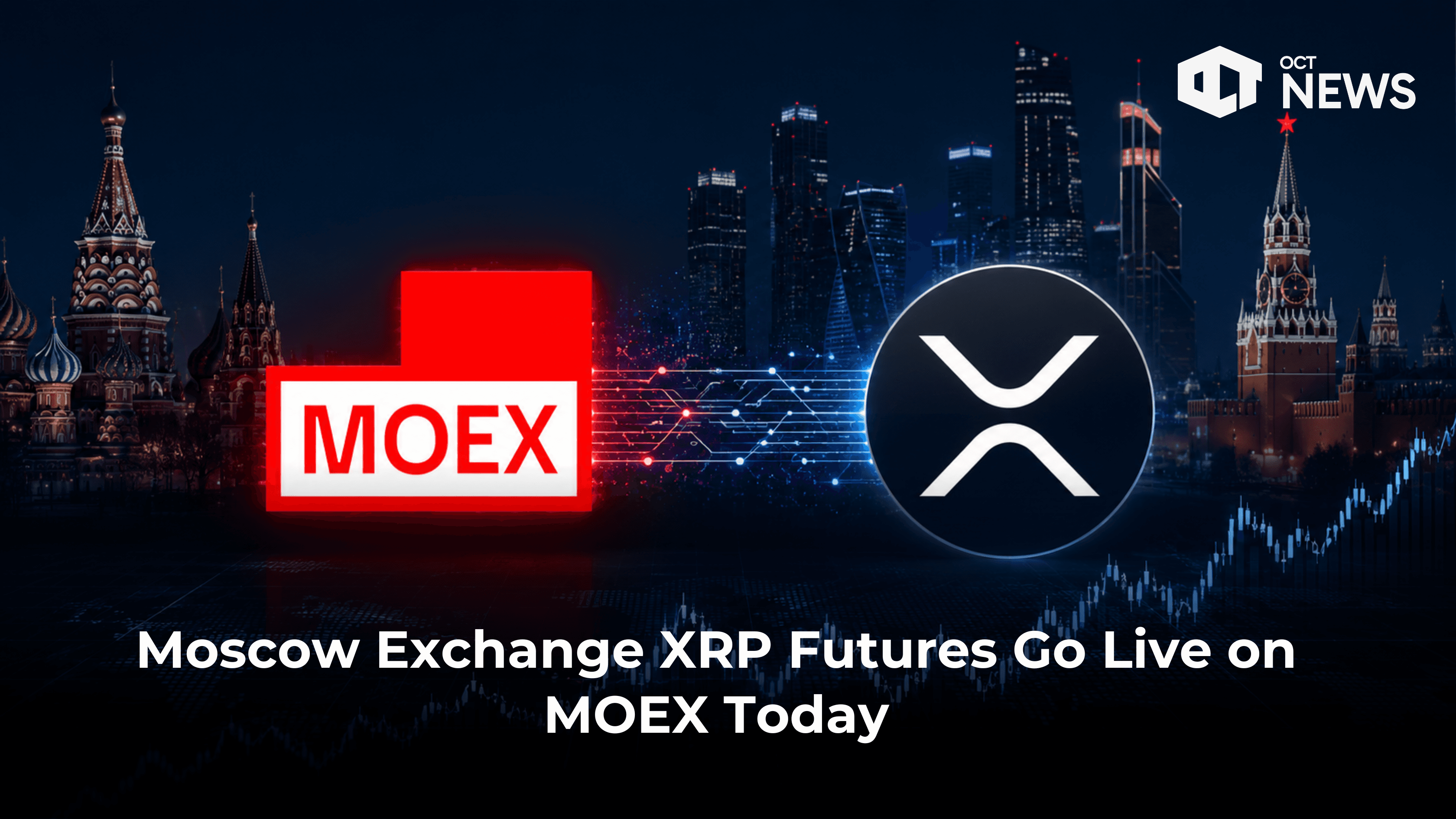
Moscow Exchange XRP futures launched in Russia with the MOEXXRP index, offering regulated XRP exposure through cash-settled contracts.

Author: Akshay
14th May 2026 – The Moscow Exchange (MOEX) began trading cash-settled XRP futures today, marking Russia’s latest push into regulated crypto derivatives. The product launched alongside futures tied to Solana (SOL), Tron (TRX), and BNB.
High Signal Summary For A Quick Glance

Nikletsgo2026 🙏🏻🧬✨are we there yet 😩
@nikletsgo277373

@RippleXity And price is down 🤣🤣
🚨 JUST IN: A $7,530,000,000,000 economy just listed a live institutional ripple:native index. 🇷🇺 Russia just flipped the switch on institutional ripple:native exposure with the MOEX ripple:native Index. https://t.co/0pJSNQq40E https://t.co/KXl53ZcE6g
07:55 AM·May 14, 2026

MRubens
@MauriceRubens2
@RippleXity China next? 😎
🚨 JUST IN: A $7,530,000,000,000 economy just listed a live institutional ripple:native index. 🇷🇺 Russia just flipped the switch on institutional ripple:native exposure with the MOEX ripple:native Index. https://t.co/0pJSNQq40E https://t.co/KXl53ZcE6g
07:41 AM·May 14, 2026
MOEX first signaled the expansion on May 13, 2026, when it started calculating the MOEXXRP index. That index serves as the price benchmark for the new futures contracts. Trading opened one day later on May 14.
The Moscow Exchange XRP futures are cash-settled instruments denominated in Russian rubles. They do not involve any actual XRP tokens. No crypto custody or wallet infrastructure is required.
Instead, the contracts track a synthetic price index called MOEXXRP. This index aggregates XRP prices from four major exchanges: Binance (50%), Bybit (20%), OKX (15%), and Bitget (15%). The benchmark updates every 15 seconds during trading hours.
As a result, traders gain exposure to XRP price movements through a familiar brokerage account. The product functions more like a traditional derivative than a crypto-native instrument.
The XRP listing brings MOEX’s total crypto index count to six. The exchange introduced its first crypto benchmark, MOEXBTC, in June 2025. MOEXETH followed in October 2025.
With today’s launch, MOEX added four new indices at once: MOEXXRP, MOEXSOL, MOEXTRX, and MOEXBNB. All four use the same weighted methodology across Binance, Bybit, OKX, and Bitget.
Maria Patrikeeva, head of MOEX’s derivatives segment, framed the move as a natural progression. “The launch of futures on the Solana, Ripple, and Tron indices is a logical development of the segment of contracts on digital assets in the derivatives market of the Moscow Exchange,” she said in an official statement.
Patrikeeva also noted the domestic angle. “We provide Russian investors with access to the largest cryptocurrencies without the need to go to foreign platforms and incur infrastructure risks,” she added.
Access to these contracts is not open to everyone. MOEX restricts crypto futures to qualified, professional, and institutional investors only. Retail traders without the proper classification cannot participate.
This restriction aligns with Russia’s broader approach to digital asset regulation. Since President Putin signed the country’s foundational crypto law in 2020, regulators have moved cautiously. Regulated products remain limited to sophisticated market participants.
The Central Bank of Russia has not issued a public statement on the new listings. Its position on crypto derivatives remains unchanged from prior guidance.
Timeline: Russia’s gradual transition from crypto restrictions toward regulated institutional market access and MOEX crypto products
President Vladimir Putin signs legislation explicitly banning cryptocurrencies and NFTs as payment instruments inside Russia, tightening the country’s domestic crypto restrictions.
The Bank of Russia begins live pilot testing for the digital ruble CBDC with selected individuals and merchants, laying groundwork for controlled domestic and cross-border digital settlement systems.
Russia formally legalizes cryptocurrency mining through dedicated legislation, establishing registration rules for companies and energy-use limits for individuals.
Russia creates legal exemptions allowing cryptocurrencies for international trade settlements while regulators intensify discussions around institutional crypto market access and regulated exposure products.
MOEX launches BTC and ETH benchmark indices while the Central Bank publishes a formal proposal allowing qualified investors to gain limited crypto exposure through licensed intermediaries.
MOEX introduces new crypto indices including MOEXXRP and begins cash-settled RUB futures trading, giving qualified Russian institutions regulated synthetic exposure to XRP, SOL, TRX, and BNB.
Russia targets July 2026 for implementation of broader legislation governing licensed institutional crypto access under Central Bank oversight.
One detail stands out in MOEX’s official documentation. The exchange refers to the underlying asset as “Ripple” rather than “XRP.” This distinction matters because Ripple is the company, while XRP is the token the index actually tracks.
The MOEX methodology document confirms the MOEXXRP index prices XRP the token. The “Ripple” label appears to be a branding shorthand rather than a reference to Ripple Labs equity or products.
Despite the launch, XRP’s spot price showed no meaningful reaction. The token traded between $1.42 and $1.47 around the announcement window. No significant volume spike accompanied the news.
This muted response is consistent with the product’s limited scope. Moscow Exchange XRP futures are synthetic, cash-settled, and restricted to a narrow investor class. They do not create direct buying pressure on XRP itself.
Some community members on social media have framed the MOEX listing as a major adoption milestone. Several posts referenced Russia’s $7.53 trillion PPP-adjusted GDP to suggest large capital inflows. That framing overstates the product’s actual reach and mechanics.
These futures are not spot trading pairs. They are not exchange-traded funds. They do not involve any on-chain activity.
The entire product is synthetic. MOEX calculates an index, and traders bet on that index’s direction using ruble-denominated futures. No XRP changes hands at any point in the process.
This structure is similar to how traditional commodity futures work. A trader can gain price exposure to oil through futures without ever taking physical delivery. The MOEX crypto futures operate on the same principle.
How major economies provide institutional crypto exposure (May 2026)
MOEX’s rapid expansion from two crypto benchmarks to six suggests further growth is likely. The exchange now covers BTC, ETH, XRP, SOL, TRX, and BNB. Other major-cap tokens could follow if demand from qualified investors justifies new listings.
No major Western outlets, including CoinDesk, Bloomberg, or Reuters, have covered the launch as of publication. The MOEX announcement remains the primary source.
For now, the Moscow Exchange XRP futures represent a measured step in Russia’s regulated crypto market. Whether this translates into broader access for retail investors will depend on future regulatory shifts from the Central Bank.
This article is for informational purposes only and does not constitute financial advice. Always do your own research before making investment decisions.
Our Crypto Talk is committed to unbiased, transparent, and true reporting to the best of our knowledge. This news article aims to provide accurate information in a timely manner. However, we advise the readers to verify facts independently and consult a professional before making any decisions based on the content since our sources could be wrong too. Check our Terms and conditions for more info.