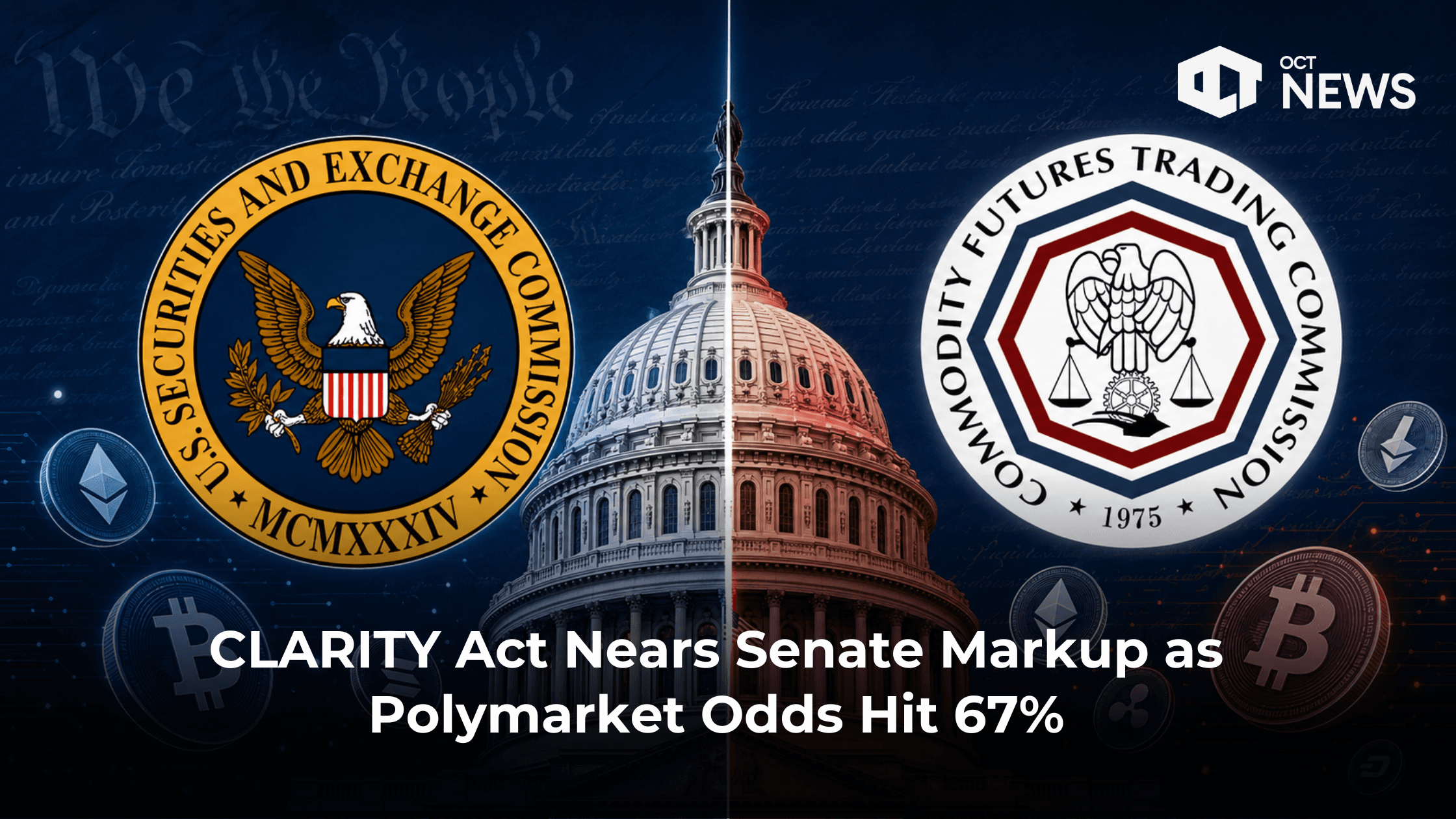
CLARITY Act crypto odds hit 67% on Polymarket as Senate Banking markup could define the SEC-CFTC regulatory split.

Author: Kritika Gupta
8th May 2026- The CLARITY Act is approaching its most critical milestone yet. The Senate Banking Committee is preparing to mark up H.R. 3633 as early as this week. Polymarket bettors now price 2026 passage at roughly 67%. The bill would create a clear jurisdictional split between the SEC and CFTC. As a result, it could end more than a decade of regulatory ambiguity. That ambiguity has cost the crypto industry tens of billions in fines and legal fees.
High Signal Summary For A Quick Glance

Xaif Crypto
@Xaif_Crypto

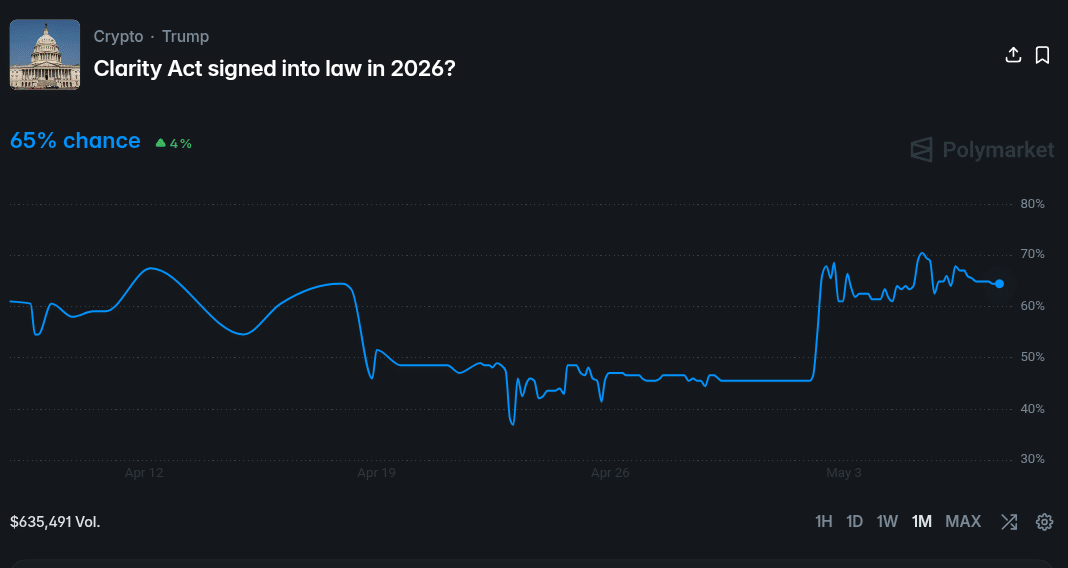
Polymarket says 65% chance the CLARITY Act becomes law this year 🇺🇸 bro we've been waiting LONG ENOUGH just sign the damn thing already 😤 ripple:native ethereum:0x8292bb45bf1ee4d140127049757c2e0ff06317ed https://t.co/ploVM5R7Si
12:03 PM·May 8, 2026

Pendle Intern
@PendleIntern
Polymarket now puts Clarity Act CLARITY Act at 70% to pass this year. Many don't realize how big of an ADVANTAGE this is for $PENDLE. CLARITY's core distinction is between passive interest and yield earned through active market participation. $PENDLE's model has always been the https://t.co/6VeZxGZPWE https://t.co/X9BdtnallJ

The CLARITY Act has nearly 70% chance of passing according to Polymarket. CT is still talking about what it means for $BTC and $ETH... but nobody is connecting the dots to @pendle_fi. Serious mistake, but you can still fix it by reading on 🧵👇🏻 https://t.co/NQFiEQhEAj
11:53 AM·May 8, 2026
Steady attention without excessive speculation.
At its core, the CLARITY Act draws a line between two types of digital assets. Tokens that meet the Howey test stay under SEC oversight as “investment contracts.” In contrast, tokens on mature, decentralized blockchains become “digital commodities” under CFTC jurisdiction.
The distinction matters because it changes how exchanges operate. A “digital commodity” classification lets CFTC-regulated exchanges list tokens without SEC registration. Meanwhile, DeFi protocols gain clearer liability shields for non-custodial software.
The bill also provides registration pathways for centralized exchanges, brokers, and stablecoin issuers. In addition, it includes AML compliance requirements across the board.
Rep. French Hill (R-AR-2) introduced the bill on May 29, 2025. The House then passed it in July 2025 with a bipartisan 294-134 vote. The Senate Banking Committee received it on September 18, 2025.
Since then, Senate negotiations stalled over stablecoin yield provisions, DeFi liability questions, and ethics rules. A compromise from Senators Tillis and Alsobrooks on stablecoin yield broke the impasse in March 2026.
According to CoinDesk, the White House is now targeting July 4 for passage. Sen. Tim Scott, who chairs the Banking Committee, is expected to notice a markup this week. Senators Cynthia Lummis and Bill Hagerty have both confirmed committee movement.
The Polymarket contract for CLARITY Act passage in 2026 trades at roughly 67-69% Yes. The market has attracted over $642,000 in volume so far.
Odds rose sharply from around 45% in early May after the yield compromise news. The surge therefore reflects growing confidence in the Senate timeline.
Not everyone agrees with those odds, though. Galaxy Research pegged the probability closer to 50% in an April 22 analysis. They cited calendar constraints and unresolved amendments as key risks. TD Cowen analysts share a similarly cautious view.
Grayscale Research published a detailed analysis on May 7 through its Head of Research, Zach Pandl. The report framed the bill as a turning point for the industry.
“The CLARITY Act matters because for much of the past decade, digital asset regulation has been shaped primarily through enforcement rather than formal rulemaking,” Pandl wrote. “Tens of billions of dollars in regulatory fines have been paid.”
Pandl also argued that this ambiguity has become “increasingly difficult to sustain.” The crypto market has since grown into a multi-trillion-dollar ecosystem.
Key milestones related to this development
U.S. crypto oversight is shaped mainly through SEC and CFTC enforcement actions rather than a unified market-structure law.
Lawmakers begin advancing market-structure proposals to define how digital assets should be classified and which regulator should oversee them.
The CLARITY Act emerges as a new framework for crypto asset classification, exchange registration, and SEC-CFTC jurisdictional boundaries.
The bill advances through House committees, moving from proposal stage toward broader legislative consideration.
Prediction-market odds move above the halfway mark, signaling rising confidence that the bill could pass.
Polymarket odds rise to roughly 67%, while attention turns to a Senate Banking Committee markup before the July recess.
If the bill clears Senate committee review, the next major test is whether it receives enough support for a Senate floor vote.
After passage in both chambers, the bill would need the president’s signature to become law.
Several obstacles remain between committee markup and a presidential signature. For instance, the banking lobby has pushed back on stablecoin yield language. They argue it does not adequately protect traditional deposits.
Sen. Elizabeth Warren and some Democrats also want stronger investor protections. They are pushing for ethics rules that bar officials from holding crypto. Potential “poison-pill” amendments could further derail progress.
After committee passage, the Senate must still hold a full floor vote. Any changes would then require reconciliation with the House version. All of this needs to happen before the 2026 midterm calendar tightens.
Crypto Twitter sentiment is strongly bullish as a result of recent developments. The dominant narrative centers on institutional adoption unlocking once regulatory clarity arrives.
XRP hovered near $1.40 as of May 5 amid rising odds. Broader crypto prices have shown modest strength, though macro factors remain the primary driver for BTC and ETH.
Specific milestones have triggered market reactions. For example, the July 2025 House passage and the March 2026 yield compromise produced short-term lifts in SOL, ADA, and exchange tokens.
Retail communities on Reddit mirror the optimism. Institutional voices like Grayscale remain more measured but still positive on the trajectory.
The immediate next step is the Senate Banking Committee markup, expected between May 8 and May 11. If the committee passes the bill, a full Senate floor vote could follow in June.
Tokens like SOL, ADA, and XRP could see reclassification as “digital commodities” if the bill passes. Exact designations remain uncertain, though, until the CFTC acts.
The Senate Banking markup will signal whether 2026 becomes the year crypto finally gets a formal regulatory framework. Until then, Polymarket’s 67% odds and the July 4 White House target are the clearest indicators of momentum.
This article is for informational purposes only and does not constitute financial advice. Always do your own research before making investment decisions.
Our Crypto Talk is committed to unbiased, transparent, and true reporting to the best of our knowledge. This news article aims to provide accurate information in a timely manner. However, we advise the readers to verify facts independently and consult a professional before making any decisions based on the content since our sources could be wrong too. Check our Terms and conditions for more info.