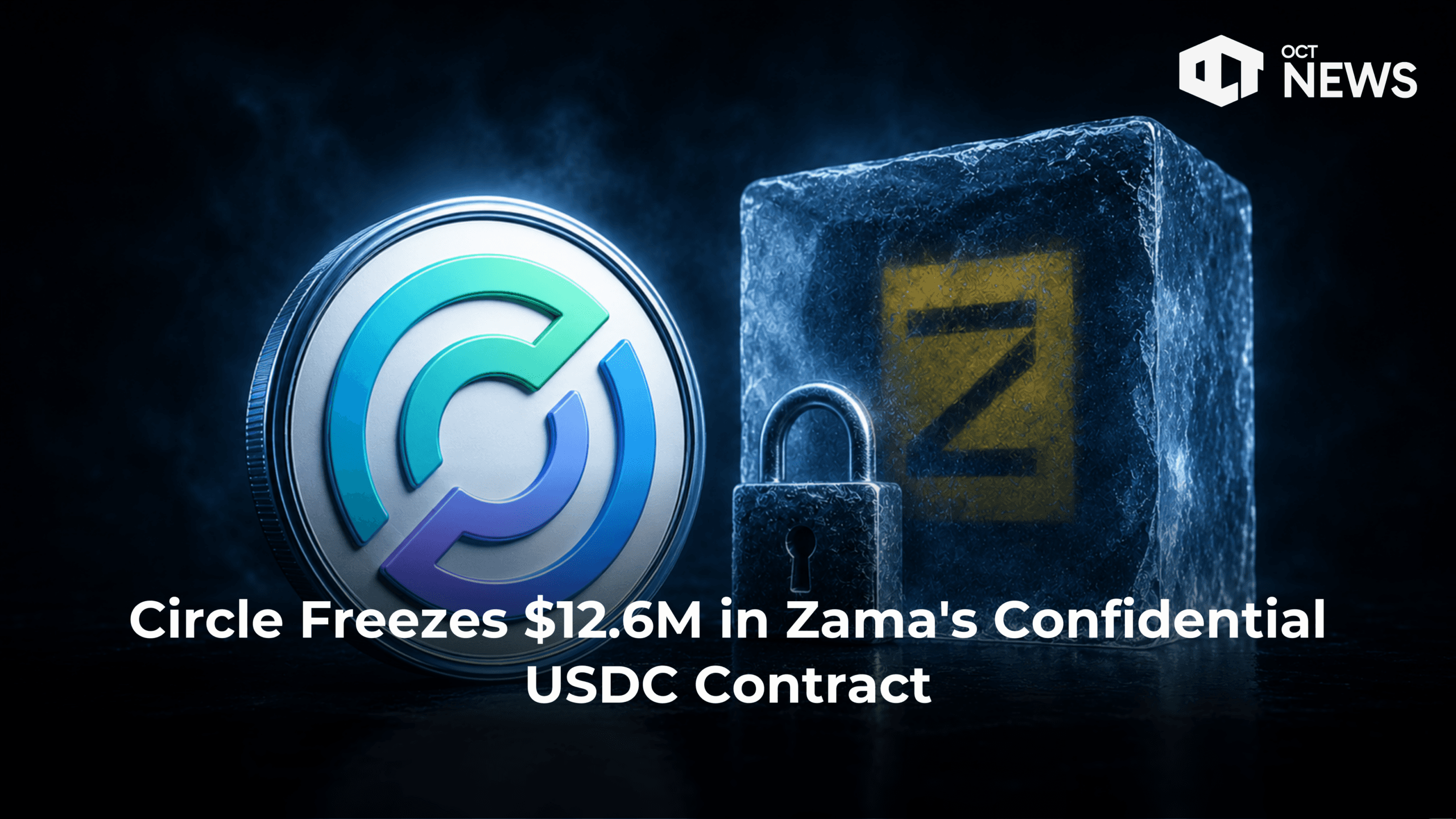
Circle blacklisted Zama's cUSDC contract, freezing $12.6M in USDC after a $12.4M deposit linked to Overnight Finance and locking user funds.

Author: Akshat Thakur
May 30, 2026 – Circle blacklisted the confidential USDC (cUSDC) smart contract run by privacy protocol Zama on Ethereum. The action froze roughly $12.6 million in USDC inside the contract. On-chain investigator ZachXBT flagged the freeze shortly before multiple outlets confirmed it.
High Signal Summary For A Quick Glance

Ashish Singh
@ashishknows

@waleswoosh The future of finance not look good here @eth_apple https://t.co/KpYh38cqB9

Update from ZachXBT. What does this mean for privacy protocols? https://t.co/1nAfXGnCoM
08:22 AM·May 30, 2026

levithefirst
@levithefirst
@waleswoosh "decentralization"
Update from ZachXBT. What does this mean for privacy protocols? https://t.co/1nAfXGnCoM
08:21 AM·May 30, 2026

wale.moca 🐳
@waleswoosh
Update from ZachXBT. What does this mean for privacy protocols? https://t.co/1nAfXGnCoM

08:20 AM·May 30, 2026
Steady attention without excessive speculation.
The blacklisted contract address, 0xe978F22157048E5DB8E5d07971376e86671672B2, holds exactly 12,606,386 USDC according to Etherscan. As a result, Circle’s blacklist function now prevents any outgoing USDC transfers from this address.
Zama is a cryptography company that builds Fully Homomorphic Encryption (FHE) tools for blockchain. In simple terms, FHE allows computations on encrypted data without revealing the values. As a result, balances and transfer amounts stay hidden on-chain.
The cUSDC token is an ERC-7984 confidential wrapper. Users deposit standard USDC into the contract and receive cUSDC tokens in return. All balances and transfers then use FHE ciphertexts, so third parties cannot see individual holdings.
Unwrapping cUSDC back to standard USDC requires a two-step process. Specifically, it involves a relayer and a decryption proof. Meanwhile, the wrapper contract pools all deposited USDC under a single address. That design choice is central to what happened next.
According to ZachXBT’s investigation, the freeze traces back to a 12.4 million USDC deposit on May 11, 2026. That deposit came from a wallet linked to Overnight Finance, a DeFi yield protocol.
Overnight Finance recently faced public allegations from holders. Community threads describe claims of rug-pull behavior and governance concerns. The exact nature of these allegations remains disputed, and consequently, Overnight has not published an official response.
Importantly, Circle blacklisted the entire cUSDC contract address rather than an individual wallet. Because the wrapper pools all deposited USDC into one address, the compliance action locked every dollar inside. In other words, it froze both the Overnight-linked funds and everyone else’s deposits.
Zama described the freeze as collateral damage from Circle’s compliance system. In response, the protocol said its legal team is working to isolate the issue. No timeline has been given for restoring user access.
The freeze therefore affects all cUSDC holders, not just the party whose funds triggered it. For instance, any user who deposited legitimate USDC into the wrapper before May 11 now has their funds locked.
Circle has not released a public statement about this action. The company maintains a blacklist function within the USDC smart contract. In the past, it froze 16 business wallets in March 2026 and later reversed some of those freezes.
Timeline of Overnight Finance Allegations and Zama cUSDC Blacklisting
Overnight Finance faces growing community accusations involving alleged rug-pull behavior, treasury misuse, wallet co-mingling, and mismanagement of funds reportedly linked to OVN holders. Discussions intensify around governance activity and treasury allocation decisions.
A Snapshot governance vote involving treasury allocation attracts scrutiny. Separately, the U.S. civil case Newton_ACDC_Fund_LP_et_al_v_Ermilov_et_al brings additional attention to disputes involving Patagon Management and allegations surrounding control of the Overnight Finance ecosystem.
Wallet 0xf7Fcc767de537953b3519d4b3097a24a6dfe1c84, publicly linked to Overnight Finance activity, deposits approximately 12.4 million USDC into Zama’s confidential cUSDC contract infrastructure.
Circle blacklists the Zama cUSDC contract address. Assets associated with the contract become non-transferable, triggering concerns across both the privacy and stablecoin communities.
ZachXBT publicly discloses the blacklist event and links the frozen funds to the previously identified Overnight Finance-related wallet. The information rapidly spreads across crypto social media and news outlets.
Zama issues its first statement, describing the blacklist as collateral damage caused by compliance actions against a related address rather than a direct action against the protocol itself. Legal and compliance teams begin working on remediation options.
The affected cUSDC remains impacted by Circle’s blacklist. Zama states it is pursuing legal and technical pathways to isolate the issue and restore normal functionality, while broader scrutiny of Overnight Finance continues.
The incident sparked a wave of criticism on social media. According to analysis published on Odaily, commentators noted that Circle demonstrated “a very visible centralized kill switch” over supposedly decentralized assets.
The core irony here is structural. FHE encryption hides user balances from everyone on-chain. Yet the underlying USDC still answers to its issuer. In essence, privacy wrappers built on centralized stablecoins inherit the censorship risk of the base asset.
Supporters of the freeze, on the other hand, argue that stablecoin issuers need compliance tools to fight fraud. If the Overnight-linked deposit involves stolen funds, then Circle’s action could be justified.
Critics counter that freezing an entire wrapper contract punishes innocent users. As a result, the debate highlights a deeper architectural flaw in privacy-stablecoin hybrids.
The $ZAMA token dropped about 10% right after news of the freeze spread on social media. The sell-off reflected concern about Zama’s ability to operate its confidential token products.
In contrast, USDC itself maintained its peg throughout the event. The freeze did not trigger broader stablecoin instability. Meanwhile, Overnight Finance’s TVL had already shown prior drawdowns on DefiLlama, consistent with the May allegations.
Several important questions still lack answers. For example, Circle has not confirmed whether the freeze came from a law enforcement request or an internal review. The company also has not published a timeline for a potential unfreeze.
Additionally, the Overnight Finance wallet connection rests on ZachXBT’s tracing work. While ZachXBT has a strong track record, the link has not been verified through legal proceedings.
Zama’s legal efforts to restore access are ongoing. If Circle maintains the blacklist, then Zama may need to deploy a new wrapper contract. Alternatively, it could migrate to a stablecoin without centralized freeze capabilities.
This freeze exposes a design limitation in privacy-stablecoin hybrids. Confidential ERC-20 tokens provide user-level privacy, but when the base asset has a centralized kill switch, the privacy layer offers no protection against issuer-level censorship.
As a result, privacy protocols building on centralized stablecoins may now reconsider their architecture. Decentralized stablecoins like DAI lack the same blacklist risk, though they introduce different trade-offs in stability.
For now, the $12.6 million in Zama’s cUSDC contract remains frozen. Zama’s legal team is pursuing resolution with Circle, and the broader crypto community is watching to see whether this case sets a precedent for how issuers treat privacy wrapper contracts.
Our Crypto Talk is committed to unbiased, transparent, and true reporting to the best of our knowledge. This news article aims to provide accurate information in a timely manner. However, we advise the readers to verify facts independently and consult a professional before making any decisions based on the content since our sources could be wrong too. Check our Terms and conditions for more info.


Zama