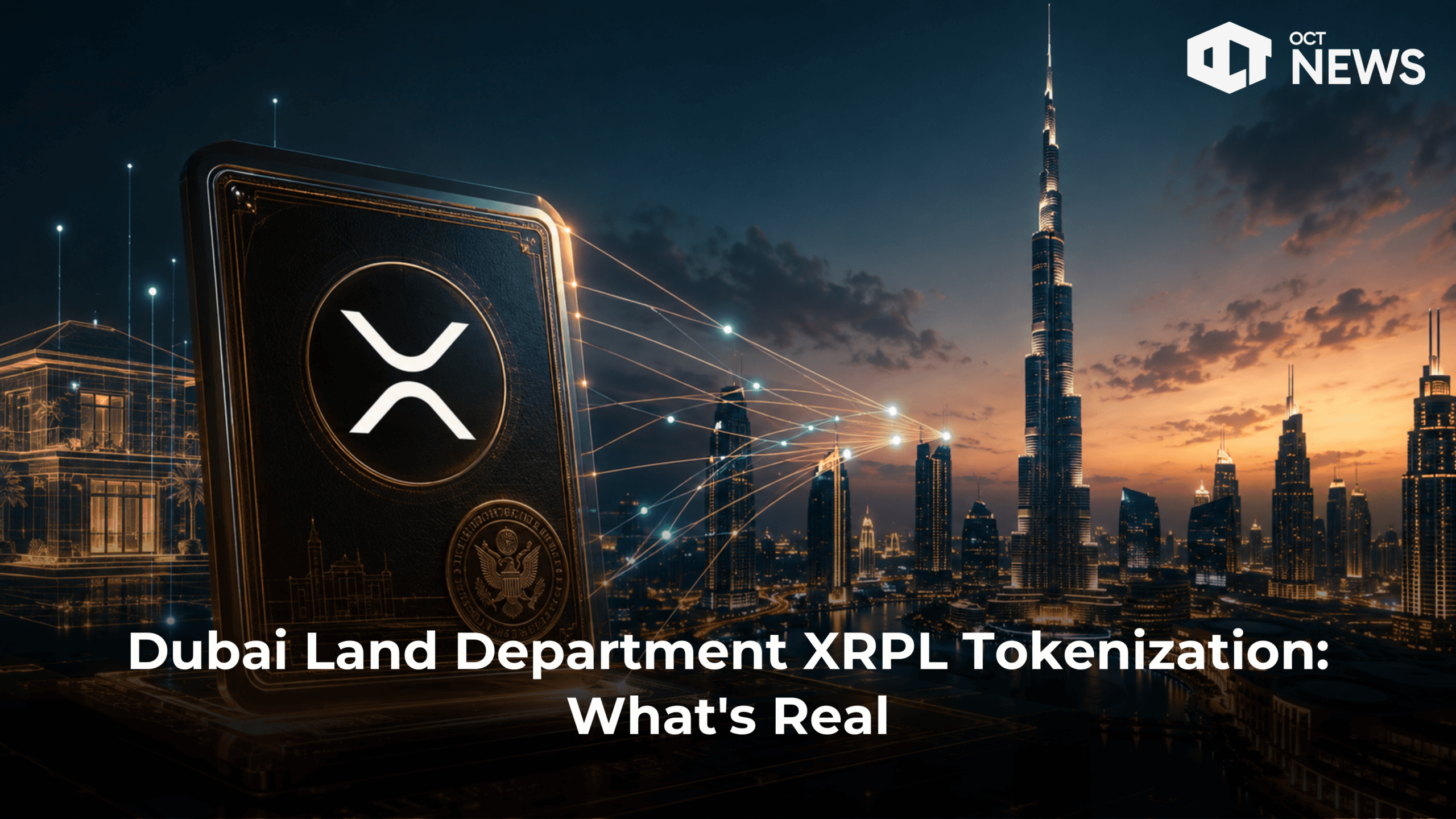
Dubai Land Department’s XRPL tokenization project explained, from the 2025 pilot to the 2033 AED 60B target.

Author: Akshay
17th August 2026 – A viral “JUST IN” post pushed the Dubai Land Department XRPL project back into the spotlight on 17 August 2026. Yet no new announcement actually happened. Instead, the post recirculates an ongoing tokenization pilot that started in 2025.
High Signal Summary For A Quick Glance

ceviz ağacı
@bobidibibidibo1

@RippleXity xrp bir ripple dolandırıcılığıdır. delist edilmesi gerekir
🚨 JUST IN: A government just made the $XRP Ledger part of its legal infrastructure. Dubai's Land Department, the office that issues every title deed in the city, mints tokenized deeds directly on the #XRPL. First government property registry in the Middle East to use a public https://t.co/UlfLMmmmwe https://t.co/4N45gm6MEc
09:25 AM·Aug 17, 2026

WAODAO
@waodao_ai
@RippleXity The milestone is not merely putting the deed onchain, but closing the full loop: enforceable title, compliant transfer, redemption and continuous secondary liquidity. A registry becomes a market only when those four stay connected. https://t.co/62sLHCKbTz

🚨 JUST IN: A government just made the $XRP Ledger part of its legal infrastructure. Dubai's Land Department, the office that issues every title deed in the city, mints tokenized deeds directly on the #XRPL. First government property registry in the Middle East to use a public https://t.co/UlfLMmmmwe https://t.co/4N45gm6MEc
09:14 AM·Aug 17, 2026

TienOnchain
@OnchainTien
@RippleXity This is a genuine infrastructure milestone. Dubai’s official land registry minting title deeds directly on the XRP Ledger means the tokens are tied to government-issued legal records, not just wrappers. A public blockchain now sits inside real property law — hard to overstate
🚨 JUST IN: A government just made the $XRP Ledger part of its legal infrastructure. Dubai's Land Department, the office that issues every title deed in the city, mints tokenized deeds directly on the #XRPL. First government property registry in the Middle East to use a public https://t.co/UlfLMmmmwe https://t.co/4N45gm6MEc
09:10 AM·Aug 17, 2026
High attention and emotional sentiment detected.
The framing suggests Dubai just wired its entire property registry onto the XRP Ledger. In reality, this is a controlled pilot that has run for more than a year. So the facts matter more than the urgency.
The post claims Dubai “made the XRP Ledger part of its legal infrastructure.” It also says the city now “mints tokenized deeds directly.” That overstates both the novelty and the scope. Rather than a city-wide switch, the initiative remains a limited pilot covering a small set of properties.
Notably, the Dubai Land Department’s own pages describe the effort as the region’s first tokenized real estate project. However, they do not name the XRP Ledger or any blockchain at all. The XRPL attribution comes from Ripple and Ctrl Alt, not from DLD directly.
Even some XRP-aligned voices flagged the exaggeration. Several replies called it “a bit of a stretch” to frame the pilot as an official settlement layer. So the “JUST IN” urgency does not match reality.
DLD launched the pilot phase on 25 May 2025 through the PRYPCO Mint platform. The program lets investors buy fractional shares of ready-to-own properties. Tickets start at AED 2,000, or roughly $545.
At launch, the pilot stayed limited to UAE Emirates ID holders. Transactions settled in AED only, and no cryptocurrencies changed hands. So despite the XRPL rails, buyers used regular dirhams.
Ctrl Alt serves as the designated tokenization provider. According to Ripple and Ctrl Alt, the firm mints title-deed tokens on the public XRP Ledger. Those records then sync with DLD’s official registry. Meanwhile, Ripple supplies institutional custody, a partnership the two firms announced on 16 July 2025.
Reece Merrick, Ripple’s Managing Director for the Middle East and Africa, framed the choice clearly. “That the DLD has chosen the XRPL for this is really exciting,” he said. He added that the move “reinforces the XRPL’s credentials as the blockchain of choice for serious financial use cases.”
This is not a solo Ripple effort. DLD leads as the government authority, while Ctrl Alt runs the tokenization engine and PRYPCO Mint handles distribution.
Regulation sits at the center too. The Virtual Assets Regulatory Authority oversees compliance, and Zand Digital Bank acts as the banking partner. The Dubai Future Foundation supports the work through its Real Estate Sandbox. So a full stack of government and private players backs the pilot.
Timeline: Lido’s NEST mechanism evolved from an initial tokenomics proposal into an audited, governance-approved and now live automated LDO buyback system, with the first on-chain buyback batch still pending.
Lido publishes “NEST – Network Economic Support Tokenomics”, establishing the modular foundation for using stETH and related treasury resources to support stETH-to-LDO swaps routed through the DAO treasury. The design extends the existing STONKS framework and sets the groundwork for automated economic support.
The initial NEST governance proposal passes with approximately 58.1 million LDO voting to approve versus just 272 LDO against. This establishes community support for continuing development of the NEST framework.
The development team declares NEST v1, an MVP supporting manual any-to-any swaps, ready for use. The code has been audited by Ackee with no critical findings, while work on a more automated buyback architecture continues separately.
Lido develops the full automated design through the “Liquid Buybacks: NEST execution with LDO/wstETH liquidity” workstream. LIP-36 is created on April 20 and merged on May 8, formalizing the technical and governance framework for automated LDO buybacks and liquidity provisioning.
The Snapshot vote on “NEST: Automated LDO Buyback and Liquidity Provisioning” passes with roughly 94.5% support. Approximately 52.4 million to 55.4 million LDO vote in favor, approving the automated design and its proposed operating parameters.
ack3 completes a security review of the NEST implementation. The audit identifies 16 findings, with no critical issues. The final report is published publicly on August 4, while subsequent verification confirms that the deployed mainnet runtime bytecode matches the reviewed implementation.
Lido’s on-chain Aragon governance vote authorizes the deployment and activation of NEST. The proposal passes with near-unanimous support, with reports indicating approximately 52.7 million LDO in favor versus 2 LDO against.
Lido officially announces that NEST is live and operational on mainnet in Treasury mode. The approved configuration includes a $40 million baseline, a 50% surplus share, a $50,000 daily cap, and a $10 million annual cap for automated LDO buybacks.
The next milestone is the first actual on-chain LDO buyback. NEST is now live and permissionless, but execution occurs only when the cumulative surplus balance is positive and the transaction remains within the approved daily and annual limits. As of August 14, no public confirmation of the first buyback transaction has been reported.
Phase One tokenized 10 properties worth more than $5 million into roughly 7.8 million tokens. Then DLD announced Phase Two on 9 February 2026.
Controlled secondary trading of those tokens went live from 20 February 2026. As a result, holders can now resell their shares inside a supervised framework. That framework tests transparency and investor protections. Still, the program stays capped at the original pilot set, not the whole city.
The long-term goal is bigger. DLD wants about 7% of Dubai property transactions tokenized by 2033. In money terms, that means AED 60 billion, near $16 billion. The target aligns with the Dubai Real Estate Sector Strategy 2033 and the wider D33 agenda.
Here the technical reality trims the hype. The tokens represent fractional ownership shares, likely issued on the XRPL as native tokens or NFTs. Yet the authoritative legal title still lives inside DLD’s off-chain systems.
In other words, the on-chain token is a synced, government-tied representation. It enables fractionalization and regulated liquidity. But it does not replace the traditional title process. So legal primacy stays with the registry, not the ledger.
“Public blockchain” also needs context. The XRPL is open at its base layer, so anyone can view or validate activity in principle. In practice, though, issuance and trading run through KYC checks and compliance layers. These include Asset-Referenced Virtual Assets for regulatory fit.
One caveat stands out for verification. No public XRPL explorer links to specific issuer addresses or deed tokens have surfaced in primary sources. So the tokens appear to move through permissioned flows rather than open public minting.
Markets treated the recirculated posts as old news. XRP traded near $0.99 to $1.01 across 16 and 17 August 2026, with daily moves under 1%.
No clear price or volume spike tracked the viral thread. That reaction fits the core point, because the “news” was not new. So traders who chased the headline found little fresh to price in.
For now, the project stays in measured, pilot mode. Watch for the count of tokenized properties to grow. Watch too for DLD to clarify whether tokens ever become the sole legal record.
The bigger question is scale. Reaching the AED 60 billion target by 2033 would demand a big jump. The pilot would need to move from a handful of properties to a real slice of the market. Until then, treat every “JUST IN” post about the Dubai Land Department XRPL rollout with a careful eye.
This article is for information only and is not financial advice. Always do your own research before making any investment decision.
Our Crypto Talk is committed to unbiased, transparent, and true reporting to the best of our knowledge. This news article aims to provide accurate information in a timely manner. However, we advise the readers to verify facts independently and consult a professional before making any decisions based on the content since our sources could be wrong too. Check our Terms and conditions for more info.



XRP