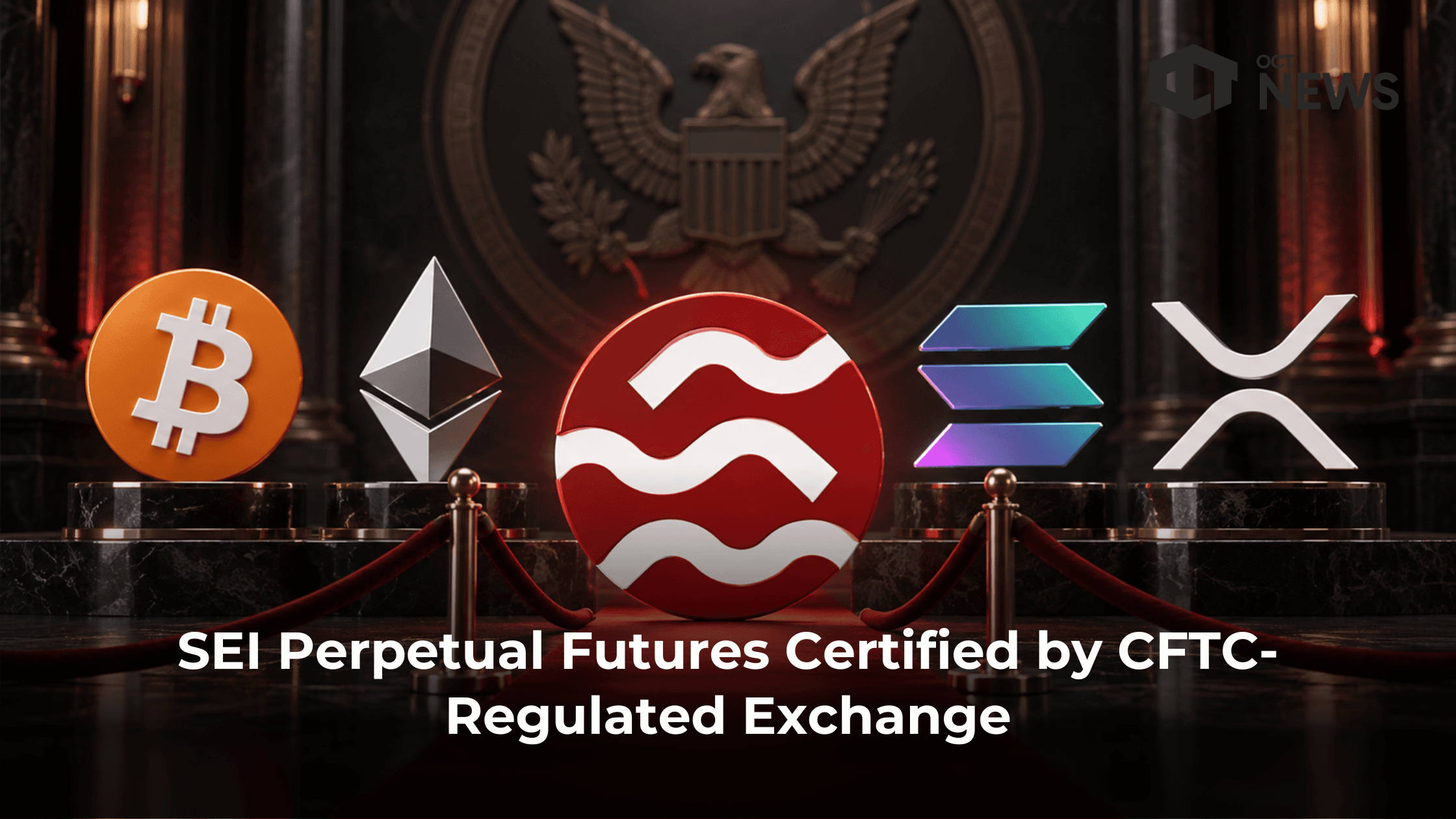
SEI perpetual futures gain exchange self-certification, offering USD cash settlement and 24/7 trading on a CFTC-regulated venue.

Author: Kritika Gupta
16th October 2026 – A CFTC-regulated exchange has certified SEI perpetual futures, giving the token a regulated U.S. derivatives venue for the first time.
High Signal Summary For A Quick Glance

Giannis Andreou
@gandreou007

🏛️ $SEI PERPETUAL FUTURES ADD A REGULATED ACCESS ROUTE Sei says $SEI perpetual futures have been certified by a CFTC-regulated exchange. The contracts are cash-settled in USD, trade around the clock and have no expiration. Exchange certification is distinct from CFTC https://t.co/dKhJPDtiaW

01:56 PM·Oct 16, 2026

TMA | The Money Ape
@TheMoneyApe
🚨 SEI NETWORK BIG UPDATE 🚨 $SEI perpetual futures have been certified by a CFTC-regulated exchange, joining $BTC, $ETH, $SOL & $XRP. Meanwhile, 3 SEI ETFs are also going through SEC registration: REX-Osprey, Canary Staked SEI ETF & 21Shares SEI ETF. 🚀 https://t.co/jGc8sdBFWC

01:54 PM·Oct 16, 2026
High attention and emotional sentiment detected.
Sei Network announced the listing on October 16. The exchange, CDNA, self-certified the contract with the Commodity Futures Trading Commission on October 8.
CDNA is the North American Derivatives Exchange, now doing business as Crypto.com | Derivatives North America. The firm was formerly known as Nadex.
It is a registered Designated Contract Market and Derivatives Clearing Organization. In practice, that means CDNA can both list the product and clear the trades under CFTC oversight.
The CFTC Industry Filings page lists the product as “Certified,” dated October 8, 2026. According to that record, the full name is the Sei (SEI) Perpetual Futures Contract. You can read the entry on the CFTC filings page.
Notably, the firm used self-certification under CFTC Part 40 rules. So the product went live after filing, rather than waiting for a formal Commission vote.
The contract is cash-settled in U.S. dollars. It trades 24/7, and it carries no expiration date.
For pricing, the SEI perpetual futures contract uses the CF Benchmarks CF Sei-Dollar Spot Rate, known as SEIUSD_RTI. According to the certification filing, that index drives price, funding rate, and mark price.
A perpetual future tracks the spot price of an asset indefinitely. Instead of expiring, it uses a periodic funding rate that keeps the contract price close to the reference index.
As a result, longs and shorts pay each other over time to hold the position aligned with spot. Meanwhile, positions settle in cash, so no SEI tokens change hands at delivery.
Detailed specs such as tick size, contract size, margin rates, and the funding interval sit inside the CFTC certification filing. However, secondary summaries have not fully extracted those numbers yet.
With this listing, SEI joins a short list of assets with perpetual futures on CFTC-regulated venues. That group already includes Bitcoin, Ethereum, Solana, and XRP.
The trend started in April 2025, when Bitnomial self-certified the first U.S. regulated crypto perps. Then on May 29, 2026, the CFTC approved Kalshi’s BTCPERP, the first formal approval of a crypto perpetual as a futures contract.
Since then, regulated venues expanded coverage to ETH, SOL, and XRP. In short, SEI is the latest token to cross from offshore perp markets into a regulated U.S. framework.
In its announcement, Sei Network framed the move plainly. According to the project, the listing is “another regulated way to access $SEI.”
SEI alongside BTC, ETH, SOL, and XRP in regulated perpetual futures
Exchange self-certification differs from CFTC approval or endorsement. Unspecified entries reflect gaps in the supplied research.
Self-certification is a fast-track process, not a stamp of approval on the token itself. For that reason, some community members stressed the distinction right away.
One post put it directly: exchange certification is distinct from CFTC endorsement of the token. In other words, the CFTC did not bless SEI as an investment.
There is a second nuance worth naming. Cash-settled perps give traders derivative exposure and hedging tools, yet they do not automatically drive spot buying.
Offshore SEI perps already exist on Binance, Bybit, and Hyperliquid. So the real change here is the regulated U.S. venue, not the first existence of SEI derivatives.
The SEI listing fits a broader 2026 shift. Regulators and exchanges have worked to bring perpetual futures onshore, under clear U.S. rules.
In early October 2026, the CFTC’s Division of Market Oversight issued fresh no-action relief. That guidance lets certain DCMs convert perpetual-style index futures into true perpetuals with no expiration, under set conditions.
That relief expires on October 20, 2026, so the window is tight. For context, offshore platforms have offered crypto perps for years, often with higher leverage and fewer customer protections.
By contrast, a CFTC-regulated perp runs on a registered DCM and clears through a registered DCO. Therefore it carries margin rules, surveillance, and customer safeguards that offshore venues often lack.
SEI traded near $0.065 around the announcement window, according to market trackers. The 24-hour move was positive, roughly 10% to 12% across sources.
Meanwhile, 24-hour volume sat near $60 million to $64 million. Market cap landed around $440 million to $500 million, depending on the circulating supply figure used.
SEI is the native token of the Sei Layer-1 blockchain, founded by Jayendra Jog and Jeff Feng. The token powers gas fees, staking, and governance, with a maximum supply of 10 billion SEI.
The timing lines up with the news, so the two may be connected. Still, the move also happened amid broader market conditions, and no clean causal link is available.
Several questions remain open. For one, CDNA has not announced a commercial go-live date for trading.
Beyond that, it is unclear which brokers and FCMs will offer access, or on what timeline. Expected volumes and liquidity also remain unknown for now.
For traders, the near-term takeaway is simple. SEI perpetual futures now trade under U.S. rules, with clearing, surveillance, and standard customer protections attached.
Overall, the listing adds a regulated option rather than replacing offshore venues. This article is not financial advice, and readers should do their own research before trading leveraged products.
Our Crypto Talk is committed to unbiased, transparent, and true reporting to the best of our knowledge. This news article aims to provide accurate information in a timely manner. However, we advise the readers to verify facts independently and consult a professional before making any decisions based on the content since our sources could be wrong too. Check our Terms and conditions for more info.


SEI Perpetual Futures Certified by CFTC-Regulated Exchange
PROPS Token Set to Launch on Robinhood Chain
ASTRA 2.0 Migration: Snapshot Nov 7, Trading Nov 10
Starknet Weighs Leaving Ethereum to Become Post-Quantum L1
SEI Perpetual Futures Certified by CFTC-Regulated Exchange
PROPS Token Set to Launch on Robinhood Chain
ASTRA 2.0 Migration: Snapshot Nov 7, Trading Nov 10
Starknet Weighs Leaving Ethereum to Become Post-Quantum L1

Sei