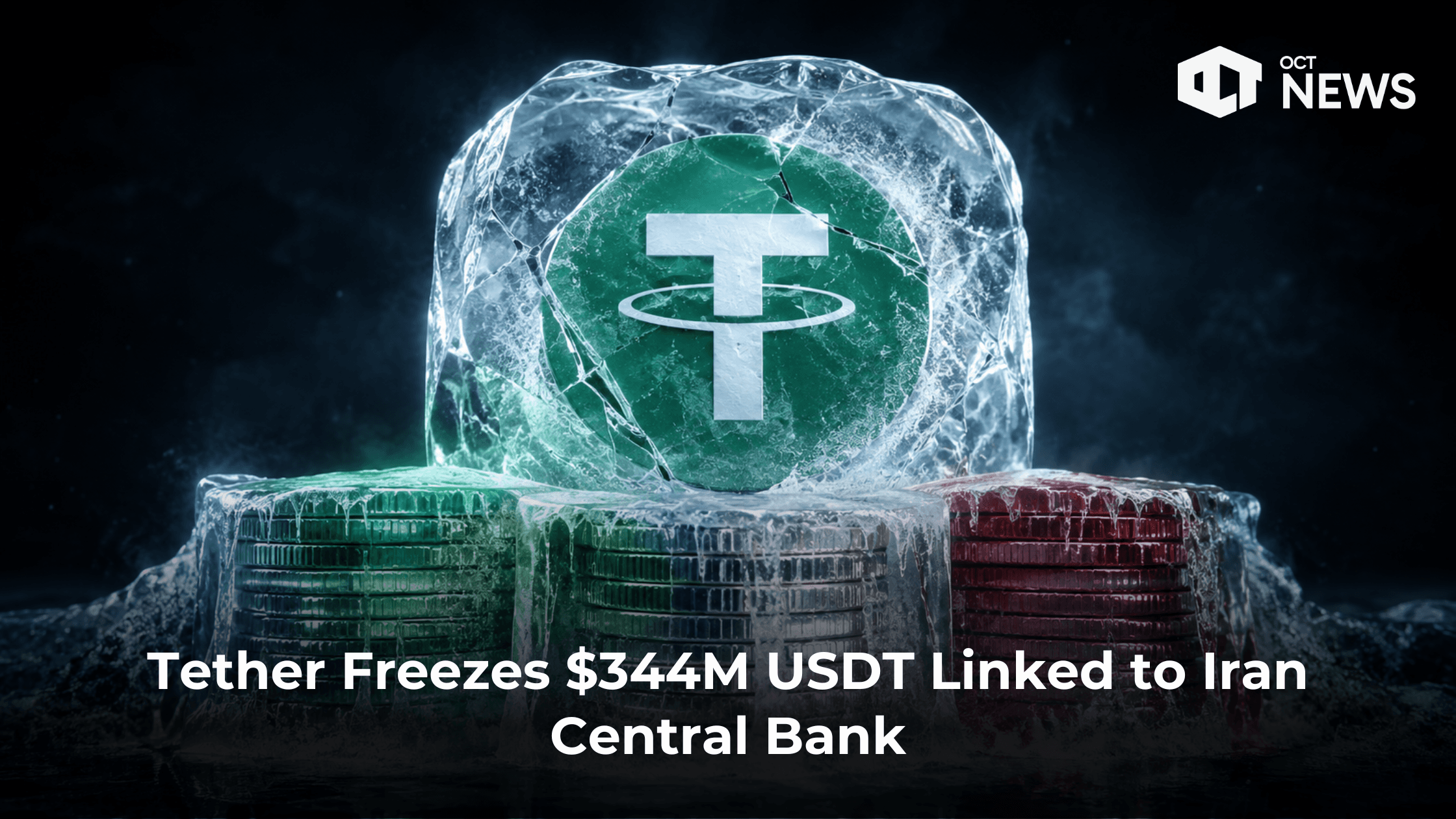
Tether Iran freeze exposes $344M in frozen USDT tied to CBI wallets, OFAC sanctions, and Arkham’s Iran crypto deanonymization.

Author: Kritika Gupta
May 13, 2026 – The Tether Iran freeze has put renewed attention on how centralized stablecoins can enforce sanctions at the wallet level. Tether froze more than $344 million in USDT across two Tron wallets. U.S. authorities flagged them as property of Iran’s Central Bank. The freeze took place on April 23, 2026. Tether acted in coordination with the Office of Foreign Assets Control (OFAC) and U.S. law enforcement.
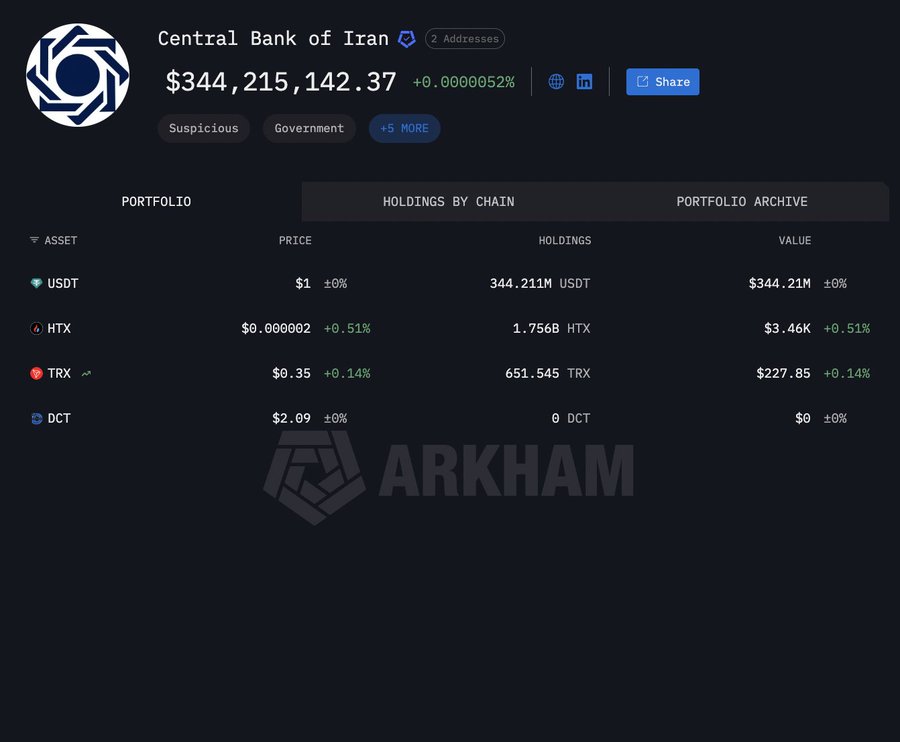
Then on May 13, blockchain intelligence firm Arkham Intelligence published research on the wallets. The firm confirmed it had deanonymized and labeled both as the “Central Bank of Iran” entity.
High Signal Summary For A Quick Glance

Hailey LUNC XRP
@TheMoonHailey

🇮🇷 NEW: Arkham identified wallets linked to Iran’s central bank after Tether froze $344M in USDT tied to sanctions evasion. https://t.co/h4KD7EpuWF
08:14 AM·May 13, 2026
The Tether Iran freeze involved two Tron wallets held a combined $344 million in USDT. According to on-chain data, one wallet contained roughly $213 million. The other held about $131 million.
Tether blacklisted both addresses at the smart-contract level on April 23. As a result, the blacklist function now prevents all transfers to and from those wallets. The funds remain permanently locked unless Tether reverses the action. “USD₮ is not a safe haven for illicit activity,” Tether CEO Paolo Ardoino said on April 23. He added that Tether acts “immediately and decisively” against sanctioned entities.
According to Arkham’s analysis, Iran’s Central Bank used Tron-based USDT to move capital under sanctions. Specifically, the CBI allegedly relied on the stablecoin to stabilize the rial and settle international trade.
In addition, transaction trails link the frozen wallets to Iranian exchanges like Nobitex and the now-sanctioned Garantex. Nearly all funds moved through Tron rather than Ethereum. That preference stems from Tron’s lower fees and faster settlement times.
Meanwhile, blockchain analytics firm Elliptic reported in January 2026 that CBI accumulated at least $507 million in USDT. As a result, the $344 million freeze covers a significant share of that total. Still, additional active wallets may exist beyond what analysts have identified so far.
Key milestones related to this development
U.S. sanctions on Iran start after the hostage crisis and later expand across banking, oil, shipping, defense, and financial networks.
Iran-linked actors increasingly explore crypto rails to bypass restricted access to the cross-border payment channels.
Blockchain intelligence firms track roughly $1 billion routed through IRGC-linked crypto exchange infrastructure, with major exposure to USDT.
Tether becomes more aggressive in freezing wallets tied to crime, and law-enforcement requests.
Tether blocks wallets linked to sanctioned Russian exchange Garantex, freezing more than 2.5 billion rubles in USDT and forcing the platform to suspend services.
OFAC designates Zedcex and Zedxion, marking a major enforcement step against IRGC-linked digital asset exchange infrastructure.
Tether, OFAC, and law enforcement freeze more than $344 million in USDT across two Tron addresses linked by U.S. officials to suspected Iran sanctions evasion.
U.S. officials report sanctions against wallets tied to Iran, with the action freezing $344 million in cryptocurrency.
Arkham uses the freeze as a catalyst to deanonymize and label on-chain wallets it attributes to the Central Bank of Iran.
The case now centers on Iran-linked wallets, Tron-based USDT flows, U.S. sanctions enforcement, Tether’s blacklist function, and Arkham’s public wallet intelligence.
Arkham Intelligence published its findings on May 11. The firm then announced them publicly on X on May 13. Its research team used on-chain clustering and shared counterparty data to attribute the wallets to CBI.
“Arkham Intel has deanonymized the Central Bank of Iran’s crypto wallets,” the firm said on X. The Arkham entity page for CBI now shows the full history of inflows, outflows, and counterparties.
Specifically, Arkham used the OFAC and Tether freeze as a seed label. From there, the team mapped the broader network of intermediary addresses. This approach builds on Arkham’s track record with nation-state crypto activity.
The Tether freeze fits into the Trump administration’s maximum-pressure campaign on Iran. Multiple outlets have reported the effort under the name “Operation Economic Fury.” According to CNN, a U.S. official confirmed “material links to the Iranian regime.”
For context, Iran has escalated its use of crypto for sanctions evasion since 2019. That year, OFAC first designated CBI. In March and April 2026, tensions rose further. Iran demanded Bitcoin tolls for Strait of Hormuz shipping, and heavy outflows from Nobitex followed U.S. airstrikes.
Largest Tether freezes by amount
This action is part of a broader pattern. Tether has frozen more than $3.3 billion in USDT across 7,268 addresses, according to company disclosures. The firm coordinates regularly with law enforcement worldwide.
Ardoino emphasized that Tether combines blockchain transparency with real-time monitoring. He also stressed direct coordination with law enforcement “to stop funds before they can move.” In other words, the company positions itself as a compliance partner.
Notably, no material disruption to the USDT peg or market cap occurred after the freeze. Stablecoin flows on Tron and Ethereum continued normally outside the two frozen addresses.
The freeze also reignited debate about centralized stablecoins. On X, some commentators called Tether “the new OFAC.” They argued a private company should not freeze sovereign funds at will.
At the same time, privacy advocates raised concerns about Arkham’s deanonymization capabilities. If a blockchain analytics firm can unmask a nation-state’s wallets, critics argue, then individual users face even greater exposure.
On the other side, institutional observers see the freeze as a sign of maturing infrastructure. Compliance tools now operate at the same speed as the networks they monitor. For regulators, that represents progress. For cypherpunks, it represents a departure from crypto’s founding principles.
Several questions remain unanswered. It is still unclear whether OFAC directed the freeze preemptively or responded to intelligence after the fact. Similarly, the full scope of CBI’s on-chain activity beyond the labeled wallets remains uncertain.
Iran has not issued an official response as of May 13, 2026. No public statement from Iranian officials or CBI has surfaced about the freeze or the deanonymization. The Tether Iran freeze now stands as one of the largest publicly reported sanctions-linked USDT freezes.
Our Crypto Talk is committed to unbiased, transparent, and true reporting to the best of our knowledge. This news article aims to provide accurate information in a timely manner. However, we advise the readers to verify facts independently and consult a professional before making any decisions based on the content since our sources could be wrong too. Check our Terms and conditions for more info.


Ledger Probes User Fund Losses Tied to Reseller CryptoBilis
Why Provenance Blockchain (HASH) Is Up 39.6% Today?
Halborn Clears XMAQUINA RCM Audit With Zero Critical Bugs
Fidelity Scoops $354M Bitcoin, ETH & SOL in 20 Days
Ledger Probes User Fund Losses Tied to Reseller CryptoBilis
Why Provenance Blockchain (HASH) Is Up 39.6% Today?
Halborn Clears XMAQUINA RCM Audit With Zero Critical Bugs
Fidelity Scoops $354M Bitcoin, ETH & SOL in 20 Days