Keeta (KTA) Review: Is KTA Worth Buying in 2026?
Explore Keeta Network: A scalable Layer-1 bridging TradFi and DeFi with 11M TPS, on-chain KYC and support from ex-Google CEO Eric Schmidt.


Author: Akshat Thakur
Why High-Performance Layer-1 Blockchains for Payments Are Hard to Get Right
Building a blockchain for payments, interoperability, and tokenization sounds simple on paper. In reality, it is one of the hardest sectors in crypto.
Most networks can achieve fast transactions in controlled environments. Far fewer can attract real institutional users, maintain regulatory compliance, and process large volumes of transactions without sacrificing security or decentralization.
Payments introduce challenges that many crypto projects underestimate. Financial institutions require identity verification, anti-money laundering controls, reporting standards, and legal clarity. Bridging traditional banking systems with blockchain networks also creates complexity, cost, and operational risk.
Tokenization faces similar hurdles. Bringing real-world assets on-chain requires trusted issuance, compliance frameworks, custody solutions, and liquidity. Without these elements, tokenized assets often remain experimental rather than widely adopted.
Scalability is another common issue. Many Layer-1 projects advertise impressive throughput figures, yet few have proven those numbers under sustained real-world demand. Validator concentration and network governance can also create centralization concerns.
Token utility remains a challenge across the sector. A payment token only gains lasting value if businesses, institutions, and consumers actively use the network. Without genuine transaction activity, demand often becomes speculative.
This is why comparisons such as “the next XRP” or “Visa on blockchain” rarely tell the full story. Payments infrastructure requires more than speed.
Keeta approaches the market as a specialized layer connecting crypto networks, traditional payment rails, and tokenized assets. Its focus combines compliance, interoperability, and performance within a single ecosystem. Specialization only matters if real partnerships, volume, and institutional adoption actually scale.
What Is Keeta?
Keeta is a high-performance Layer-1 blockchain designed to serve as a unifying layer for global finance. The project aims to connect cryptocurrencies, traditional payment systems, tokenized assets, and financial institutions through a single interoperable network.
The company was founded in 2022 by Ty Schenk, who currently serves as CEO. Schenk brings experience from fintech and software development. Keeta also gained attention after receiving backing from Eric Schmidt, the former CEO of Google.
The Keeta token, KTA, launched around March 2025. The network reached a major milestone when its mainnet went live in September 2025. Since then, the team has expanded into consumer and business-focused financial products while pursuing deeper integration with traditional financial infrastructure.
The project’s core thesis is straightforward. Keeta wants to make cross-border payments, asset transfers, and tokenization as simple as using mainstream financial apps while maintaining regulatory compliance and enterprise-grade performance.
For investors researching what is Keeta or looking for a Keeta crypto review, the project stands out because it combines payment infrastructure, interoperability, compliance, and tokenization within a single Layer-1 architecture rather than focusing solely on DeFi or smart contracts.
How Keeta Works
The Keeta Network is designed to simplify movement between crypto assets, traditional financial systems, and tokenized assets.
A typical transaction begins when a user or business accesses Keeta through one of its applications or integrations. They can initiate a payment, transfer funds, perform an atomic swap, or tokenize an asset. The network then routes the transaction through supported blockchain networks and traditional payment rails, including ACH transfers, wire systems, and card networks.
Settlement is designed to occur almost instantly while compliance checks happen within the network itself.
Keeta Personal serves as an all-in-one financial account. Users can manage cryptocurrencies, hold multiple currencies, make payments, and access investment-related features from a single platform.
Keeta Business focuses on global financial operations. Businesses can send and receive payments internationally, manage treasury functions, and integrate payment tools directly into websites through checkout solutions.
Tokenization is another major component. The platform allows assets to be represented on-chain while maintaining compliance requirements. Atomic swap technology enables direct asset exchanges without relying on traditional intermediaries.
Keeta also uses Anchors, which act as connectivity layers between external blockchains, payment systems, and financial infrastructure. Current integrations include support for stablecoins, international payouts, and selected tokenized financial products.
The goal is straightforward. Reduce friction between crypto and traditional finance while keeping compliance, identity verification, and settlement inside a single ecosystem.
Technology & Architecture
Keeta Network operates as a Layer-1 blockchain built around a hybrid architecture that combines Directed Acyclic Graph principles with Delegated Proof-of-Stake components.
Unlike traditional blockchains that process transactions through a shared chain and mempool, Keeta assigns each account its own transaction chain. Virtual links connect these chains together, allowing transactions to process in parallel. This approach is intended to increase throughput while reducing congestion.
The network claims performance of up to 10 million transactions per second and settlement times near 400 milliseconds. While benchmark testing has produced impressive results, long-term performance under sustained production usage remains an important metric to monitor.
A major differentiator is its compliance infrastructure. Native rule engines, built-in identity verification, KYC and KYB tools, and tokenization controls allow financial institutions to enforce regulatory requirements directly on-chain.
Keeta’s interoperability layer connects blockchains, payment networks, and financial institutions through Anchors. Atomic swaps enable trustless asset exchanges across supported ecosystems.
Compared with high-performance Layer-1 networks such as Sei and Monad, Keeta focuses more heavily on payments and institutional infrastructure. Compared with payment-focused networks like XRP and Stellar, it combines compliance, tokenization, and interoperability into a broader financial stack.
Recent milestones include the September 2025 mainnet launch, the May 2026 rollout of Keeta Personal, ongoing multi-currency expansion efforts, and progress toward a regulated bank acquisition.
The technology is ambitious. The opportunity depends on whether Keeta can convert its infrastructure into meaningful transaction volume, institutional partnerships, and sustainable long-term adoption.
Keeta Team & Backers
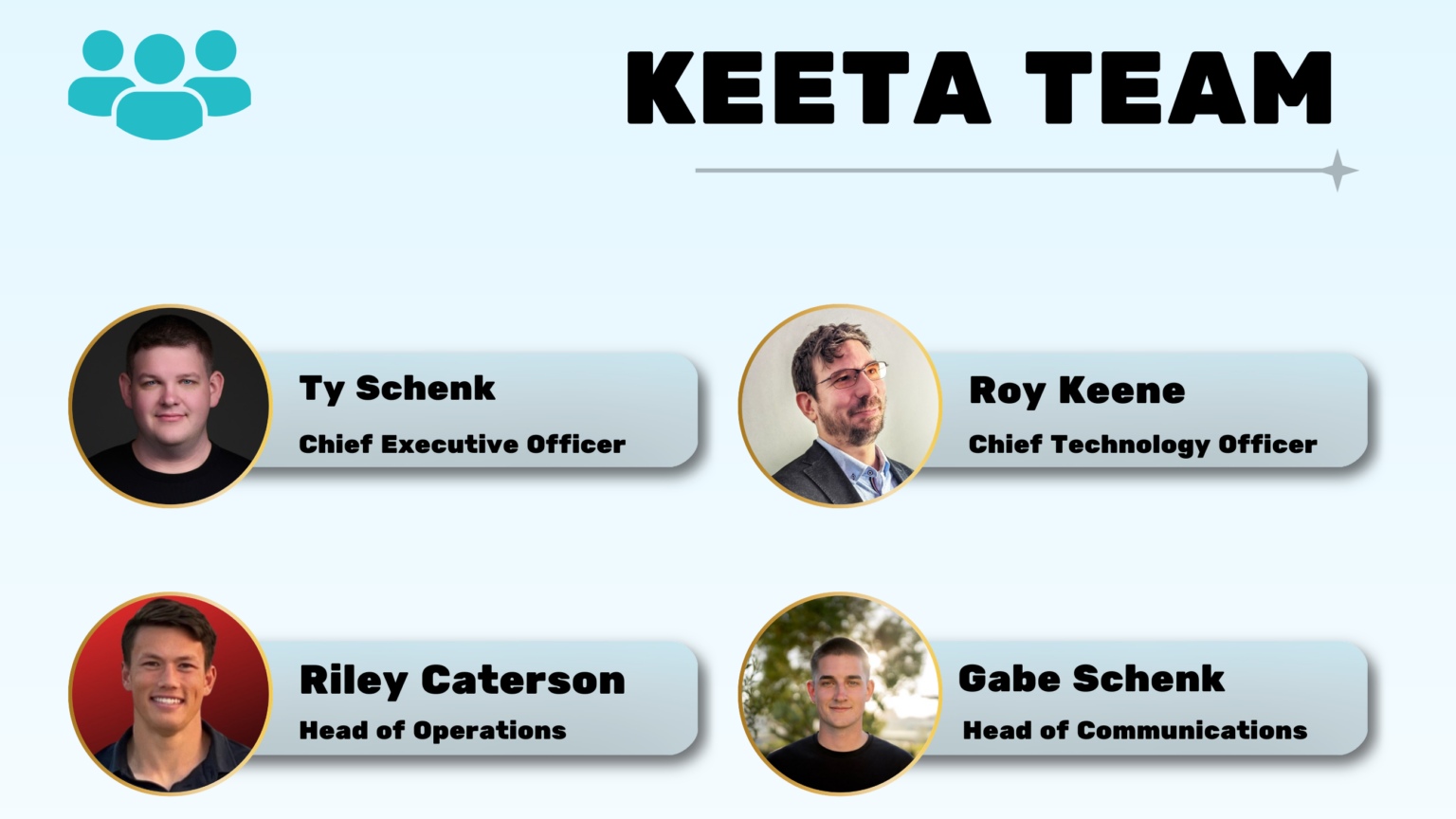
Keeta was founded in 2022 by Ty Schenk, who continues to serve as CEO. Schenk brings a fintech and software engineering background, with experience building payment-oriented systems and financial technology products. His focus has been on creating infrastructure that connects blockchain networks with traditional financial rails.
Roy Keene serves as Chief Technology Officer and contributes experience in blockchain architecture and high-performance network design. The broader team includes legal, product, and design leadership, although public information on many team members remains more limited than some larger Layer-1 competitors.
The most notable supporter is Eric Schmidt, the former Google CEO. Schmidt participated in an early funding round that reportedly valued Keeta at roughly $75 million. His involvement gave the project both capital and credibility during its early growth phase.
Keeta also maintains ties to Google Cloud infrastructure and has pursued deeper integration with traditional finance through its proposed bank acquisition strategy. These efforts align with the project’s goal of becoming a bridge between blockchain networks and regulated financial systems.
Compared with bootstrap projects or purely crypto-native startups, Keeta benefits from stronger institutional credibility. High-profile backing can improve access to partners, regulators, and enterprise clients. However, well-known investors do not guarantee adoption or long-term success.
Ultimately, execution matters more than reputation. Investors should focus on product development, transaction growth, and partnership expansion rather than relying solely on the strength of the names behind the project.
Keeta Tokenomics ($KTA)
Token Overview
KTA is the native utility token of the Keeta Network. It powers transactions, staking, governance, and ecosystem incentives across the platform.
The token has a maximum supply of 1 billion KTA. Approximately 554 million tokens are currently in circulation, representing about 55% of the total supply. Since the March 2025 launch, circulating supply has increased steadily through scheduled vesting and ecosystem distributions.
KTA reached an all-time high of roughly $1.60 during 2025. At current prices near $0.16, the token remains around 90% below its peak. Like many newer Layer-1 assets, price performance has been heavily influenced by broader market sentiment and adoption expectations.
As the native asset of the Keeta Network, KTA sits at the center of the ecosystem’s economic model. Long-term value will depend on whether network usage, payments activity, and tokenization demand grow alongside supply expansion.
Token Allocation
Keeta’s token distribution is designed to balance ecosystem growth, development funding, and long-term incentives.
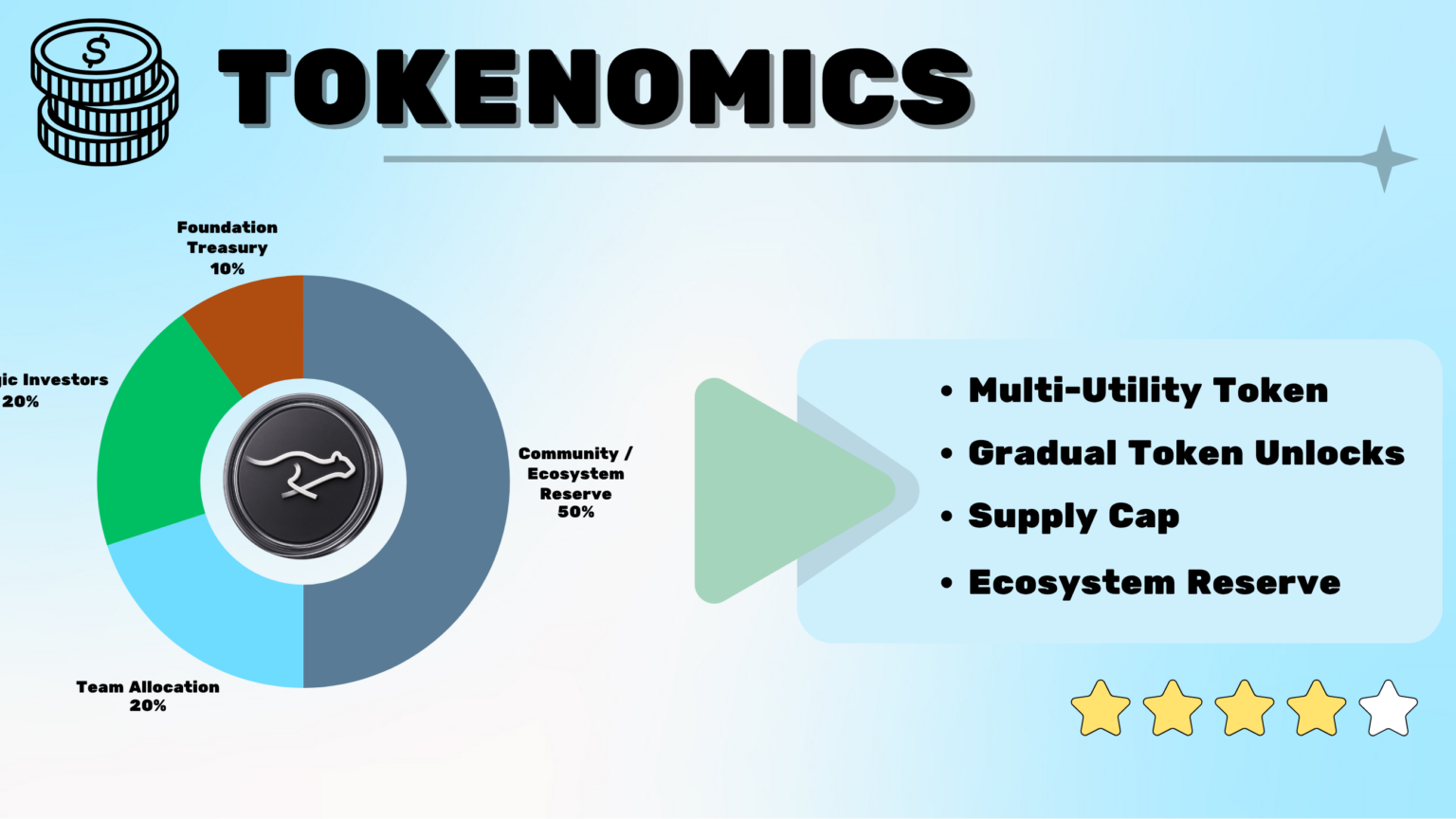
Publicly available information indicates that approximately 50% of the supply is allocated to community incentives and ecosystem development. Team and shareholder allocations account for roughly 20% to 22.5% of the supply. Strategic investors and backers hold around 20%, while the remaining allocation is reserved for foundation operations, treasury management, and future network initiatives.
The structure places a significant share of tokens in ecosystem-focused categories, which can help support adoption and liquidity. However, insiders and early investors still control meaningful portions of supply, making vesting schedules an important metric for token holders to monitor.
As with many early-stage blockchain projects, exact allocation percentages may vary slightly across different public sources and documentation updates.
Vesting & Unlock Pressure
Token unlocks remain one of the most important factors affecting KTA’s supply dynamics.
Most team allocations follow a nine-month lock period before entering monthly linear vesting schedules that extend for approximately three years. Investor allocations generally include a six-month lockup followed by vesting over roughly twenty-four months. Foundation and treasury allocations are distributed more gradually over longer timeframes.
Unlike projects that face large cliff unlocks, Keeta’s supply expansion follows a more gradual release schedule. This reduces the risk of sudden supply shocks but still creates consistent dilution pressure.
Monthly unlocks are expected to continue through approximately 2029. As additional tokens enter circulation, network growth will need to absorb the expanding supply. If adoption accelerates, the market may absorb these releases more easily. If activity remains limited, unlocks could place continued pressure on price performance.
For investors evaluating KTA, monitoring vesting schedules and future unlock events is just as important as tracking ecosystem growth.
Token Utility
KTA serves multiple functions across the Keeta ecosystem.
Users pay transaction fees in KTA when interacting with the network. Validators and delegators stake tokens to help secure the delegated proof-of-stake system and earn staking rewards. Token holders can also participate in governance decisions related to network upgrades and ecosystem development.
Beyond core blockchain functions, KTA supports incentives tied to payments, tokenization, liquidity programs, and ecosystem participation. As more applications and financial services launch on Keeta, these use cases could expand further.
The strength of the token model ultimately depends on real network activity. Transaction fees, staking demand, and ecosystem participation can create organic demand for KTA. However, utility alone does not guarantee value accrual.
Available documentation places limited emphasis on aggressive deflationary mechanisms such as large-scale token burns. As a result, long-term demand growth will likely depend more on adoption than on supply reduction. Investors should view staking rewards and token incentives as supportive features rather than primary drivers of value.
Is Keeta Safe?
A common question among investors is, “Is Keeta safe?”
Since its mainnet launch in September 2025, the network has not experienced any publicly reported major exploits or security incidents. While this is encouraging, Keeta remains a relatively young blockchain compared with more established Layer-1 networks.
The platform incorporates several security-focused features. Built-in identity verification, KYC and KYB tooling, and compliance frameworks are designed to support regulated financial activity. These features may reduce operational risks for institutions compared with fully anonymous ecosystems.
Keeta uses a delegated proof-of-stake model for network security. Validators and token delegators help secure the network and participate in governance. However, detailed public metrics regarding validator concentration and total staked supply remain limited.
Independent audits remain one of the most important indicators of blockchain security. Investors should review the latest audit reports directly from official project sources before committing capital. Public information regarding a large-scale bug bounty program also remains limited at the time of writing.
Transparency has improved since launch, but some areas still need greater visibility. Detailed validator statistics, audit disclosures, and network security metrics would strengthen confidence among investors and institutions.
No blockchain is completely risk-free. Smart contract vulnerabilities, operational failures, governance issues, and regulatory developments can affect any project. Keeta’s compliance-first approach provides some advantages, but long-term safety will depend on continued audits, growing decentralization, and a proven operational track record.
Keeta vs Competitors
Keeta enters a competitive market that already includes established payment networks and newer high-performance Layer-1 blockchains. Its key differentiator is the combination of compliance, tokenization, interoperability, and direct integration with traditional financial rails.
Keeta (KTA)
DAG + Hybrid dPoS
~400ms finality
Keeta Personal launched May 2026.
Business and Checkout products active.
Bank acquisition pending.
Validator staking
Governance
Ecosystem incentives
XRP
Seconds-level finality
Ripple payment products widely integrated across financial institutions.
Bridge asset for liquidity
Stellar (XLM)
Fast finality
Basic transaction utility
Sei (SEI)
Giga Upgrade in Progress
Giga Target: 200K+ TPS
Sub-400ms finality target
Major 2026 upgrades focused on scalability and trading infrastructure.
Staking
Governance
Monad
~0.8s finality
Full EVM-compatible tooling and developer stack available.
Staking
Standard L1 governance
Compared with XRP and Stellar, Keeta focuses more heavily on compliance tooling, tokenization infrastructure, and direct integration with traditional financial systems. Compared with Sei and Monad, it targets regulated payments and financial services rather than primarily DeFi and trading applications.
The opportunity is clear. Keeta attempts to combine the strengths of payment networks and high-performance Layer-1s into a single platform. The challenge is proving adoption in a market where several competitors already possess larger ecosystems, stronger liquidity, and established user bases.
Strengths & Risks (Bull vs Bear Case)
The bull case starts with Keeta’s positioning. Few blockchain projects combine payments, compliance, tokenization, and interoperability within a single architecture. Eric Schmidt’s backing adds credibility and may help open doors with institutions and strategic partners. The network’s claimed throughput and fast settlement speeds are also attractive for payment use cases.
Keeta has moved beyond theory. The launch of Keeta Personal, Business products, and merchant checkout solutions demonstrates progress toward a usable ecosystem. Built-in KYC, KYB, and identity tools address challenges that often prevent institutions from adopting blockchain infrastructure. The planned bank acquisition could further strengthen direct access to traditional financial rails.
The bear case is equally important. XRP, Stellar, Visa, PayPal, and traditional banking networks already operate at meaningful scale. Keeta must convince users and institutions to switch from existing solutions.
Performance claims also remain largely unproven under sustained real-world transaction loads. Regulatory approvals, particularly around banking initiatives, introduce additional execution risk. Ongoing token unlocks create dilution pressure, while adoption challenges remain significant for any newer Layer-1 network.
Investors should also monitor decentralization metrics as the validator ecosystem develops. A strong vision alone is not enough. Success will depend on transaction growth, institutional partnerships, and measurable network usage.
Should You Buy KTA? (OCT Verdict)
For builders and developers, KTA may be worth considering. The network offers compliance tools, tokenization features, and payment-focused infrastructure that could appeal to projects targeting real-world financial applications.
For short-term traders, KTA is primarily a watch. The token remains highly sensitive to product launches, exchange listings, adoption announcements, regulatory developments, and unlock schedules. Volatility should be expected.
For long-term investors, the answer is more nuanced. Those comfortable with higher risk may consider a small speculative position if they believe Keeta can execute its crypto-TradFi strategy. More conservative investors may prefer to watch adoption metrics, transaction volume, and institutional traction before committing capital.
If you are asking, “is Keeta worth buying?”, the answer depends less on the technology and more on future execution. The infrastructure is promising, but adoption remains the key variable.
Always conduct your own research. No cryptocurrency investment is without risk, particularly in early-stage Layer-1 ecosystems.
Final Verdict: Is Keeta a Buy in 2026?
Keeta combines a strong crypto-TradFi vision, notable backing, and ambitious technology focused on payments, compliance, and tokenization.
However, real-world adoption, transaction volume, and institutional execution remain largely unproven. It is a project worth watching closely, but long-term success will depend on measurable usage rather than technical promises alone.
Frequently Asked Questions
What is Keeta?
How does Keeta work?
What is the current status of Keeta’s mainnet and bank integration?
What is KTA used for?
Is Keeta safe?
How is Keeta different from XRP?
Is KTA a good investment?
In this article
Why High-Performance Layer-1 Blockchains for Payments Are Hard to Get RightWhat Is Keeta?How Keeta WorksTechnology & ArchitectureKeeta Tokenomics ($KTA)Is Keeta Safe?Strengths & Risks (Bull vs Bear Case)Should You Buy KTA? (OCT Verdict)Final Verdict: Is Keeta a Buy in 2026?