Sei Review 2026: 95% Below ATH, But Is SEI Undervalued?
Full Sei review for 2026. We analyze SEI's parallelized EVM, Giga upgrade timeline, token unlock pressure, & whether $SEI is worth buying.


Author: Akshat Thakur
Why High-Performance L1s Are Hard to Get Right
High-performance Layer 1 blockchains attract attention quickly. Sustaining usage is the harder part. The sector is filled with networks that advertise massive TPS numbers but struggle once incentives slow down and real users arrive. Most chains fail in three areas: retaining developers, maintaining liquidity, and building an economy that survives beyond launch hype. This Sei review examines whether Sei can avoid the same pattern through its trading-focused infrastructure approach.
The same pattern appears repeatedly. A new chain launches with aggressive marketing and “next Solana” narratives. Early activity spikes because of airdrops, validator rewards, or VC-backed liquidity campaigns. Then usage declines sharply. Daily active addresses fall. TVL stagnates. Validators become concentrated among a small group of operators, while token unlock schedules create persistent sell pressure on the market.
The “Solana killer” framing also oversimplifies the market. Raw throughput alone does not create durable ecosystems. Solana succeeded because trading, NFTs, memecoins, and consumer applications generated actual demand for blockspace. Many newer chains copied the speed claims without building infrastructure optimized for a specific user behavior.
Sei takes a narrower approach. Instead of competing as a general-purpose chain for every category, it focuses heavily on trading infrastructure. The network architecture prioritizes fast execution, low latency, and on-chain order books designed for DeFi markets.
That specialization gives Sei a clearer identity than many competing L1s. Still, specialization only matters if the niche itself continues growing. Sei’s long-term success depends on whether on-chain trading activity expands enough to justify a dedicated execution layer.
Users comparing Sei with other high-performance chains may also want to review Sui and other trading-focused ecosystems for context.
What Is Sei?
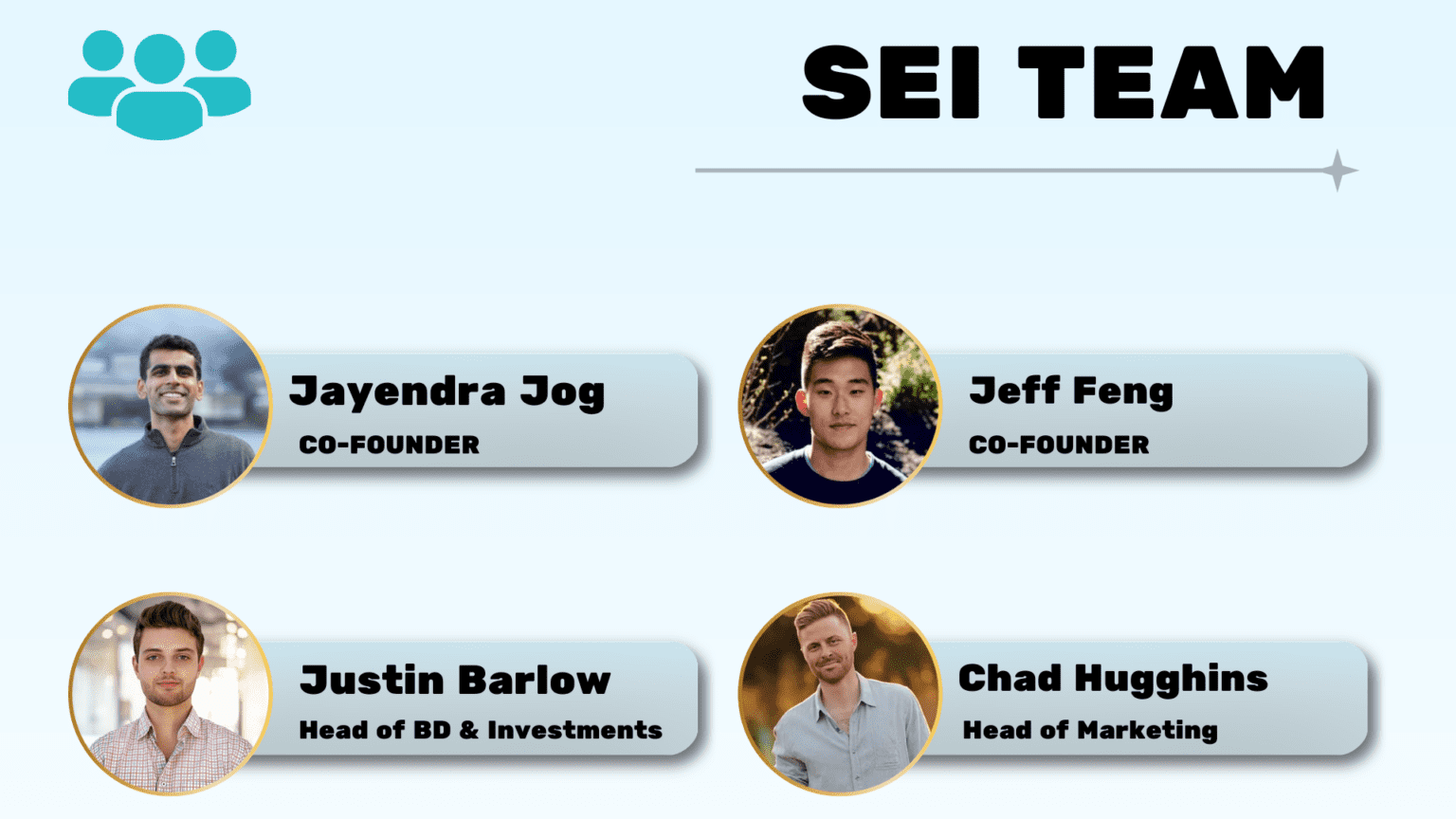
Sei is a Layer 1 blockchain built using the Cosmos SDK and optimized primarily for trading and DeFi applications. The network was created by Sei Labs in 2021, founded by Jayendra Jog and Jeff Feng. The mainnet beta launched in August 2023.
The core thesis behind Sei is straightforward. Exchanging digital assets remains the largest and most consistent blockchain use case. Instead of treating trading infrastructure as an application-layer problem, Sei integrates trading-focused optimizations directly into the base layer.
Sei supports both EVM compatibility and CosmWasm smart contracts. That dual-environment approach allows Ethereum developers to migrate existing Solidity applications while still maintaining compatibility with Cosmos-native tooling and interoperability.
The network positions itself as infrastructure for high-frequency DeFi activity rather than a broad “everything chain.” This includes perpetuals trading, lending markets, order-book DEXs, and capital-efficient liquidity protocols.
As of May 2026, SEI trades around the $0.06–$0.07 range with a market capitalization between $400 million and $480 million depending on market conditions. The circulating supply sits near 6.97 billion SEI out of a maximum supply of 10 billion tokens. The asset typically ranks between #90 and #120 by market capitalization. SEI is listed on major exchanges including Binance, Coinbase, KuCoin, OKX, Bybit, Kraken, Gate.io, PancakeSwap, and Osmosis. Market data sourced from CoinMarketCap and CoinGecko.
How Sei Works?
The developer flow on Sei is relatively simple. A builder deploys an application using either EVM tooling or CosmWasm smart contracts. Users then interact with the application while the network processes transactions with near-instant settlement and parallel execution.
Sei’s architecture is built around low-latency execution. The chain uses Twin-Turbo Consensus, an optimized variation of Tendermint consensus designed to reduce confirmation delays and improve transaction throughput. Sei currently advertises roughly 380ms finality and throughput around 12,500 TPS under optimized conditions.
One of the network’s most distinct features is its native order-matching engine integrated directly into the blockchain layer. Most Layer 1s rely on external infrastructure or off-chain matching systems for advanced trading functionality. Sei instead embeds Central Limit Order Book functionality directly into the protocol stack, allowing applications to process trades more efficiently on-chain.
Sei V2 also introduced a parallelized EVM architecture. Instead of executing every transaction sequentially like traditional Ethereum-compatible chains, Sei processes multiple independent transactions simultaneously. This improves throughput during periods of heavy activity and reduces congestion bottlenecks for trading-heavy applications.
The transaction lifecycle follows a straightforward path. A developer deploys a trading or DeFi application, users submit transactions, Twin-Turbo Consensus processes blocks, and the parallel execution engine handles multiple operations simultaneously before final settlement reaches users in under a second.
Several ecosystem applications already utilize this infrastructure. Saphyre focuses on decentralized trading functionality, while Yei Finance provides borrowing and lending markets. Takara Lend expands into yield and credit products, and Morpho vault integrations bring additional capital efficiency tools into the ecosystem.
The larger question is whether this architecture translates into sustained adoption. High throughput alone does not guarantee demand. Sei’s future likely depends more on whether traders and liquidity providers continue choosing on-chain order books over alternative execution environments.
Developers and researchers tracking Sei metrics can monitor ecosystem activity through DefiLlama, security information through CertiK, and research coverage from Messari.
This article is for informational purposes only and should not be considered financial advice. Crypto assets remain volatile. Staking rewards may appear attractive, but inflationary token emissions could reduce long-term value if network demand fails to grow proportionally. Whether SEI performs well from here depends on adoption, ecosystem growth, token unlock pressure, and broader market conditions.
Technology & Architecture
Sei is built on the Cosmos SDK, which gives the network native interoperability through IBC. That allows assets and liquidity to move across Cosmos-based chains without relying on external bridges. For a trading-focused blockchain, interoperability matters because fragmented liquidity remains one of the biggest inefficiencies in DeFi infrastructure.
The network combines Cosmos architecture with a parallelized EVM that uses Optimistic Concurrency Control (OCC). Traditional EVM chains process transactions sequentially, which creates bottlenecks during periods of heavy activity. Sei instead identifies transactions that do not conflict with each other and executes them simultaneously across multiple cores. This design improves throughput without depending entirely on off-chain scaling layers.
SeiDB acts as the network’s custom database layer. The goal is to reduce state bloat, improve read and write efficiency, and shorten validator sync times under heavy load. The project archived SeiDB into the main repository in October 2025 as part of broader infrastructure consolidation. Faster synchronization becomes increasingly important as chain activity grows because bloated state storage remains one of the major scaling problems for monolithic blockchains.
Giga Upgrade
The Giga Upgrade is the most important technical roadmap item for Sei going into 2026. The upgrade introduces Autobahn consensus, asynchronous execution, and major throughput improvements designed to push the network toward institutional-scale trading infrastructure.
The target metrics are aggressive. Sei aims for more than 200,000 TPS, sub-400ms finality, and roughly 5 Gigagas throughput. Internal devnet benchmarks reportedly achieved performance near those levels during 2025 validation testing.
The architecture changes are significant. Autobahn consensus allows multiple proposers to coordinate execution more efficiently across independent lanes, while asynchronous execution separates transaction processing from immediate state synchronization. In theory, this should improve throughput under sustained trading load while reducing latency spikes during congestion.
The important caveat is that Giga remains in devnet. The whitepaper is published and validation benchmarks have been demonstrated, but the full system has not yet been proven under live mainnet conditions. Sei plans a phased rollout during 2026 rather than a single migration event. That lowers operational risk, but it also means investors and developers still need to see whether the performance claims hold up in production environments.
The broader architecture places Sei somewhere between Solana and Ethereum’s rollup ecosystem. Solana follows a monolithic high-performance design that prioritizes raw execution speed directly on Layer 1. Ethereum increasingly relies on modular rollups and external sequencers for scaling. Sei attempts to preserve monolithic execution performance while maintaining EVM compatibility and parallel processing specifically optimized for trading workloads.
MCP Integration
Sei also integrates MCP, or Model Context Protocol, infrastructure that allows AI agents to interact with the blockchain using natural language instructions. This enables autonomous systems to execute swaps, place limit orders, or trigger smart contract interactions without requiring fully custom middleware for every application.
Among Layer 1 networks, this remains relatively uncommon. Most chains discuss AI integration conceptually, while Sei is attempting to expose blockchain functionality directly to agentic systems through standardized interfaces.
The practical value still depends on adoption. AI agent infrastructure remains early, and many “AI crypto” narratives currently generate more speculation than sustained user demand. Still, if autonomous trading systems become more common across DeFi, Sei’s low-latency architecture could position it well for that category.
Team & Backers
Jayendra Jog previously worked as a software engineer at Robinhood, where he focused on trading infrastructure and backend systems. He was also recognized in Forbes 30 Under 30. Jeff Feng comes from a finance and technology background with experience tied to trading and infrastructure markets. Dan Edleback helped round out the founding team during Sei Labs’ early development phase.
The broader talent pool behind Sei includes employees and contributors with backgrounds from companies such as Robinhood, Google, Coinbase, Databricks, Uber, Goldman Sachs, and NVIDIA.
Institutional backing is one of Sei’s strongest advantages relative to smaller Layer 1 competitors. Early investors include Multicoin Capital, which led Sei’s $5 million seed round, alongside Jump Crypto, Coinbase Ventures, Circle Ventures, OKX Ventures, Delphi Digital, and HRT.
Across funding rounds, Sei raised more than $30 million and reportedly reached an $800 million valuation during its Series A phase according to TechCrunch. The ecosystem is also supported through the Sei Foundation, a US-based non-profit organization overseeing grants and ecosystem growth initiatives. Jamie Finn later joined as a strategic advisor.
The project launched additional ecosystem incentives through a $10 million Creator Fund in 2024 focused on NFT and social applications, while MEXC introduced a separate $20 million ecosystem fund supporting Sei-based development.
Compared with smaller bootstrapped projects, Sei benefits from deeper institutional relationships, larger liquidity access, and stronger operational funding. The tradeoff is that heavy VC participation also increases long-term unlock pressure and circulating supply expansion.
Sei Tokenomics (SEI)
Token Overview
SEI is the native asset of the Sei blockchain rather than an ERC-20 token issued externally on Ethereum. The maximum supply is fixed at 10 billion SEI, while circulating supply currently sits near 6.97 billion tokens. As of May 2026, the token trades around the $0.06 range with a market capitalization near $400 million depending on broader market conditions.
The token previously reached an all-time high near $1.14 during March 2024. Current prices place SEI roughly 95% below peak valuation levels. That decline reflects both wider market conditions and ongoing token dilution from unlock schedules.
Market statistics sourced from CoinMarketCap and CoinGecko.
Token Allocation
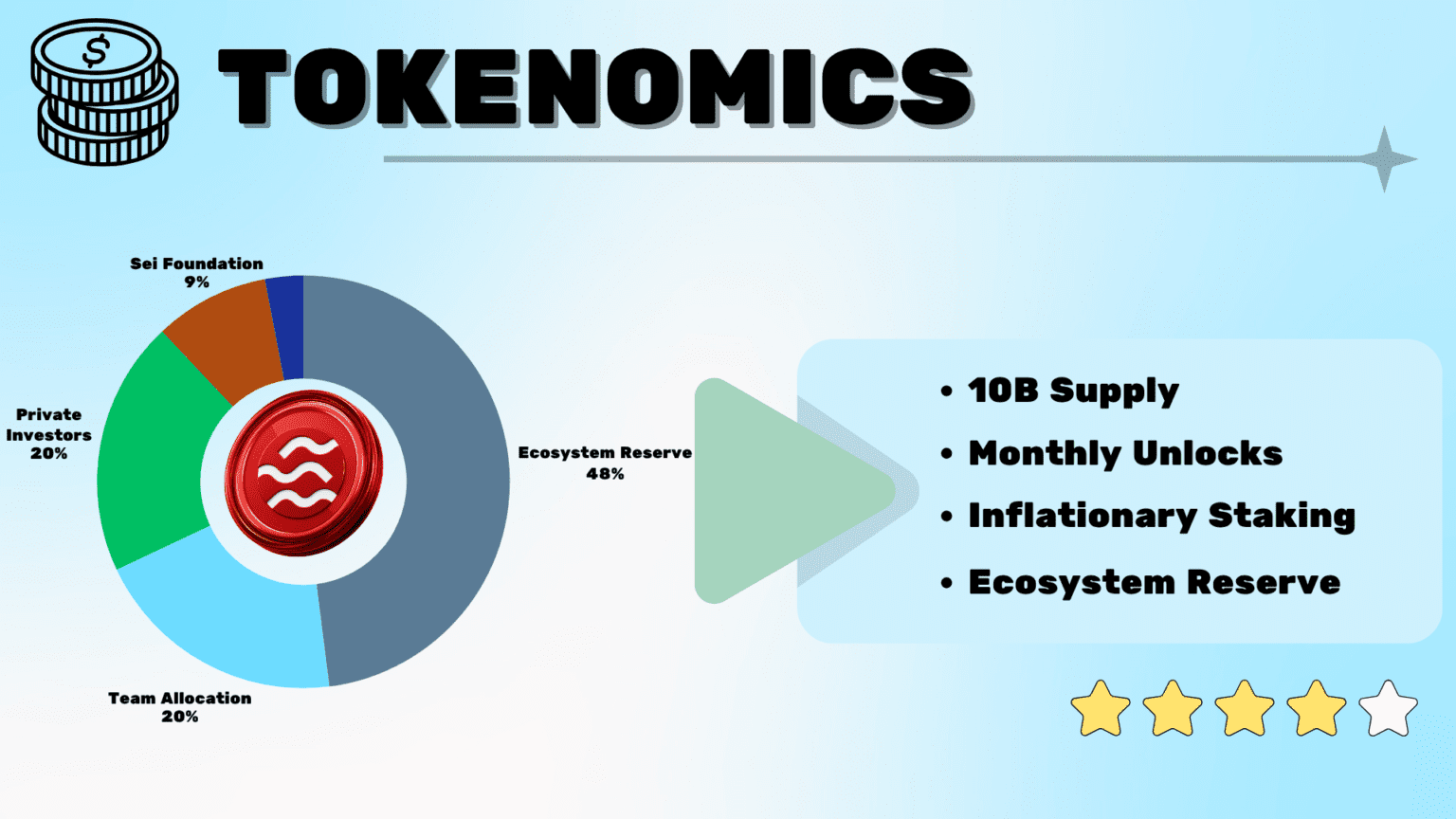
Sei allocated 48% of total supply toward the ecosystem reserve used for grants, liquidity programs, and network incentives. The core team controls 20% of supply, while another 20% went to private investors and funding participants. The Sei Foundation received 9%, and 3% was distributed through the Binance Launchpool campaign.
At the August 2023 token generation event, approximately 18% of the total supply, or 1.8 billion SEI, entered circulation. The remaining allocation follows long-term vesting schedules extending through 2031.
Vesting & Unlock Pressure
Token unlock pressure remains one of the biggest risks surrounding SEI’s long-term valuation.
Monthly unlocks currently average around 55.56 million SEI. Earlier unlock periods during 2024 and 2025 frequently released between 150 million and 200 million tokens per month into circulation. While the schedule gradually stabilizes through 2026 and 2027 with estimated monthly unlocks closer to the 112–132 million range, dilution remains ongoing for several more years.
Full token unlock is expected by August 2031.
This matters because supply expansion creates constant sell-side pressure regardless of market sentiment. Even strong ecosystem growth may struggle to offset dilution if demand does not rise proportionally. Investors often underestimate how much unlock schedules affect price performance over multi-year cycles.
Users researching tokenomics models may also want to review best tokenomics guide and token unlocks in crypto.
Token Utility
SEI functions as the network gas asset, governance token, and staking mechanism for the delegated proof-of-stake validator system. Users spend SEI to execute transactions, interact with smart contracts, and participate in governance proposals across the ecosystem.
The token also secures the network through staking. Validators and delegators receive rewards for participating in consensus and maintaining network security. However, those staking rewards are funded partly through transaction fees and partly through inflationary token emissions originating from genesis allocations and scheduled unlocks.
That distinction is important. Staking yield is not purely organic network revenue. A portion of rewards comes from newly released supply, which means nominal yields may appear attractive while real purchasing power still declines if emissions outpace demand growth.
Whether SEI’s token model becomes sustainable long term depends heavily on ecosystem activity, trading volume growth, and how effectively the network converts technical performance into actual user demand.
Security and ecosystem metrics can also be monitored through DefiLlama, CertiK, and Messari.
Is Sei Safe?
Sei completed multiple security audits through CertiK before its August 2023 mainnet launch. The audits covered Cosmos SDK modules, consensus infrastructure, and CosmWasm integrations. According to the public reports, critical findings identified during the review process were resolved before deployment.
The network also maintains an active monitoring profile on CertiK Skynet, which tracks security metrics, vulnerabilities, and ecosystem monitoring data. In addition, Sei operates an Immunefi bug bounty program with maximum payouts reportedly reaching $500,000 as of April 2026 according to CoinGecko data and ecosystem disclosures.
Validator security remains another important factor. Earlier Messari reports showed roughly 39 active validators securing the network with approximately 5.9 billion SEI staked through delegated proof-of-stake participation. Validator concentration is still smaller than more mature networks like Solana or Ethereum, which creates some centralization concerns around governance and consensus participation.
Since mainnet launch in August 2023, Sei has not experienced any major publicly reported exploits or catastrophic downtime events. That operational history matters because several competing high-performance chains faced outages or validator instability during their early growth periods.
There are still transparency gaps. Team KYC verification status on CertiK remains unconfirmed publicly, which limits independent identity verification for some core contributors.
Security audits and bug bounty programs reduce risk but do not eliminate it entirely. Smart contract exploits, validator failures, phishing attacks, and wallet compromises remain possible across all blockchain ecosystems. Users should still follow standard security practices such as hardware wallet usage, verifying URLs carefully, and avoiding unnecessary smart contract approvals.
Sei vs Competitors
Sei positions itself differently from most competing high-performance chains. The primary focus remains trading infrastructure rather than broad general-purpose applications. That specialization gives Sei a clearer niche, although competitors currently maintain larger ecosystems, deeper liquidity, and stronger developer mindshare.
Sei (SEI)
Giga targets 200K+ TPS / sub-400ms
EVM focus
Solana (SOL)
~400ms (Firedancer)
Sui (SUI)
Sub-second finality
Aptos (APT)
~390ms finality
Monad (MON)
~800ms finality
Sei’s biggest differentiator is the native order-matching engine integrated directly into the chain itself. Most competing networks optimize for broad application diversity, while Sei concentrates heavily on trading efficiency and low-latency execution.
The competitive risk is obvious. Solana already dominates retail trading activity and memecoin liquidity. Sui and Aptos continue pushing parallel execution models with larger treasuries and growing ecosystems. Monad could become a direct competitor if its parallelized EVM architecture launches successfully before Sei fully deploys the Giga upgrade.
Strengths & Risks (Bull vs Bear Case)
The bull case for Sei centers around its trading-focused infrastructure. Unlike most general-purpose Layer 1s, Sei optimizes specifically for DeFi execution, order books, and low-latency transactions. The network previously crossed $400 million in TVL and continues expanding into real-world asset infrastructure through integrations tied to Ondo USDY and KAIO’s tokenized fund access linked with BlackRock products.
Institutional visibility also increased through proposed SEI ETF filings connected to Canary Capital and 21Shares. Meanwhile, Sei’s May 2026 partnership with Xiaomi introduced wallet integrations across selected Xiaomi devices, creating a potential large-scale distribution channel if users actively adopt the wallet ecosystem. The upcoming Giga upgrade could further strengthen the thesis if Sei successfully delivers its targeted 200,000+ TPS and sub-400ms finality on mainnet.
The bear case remains significant. SEI still trades roughly 95% below its March 2024 all-time high, while monthly token unlocks continue creating ongoing dilution pressure. Giga also remains in devnet, meaning execution risk is still high until production deployment proves stable under real network conditions.
Ecosystem concentration adds another concern because a large portion of TVL remains tied to Yei Finance. Competition is also intense across high-performance chains including Solana, Sui, and Monad. Staking rewards also remain partly inflationary, which means token demand must continue growing to offset supply expansion.
Should You Buy SEI? (OCT Verdict)
Builders and developers may consider Sei if they are specifically building trading infrastructure, order-book exchanges, or low-latency DeFi applications. The combination of parallelized EVM execution, CosmWasm compatibility, and native order matching provides advantages that general-purpose chains often lack. The ecosystem is still relatively small, but the infrastructure focus is clear.
Short-term traders should recognize that SEI remains highly volatile and strongly correlated with broader crypto market conditions, especially Bitcoin liquidity cycles. Monthly unlock schedules continue creating recurring sell-side pressure that can amplify downside volatility during weaker market environments.
Long-term investors should probably focus less on marketing narratives and more on execution milestones. The most important indicators include whether the Giga upgrade successfully reaches mainnet, whether ecosystem TVL diversifies beyond a few major applications, whether institutional integrations generate real transaction activity, and whether token demand eventually offsets ongoing unlock dilution.
This article is for informational purposes only and should not be considered financial advice. Users should conduct independent research and evaluate personal risk tolerance before making any allocation decisions.
Final Verdict: Is Sei a Buy in 2026?
Sei delivers real infrastructure in a sector crowded with general-purpose chains chasing the same narratives. The technology stack is differentiated, especially around trading execution and parallelized performance. Future growth depends on successful Giga deployment, sustained ecosystem expansion, and whether real demand can eventually absorb long-term token dilution.
FAQ
What is Sei?
How does Sei work?
What is the Sei Giga upgrade?
What is SEI used for?
Is Sei safe?
How is Sei different from Solana?
Is SEI a good investment?
In this article
Why High-Performance L1s Are Hard to Get RightWhat Is Sei?How Sei Works?Technology & ArchitectureTeam & BackersSei Tokenomics (SEI)Is Sei Safe?Sei vs CompetitorsStrengths & Risks (Bull vs Bear Case)Should You Buy SEI? (OCT Verdict)Final Verdict: Is Sei a Buy in 2026?