HyperGPT (HGPT) Review: Is HGPT Worth Buying in 2026?
Full HyperGPT (HGPT) review for 2026. We break down the Web3 AI marketplace's tokenomics, risks, and whether $HGPT is worth buying.


Author: Akshat Thakur
Why Web3 AI Marketplaces Are Hard to Get Right
AI hype flooded crypto fast, but real utility never kept up. Most projects promised decentralized AI, yet delivered simple front ends connected to off-chain models with a token layered on top. That approach did not improve performance, reduce costs, or solve real user problems. It only made the experience more complex.
The failure pattern is consistent. Developers deal with high API costs and still face blockchain friction. Users struggle with wallets, slow confirmations, and unclear pricing. Token models often reward early holders instead of actual usage, which leads to heavy sell pressure once hype fades. At the same time, AI infrastructure remains expensive, and blockchain does not fix model accuracy or data quality. It adds another layer without solving the core issue.
This is where most AI crypto projects break. They prioritize narrative over execution.
HyperGPT approaches this differently. It launched on BNB Chain with a working marketplace and a unified SDK that connects multiple AI providers. It already hosts thousands of tools, which shows real delivery. However, the bigger challenge remains unchanged. Building a functional product is one step, but turning it into consistent, daily usage is what will define long-term success.
What Is HyperGPT?
HyperGPT is a Web3 AI marketplace built on BNB Chain that allows developers to create, list, and monetize AI tools while users can access them through crypto payments without relying on centralized platforms. The project launched in 2023 and is led by Turan Can Ekmekçi, positioning itself in the Web3 AI infrastructure category by aggregating multiple AI providers into a single SDK.
Developers can integrate models like OpenAI, Gemini, and Claude using one system, build applications, and publish them directly to the marketplace where users can discover and use them instantly. The goal is straightforward: turn AI tools into tradable digital products instead of locked services. This directly answers what is hypergpt and forms the foundation of any hypergpt review.
Price: $0.002403 USD, market cap stands at $2,167,503, circulating supply is 902,125,000 HGPT, max supply is 1,000,000,000 HGPT, current rank is #1589, and it trades across exchanges including MEXC, BingX, BitMart, Gate.io, CoinEx, and PancakeSwap, with data to be refreshed on publish day.
How HyperGPT Works
HyperGPT runs on a simple end-to-end flow that connects developers to users through a marketplace powered by smart contracts. A developer starts with HyperSDK, which is live, and uses a single API key to access multiple AI providers without managing separate integrations. This allows fast development of tools such as chatbots, coding assistants, image generators, or contract builders.
Once the product is ready, the developer lists it on HyperStore or AI Store, both of which are live marketplaces where tools are published and discovered. Users then browse or search for solutions based on their needs and interact with different products across the ecosystem. HyperChat is live and handles conversational AI, HyperCodes is live for coding assistance, HyperContracts is live for smart contract generation, HyperImages is live for text-to-image creation, HyperPosts is live for content generation, and HyperNFT is live for NFT minting, all integrated within the same environment.
After selecting a tool, the user makes a payment using HGPT or supported tokens. A smart contract executes the transaction instantly, grants access, and transfers value directly to the developer with minimal gas fees. Every major component in this flow is already live, not in beta or roadmap stages, which means the full cycle from building to monetization works in practice today.
Technology & Architecture
HyperGPT builds its core system on BNB Chain, which gives it low transaction costs and fast confirmations. That matters because users interact with AI tools frequently, and high fees would break the experience. The platform uses smart contracts to handle payments, access rights, and execution logic. Once a user pays, the contract triggers access instantly without manual intervention. This keeps the flow predictable and removes intermediaries.
The backend relies on a unified SDK that connects multiple AI providers through a single API. Developers do not manage separate keys or integrations. This reduces friction and speeds up deployment. For storage, HyperGPT uses IPFS to host datasets and generated assets. IPFS keeps files distributed and tamper-resistant, while blockchain encryption secures access and ownership.
The system also integrates APIs from major AI providers, which means compute stays off-chain while execution and payments remain on-chain. This design avoids the cost of running heavy AI workloads directly on blockchain. HyperGPT also expands beyond a single chain through integrations like LF Wallet and DeAgentAI, which enable cross-chain interaction without forcing users to bridge manually. The core contracts still remain on BNB Chain, but access extends across networks. The architecture focuses on usability and cost efficiency rather than chasing full decentralization of compute, which remains impractical today.
Team & Backers
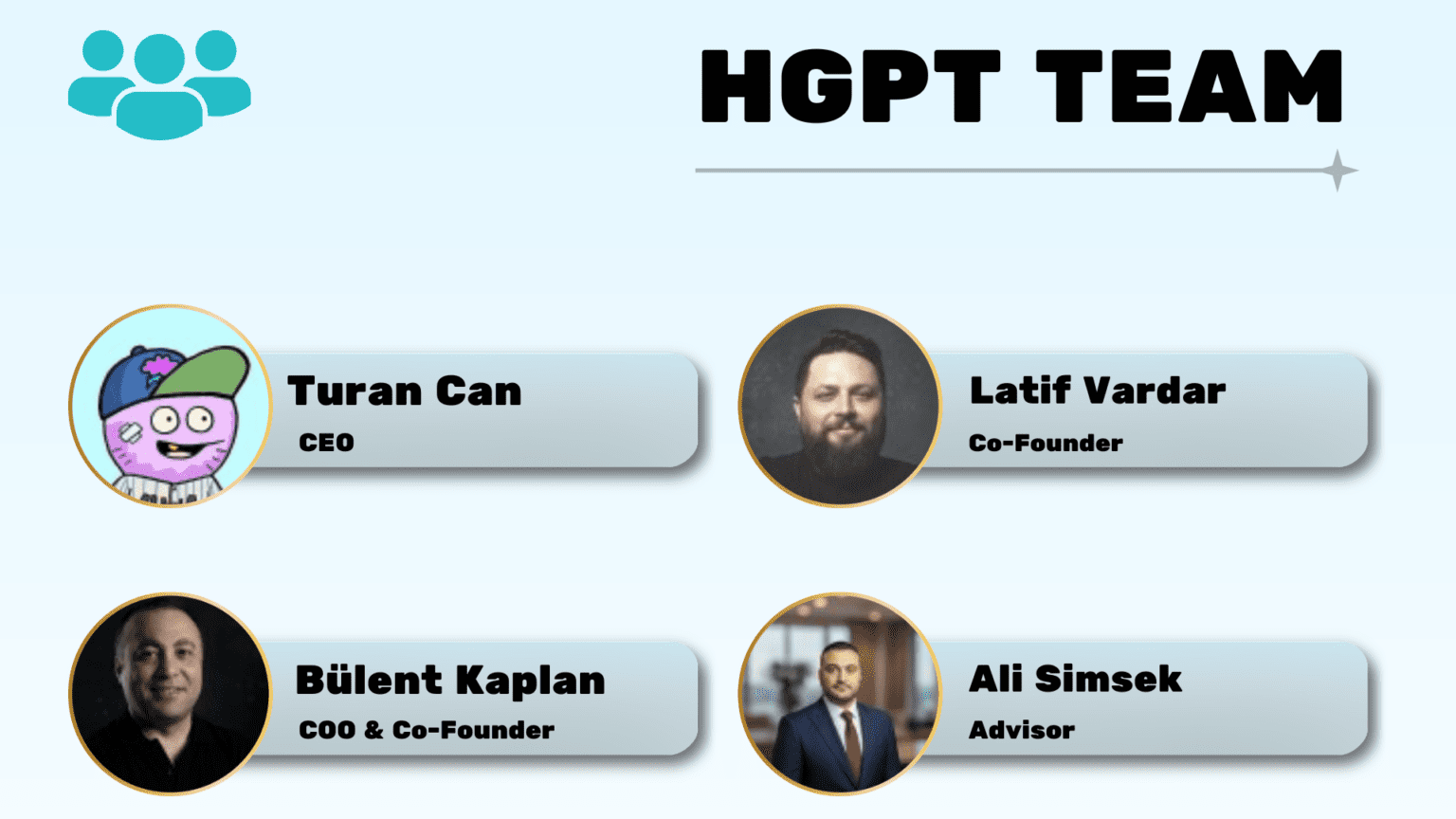
HyperGPT operates with a small but verifiable team. The project is led by Turan Can Ekmekçi, who has over 15 years of experience in marketing and has worked with companies like Sony, ESET, and McAfee. His background appears on LinkedIn and aligns with the project’s focus on product positioning and partnerships. Co-founders Latif Vardar and Bülent Kaplan bring technical experience, with a combined background in software development that supports the platform’s engineering side.
The broader team includes around 15 members, with a strong focus on AI and machine learning roles. Instead of heavy marketing, the project shows progress through product releases and updates. HyperGPT is also part of the IBM Partner Plus program, which gives it access to enterprise tools like IBM watsonx and adds a layer of institutional credibility. This is one of the few verifiable partnerships tied to the project.
There are no confirmed links to major investors like Microsoft or Binance in official documentation. That absence matters. The project relies more on execution than on high-profile backers. This reduces hype but also means slower visibility in a crowded market.
HyperGPT Tokenomics (HGPT)
Token Overview
HyperGPT runs its HGPT token on BNB Chain with the contract address 0x529c79f6918665ebe250f32eeeaa1d410a0798c6. The max supply is fixed at 1,000,000,000 tokens, and circulating supply stands at 902,125,000 as of May 4, 2026. The price trades near $0.002403, which places the market cap at around $2.17 million. The token reached an all-time high near $0.00485 in February 2026 and now sits roughly 50 percent below that level. This drawdown reflects early-stage demand rather than extreme speculation.
Token Allocation
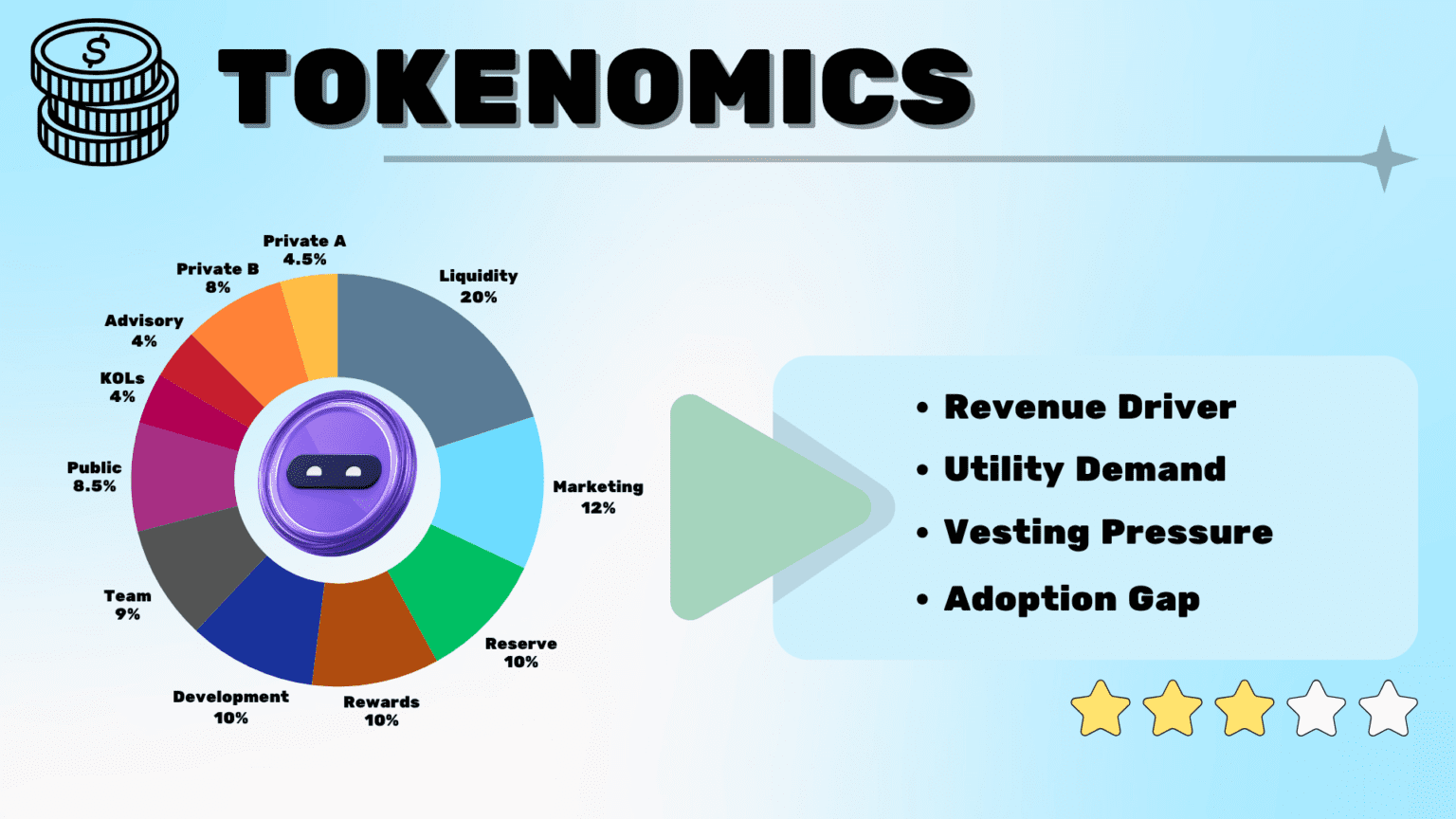
HyperGPT distributes its supply across multiple groups with structured vesting. Private A holds 4.5 percent with a three-month cliff and 18-month vesting, while Private B holds 8 percent with a three-month cliff and 15-month vesting. KOL allocations account for 4 percent with a two-month cliff and 10-month vesting, and the public sale covers 8.5 percent with no cliff and eight-month vesting. The team receives 9 percent with a six-month cliff and 30-month vesting, while development holds 10 percent with a five-month cliff and 32-month vesting. Advisory takes 4 percent with a six-month cliff and 24-month vesting, and marketing holds 12 percent with a four-month cliff and 36-month vesting. Rewards account for 10 percent with no cliff and 48-month vesting, reserve holds 10 percent with a six-month cliff and 42-month vesting, and liquidity takes the largest share at 20 percent with no cliff and 12-month vesting. Only 6.46 percent unlocked at launch, which spreads selling pressure over time instead of concentrating it early.
Token Utility
HGPT functions as the payment layer across the marketplace. Users spend it to access AI tools, agents, and services. The token also unlocks platform features such as advanced analytics and premium tools. Staking and liquidity incentives support ecosystem stability, while governance allows holders to influence decisions. The utility connects directly to platform usage, which gives it a real role beyond speculation.
However, demand depends on user growth. The system works, and transactions happen on-chain, but scale remains limited. Without a larger user base, the token behaves more like a payment token than a high-demand asset. The design avoids major flaws, but it cannot escape the broader challenge of low adoption across Web3 AI platforms.
Is HyperGPT Safe?
HyperGPT completed a smart contract audit by CertiK in June 2023. The audit identified three issues, resolved two, and acknowledged one related to token distribution structure. The project holds a CertiK Skynet score of 85.83, which places it in the A rating range. This indicates solid contract-level security, though it does not guarantee overall ecosystem safety.
Liquidity remains active, with daily trading volume around $350,000 across centralized and decentralized exchanges. Wallet concentration shows a top holder ratio near 17.52 percent, which sits in a moderate range and avoids extreme centralization. The owner wallet holds zero tokens, which removes a common risk factor.
The platform has operated since 2023 without reported exploits or major security incidents. It runs live products and updates consistently. However, CertiK does not list team KYC verification, which leaves a gap in transparency. Overall, the project shows a reasonable safety profile for its size and stage. It demonstrates stronger execution and audit coverage than many peers, but it still requires standard caution from users interacting with smart contracts and crypto wallets.
HyperGPT vs Competitors
HyperGPT operates in the same broad category as decentralized AI and compute networks, but it targets a different layer. It focuses on AI application marketplaces, while others focus on infrastructure or compute. The gap in scale is clear when comparing market caps and adoption.
HyperGPT (HGPT)
Marketplace with 6,500+ apps and SDK
Bittensor (TAO)
Mainnet with active subnets
Render (RENDER)
Live network
Akash (AKT)
Live mainnet
The comparison shows a clear divide. HyperGPT focuses on distribution and usability, while competitors focus on infrastructure. That makes HyperGPT easier to use today, but it also limits its moat against larger networks that control compute resources.
Strengths & Risks (Bull vs Bear Case)
HyperGPT shows strong execution for its size. It delivers a working SDK, a live marketplace, and thousands of usable tools. Developers can build and monetize without complex setup, and users can access services directly with crypto payments. The low fees on BNB Chain support frequent usage, and the small market cap leaves room for upside if adoption grows.
The risks are equally clear. The project operates at a very small scale compared to competitors with deep liquidity and strong developer ecosystems. Adoption across Web3 AI remains low, and most users still rely on centralized AI tools that offer better performance and simpler access. Token demand depends heavily on marketplace activity, which has not yet reached meaningful scale. Wallet concentration and modest trading volume also limit liquidity.
A balanced view shows that HyperGPT executes better than most small-cap AI projects but still faces the same structural barriers as the sector. It proves that a working marketplace exists, but it has not yet proven that users will adopt it at scale.
Should You Buy HGPT? (OCT Verdict)
Builders and developers can consider HGPT because the product works today and solves real integration problems. The SDK reduces friction, and the marketplace already supports real transactions.
Short-term traders should avoid it because liquidity remains low and price movement depends on limited volume. Exits can become difficult during volatility.
Long-term investors can watch it closely. Growth in active users, higher transaction volume, and expansion beyond niche builders will signal whether the platform can scale. Without these metrics, the token remains early-stage and speculative.
Final Verdict: Is HyperGPT a Buy in 2026?
HyperGPT delivers real products in a sector full of unfinished ideas. Future growth depends on user adoption, marketplace activity, and successful cross-chain expansion. It works today, but it still needs scale before it becomes a strong investment case.
Frequently Asked Questions
What is HyperGPT?
How does HyperGPT work?
Is HyperGPT fully live?
What is HGPT used for?
Is HyperGPT safe?
How is HGPT different from competitors?
Is HGPT a good investment?
In this article
Why Web3 AI Marketplaces Are Hard to Get RightWhat Is HyperGPT?How HyperGPT WorksTechnology & ArchitectureTeam & BackersHyperGPT Tokenomics (HGPT)Is HyperGPT Safe?HyperGPT vs CompetitorsStrengths & Risks (Bull vs Bear Case)Should You Buy HGPT? (OCT Verdict)Final Verdict: Is HyperGPT a Buy in 2026?