OVER is building a decentralized 3D mapping network for Physical AI, robotics, and VPS. Explore its data, $OVR token, traction, and risks.

Author: Akshat Thakur
OVER, short for Over the Reality, is a long-running DePIN platform that incentivizes smartphone users to scan real-world locations. The network is building a crowdsourced 3D map designed for Visual Positioning Systems, Physical AI models, robotics navigation, and geo-localized XR experiences.
The network currently claims hundreds of thousands of mapped sites, more than 100 million images, and multi-hundred-terabyte spatial data inventory.
The core opportunity is the growing need for high-quality 3D data. Most AI systems have been trained on massive amounts of 2D images and text. Physical AI, robotics, autonomous agents, and advanced AR systems need something different. They need dense 3D reconstructions with accurate scale, location, and visual information.
Traditional mapping is expensive and centralized. OVER takes a different approach by turning everyday smartphones into a decentralized mapping network through its map2earn model.
The ecosystem goes beyond data collection. OVER also includes OVRLand NFTs, a privacy-focused Visual Positioning System, and tools for creating geo-localized XR experiences.
The timing is important. Physical AI, spatial intelligence, and robotics have become major technology narratives in 2025 and 2026. Real-world 3D datasets are becoming an increasingly important input for training and navigation systems.
OVER has been collecting this data for years while the market was focused heavily on AR and metaverse applications. The project is now repositioning that accumulated inventory as infrastructure for Physical AI and spatial intelligence.
The key question is whether years of mapping activity can become a meaningful commercial data moat.
OVER operates in a competitive market with much larger companies and established mapping infrastructure.
Niantic remains one of the strongest consumer-facing players in spatial computing and AR through its Lightship platform and Scaniverse acquisition. Its distribution and developer reach are significantly larger than OVER’s.
Traditional geospatial companies such as Google and Apple also control extensive proprietary mapping datasets and VPS-like technology. They benefit from enormous user bases, large budgets, and mature infrastructure.
Other DePIN and real-world data networks are also competing for users, data contributors, and investor attention. Meanwhile, many AR, XR, and land-NFT projects from the previous cycle have either faded or lost relevance.
OVER’s main difference is its decentralized approach. Instead of relying entirely on centralized mapping teams, it uses token incentives to encourage users to map physical locations.
The network has already built hundreds of thousands of mapped locations and more than 100 million images. It combines this data layer with OVRLand, a tokenized spatial ownership system, a centimeter-level VPS designed for standard smartphones, and tools for publishing geo-localized XR experiences.
Mappers earn $OVR, while OVRLand owners control publishing rights and can participate in certain revenue opportunities.
The existing dataset is the strongest part of the thesis. Building this much mapped coverage through a community network takes time and creates an inventory that a new competitor cannot reproduce instantly.
However, centralized companies can collect similar data. The real differentiation comes from combining existing coverage, open participation, token incentives, and on-chain spatial ownership.
The bigger question is monetization. OVER needs to turn its dataset into revenue through AI training, VPS licensing, B2B XR, or other commercial applications. It also needs that activity to create meaningful value for $OVR and OVRLand holders.
The mapping moat is real. The economic moat still needs to prove itself.
OVER has a fully doxxed team based in Italy and has been building continuously since 2018. That longevity stands out in a sector where many AR and metaverse projects disappeared after the previous cycle.
Davide Cuttini is the CEO and co-founder. His background includes software engineering, augmented reality, deep learning, and robotics. He serves as the project’s primary technical and product driver.
Diego Di Tommaso is a co-founder and COO. His background includes technology advisory and traditional finance, including work related to PwC. He has also remained a visible public representative of the project over the years.
Other early contributors bring experience across AR, VR, futurism, and technical development.
The company operates through OVER HOLDING S.R.L. in Udine, alongside an Estonian entity for token-related activities. The team has roughly 30 or more people and participates in EU-funded research consortia.
For a project focused on spatial data and Physical AI, the team’s long operating history is a positive signal. OVER continued building through the bear market instead of abandoning the project.
The team has also shown an ability to adapt. OVER initially focused heavily on AR, metaverse, and digital land. It is now repositioning its accumulated mapping data toward Physical AI and VPS applications.
The main limitation is commercial execution. The team has demonstrated years of mapping output, but it has not yet proven large-scale monetization of that dataset at the level suggested by the current Physical AI narrative.

OVER is not a new project preparing for its first token launch. The $OVR token launched in December 2020 through an Initial Bonding Curve Offering, with the total supply later fixed at approximately 89.9 million tokens.
Early funding was relatively modest and came at a difficult stage for the broader market. The project instead spent years building its mapping network and expanding its ecosystem.
Institutional interest increased in 2025, when EV3, Modular Capital, and Lattice invested in the project. OVER has also received support from earlier European and crypto-native investors.
The project participates in EU research programs and has generated reported revenue from OVRLand sales and B2B activity over the years.
This is not a project backed by a massive $50 million or $100 million venture round. Its story is different.
OVER survived multiple market cycles, continued expanding its mapping network, and later attracted specialized crypto investors as the Physical AI opportunity became more relevant.
The EV3, Modular Capital, and Lattice involvement adds credibility, particularly because the project already has a live token and an established data inventory.
The key funding question now is not whether OVER can reach TGE. That already happened years ago. The important question is whether future capital and commercial revenue can support the transition from a mapping network into a scaled Physical AI and VPS business.
Yes. OVER has a live, multi-year mapping and spatial computing network that anyone can use today.
The core Map2Earn program is active. Users can download the OVER app, scan real-world locations with a standard smartphone or supported 360° cameras such as the Insta360 X5, upload their captures, and receive rewards when the maps are approved. Basic participation is open without a closed beta or long waitlist.
OVER also operates a Visual Positioning System across its mapped locations. Company figures cite more than 283,000 locations worldwide. The network also includes a Web XR Builder, Unity SDK, in-app AR publishing tools, and ways to explore or access the underlying 3D map data.
The current public figures show 283,000+ mapped locations, 106 million+ images, and 1,275 TB of spatial data. Earlier figures also referenced hundreds of thousands of OVRLand NFTs sold and tens of thousands of published AR experiences.
The project has also maintained GitHub repositories under the OVR Platform organization, including SDKs, staking contracts, and marketplace-related infrastructure. However, the strongest proof of development is the live mapping network and applications rather than open-source activity.
This is not a testnet or a slide deck. OVER has operated its mapping network for years, its VPS works across the collected inventory, and new contributors can start mapping today.
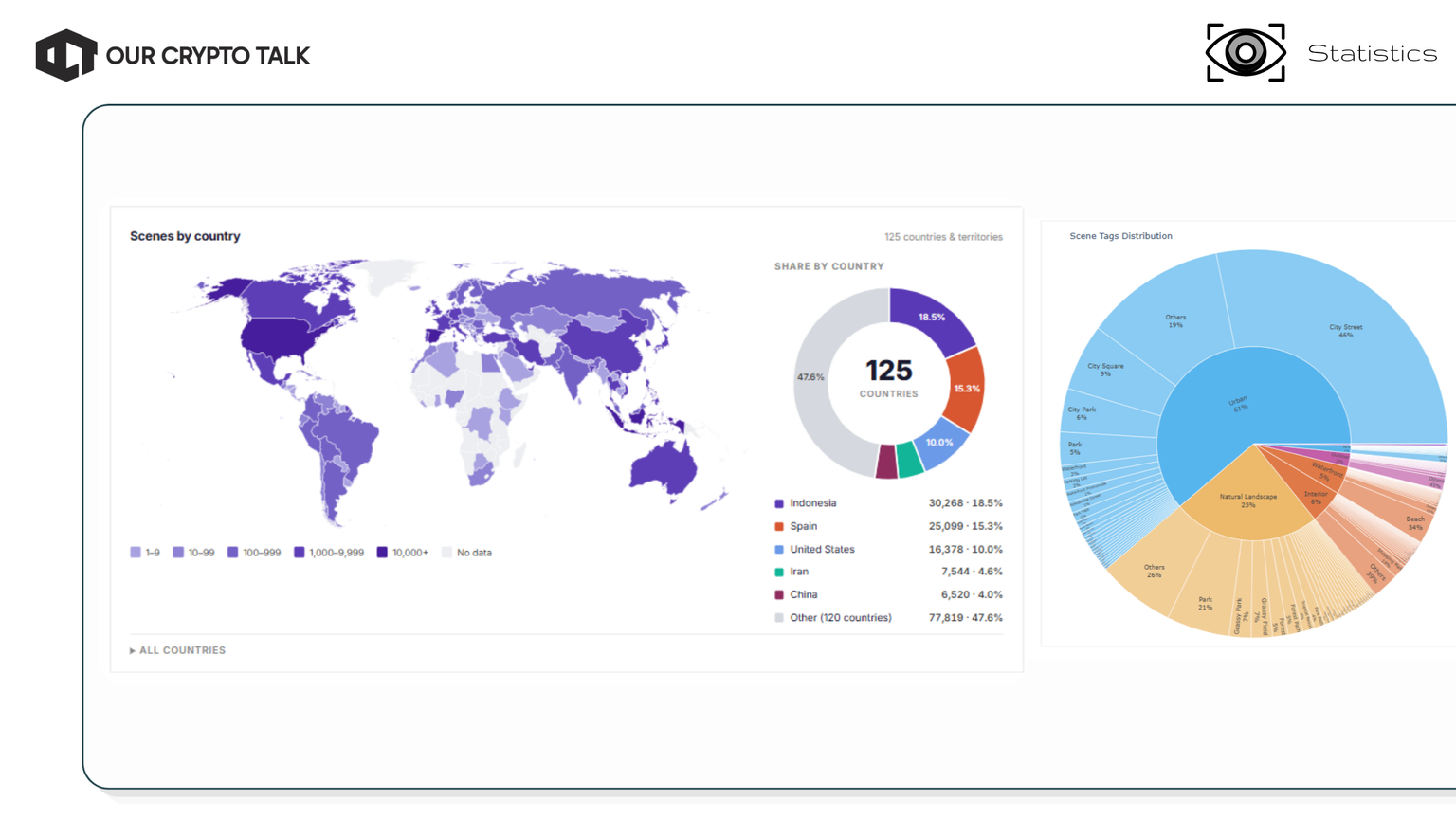
OVER’s strongest traction comes from the size of its actual 3D map rather than social media activity.
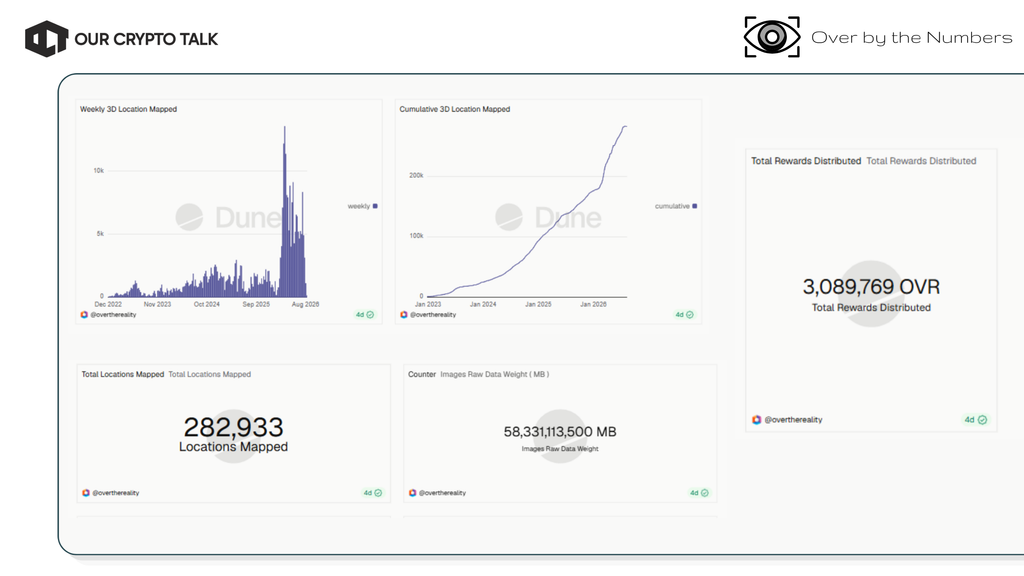
The network currently claims more than 283,000 mapped locations, 106 million images, and 1,275 TB of spatial data. These figures represent real mapping work performed by contributors over several years.
Earlier figures also showed continued network growth, including 150,000 to 200,000+ mapped locations, more than 45 million mapped square meters, and over 880,000 OVRLand NFTs sold to more than 30,000 wallets.
Map2Earn creates another measurable activity signal because contributors spend time, mobile data, and sometimes money on mapping hardware. Historical programs paid around $0.90 to $3 per approved map in some cases. More recent Insta360-focused programs have advertised higher effective rates in premium zones, reaching the low double digits per hour depending on location priority.
OVRLand has also generated meaningful historical activity. Hundreds of thousands of spatial domain NFTs have been sold, while thousands of publishers have created geo-localized AR experiences. These activities required either capital or creative effort from participants.
The $OVR token has also been live and traded since late 2020. Its current market capitalization sits in the low single-digit millions, roughly $1.5 million to $2.6 million depending on the circulating supply figure used.
Social metrics are less important. A large follower count does not prove that the map has commercial value.
The main caveat is monetization. A large dataset does not automatically mean AI companies or robotics firms will pay significant amounts for it. The real test is whether the data gets licensed, used for VPS applications, incorporated into Physical AI models, or generates recurring enterprise revenue.
OVER has built the inventory. It now needs to prove that inventory can produce sustainable economic value.
$OVR is a mature token that launched in December 2020 through an Initial Bonding Curve Offering on Ethereum and later became active on Polygon.
The total and maximum supply was eventually fixed at approximately 89.89 million OVR after the bonding curve closed.
Unlike newer tokens preparing for TGE, OVR already has a large circulating supply. Recent trackers show circulating figures between roughly 51 million and 88 million tokens, depending on the source and methodology.
At prices around $0.03, the token’s market capitalization sits in the low single-digit millions, with a similarly low fully diluted valuation.
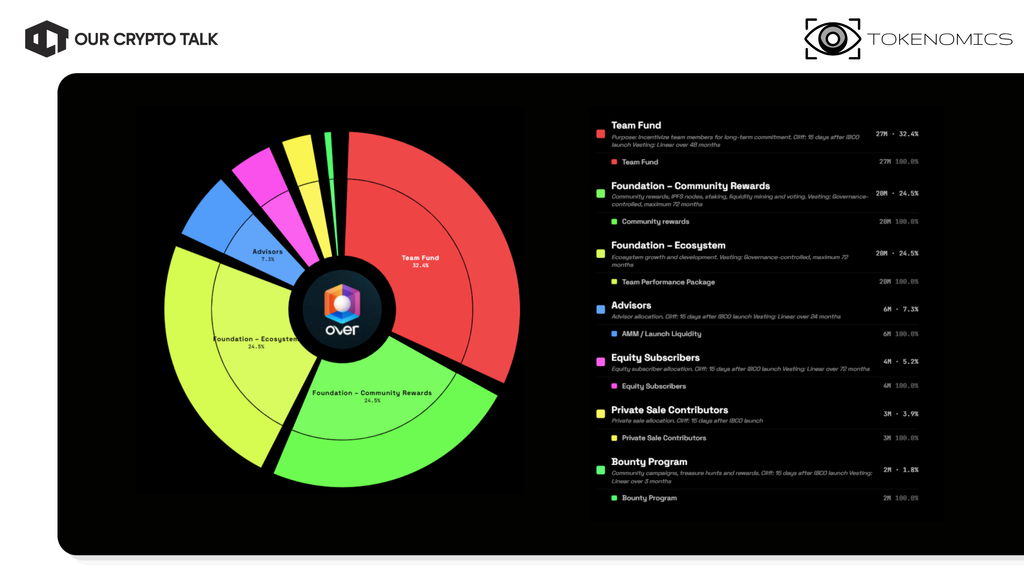
The original distribution included allocations for private and equity investors, the team, advisors, community rewards, and the IBCO. The team allocation included multi-year linear vesting.
Because OVR launched more than five years ago, most of the original vesting schedules have already completed or are close to completion. There is no typical TGE unlock cliff waiting ahead.
This creates an unusual token structure. The free float is already large relative to the market capitalization, so classic insider unlock pressure is less important than it is for newer launches.
$OVR functions as the main medium of exchange across the ecosystem. It is used for mapping rewards and has been used to purchase OVRLand NFTs and related assets. It has also supported staking and governance participation in different forms over the years.
Future value accrual could come from mechanisms linked to Web2 and B2B activity. The team has discussed routing portions of dataset or publishing revenue toward the token or land holders through mechanisms such as revenue sharing, buybacks, or burns.
However, these mechanisms depend on actual commercial revenue. OVR is not simply an emissions token, but it also does not have a tightly engineered supply structure that automatically creates demand.
The key driver is therefore external adoption. More mapping, OVRLand activity, VPS usage, and especially commercial licensing of the 3D dataset could create stronger demand for OVR.
The current valuation looks distressed relative to the size of the mapped inventory. The lack of a major upcoming unlock is a positive.
The bigger risk is the opposite of a low-float launch. A large liquid supply combined with weak demand can keep the token suppressed even if the underlying dataset continues growing.
There is no traditional early-access or pre-TGE farming opportunity because $OVR has been live since 2020.
The most direct way to participate is through Map2Earn. Users can download the OVER app, scan real-world locations with a smartphone or supported 360° camera such as the Insta360 X5, upload the captures, and earn rewards when their maps are approved.
Premium locations can offer higher effective rewards. The activity requires genuine work, including walking, scanning, uploading, and sometimes purchasing mapping hardware.
Another option is buying $OVR on secondary markets. This provides direct financial exposure to the network at its current low market capitalization.
Users can also acquire OVRLand NFTs. These represent specific geographic hexes and give owners publishing rights along with potential participation in certain revenue streams connected to those locations.
Builders can use OVER’s Web Builder, in-app tools, or Unity SDK to create geo-localized AR experiences on available or owned land.
There is also a potential commercial path through the network’s data and VPS capabilities. Companies working on AI training, robotics, navigation, or related applications can explore the available spatial data and positioning infrastructure.
There is no high-ROI, low-effort points campaign left to farm. Map2Earn is the closest equivalent, but it requires real physical effort rather than clicking through quests.
The real question is whether the time spent mapping or the capital spent on OVR and OVRLand will benefit from growing demand for OVER’s spatial data.
The opportunity is no longer about getting an early token allocation. It is about participating in an existing 3D mapping network and betting that its accumulated data becomes valuable infrastructure for Physical AI, VPS, robotics, and spatial computing.
OVER is a mature, high-float token tied to a real multi-year 3D mapping network. The main question is no longer whether the project can build the dataset. It is whether that dataset can generate enough commercial demand to create meaningful value for $OVR holders.
Map2Earn is the main contribution opportunity. Users travel to locations, capture scans with a smartphone or 360° camera, upload them, and wait for approval.
Historical rewards ranged from roughly $0.90 to $3 per approved map. Newer programs have advertised higher effective hourly rates in premium zones, sometimes reaching the low double digits.
For most users, the economics are not compelling after travel, mobile data, equipment, and approval time. Map2Earn is better viewed as paid micro-work that also contributes to the network, not as a high-ROI farming strategy.
$OVR has been live since December 2020 with a fixed supply of approximately 89.9 million tokens. Most of the supply is already circulating.
At around $0.03, the market cap sits roughly between $1.5 million and $2.6 million, depending on the circulating supply figure used.
That valuation is extremely low compared with the claimed 283,000+ mapped locations, 106 million+ images, and 1,275 TB of spatial data.
The potential asymmetry is clear. If the dataset starts generating meaningful revenue from AI, robotics, VPS, or enterprise use, the current valuation could look heavily discounted.
But that upside depends on commercial monetization and value flowing back to $OVR or OVRLand holders. A large dataset alone does not guarantee token appreciation.
The strongest argument for $OVR is the combination of a real product, years of data collection, and a very low market capitalization.
OVER has continued building since 2020 and now has a large spatial dataset that would take competitors significant time and resources to recreate through community mapping.
The project is also repositioning toward Physical AI, robotics, and spatial intelligence at a time when demand for real-world data is increasing.
The main weakness is token value capture. Mapping activity can continue growing without creating strong demand for $OVR unless the network converts that inventory into paid commercial usage.
Liquidity is another concern. At a market cap this small, larger positions could face significant slippage when entering or exiting.
The biggest threat is competition. Niantic, Google, Apple, and specialized geospatial companies have deeper resources and established mapping infrastructure. New DePIN and AI-data networks can also compete for demand from AI and robotics companies.
Narrative risk is another concern. OVER’s current positioning benefits heavily from the Physical AI and spatial intelligence narratives. If major AI companies rely more on synthetic data, proprietary datasets, or alternative mapping providers, demand for OVER’s inventory could remain weak.
Privacy and data rights also matter. Large-scale mapping creates potential issues around consent, location privacy, GDPR, data protection, and commercial AI training rights. Regulatory restrictions could limit how the dataset is collected or licensed.
The biggest execution risk is commercial conversion. OVER needs to turn its map into paid VPS usage, data licenses, or enterprise XR contracts. If that does not happen, the project could end up with a large dataset that remains commercially underused.
There is also token-value capture risk. Even if OVER generates meaningful revenue, $OVR holders may not benefit significantly unless the ecosystem creates transparent mechanisms such as buybacks, burns, or revenue sharing.
Watch the commercial traction.
Mapping growth is useful, but it is no longer enough. The next major signal should be evidence that external companies are paying for OVER’s data or VPS infrastructure.
Investors should also watch whether that revenue creates measurable value for $OVR or OVRLand holders.
Buying purely because the market cap is low is a high-risk bet. The better setup would be confirmation that the accumulated dataset is becoming a real commercial input for Physical AI and robotics.
WATCH
OVER has something most narrative DePIN and AI-data projects do not: a multi-year 3D mapping network with hundreds of thousands of locations, more than 100 million images, and over a petabyte of spatial data.
The product is live. Map2Earn is operational, VPS works across existing coverage, and users can build spatial experiences today. The token also trades at a very low valuation relative to the size of the underlying data asset.
The problem is monetization.
$OVR has been live for more than five years, yet large-scale commercial demand for the dataset remains unproven. Competition is strong, privacy risks exist, and token value capture still needs to become clearer.
The milestone that changes the rating is simple: verifiable commercial traction through paid data licenses, meaningful VPS or enterprise contracts, or transparent revenue-sharing mechanisms that benefit $OVR or OVRLand holders.
Until that happens, OVER remains a Watch. The data asset is real, the valuation is interesting, but commercial conversion needs to catch up.
All the opinions in this article are that of the author and in no way are financial advice. Our Crypto Talk and the author always suggest you do your own research in crypto and to never take anything as financial advice that you read on the internet. Check our Terms and conditions for more info.


Web3 Gaming Comeback 2026: GTA 6 Hype vs 99% Crashes
Layer 2 Projects Shutting Down: Who’s Next After Blast?
Embodied Data Pyramid and Decentralized Data Layer for Robotics
DeFi Needs Better Liquidity. Can Ramses Deliver?
Web3 Gaming Comeback 2026: GTA 6 Hype vs 99% Crashes
Layer 2 Projects Shutting Down: Who’s Next After Blast?
Embodied Data Pyramid and Decentralized Data Layer for Robotics
DeFi Needs Better Liquidity. Can Ramses Deliver?