Zano ( $ZANO ) Review: Is ZANO Worth Buying in 2026?
Zano ($ZANO) review covering tokenomics, Hard Fork 6, Confidential Assets, privacy features, risks, and whether it's worth buying in 2026.


Author: Akshat Thakur
Why Privacy-by-Default Layer-1 Blockchains Are Hard to Get Right
Privacy-first Layer-1 blockchains face challenges that extend well beyond building strong cryptography. The biggest hurdle is adoption. Mandatory privacy often conflicts with regulatory expectations, making exchange listings, institutional partnerships, and DeFi integrations harder to secure. Many centralized exchanges remain cautious about fully private assets, limiting liquidity and reducing accessibility for new users.
Building sustainable ecosystems is equally difficult. Without venture funding or aggressive token incentives, privacy projects often rely on smaller open-source communities for development. At the same time, proving real network activity is harder because transactions are intentionally opaque. Unlike transparent blockchains, it is difficult for investors to verify usage, capital flows, or ecosystem growth directly on-chain.
Competition also remains intense. Monero has spent more than a decade establishing itself as the leading privacy cryptocurrency, while projects like Zcash continue to pursue institutional adoption through different privacy models. Newer privacy chains must demonstrate meaningful advantages beyond simply offering anonymous payments.
Zano positions itself differently. Rather than focusing solely on private transactions, it aims to build a privacy-first Layer-1 where users can issue confidential assets, stake privately, and eventually move assets across multiple blockchains. That specialization only creates value if developers, users, and applications choose to build private economies on top of the network.
What Is Zano?
Zano is an open-source Layer-1 blockchain where every transaction is private by default. The protocol hides the sender, receiver, transferred amount, and asset type without requiring users to select a privacy mode. Every transfer follows the same confidential model.
The project was co-founded by Andrey Sabelnikov, the original developer of CryptoNote, the privacy protocol that later inspired Monero, alongside Pavel Nikienkov. Since launching its mainnet in 2019, Zano has expanded beyond private payments into a broader privacy infrastructure that includes Confidential Assets, private Proof-of-Stake, aliases, and confidential applications.
As of August 2026, Zano has a circulating supply of approximately 15.4 million coins and a market capitalization near $130 million. Development has continued steadily through upgrades such as the Zarcanum hard fork in 2024.
In July 2026, the project also announced the Zenith roadmap, outlining its planned transition to a pure Proof-of-Stake network developed with Common Prefix. Meanwhile, Hard Fork 6 is scheduled for late August 2026, introducing Gateway Addresses, native cross-chain bridging, and infrastructure improvements.
The upgrade introduces Gateway Addresses, native cross-chain bridging, and infrastructure improvements aimed at making Zano easier for exchanges, bridges, and decentralized applications to integrate.
Unlike many privacy coins that focus exclusively on payments, Zano is positioning itself as infrastructure for confidential assets, private applications, and cross-chain privacy.
How Zano Works
Every transaction on Zano is private by default. Users simply send funds without choosing between public or private modes. The protocol automatically hides transaction details while allowing recipients to verify ownership securely.
Beyond payments, Zano allows anyone to create Confidential Assets. These user-issued tokens inherit the same privacy guarantees as the native ZANO coin, keeping balances, transfers, and asset information confidential.
The network currently operates through a hybrid consensus model that combines Proof-of-Work mining with private Proof-of-Stake. Miners validate PoW blocks while private stakers validate alternating PoS blocks without publicly exposing validator balances or staking positions. However, following the Zenith roadmap announced in July 2026, Zano plans to transition to a pure Proof-of-Stake network developed with Common Prefix, retiring PoW mining once Zenith activates.
Several features expand the ecosystem beyond payments. Ionic Swaps enable private atomic swaps between supported assets. Human-readable aliases replace long wallet addresses with simpler usernames. Wallets, payment tools, and spending cards continue improving accessibility for both individuals and businesses.
Hard Fork 6 represents the next major milestone. Scheduled for late August 2026, it introduces Gateway Addresses that simplify exchange and bridge integrations while preserving privacy for ordinary users. The upgrade also enables trustless two-way bridging between Zano and ecosystems including Ethereum, Solana, and TON through Bridgeless infrastructure.
Technology & Architecture
Privacy is enforced at the protocol level rather than offered as an optional feature. Every transaction uses d/v-CLSAG ring signatures, stealth addresses, Pedersen commitments, and Bulletproofs+ to hide the sender, receiver, transferred amount, and asset type.
Unlike many privacy chains, Zano currently combines Proof-of-Work with Proof-of-Stake. Mining uses ProgPowZ, while the Zarcanum upgrade (introduced in 2024) made the Proof-of-Stake layer private by hiding validator identities, balances, and staking positions on-chain. As outlined in the July 2026 Zenith announcement, the project intends to replace the hybrid model with a pure Proof-of-Stake consensus after Zenith activates.
Confidential Assets extend these privacy guarantees beyond the native coin. Developers and businesses can issue their own private tokens that inherit the same transaction privacy as ZANO. Ionic Swaps further expand functionality by enabling private peer-to-peer asset exchanges without centralized intermediaries.
The Zarcanum upgrade in 2024 transformed Zano from a private payments network into a broader confidential asset platform. Hard Fork 6 continues that evolution by introducing Gateway Addresses, intrinsic payment IDs, and native cross-chain connectivity with Ethereum, Solana, and TON through Bridgeless.
Compared with Monero, Zano builds on similar CryptoNote foundations while adding private staking, confidential asset issuance, and cross-chain interoperability. Rather than competing only as a privacy coin, Zano is attempting to become infrastructure for private digital assets and confidential applications.
Team & Backers
Zano was co-founded by Andrey Sabelnikov and Pavel Nikienkov. Sabelnikov is best known as the original lead developer of the CryptoNote reference implementation, the privacy protocol that later influenced Monero and several other privacy cryptocurrencies. His background in privacy cryptography and blockchain engineering gives Zano one of the strongest technical pedigrees in the sector.
Nikienkov oversees project management and ecosystem coordination. The broader team includes Valeriy Pisarkov, who leads core protocol research and development, alongside contributors focused on engineering, community growth, and marketing.
Unlike many modern Layer-1s, Zano did not raise large venture capital rounds or launch through a public ICO. Instead, the project has been largely self-funded through its genesis premine, which financed development, operations, marketing, and repayment of an early development loan. The remaining treasury has steadily declined as funds have been deployed over several years.
This independent funding model has allowed Zano to develop without heavy VC influence or aggressive token distribution schedules. The trade-off is a smaller ecosystem budget and slower marketing compared with venture-backed competitors.

Zano Tokenomics (ZANO)
Zano follows a relatively straightforward monetary model centered on predictable issuance and transaction-based deflation.
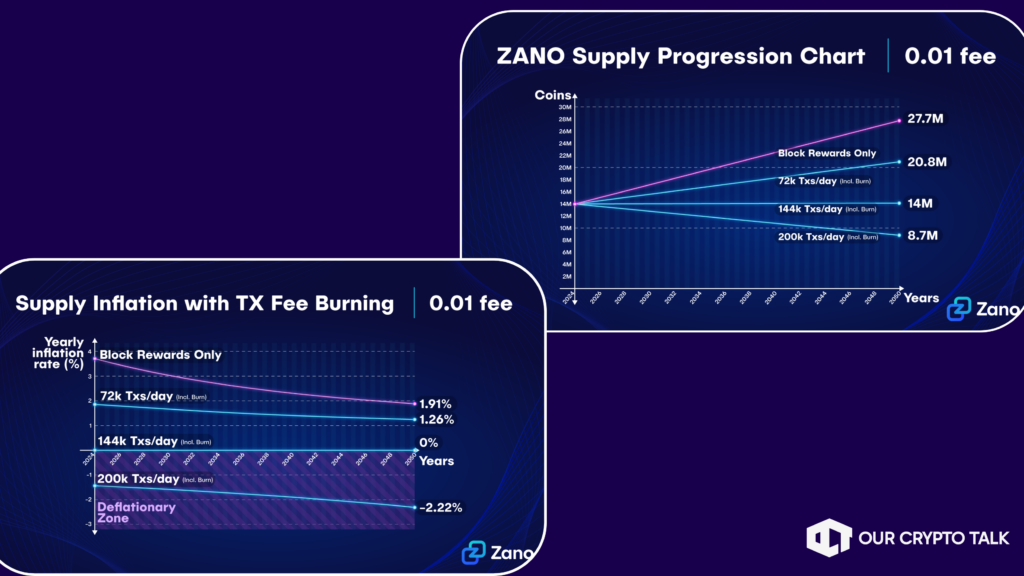
The network has no fixed maximum supply. Instead, it produces one new ZANO every minute, creating approximately 1,440 new coins each day.
The network currently alternates between Proof-of-Work and private Proof-of-Stake blocks. Each block reward is paid entirely to the miner or staker who produces that block, resulting in roughly equal daily issuance for both consensus mechanisms.
Zarcanum, introduced in 2024, did not create the hybrid consensus, it upgraded the Proof-of-Stake side by making staking private. This issuance model reflects the network’s current hybrid consensus. Under the announced Zenith roadmap, Proof-of-Work mining will end after activation, meaning block issuance and reward distribution are expected to be restructured as Zano transitions to a pure Proof-of-Stake network.
At launch, approximately 3.69 million ZANO were premined to fund long-term development, operations, marketing, and repayment of an early project loan. Most of those funds have already been spent. As of mid-2026, the foundation controls roughly 440,000 ZANO, representing less than 3 percent of the total supply.
The primary source of ongoing inflation comes from block rewards. However, Zano permanently burns 100 percent of transaction fees. As network activity increases, fee burns offset a larger share of daily issuance. In theory, if daily fee burns exceed new block rewards, the network could become deflationary.
ZANO also serves as the network’s utility token. It pays transaction fees, secures the network through private staking, powers Confidential Assets, and acts as the native currency across the ecosystem. Rather than relying on protocol revenue sharing, the token’s long-term value is more closely tied to network usage and transaction volume.
Is Zano Safe?
From a technical perspective, Zano has built a strong security foundation. The protocol combines d/v-CLSAG ring signatures, stealth addresses, Pedersen commitments, and Bulletproofs+ to provide mandatory privacy for every transaction.
Network security is currently reinforced through a hybrid Proof-of-Work and private Proof-of-Stake model. However, Zano has announced its planned transition to a pure Proof-of-Stake consensus under the Zenith upgrade, meaning its long-term security model will differ from the current hybrid architecture.
Key components, including Zarcanum and the d/v-CLSAG implementation, have undergone independent reviews by Cypher Stack. The codebase remains open source, and since its 2019 mainnet launch, there have been no widely reported exploits affecting the core network.
That does not eliminate risk.
Privacy-focused cryptocurrencies continue to face greater regulatory scrutiny than most blockchain projects. Exchange delistings, jurisdiction-specific restrictions, and evolving compliance requirements remain ongoing challenges. Like any blockchain, Zano also carries implementation and software risks despite independent reviews and years of development.
Overall, Zano demonstrates a solid technical security record supported by mature cryptography, independent audits, and several years of stable operation. Investors should still weigh those strengths against the regulatory and liquidity risks that affect the broader privacy coin sector.
Zano vs Competitors
Zano competes in a small but highly competitive privacy sector. While it shares roots with Monero, its focus has expanded beyond private payments to include Confidential Assets, private staking, and cross-chain interoperability.
Zano
Since 2019
HF6: Aug. 2026
Monero
(RandomX)
Zcash
(Equihash)
ZSA upgrades
Each project targets a different segment of the privacy market. Monero remains the benchmark for private digital cash, backed by the largest user base and deepest liquidity. Zcash offers optional privacy, making it easier to integrate with regulated institutions while still supporting shielded transactions.
Zano takes a different approach. Instead of focusing only on payments, it aims to become infrastructure for a broader private economy through Confidential Assets, private staking, and upcoming cross-chain connectivity. Hard Fork 6 also targets one of the project’s biggest weaknesses by making exchange and bridge integrations significantly easier.
The trade-off is maturity. Zano offers more features than many privacy competitors, but it also has the shortest track record, the smallest ecosystem, and far lower liquidity than Monero or Zcash.
Strengths & Risks
Zano combines mandatory privacy with features that extend beyond simple payments. Confidential Assets allow anyone to issue private tokens, while private Proof-of-Stake lets users earn rewards without exposing balances or validator information. The protocol also benefits from CryptoNote heritage and leadership from one of CryptoNote’s original developers.
Beyond Hard Fork 6, the announced Zenith upgrade represents an even larger architectural change. It proposes retiring Proof-of-Work mining and transitioning Zano to a pure Proof-of-Stake network, making its future security model significantly different from the hybrid design that has existed since launch.
Gateway Addresses and native cross-chain bridges are designed to simplify integrations with exchanges, bridges, and decentralized applications, potentially improving accessibility without weakening privacy.
Combined with the 100 percent transaction fee burn, higher network usage could help reduce long-term inflation under the current issuance model, although Zenith is expected to restructure emissions after the transition to pure Proof-of-Stake.
But Zano remains a relatively small cryptocurrency with limited liquidity and exchange availability compared with larger privacy projects. Daily emissions continue adding new supply, while fee burns only become meaningful if transaction activity grows substantially.
The broader privacy sector also faces persistent regulatory pressure. Exchange delistings and compliance concerns remain risks for every privacy-focused cryptocurrency. At the same time, Monero continues to dominate private payments, while Zcash maintains stronger institutional recognition through its optional privacy model.
For Zano, the biggest challenge is execution. Hard Fork 6, Confidential Assets, and cross-chain connectivity all strengthen the technology, but long-term value will ultimately depend on attracting users, developers, and sustained on-chain activity.
Should You Buy ZANO?
The answer depends on why you want exposure to the privacy sector.
Builders developing confidential applications, private assets, or privacy-first payment systems may find Zano’s feature set attractive. Confidential Assets, private staking, and its expanding cross-chain infrastructure provide capabilities that few competing privacy chains currently offer.
Investors should focus less on short-term price movements and more on adoption metrics. Growth in Confidential Asset issuance, transaction volume, ecosystem integrations, exchange accessibility after Hard Fork 6, and developer activity will provide better signals of long-term progress than market sentiment alone.
Zano has built an impressive technical foundation. The next stage is proving that those features translate into broader adoption and stronger network effects.
As always, conduct your own research before investing. Privacy cryptocurrencies remain a high-risk segment of the digital asset market and can experience significant volatility.
Final Verdict: Is Zano Worth Buying in 2026?
Zano has evolved beyond being another privacy coin. Its combination of mandatory privacy, Confidential Assets, expanding cross-chain infrastructure, and its planned transition to a pure Proof-of-Stake consensus under Zenith gives it one of the broader feature sets in the privacy sector.
The opportunity is clear, but so are the challenges.
The project still needs deeper liquidity, wider exchange support, and stronger ecosystem adoption to compete with more established privacy networks.
Hard Fork 6 should improve accessibility, while the planned Zenith transition will fundamentally reshape Zano’s consensus model. Long-term success will ultimately depend on whether these upgrades translate into stronger adoption by developers, businesses, and users.
Overall, Zano stands out as one of the more technically ambitious privacy Layer-1s. Whether that technical advantage translates into sustained adoption remains the key question investors should continue watching through 2026.
Frequently Asked Questions
What is Zano?
How does Zano work?
What is new in Zano Hard Fork 6?
What is ZANO used for?
Is Zano safe?
How is Zano different from Monero?
Is ZANO a good investment?
In this article
Why Privacy-by-Default Layer-1 Blockchains Are Hard to Get RightWhat Is Zano?How Zano WorksTechnology & ArchitectureTeam & BackersZano Tokenomics (ZANO)Is Zano Safe?Zano vs CompetitorsStrengths & RisksShould You Buy ZANO?Final Verdict: Is Zano Worth Buying in 2026?