Grayscale watchlist reveals where institutional crypto capital may flow next. Explore key sectors, assets, and what it means for 2026 trends.

Author: Chirag Sharma
Very few indicators carry as much weight as the Grayscale watchlist. While retail investors often chase short-term narratives and hype-driven tokens, institutional capital tends to move based on structured analysis, regulatory clarity, and long-term conviction. This is exactly where the Grayscale watchlist becomes incredibly important.
Every quarter, Grayscale Investments releases its “Assets Under Consideration” list, which is widely referred to as the Grayscale watchlist across the industry. This list is not just a random collection of trending tokens but a carefully curated pipeline of assets that may eventually become part of institutional investment products.
For investors who understand how institutional flows shape markets, this list provides a rare and valuable insight. It reveals where large capital allocators are focusing their attention and which sectors are gaining credibility at a structural level. Understanding the Grayscale watchlist is not about predicting immediate price movements but about identifying long-term positioning trends before they fully play out.
The biggest misconception about the Grayscale watchlist is that it guarantees future price appreciation or immediate product launches. In reality, the list serves as an internal evaluation framework that reflects Grayscale’s ongoing research into potential investment opportunities.
Each asset included in the Grayscale watchlist goes through multiple layers of analysis before being considered. These layers typically include custody infrastructure readiness, regulatory classification, liquidity depth across markets, and the asset’s ability to demonstrate real-world utility. Only projects that meet these criteria are even considered worthy of inclusion.
This structured filtering process is what gives the Grayscale watchlist its credibility. It is not a speculative list driven by social sentiment but a reflection of institutional due diligence standards. In a market where thousands of tokens compete for attention, being part of this shortlist signals a certain level of maturity and readiness.
For investors, this means the watchlist can be used as a high-quality starting point for deeper research. Instead of scanning hundreds of projects, one can focus on a curated set that has already passed initial institutional screening.
The Q2 2026 Grayscale watchlist includes approximately 30 assets, organized into four major sectors that reflect the evolving structure of the crypto market.
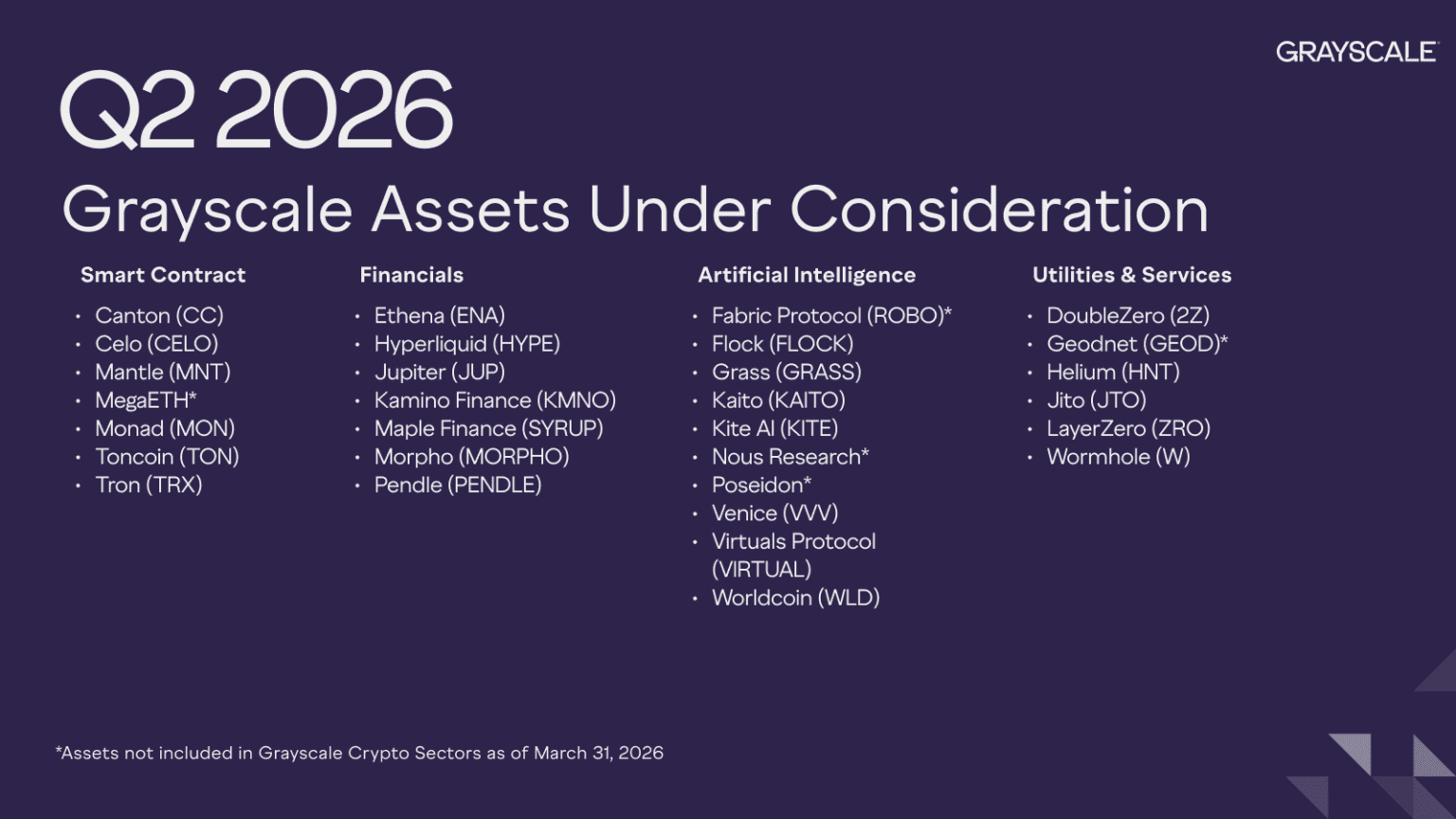
These sectors include Smart Contract Platforms, Financials (DeFi), Artificial Intelligence, and Utilities & Services. One notable change in this edition is the removal of the “Consumer” category, which indicates a clear shift toward infrastructure-focused investments.
This shift is important because it highlights how institutional thinking has evolved. Instead of focusing on consumer-facing applications that may struggle with adoption, Grayscale is prioritizing foundational layers that enable entire ecosystems to function.
Within these categories, several established assets continue to appear, reinforcing their importance in the broader market. These include TRON, Toncoin, Ethena, and Hyperliquid. These projects are not just popular but have demonstrated consistent usage, liquidity, and revenue generation.
However, the real insight comes from the inclusion of less obvious names, which often signal emerging narratives before they become mainstream.
Every version of the Grayscale watchlist contains a few unexpected assets that initially seem out of place but later prove to be highly insightful. These inclusions often reflect early institutional positioning in new sectors.
In the latest update, projects like GRASS, Jupiter, and Helium stand out as particularly interesting choices.
These assets highlight a broader shift in how institutions are viewing crypto. GRASS represents decentralized data infrastructure for artificial intelligence, Jupiter captures trading activity within the Solana ecosystem, and Helium brings blockchain technology into real-world wireless networks.
What ties these selections together is their focus on utility rather than speculation. They are not just tokens but components of larger systems that solve real problems. This suggests that the next phase of crypto growth will be driven by functionality rather than narrative alone.
The Grayscale watchlist, therefore, acts as an early signal for where institutional capital might rotate in the coming months.
To fully appreciate the significance of the current Grayscale watchlist, it is important to understand how it has evolved over the years.
Initially, Grayscale focused almost entirely on Bitcoin, with its flagship product dominating institutional exposure to crypto. The approval of spot Bitcoin ETFs in 2024 marked a turning point, proving that regulated crypto investment vehicles could attract large-scale capital.
Following this, Grayscale expanded into Ethereum and gradually introduced exposure to other sectors. Over time, the watchlist began to include DeFi protocols, Layer 1 networks, and eventually AI-related projects.
By 2026, the watchlist reflects a much more mature market structure. The focus has shifted from identifying the next dominant blockchain to understanding how different sectors interact within a broader ecosystem.
This evolution mirrors the overall growth of the crypto industry, which has moved from speculation toward utility-driven adoption.
A closer look at the Grayscale watchlist reveals two dominant themes that define its current structure.
The first theme is financial infrastructure, which includes smart contract platforms and DeFi protocols. These assets form the backbone of on-chain finance and enable services such as lending, trading, and payments. Projects like TRON and Toncoin provide scalable execution layers, while protocols like Ethena and Hyperliquid focus on financial applications that generate real revenue.
The second theme is the convergence of crypto with artificial intelligence and decentralized infrastructure. This includes projects that enable data sharing, compute distribution, and real-world network deployment. Assets like GRASS and Helium represent this shift, showing how blockchain can support emerging technologies beyond finance.
Together, these themes highlight a broader transformation within the crypto market. The focus is no longer on isolated tokens but on interconnected systems that drive economic activity.
The Grayscale watchlist has both immediate and long-term effects on the market, making it one of the most closely watched signals in crypto.
In the short term, inclusion in the watchlist often leads to increased visibility and speculative interest. Traders anticipate potential future products and position themselves accordingly, which can create temporary price movements.
However, the long-term impact is far more significant. Assets that remain on the watchlist gain credibility over time, attracting attention from other institutional players, analysts, and developers. This increased attention often leads to higher liquidity, stronger ecosystems, and more sustainable growth.
The watchlist essentially acts as a validation layer. It does not guarantee success, but it significantly increases the probability of long-term relevance.
Despite its importance, the Grayscale watchlist should not be viewed as a definitive investment guide. There are several limitations that investors must consider.
First, inclusion does not guarantee that an asset will eventually receive a dedicated product. Some assets may remain in the evaluation phase for extended periods without progressing further.
Second, regulatory uncertainty can delay or prevent the development of investment products. Even strong projects can face challenges depending on how they are classified.
Third, market conditions play a critical role. A shift in sentiment can impact even the most promising assets, especially during broader downturns.
Finally, narratives can change quickly in crypto. Sectors that appear promising today may lose momentum if adoption does not materialize as expected.
These risks highlight the importance of using the Grayscale watchlist as a starting point rather than a final decision-making tool.
The most effective way to use the Grayscale watchlist is as a research framework that helps narrow down potential opportunities.
Instead of treating it as a buy signal, investors should analyze each asset based on key metrics such as on-chain activity, tokenomics, revenue generation, and developer engagement. This approach allows for a more informed understanding of each project’s strengths and weaknesses.
The watchlist can also guide portfolio construction. A balanced approach that includes exposure to multiple sectors can provide resilience as market narratives shift over time.
By aligning investments with the broader themes identified in the watchlist, investors can position themselves ahead of institutional capital flows.
The Grayscale watchlist is far more than a simple list of tokens. It is a reflection of institutional thinking and a roadmap for where the crypto market may be heading.
In 2026, as the industry continues to mature, the importance of such signals will only increase. The gap between retail speculation and institutional strategy is widening, and understanding this gap is crucial for long-term success.
The Grayscale watchlist does not provide guaranteed winners, but it offers something equally valuable: direction. And in a market as dynamic as crypto, having the right direction can make all the difference.
All the opinions in this article are that of the author and in no way are financial advice. Our Crypto Talk and the author always suggest you do your own research in crypto and to never take anything as financial advice that you read on the internet. Check our Terms and conditions for more info.