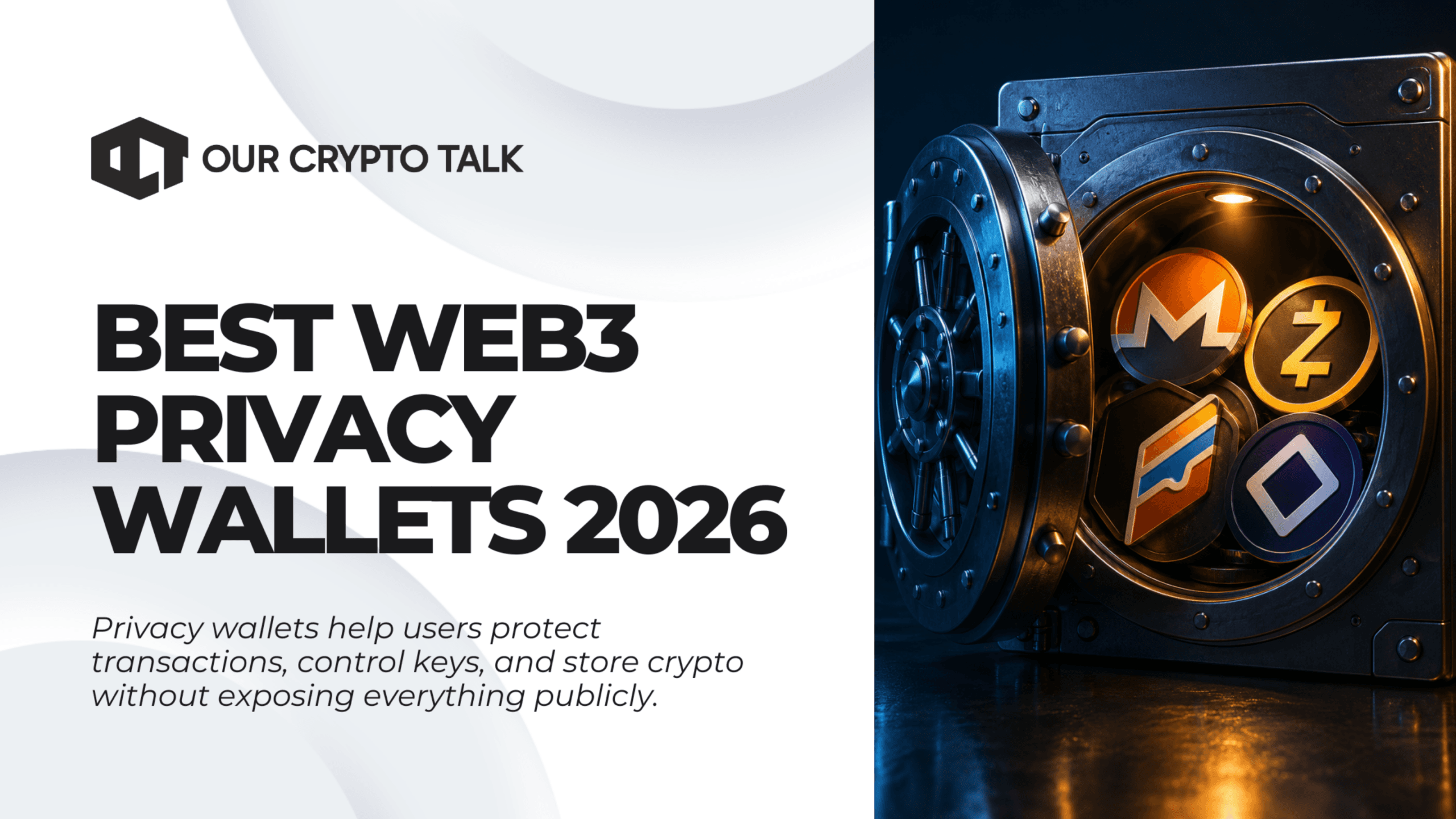
We ranked the best Web3 privacy wallets of 2026 with zero affiliate deals. Monero, Zcash, Railgun DeFi, and Bitcoin picks, plus the red flags we used to cut the rest.

Author: Kritika Gupta
Most crypto wallets still operate on fully transparent chains, so users who actually care about financial privacy need Web3 Privacy Wallets built around privacy-first protocols, shielded transactions, or zero-knowledge infrastructure.
Best privacy wallets compared by use case, custody, platforms, and verdict
These wallets prioritize actual privacy guarantees instead of marketing buzzwords or inflated asset support. The underlying protocol still matters most. A “privacy wallet” running on a transparent chain without zero-knowledge protection or native shielding does not deliver meaningful privacy.
Most Web3 “privacy wallets” are not private. They simply wrap transparent blockchains in cleaner UX and marketing language. Supporting 1,000 tokens does not create privacy. A wallet only becomes private when the protocol underneath it hides transaction data by design, or when the wallet integrates a real cryptographic privacy layer such as Railgun.
That distinction matters because most affiliate-driven wallet rankings deliberately blur it.
A standard MetaMask-style wallet running on Ethereum, Solana, or BNB Chain exposes balances, addresses, transaction history, and wallet relationships publicly. Anyone can inspect that data through a block explorer. Adding a dark mode UI and calling it “private” changes nothing.
Real privacy systems work differently. Monero hides sender, receiver, and transaction amount through ring signatures, stealth addresses, and RingCT. Shielded Zcash uses zk-SNARKs to encrypt transaction details inside the shielded pool. Railgun adds zero-knowledge privacy infrastructure on top of EVM chains, allowing users to shield assets and interact privately with DeFi protocols.
If the protocol does not hide transaction data, the wallet cannot magically create privacy afterward.
The strongest privacy wallets usually share several core traits:
The opposite signals usually expose fake privacy products immediately.
Custodial wallets force users to trust a company with their keys. Closed-source wallets ask users to trust code they cannot inspect. “Privacy wallets” built on fully transparent chains without zero-knowledge shielding offer little more than cosmetic privacy.
Remote-server architecture also matters more than most users realize. Some wallets rely heavily on centralized infrastructure that receives wallet metadata or even view keys. That trade-off often improves sync speed and mobile UX, but it weakens privacy guarantees. Users who prioritize convenience usually accept that compromise without realizing it.
Privacy is not a feature checkbox. It is a security model.
A genuinely private wallet minimizes data leakage at every layer, including transaction visibility, metadata exposure, key custody, and network surveillance. Everything else is branding.
Most Web3 privacy wallets ranking exist to drive affiliate clicks, referral signups, or token sales. That incentive structure shapes the rankings long before users ever read them.
OurCryptoTalk does not accept affiliate revenue, referral payments, sponsored placements, or paid ranking positions for wallet coverage. If a wallet’s primary business model revolves around referral funnels, token presales, or influencer-driven marketing campaigns, we exclude it by default.
That immediately removed a large portion of the so-called “privacy wallet” market.
We also rejected wallets that failed basic privacy and security standards, including:
A clean UI does not matter if the wallet leaks transaction data publicly. We evaluated wallets using a narrower framework built around actual privacy guarantees:
That process naturally favored projects such as Cake Wallet, Feather, Railway, Sparrow, and shielded Zcash tooling because they solve real privacy problems instead of selling narratives.
This methodology is the trust moat. Most comparison sites cannot publish criteria like this because their rankings depend on sponsorship relationships. Many “best wallet” lists rank whichever company pays the highest affiliate commission that month. Readers rarely realize that. Privacy infrastructure demands a higher standard. We treated it that way.
Monero still sets the standard for on-chain privacy in 2026 because the protocol hides sender, receiver, and transaction amount by default. Wallet quality matters, but Monero’s protocol-level protections remain the real foundation underneath every recommendation here.
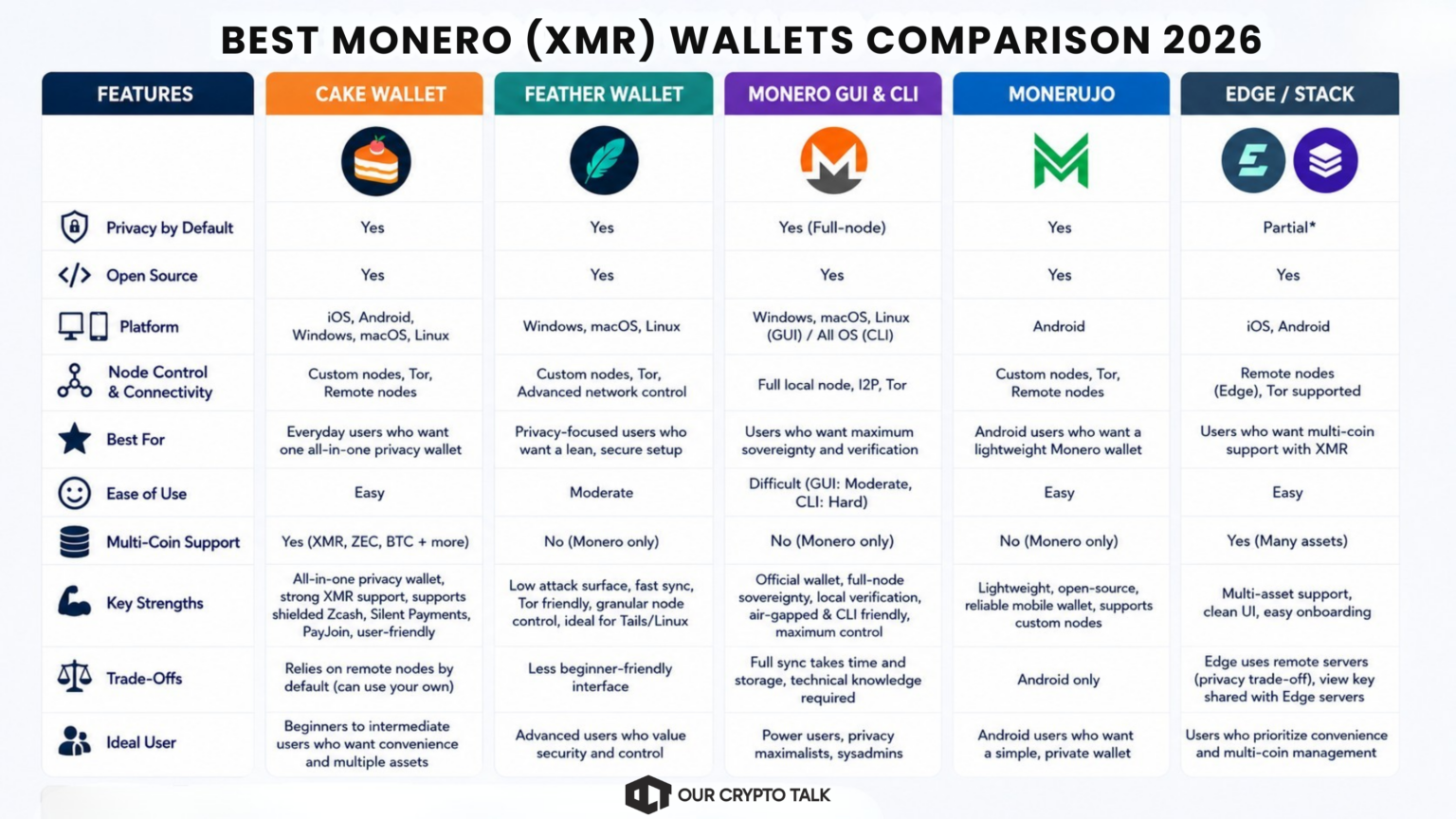
Cake Wallet
Cake Wallet became the default recommendation for most Monero users after MyMonero shut down in January 2026. The wallet combines strong Monero support with multi-platform availability across mobile and desktop, while remaining fully open-source and non-custodial.
Cake now also supports shielded Zcash, Bitcoin Silent Payments, and PayJoin, which makes it the strongest all-round privacy wallet currently available. The app handles daily spending well, syncs reliably, and offers a much cleaner onboarding experience than most legacy privacy wallets.
Users who want one privacy-focused wallet for Monero, Bitcoin, and shielded Zcash will probably end up here. Users who want maximum minimalism or a pure Monero-only setup may prefer Feather or Monero GUI instead.
Feather Wallet
Feather targets users who want a leaner and more security-conscious Monero desktop environment. The wallet focuses heavily on low attack surface, custom node control, Tor integration, and lightweight performance without sacrificing advanced functionality.
It syncs faster than Monero GUI in many setups and avoids unnecessary interface complexity. Feather also works particularly well on Tails and hardened Linux environments. Advanced users who care about operational privacy often prefer it because the wallet exposes more networking and node-level control directly inside the UI. Absolute beginners may find the experience less intuitive than Cake Wallet, especially if they do not understand remote nodes or Tor routing.
Monero GUI and CLI
The official Monero GUI and CLI remain the gold standard for users who want maximum sovereignty and local verification. The community maintains both tools directly, and they provide the cleanest path toward full-node operation with fully local blockchain sync.
The CLI remains especially valuable for air-gapped systems, scripting, and hardened privacy setups. No other Monero wallet gives users this level of raw control over the protocol itself. The trade-off is convenience.
Full local sync requires storage, patience, and technical understanding. Casual mobile-first users will likely find Cake or Monerujo more practical for daily use.
Monerujo
Monerujo remains the Android staple for Monero users. The wallet stays lightweight, open-source, and privacy-focused while supporting custom nodes and reliable day-to-day spending.
It avoids unnecessary bloat and continues serving as one of the cleanest mobile Monero experiences available. iPhone users obviously cannot use it, and users seeking multi-coin support will need a broader wallet.
Edge and Stack
Edge and Stack still serve users who want multi-coin compatibility alongside Monero support. However, Edge uses remote infrastructure that receives a Monero view key during sync, which creates a real privacy trade-off in exchange for convenience and speed. Privacy-focused users should understand that compromise clearly before using it.
Zcash privacy only exists inside the shielded pool. That remains the most important thing users need to understand in 2026. Transparent ZEC transactions expose sender, receiver, and amount publicly, just like Bitcoin. Users only receive Zcash privacy when they actively use shielded addresses and shielded transfers.
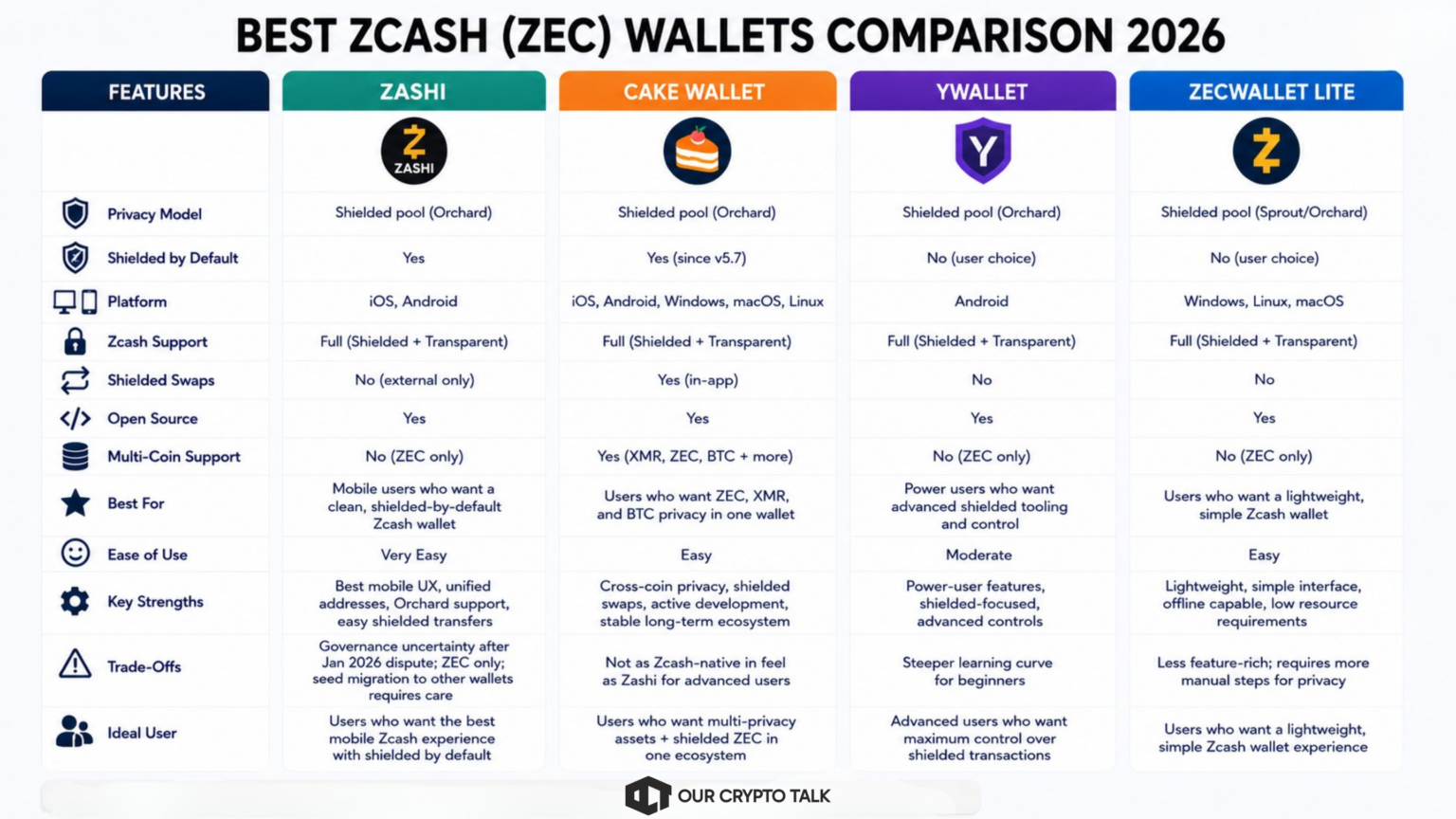
That distinction shaped the entire Zcash wallet landscape this year.
Zashi
Zashi remains the leading shielded-by-default Zcash wallet for mobile users. The wallet delivers one of the cleanest UX experiences in privacy crypto, with unified addresses, Orchard shielded support, and simple onboarding for newer users. It also pushed shielded usage further into the mainstream by making private transfers feel less intimidating than older Zcash tooling.
However, users should understand the governance situation surrounding the project. In January 2026, disagreements between the Bootstrap nonprofit and former Electric Coin Co. staff created a public dispute around governance direction and long-term stewardship of Zashi. The wallet still functions normally, and shielded infrastructure remains intact, but the situation introduced some uncertainty around roadmap confidence and future development alignment. That is a governance concern, not a protocol failure.
Users moving away from Zashi should also note that seed migration into Cake Wallet requires careful handling because wallet implementations and backup flows differ slightly.
Cake Wallet
Cake Wallet strengthened its position dramatically after adding default-shielded Zcash support in January 2026 through version 5.7. The wallet now supports shielded transactions and in-app shielded swaps while combining Zcash, Monero, and Bitcoin privacy features inside one ecosystem.
That cross-coin flexibility gives Cake a strong advantage for users who already hold Monero or use Bitcoin privacy tools alongside shielded ZEC. The app also feels more stable from a long-term ecosystem perspective because it does not depend entirely on one chain or governance structure.
Users who want a pure Zcash-native experience may still prefer Zashi’s interface, but Cake currently offers the strongest multi-privacy-asset setup in crypto.
Ywallet and Zecwallet Lite
They remain viable alternatives for users who want lighter or more specialized Zcash environments. Ywallet focuses heavily on shielded functionality and power-user tooling, while Zecwallet Lite still serves users who prefer simpler lightweight access without running heavier infrastructure.
The practical takeaway remains simple: shielded usage matters more than branding. A “Zcash wallet” does not automatically create privacy if users continue operating entirely through transparent addresses.
This category represents the real frontier for Web3 privacy wallets in 2026.
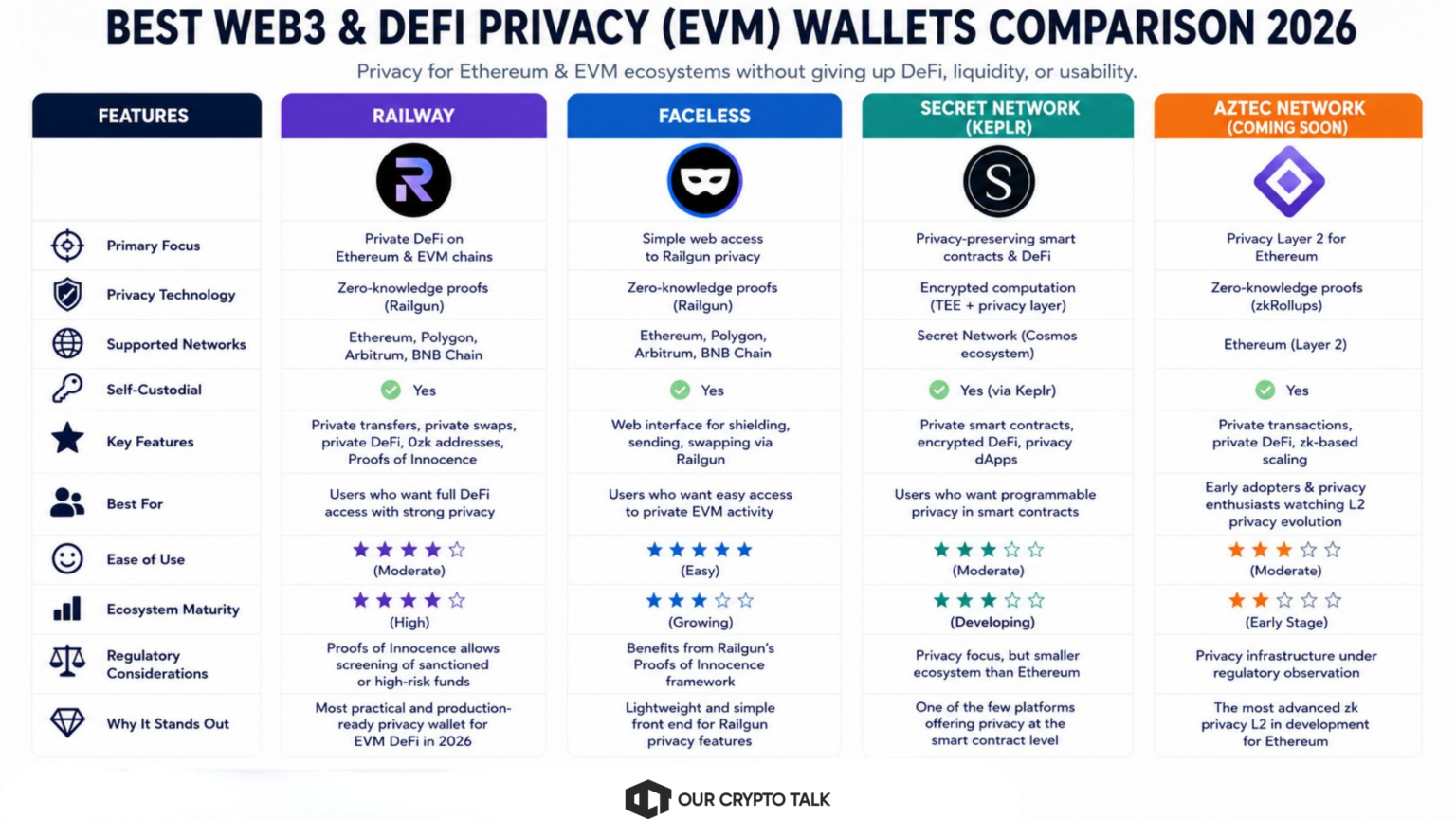
Traditional privacy coins such as Monero and Zcash protect transfers well, but they cannot natively interact with Ethereum DeFi, lending markets, perpetuals, NFT ecosystems, or on-chain trading infrastructure. At the same time, standard EVM wallets such as MetaMask expose nearly everything publicly through block explorers like Etherscan.
Wallet balances, transaction history, swaps, LP positions, bridge usage, and wallet relationships remain fully transparent by default. That transparency created a massive gap between DeFi usability and financial privacy. Railway currently offers the strongest practical solution to that problem.
Built on Railgun’s zero-knowledge infrastructure, Railway allows users to shield assets into private 0zk addresses while maintaining access to major EVM ecosystems. The wallet operates as fully self-custodial and open-source, while supporting private transfers, private swaps, and private DeFi activity across Ethereum, Polygon, Arbitrum, and BNB Chain.
Instead of broadcasting every wallet action publicly, Railway uses zero-knowledge proofs to break the visible on-chain link between wallet identity and transaction activity.
One of the more important design decisions inside the Railgun ecosystem is “Proofs of Innocence.” That system allows users and integrators to screen out sanctioned or high-risk funds without exposing the entire privacy pool. Regulators and institutions increasingly view that distinction as important because it separates privacy infrastructure from indiscriminate laundering narratives.
The broader regulatory environment also shifted slightly in 2026.
In April 2026, a US Treasury report acknowledged that privacy tools and mixers can serve legitimate financial privacy purposes beyond illicit activity. The report did not eliminate regulatory pressure, but it reduced some of the blanket hostility surrounding privacy infrastructure after years of enforcement-heavy narratives.
Several adjacent projects also deserve attention. Faceless operates as a lightweight web front end for Railgun users who want simpler access to shielded EVM activity without heavier wallet complexity.
Secret Network, primarily accessed through Keplr, continues building privacy-preserving smart contract infrastructure through encrypted computation models. Its ecosystem remains smaller than Ethereum’s, but it still represents one of the few serious attempts at programmable on-chain privacy.
Aztec remains the privacy Layer 2 to watch closely. The project spent years developing zk-based privacy infrastructure for Ethereum and continues progressing toward broader deployment. Users should verify mainnet and production-readiness status before committing significant capital because rollout timelines have shifted multiple times.
The practical reality remains simple: standard Web3 wallets expose nearly everything. Railway and Railgun currently provide the clearest path toward usable DeFi privacy without abandoning Ethereum liquidity entirely.
Bitcoin privacy changed dramatically over the last several years, and most older guides no longer reflect reality.
The CoinJoin era was effectively gutted.
Samourai Wallet collapsed after US authorities arrested its founders in 2024, while Wasabi Wallet removed CoinJoin support and blocked US users earlier the same year. Those crackdowns reshaped the entire Bitcoin privacy landscape because CoinJoin had become the dominant retail privacy tool for self-custody Bitcoin users.
What remains today is more fragmented, more manual, and significantly less forgiving than Monero’s default privacy model.
Modern Bitcoin privacy now depends heavily on operational discipline.
Users need to manage UTXOs carefully, avoid address reuse, separate wallet clusters properly, and understand how transaction graph analysis works. Wallets such as Sparrow and Electrum remain important because they expose detailed coin control functionality directly to users instead of hiding it behind simplified UX.
Sparrow Wallet currently leads this category for serious self-custody users. The wallet provides advanced coin labeling, transaction editing, Tor support, PayJoin support, and detailed UTXO management tools. It also integrated newer privacy improvements such as Silent Payments, which help reduce address reuse and metadata leakage.
Electrum still serves advanced Bitcoin users well because of its flexibility, lightweight architecture, and mature ecosystem support. However, it requires significantly more technical understanding than modern mobile-first wallets.
Cake Wallet also deserves mention because it brought newer Bitcoin privacy tooling into a more accessible mobile environment. The wallet now supports Silent Payments and PayJoin alongside Monero and shielded Zcash functionality, making it one of the few practical cross-chain privacy wallets available.
Even with those improvements, Bitcoin privacy still remains fundamentally weaker than Monero privacy.
Bitcoin’s ledger stays fully transparent, and most privacy techniques only reduce traceability rather than eliminate it entirely. Sophisticated chain analysis companies still cluster addresses, analyze spending behavior, and identify patterns through metadata leakage.
That does not make Bitcoin privacy impossible. It simply makes it operationally demanding.
Readers should understand that clearly before treating Bitcoin as a substitute for privacy-native protocols.
Hardware wallets solve a different problem than privacy wallets.
Devices such as Ledger and Trezor protect private keys against remote theft, malware, phishing, and compromised computers. They improve key security. They do not make transactions private.
That distinction confuses many crypto users.
A Ledger holding Monero does not create Monero privacy on its own. The Monero protocol itself hides sender, receiver, and transaction amount through ring signatures, stealth addresses, and RingCT. The hardware wallet simply stores the keys securely while the protocol handles the privacy layer underneath.
The same logic applies to Zcash and shielded transactions.
In 2026, most major hardware wallets support Monero through integrations with wallets such as Cake Wallet, Feather, Monero GUI, Monero CLI, and Monerujo. Shielded Zcash support remains more limited and fragmented, so users should verify the latest official compatibility matrices before moving large balances into cold storage setups.
The mental model matters more than the brand.
Hardware wallets function as the cold-storage security layer for long-term holdings. Software privacy wallets function as the spend-and-interact layer for actual on-chain activity.
Most experienced privacy users separate those roles deliberately:
That separation reduces attack surface while preserving usability.
The gap between those two layers is also narrowing gradually.
Railgun’s ongoing Ledger integration work signals where the market is moving next. Privacy infrastructure and hardware-backed key security increasingly operate together instead of as separate ecosystems. Over time, users will likely expect both layers by default.
For now, the important takeaway stays simple: hardware wallets protect keys, not transaction visibility. Privacy still depends entirely on the protocol and wallet infrastructure underneath.
Web3 privacy wallets can reduce on-chain exposure. They cannot fix poor operational security.
That distinction matters because many users treat privacy tools as automatic protection, then unknowingly leak their identity through behavior instead of technology.
The most common mistake starts at the funding layer.
Sending funds directly from a KYC exchange into a privacy wallet permanently links the withdrawal to a real-world identity. Even if the destination wallet uses Monero, shielded Zcash, or Railgun afterward, the initial exchange withdrawal still creates a traceable connection. Privacy tools can reduce future visibility, but they cannot erase historical identity links that already exist.
Address reuse creates another major problem.
Reusing transparent Bitcoin or Ethereum addresses allows block explorers and analytics firms to cluster activity together over time. Even partial privacy setups break down quickly when users repeatedly expose the same wallet relationships publicly.
Network-level privacy matters too.
Users who ignore Tor routing, custom node settings, VPN separation, or remote-server exposure often leak metadata even while using technically private protocols. A wallet may hide transaction contents successfully while still exposing IP-level or behavioral information elsewhere.
The broader regulatory environment also complicates things.
In some jurisdictions, simply interacting with shielded pools, mixers, or privacy infrastructure can attract additional scrutiny regardless of user intent. Privacy tools serve legitimate financial confidentiality purposes, but regulators and analytics firms still monitor flows into privacy ecosystems closely.
That does not mean users should avoid privacy tools entirely. It means they should understand the trade-offs clearly instead of assuming privacy software creates invisibility.
Operational security always matters more than marketing claims.
Users who want stronger privacy should think in layers:
Weakness at any one layer can compromise the rest.
Readers who want the deeper regulatory, operational, and acquisition side of this topic should review the broader privacy guides before moving significant capital through shielded ecosystems.
Most users do not need ten Web3 privacy wallets. They need the right wallet for the specific privacy problem they are trying to solve.
The decision framework is actually straightforward.
Users who primarily hold and spend Monero should use Cake Wallet or Feather. Cake delivers the best balance between usability, multi-platform support, and cross-chain privacy features. Feather fits users who want tighter node control, lower attack surface, and a more hardened desktop environment.
Users focused on shielded Zcash should use Zashi or Cake Wallet. Zashi still offers the cleanest shielded-first mobile experience, while Cake provides stronger multi-asset flexibility across Monero, Bitcoin, and shielded ZEC.
Users who want private Ethereum and DeFi activity should use Railway. Standard EVM wallets expose nearly every transaction publicly. Railway and Railgun currently provide the clearest path toward usable self-custodial DeFi privacy without abandoning Ethereum liquidity entirely.
Users holding large long-term balances should separate storage from interaction. Use a hardware wallet such as Ledger or Trezor for cold storage, then use a software privacy wallet for spending, swaps, and shielded activity. Hardware wallets protect keys. Privacy wallets protect transaction visibility. They solve different problems.
Users who still want Bitcoin privacy should use Sparrow with disciplined coin control, PayJoin, Silent Payments, and careful UTXO management. That setup works, but it requires significantly more operational discipline than Monero. Readers should understand that trade-off honestly before relying on Bitcoin for serious privacy.
The broader conclusion matters more than any individual wallet recommendation.
The best Web3 privacy wallets become useless if the protocol underneath it exposes transaction data publicly. Strong privacy also collapses quickly when users ignore operational security, fund wallets carelessly, or reuse transparent addresses repeatedly.
Use a privacy wallet if you value financial confidentiality, self-custody, and reduced on-chain surveillance.
Skip it if you are comfortable with transparent transactions, exchange-linked identities, and public wallet histories. There is no middle ground that magically delivers privacy without responsibility.