Quantum Threat to Bitcoin: Resistant Altcoins
Quantum computing poses a threat to Bitcoin. Learn about vulnerabilities, impacts, and which altcoins are resistant to quantum attacks


Author: Chirag Sharma
Quantum computing has emerged as one of the most powerful technological shifts of the 21st century. It promises to revolutionize areas such as medicine, logistics, and artificial intelligence. At the same time, it presents a direct threat to systems built on classical cryptography. Bitcoin, the pioneer cryptocurrency, is at the center of this debate.
For more than a decade, Bitcoin’s cryptographic foundation has stood strong against hackers and nation-states. Yet, the arrival of quantum machines capable of solving problems once thought impossible could change everything. If quantum algorithms can break Bitcoin’s digital signatures or weaken its hashing security, the results would be catastrophic for the entire crypto ecosystem.
Reports from global institutions have already sounded the alarm. A 2022 Hudson Institute study warned that a quantum hack could cause trillions of dollars in losses. By 2025, Deloitte and other firms emphasized that about one quarter of all Bitcoins in circulation are at risk because their public keys are exposed. At the same time, governments and researchers have begun pushing for post-quantum cryptography standards.

This article explores the quantum threat to Bitcoin: vulnerabilities, impacts, and resistant cryptocurrencies. We will look at how Bitcoin’s cryptography works today, why quantum computing introduces new risks, what would happen if those risks materialize, and which altcoins are building solutions for a post-quantum world.
The Context of Quantum Threat to Bitcoin
Bitcoin’s security model relies on two cryptographic building blocks. The first is the Elliptic Curve Digital Signature Algorithm (ECDSA), which protects private keys and ensures that only the owner of a Bitcoin address can authorize a transaction. The second is SHA-256, a hashing function that secures the blockchain by making it computationally impossible for attackers to alter past transactions without redoing enormous amounts of work.
These systems have proven safe against classical computing. Supercomputers, with all their power, cannot brute force ECDSA keys or reverse SHA-256 hashes within any realistic timeframe. This is why Bitcoin has grown into a trillion-dollar asset.
Quantum computing, however, changes the landscape. By exploiting quantum mechanics, algorithms such as Shor’s can break ECDSA, while Grover’s can weaken SHA-256. The result is that what seems impossible for classical systems may become feasible within a decade.
Warnings about this are not theoretical. Deloitte, in recent reports, noted that nearly 25 percent of all Bitcoin addresses are vulnerable because they expose their public keys. These addresses represent millions of coins that could be stolen once a quantum machine of sufficient scale is built. The Hudson Institute projected losses of up to three trillion dollars if a successful attack were launched against Bitcoin’s network.
Forbes Highlights The Issue
In June 2025, Forbes highlighted the urgency of the issue of quantum threat to Bitcoin, pointing out that major players like Google and IBM had achieved key milestones in error correction and scaling quantum processors. Meanwhile, at the All-In Summit 2025, Solana’s co-founder Anatoly Yakovenko stated that Bitcoin must move to quantum-resistant cryptography within five years to remain secure.
Governments are not ignoring the threat. The US National Institute of Standards and Technology (NIST) finalized its post-quantum cryptography standards in 2024. Algorithms such as CRYSTALS-Kyber and CRYSTALS-Dilithium have already been recommended as replacements for classical methods. The challenge, however, is that Bitcoin is decentralized. Unlike a corporation that can upgrade its security in one stroke, Bitcoin requires broad consensus across miners, developers, and users.
The risks are further magnified by a concept known as “harvest now, decrypt later.” Attackers can already record blockchain data today and simply wait for quantum capabilities to catch up. When that happens, past transactions with exposed keys could be compromised retroactively.
In short, the crypto community is entering a decisive moment. Quantum progress is no longer a distant possibility. With estimates pointing to a cryptographically relevant quantum computer by 2030, Bitcoin has a limited window to adapt.
Why Current Cryptography Is Strong
To understand why quantum computing is such a threat to Bitcoin and crypto, it is important to recognize why Bitcoin’s cryptography is considered strong in the classical sense.
At the heart of Bitcoin’s security is ECDSA, which relies on the elliptic curve discrete logarithm problem. Given a public key, it is practically impossible for a classical computer to derive the private key. With 256-bit security, the number of possible keys is astronomical. Even with the fastest supercomputers, brute forcing would take longer than the age of the universe. This makes private keys safe against current attacks.
SHA-256, the hashing algorithm that underpins proof-of-work, is equally robust. It takes any input and produces a 256-bit output. Finding two inputs that result in the same hash (a collision) or reversing a hash to reveal its input is computationally infeasible. This ensures the blockchain’s immutability. To alter a single block, an attacker posing the quantum threat to Bitcoin would need to redo the proof-of-work for every subsequent block faster than the rest of the network combined. With the Bitcoin network currently running at more than 600 exahashes per second, such an attack is impossible with classical technology.
Bitcoin also uses Merkle trees and one-way functions to secure transactions, providing integrity and efficiency. These cryptographic tools have been scrutinized for decades by researchers and adopted by global standards bodies.
The Challenges Posed by Quantum Computing
Quantum computing is not just another incremental upgrade in hardware. It changes the rules of what can be solved. For Bitcoin, two algorithms stand out:
- Shor’s Algorithm
- Designed in the 1990s.
- Can break elliptic curve cryptography by solving the discrete logarithm problem in polynomial time.
- In practice, this means it could derive private keys from public keys quickly, making it possible to forge transactions.
- Grover’s Algorithm
- Provides a quadratic speed-up for search problems.
- Effectively halves the security of SHA-256 from 256 bits to about 128 bits.
- Still secure for now, but the margin shrinks.
What does this mean for Bitcoin today?
- Hardware is the bottleneck.
Current machines like IBM’s Eagle (127 qubits) or Google’s Sycamore can show “quantum supremacy” in narrow tasks. But they are nowhere near strong enough to break ECDSA. To crack Bitcoin, we would need millions of stable, error-corrected qubits. - Error correction is a mountain.
Today’s quantum computers have error rates of about 1 in 1,000 operations. Scaling up to millions of logical qubits will require massive advances in error correction. - Timeline pressure.
Some researchers say we are 10–15 years away from a cryptographically relevant quantum computer. Others argue that breakthroughs in error correction could shorten this to under 5 years. IonQ’s 2025 announcement of early fault-tolerant systems shows that progress is accelerating.
But the hardware is only part of the challenge. Bitcoin’s decentralized structure makes upgrades difficult:
- Any major change, like adopting a post-quantum signature scheme, requires either a soft fork or a hard fork.
- History shows this can be contentious. Remember SegWit? Even small upgrades led to community splits.
- Miners may resist changes that impact profitability, while users may be slow to migrate to new wallet formats.
And then there is geopolitics. Governments like the US have recommended migration to PQC by 2035, but Bitcoin has no central authority to enforce a deadline. Meanwhile, state actors could already be stockpiling blockchain data under the “harvest now, decrypt later” strategy.
Finally, quantum threat to bitcoin and other crypto projects could also disrupt mining. If Grover’s algorithm were applied efficiently, it might tilt the playing field toward actors with access to quantum machines, creating centralization risks. The very decentralization that makes Bitcoin resilient could be undermined.
In short, the challenges are not only technical but also social, political, and economic.
What If Quantum Computers Actually Crack It?
Let’s imagine the nightmare scenario.
- Immediate impact:
- Market reaction:
- Holders would panic. Even wallets not directly exposed could face sell-offs.
- Bitcoin ETFs, reserves held by companies, and even countries like El Salvador would see their balance sheets collapse.
- The broader crypto market, heavily correlated with Bitcoin, could lose trillions.
- Privacy risks:
- Beyond theft, attackers could reveal transaction histories. This opens the door to surveillance, extortion, and blackmail.
- Mining chaos:
- With Grover’s algorithm in play, a well-funded attacker could achieve a 51% attack more cheaply. This means rewriting history, double-spending, and breaking trust in the chain.
Could Bitcoin recover? Possibly. Emergency hard forks could roll out post-quantum signatures. But there are problems:
- Coordination would take time, and attackers would not wait.
- Users would need to migrate their funds, creating network congestion.
- Trust, once broken, is hard to rebuild.
Ironically, such a disaster might accelerate the adoption of quantum-resistant systems. But the damage to Bitcoin’s dominance would already be done. Prevention is clearly better than crisis management.
Quantum-Resistant Altcoin Projects and Their Approaches
This is where alternative projects come in to cater this quantum threat to Bitcoin and Altcoins. Some blockchains have been designed from the ground up with quantum threats in mind. Others have added flexibility so they can swap out vulnerable cryptography when needed. Let’s look at them.
Quantum Resistant Ledger (QRL)
QRL deserves the top spot because it was built for exactly this problem. While Bitcoin relies on ECDSA, QRL uses the XMSS (eXtended Merkle Signature Scheme).
Here’s why that matters:
- XMSS is hash-based. Shor’s algorithm cannot break it because it doesn’t rely on elliptic curve math.
- Each address uses one-time signatures, preventing key reuse risks.
- It has been standardized by the IETF, so it is not experimental theory but a recognized standard.
QRL also brings:
- Smart contract capabilities, so developers can build quantum-safe dApps.
- Tools for secure migration, helping users move funds without exposing themselves.
- The ability to add future PQC algorithms, making it adaptable.
Think of QRL as a hedge against Bitcoin’s inertia. Since its launch in 2018, it has proven that quantum resistance can be live on a blockchain, not just in research papers.
In a world where Bitcoin’s upgrade process is painfully slow, QRL shows what proactive design looks like. It is not the biggest blockchain, but it is a pioneer in showing the path forward.
IOTA
IOTA takes a different route with its Tangle, a Directed Acyclic Graph instead of a linear blockchain. This structure was built for the Internet of Things, where billions of devices may need to send micropayments.
For signatures, IOTA employs Winternitz One-Time Signature Plus (W-OTS+). Like XMSS, it is hash-based and quantum-resistant. Each signature can only be used once, but the Tangle is optimized to handle this without slowing down.
Key strengths:
- Feeless transactions, perfect for machine-to-machine payments.
- Coordicide upgrade, which removes the Coordinator node and makes the system more decentralized.
- Flexibility to incorporate future PQC algorithms.
Why does this matter? Because IoT devices are among the most vulnerable to quantum attacks. They are small, resource-constrained, and often poorly secured. If quantum computers become practical, billions of IoT transactions could be at risk. IOTA aims to solve that by embedding quantum safety into its foundations.
It may not have the same visibility as Bitcoin or Ethereum, but in terms of quantum readiness, IOTA is far ahead of most.
Nervos Network (CKB)
Nervos is less famous than IOTA or Algorand, but its design makes it very flexible for a quantum future. At its core is the Common Knowledge Base (CKB), a layer-1 blockchain that can support multiple cryptographic primitives.
Here’s why it matters for quantum resistance:
- Layered architecture: The CKB base layer focuses on security and storage, while upper layers can handle computation and scaling. This separation makes it easier to swap in new cryptography when needed.
- RISC-V virtual machine: Nervos uses a developer-friendly VM that allows multiple signature schemes to coexist. This means that post-quantum algorithms, like lattice-based or hash-based schemes, can be added without a full system redesign.
- Grover resistance: Its proof-of-work function, Eaglesong, is designed to be memory-intensive. Even with Grover’s quadratic speed-up, the cost of attacking the network remains extremely high.
In simple terms, Nervos is building cryptographic agility into its DNA. While Bitcoin struggles with hard forks, Nervos can evolve more smoothly. For developers and institutions planning for the long term, that flexibility is a serious advantage.
Algorand (ALGO)
Algorand is another strong contender in the quantum-resistant conversation. Founded by MIT cryptographer Silvio Micali, it was designed with both efficiency and future-proofing in mind.
Its quantum defense lies in Falcon, a lattice-based digital signature algorithm. Falcon was one of the finalists in NIST’s post-quantum cryptography competition, recognized for compact signatures and efficient verification.
Other strengths worth noting:
- Pure Proof of Stake (PPoS): Algorand uses a highly efficient PoS system that randomly selects validators. This reduces attack surfaces compared to traditional staking models.
- Fast finality: Transactions confirm in seconds, leaving little room for reorganization attacks.
- Research credibility: With Micali’s leadership and academic backing, Algorand has earned trust as a protocol built on rigorous science.
Why does this matter? If quantum computers advance faster than expected, Algorand already has a recognized post-quantum signature scheme embedded. This positions it ahead of Bitcoin, which still relies on vulnerable elliptic curves.
In short, Algorand combines performance with forward-looking cryptography. For enterprises exploring blockchain adoption, that combination is compelling.
Cardano (ADA)
Cardano takes a different approach by relying on peer-reviewed research and a phased roadmap. While its cryptography is not yet quantum-resistant by default, its Ouroboros Praos consensus protocol is designed to integrate new cryptographic primitives over time.
What makes it interesting for quantum defense is governance. Cardano’s Voltaire era introduces decentralized decision-making, meaning the community can vote to adopt post-quantum algorithms when needed. This makes upgrades smoother compared to Bitcoin’s slow consensus process.
The team has also published research on integrating hash-based or lattice-based signatures into the protocol. While not fully live today, the foundation is there for a community-driven transition to PQC.
Cardano is not leading the race yet, but it shows how governance and research can prepare a network for quantum challenges.
Other Mentions
Some smaller projects also deserve mention. Ozone Chain (OZO) integrates quantum key distribution (QKD), an advanced method of using quantum physics to secure communications. XX Network, founded by David Chaum, leverages cMix and quantum-resistant mixnets to provide private, future-proof messaging and payments. These niche efforts show the diversity of quantum-secure innovation.
Conclusion
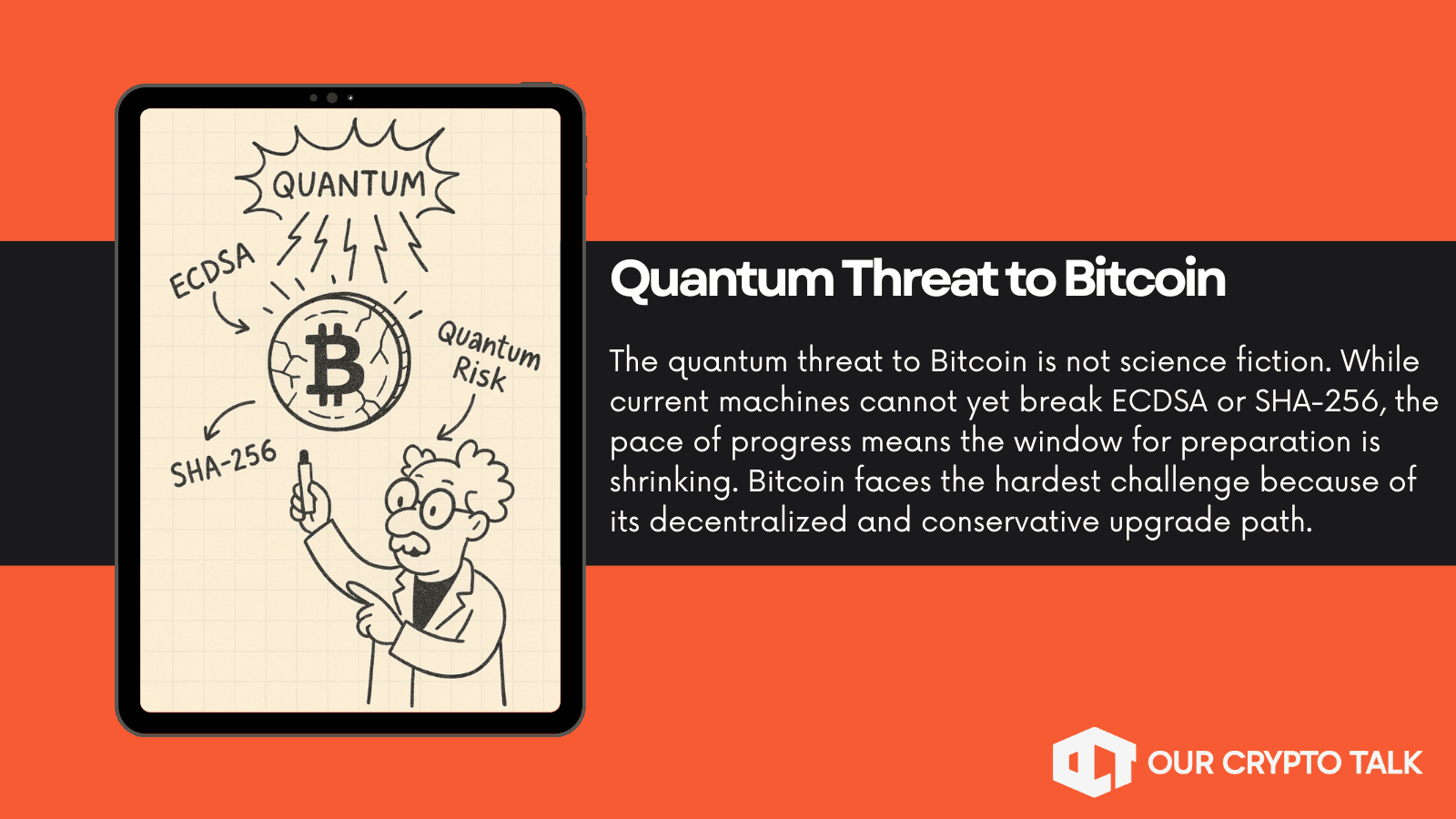
The quantum threat to Bitcoin is not science fiction. While current machines cannot yet break ECDSA or SHA-256, the pace of progress means the window for preparation is shrinking.
Bitcoin faces the hardest challenge because of its decentralized and conservative upgrade path. By contrast, altcoins like QRL, IOTA, Nervos, Algorand, and Cardano demonstrate different strategies for building quantum resistance today.
The path forward will require collaboration, cryptographic agility, and willingness to adopt NIST-approved algorithms. The industry must treat this as urgent rather than optional.
In the end, quantum risk could become a catalyst. If addressed proactively, it may strengthen trust in cryptocurrencies and spark a new wave of innovation.
Frequently Asked Questions
What is the quantum threat to Bitcoin?
How soon could quantum computers threaten Bitcoin?
Which part of Bitcoin’s security is at risk from quantum computing?
Are all Bitcoins equally vulnerable to quantum attacks?
What happens if quantum computers actually break Bitcoin’s cryptography?
Which cryptocurrencies are already quantum-resistant?
Can Bitcoin adapt to become quantum-resistant?
In this article
The Context of Quantum Threat to BitcoinWhy Current Cryptography Is StrongThe Challenges Posed by Quantum ComputingWhat If Quantum Computers Actually Crack It?Quantum-Resistant Altcoin Projects and Their ApproachesConclusion