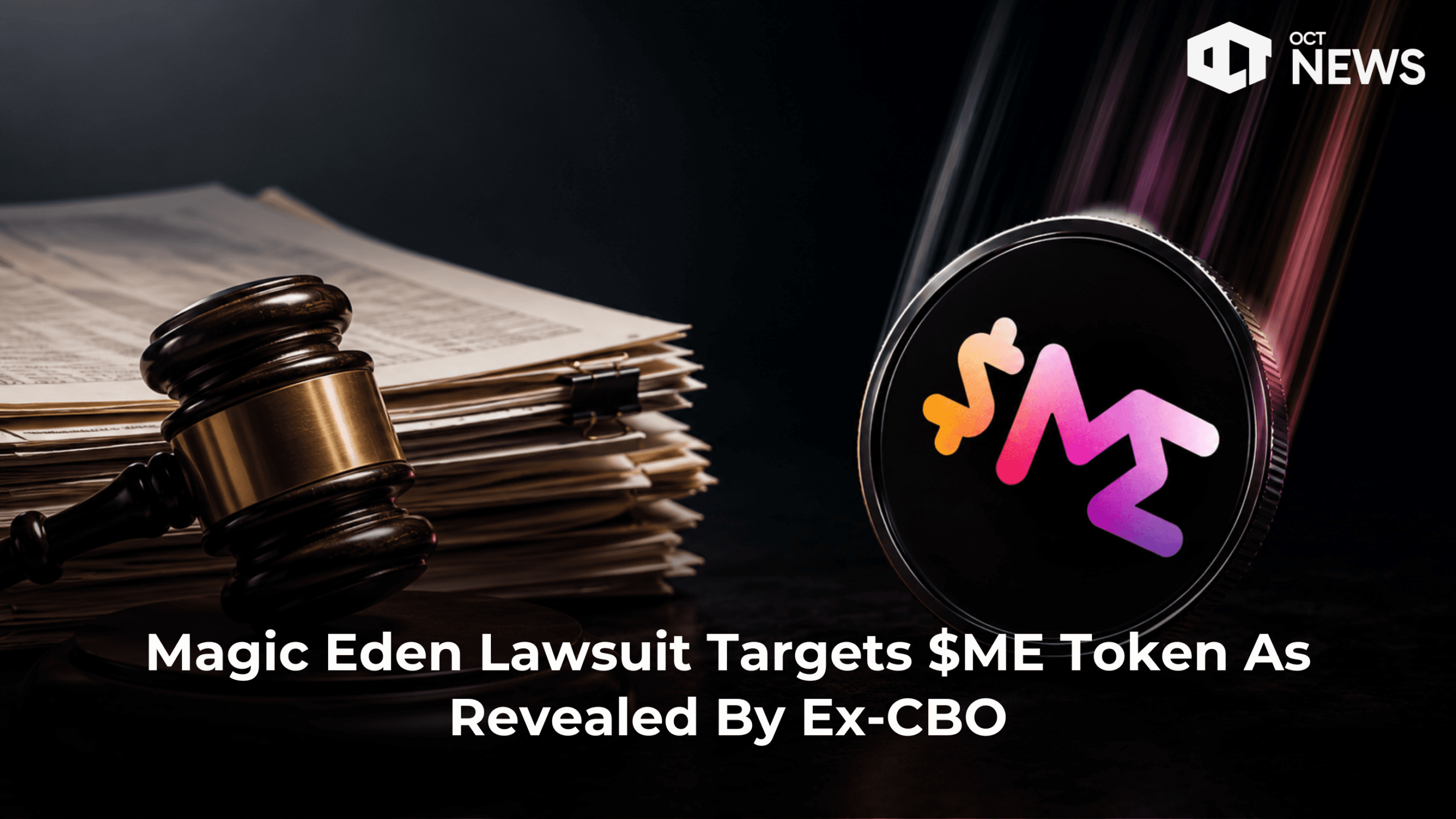
A new Magic Eden lawsuit accuses the marketplace and its founders of misleading $ME token buyers. Plaintiffs say promised features never fully arrived.

Author: Sahil Thakur
30th June 2026 – A new Magic Eden lawsuit accuses the marketplace and its founders of misleading $ME token buyers. Plaintiffs say promised features never fully arrived.
High Signal Summary For A Quick Glance

Run 📈
@romantradez

This could be the reason why @MagicEden is getting out of the marketplace industry, they could be forced to refund considerable losses incured by $ME holders Class action was opened on June 16th for alleged failures to deliver on key promises around the token including its muti https://t.co/kFwyg9tLPb

12:51 AM·Jun 30, 2026

MSB Intel
@MSBIntel
BREAKING: A federal class action accuses Magic Eden of misleading buyers of $ME, a token down 99% from its 2024 launch. The suit pleads New York consumer-protection and misrepresentation claims, not securities law, over token utilities it says arrived late or never. https://t.co/Ovh4EtEY3n

12:14 AM·Jun 30, 2026
Three named plaintiffs filed the proposed class action on June 16, 2026, in a New York federal court. They sued on behalf of $ME buyers across the country.
The case is titled Pagan v. Lu and carries docket number 1:26-cv-03608. Jaime Pagan, Ariel Ruano, and Chris Sadowski lead it as named plaintiffs.
The defendants include chief executive Jack Lu and co-founders Zhuoxun Yin, Sidney Zhang, and Zhuojie Zhou. Plaintiffs also named Euclid Labs Inc., which does business as Magic Eden, plus the ME Foundation.
According to the complaint, the defendants marketed $ME as a serious product with real utility. The filing says many of those features arrived late, changed, or never shipped.
The plaintiffs bring claims under New York consumer-protection law. They also add common-law claims for negligent misrepresentation and unjust enrichment, according to coverage from South Shore Press.
Magic Eden started in 2021 and quickly became the top NFT marketplace on Solana. Investors backed it heavily during the last bull market.
The company raised a $130 million Series B in 2022 at a $1.6 billion valuation, with Electric Capital and Greylock co-leading. Across all rounds it raised an estimated $157 million.
Over time, the firm pushed into broader crypto entertainment and a betting product. Then it pulled back toward Solana, which now sits at the center of the plaintiffs’ complaints.
Magic Eden launched $ME on December 10, 2024, through an airdrop and exchange listings. The ME Foundation pitched the token as the economic engine of an expanding ecosystem.
The marketing promised multi-chain functionality, ME DAO governance, and staking rewards. It also promised revenue sharing and token buybacks funded by platform revenue, according to the ME Foundation tokenomics post.
The plaintiffs say reality fell short. The company largely abandoned multi-chain support and refocused on Solana in early 2026.
Governance also arrived roughly nine months late, the filing alleges. Rewards became limited or seasonal, while the company delayed, changed, or scrapped buyback and revenue-share programs.
The company later shut down a wallet that buyers needed to claim tokens, the complaint adds. As a result, plaintiffs argue these gaps created artificial demand and pushed people to overpay.
$ME launched between roughly $4.50 and $5.64, and it peaked near $5.63, according to early market data. By late June 2026 it traded near $0.06, per CoinMarketCap.
That move marks a decline of about 99 percent from the peak. Earlier reports had pegged the drop closer to 97 percent, near $0.12.
On-chain data shows $ME lives on Solana under the official contract MEFNBX…Sam21u. Its market cap sits near $35 million, with about 579 million tokens circulating from a 1 billion supply.
Still, price alone does not prove the claims. Broad weakness across crypto and NFT markets also pressured many tokens during the same period.
The Magic Eden lawsuit avoids securities law entirely. Instead, it leans on New York General Business Law sections 349 and 350.
Section 349 targets deceptive business acts, while section 350 covers false advertising. Both focus on whether marketing misled ordinary consumers.
To win under section 349, plaintiffs generally must show consumer-facing conduct, a misleading act, and a resulting injury. The Magic Eden lawsuit ties each promised feature to that standard.
This framing matters. Securities fraud usually requires proof that buyers expected profit from the work of others, under the Howey test.
By contrast, consumer-protection claims focus on the promises themselves. Plaintiffs must show the marketing misled buyers and that buyers relied on it, according to the complaint.
The plaintiff firm, Burwick Law, has pursued similar token cases before. Courts have not tested any of these allegations, and the defendants have not responded publicly.
On X, many holders welcomed the filing and voiced frustration over delayed features and the price collapse. Some framed the launch as an airdrop that failed to deliver.
Others urged caution. They noted the case sits at an early stage, and a court could still reject the claims.
A few users said the broader NFT downturn deserves part of the blame. That debate mirrors the legal fight over what actually drove the loss.
The court has set an initial conference for July 31, 2026. A judge has not yet certified the proposed class.
Magic Eden has not issued a public statement on the filing as of June 30, 2026. The company could still contest the claims or argue that market forces drove the decline.
For now, the Magic Eden lawsuit gives $ME holders a formal channel to press their grievances. The next hearing should signal how seriously the court treats the case.
This article is informational and not financial advice. Always research tokens and legal filings yourself before acting.
Our Crypto Talk is committed to unbiased, transparent, and true reporting to the best of our knowledge. This news article aims to provide accurate information in a timely manner. However, we advise the readers to verify facts independently and consult a professional before making any decisions based on the content since our sources could be wrong too. Check our Terms and conditions for more info.