Post-Launch Token Controls : Vesting, Cliffs, and Lock-Ups
Decode vesting, cliffs, and lock-ups — the key post-launch token controls every crypto investor must know in 2025.
 Chirag Sharma
Sep 18, 2025, 10:13 AM UTC

Author: Chirag Sharma
Picture this: It’s early 2025, and a highly anticipated token just launched. Social media is buzzing, influencers are hyping, and exchanges are flooded with buy orders. The project looks unstoppable. But within hours, the price plummets. Why? Because insiders and early investors, free from restrictions, dumped massive amounts of tokens on the open market. Retail buyers are left holding the bag, and trust in the project evaporates. This scenario isn’t rare. Crypto history is filled with launches where poor planning or intentional manipulation caused early crashes. That’s why post-launch token controls like vesting, cliff periods, and lock-ups exist. They are the safeguards designed to regulate how tokens enter the market after launch, preventing chaos and building investor confidence.
In today’s landscape, these mechanisms are more relevant than ever. High-profile projects like World Liberty Financial (WLFI) in 2025 introduced detailed vesting schedules and cliffs to protect long-term value. Nexchain adopted tiered cliffs for different investor categories. Even giants like LayerZero (ZRO) have carefully managed unlock schedules, with major cliffs and lock-ups influencing trading activity well into 2025.
For investors, these terms aren’t just technical jargon but they’re tools for survival. By understanding how post-launch token controls work, you can evaluate whether a project is designed for sustainable growth or quick insider profits.
This article covers vesting, cliffs, and lock-ups. We’ll explore what they mean, how they work, why they matter, and what recent real-world examples teach us. The goal is simple: make you a smarter investor in a market where supply shocks can make or break fortunes

What Are Post-Launch Token Controls?
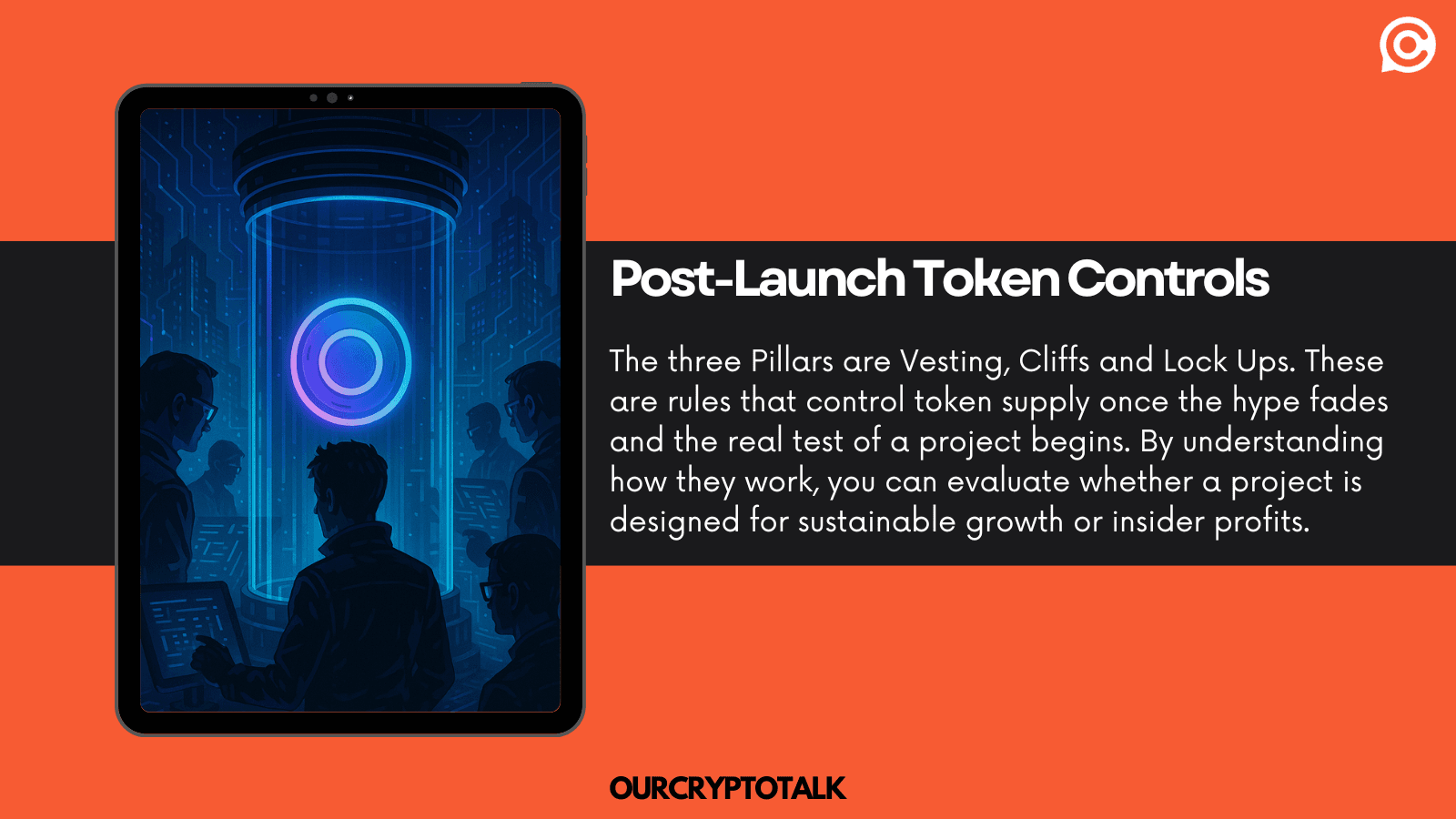
At their core, post-launch token controls are mechanisms that govern how and when tokens are released into circulation after a project’s launch—whether through an Initial DEX Offering (IDO), centralized exchange listing, or community airdrop. Think of them as a set of rules that control token supply once the hype fades and the real test of a project begins.
Why are they so critical? Because without them, projects risk flooding the market with tokens too quickly. The result: sudden price crashes, loss of investor trust, and accusations of rug pulls. Controls like vesting, cliffs, and lock-ups slow down this process, releasing tokens gradually and predictably.
Here’s a simple analogy: imagine a dam holding back water. If you open the floodgates all at once, you risk flooding the valley below. But if you release the water gradually, the ecosystem downstream thrives. Post-launch token controls are the dam of the crypto market, ensuring token supply flows steadily rather than in destructive waves.
These mechanisms have evolved alongside crypto itself. In Bitcoin’s early days, token distribution was straightforward—mining rewards halved every few years. But in modern DeFi, gaming, and infrastructure projects, sophisticated schedules are the norm. Teams, investors, and advisors often receive tokens under strict rules, designed to align their incentives with long-term project health.
The three main pillars are:
- Vesting: Gradual distribution of tokens over time, usually enforced by smart contracts.
- Cliff periods: Initial waiting periods where no tokens are released.
- Lock-ups: Broader restrictions that prevent selling or transferring tokens for a fixed time.
Together, they form a system that protects markets, builds confidence, and aligns incentives. In the sections ahead, we’ll dive into each one—starting with vesting, the foundation of all post-launch token controls.
Decoding Vesting: The Foundation of Post-Launch Token Controls
At the heart of almost every modern token launch lies vesting. It’s the rulebook for when insiders—founders, team members, early investors, and advisors—can access their allocated tokens. Instead of receiving their full share upfront, they get it gradually over time, usually according to a pre-set schedule.
Mechanically, vesting is simple but powerful. Smart contracts, most often deployed on Ethereum or similar blockchains, automatically enforce the vesting timeline. No one can bypass them—not even the project’s own founders—because the tokens remain locked until the contract releases them. This transparency makes vesting the cornerstone of post-launch token controls, ensuring trust in a system that thrives on credibility.
Why does vesting matter so much? Because it aligns incentives. Team members and advisors can’t just disappear after launch with their tokens; they have to stick around and keep building. Investors, too, are tied to the project’s long-term success. By spacing out token releases, vesting reduces the risk of sudden dumps that could crush prices.
There are several types of vesting schedules:
- Linear Vesting: Tokens are released evenly over a set period. Example: 25% of tokens per year for four years.
- Milestone-Based Vesting: Unlocks occur only when goals are met, like launching a mainnet or hitting user milestones.
- Hybrid Models: Combine cliffs and linear vesting, such as a one-year cliff followed by monthly unlocks.
Here’s a sample 4-year vesting schedule with a 1-year cliff:
- Year 1: 0% unlocked (cliff period).
- Year 2: 25% unlocked, then monthly releases.
- Year 3: 25% unlocked.
- Year 4: 25% unlocked.
- Year 5: Final 25% unlocked.
This design ensures that insiders don’t benefit until they’ve proven long-term commitment.

In essence, vesting serves as the foundation of post-launch token controls. It’s not just about slowing down token release, it’s about tying rewards to loyalty, progress, and performance.
The Role of Cliff Periods in Post-Launch Token Controls
Now let’s talk about cliff periods. If vesting is the long-term roadmap, cliffs are the speed bumps at the start. A cliff period is a span of time—commonly 6 to 12 months—where no tokens are released at all. Only after this waiting period does the vesting process begin.
Think of cliffs as a probation period. Just like employees in traditional companies often go through probation before receiving benefits, crypto team members and investors must wait through the cliff before getting any tokens. This mechanism filters out short-term players and ensures only those truly committed to the project stick around.
How do cliffs work in practice? Imagine a project allocates 20% of its supply to team members, with a two-year vesting schedule and a one-year cliff. That means:
- Year 1: Team gets 0% (cliff).
- Year 2: Team starts receiving tokens monthly or quarterly, totaling 20% by the end of the year.
This simple math ensures no early cash-outs. For retail investors, this means fewer chances of the team dumping tokens on the market in the risky early months.
Advantages of cliff periods:
- Test loyalty of insiders.
- Protect early investors by reducing supply shocks.
- Create strong signaling to the market—projects with cliffs show they’re serious about commitment.
Drawbacks of cliff periods:
- If too long, cliffs may discourage contributors who need quicker liquidity.
- If too short, they fail to offer real protection.
Cliffs also play a psychological role. They build confidence among retail investors, who can see clearly when unlocks will happen. A 12-month cliff, for example, reassures the community that the team can’t dump tokens immediately.
Ultimately, cliff periods enhance post-launch token controls by adding a safeguard layer to vesting. They’re not about punishing insiders—they’re about protecting ecosystems and signaling maturity.
Understanding Lock-Up Periods as Key Post-Launch Token Controls
Lock-up periods are another critical tool in the arsenal of post-launch token controls. While vesting and cliffs typically apply to insiders—teams, advisors, and early investors—lock-ups often extend to a broader group. These can include private-sale investors, exchange partners, or even early retail participants in an IDO.
A lock-up period is simply a predefined timeframe in which holders are restricted from selling or transferring their tokens. It’s a temporary freeze, lasting anywhere from a few weeks to a year. Unlike cliffs, which are usually baked into vesting contracts, lock-ups often apply independently. They can be enforced through smart contracts, legal agreements, or exchange-level restrictions.
Why are lock-ups used? Primarily to prevent early flooding of the market. Imagine if all presale participants could sell immediately upon launch—prices would collapse under the weight of sudden supply. By imposing a lock-up, projects create a buffer period where tokens are off-limits, helping stabilize prices while the market digests the new asset.
Advantages of lock-ups:
- Market stability: Prevents sudden supply shocks.
- Investor confidence: Signals fairness, as even insiders must wait.
- Hype creation: Builds anticipation for when lock-ups expire.
Drawbacks of lock-ups:
- Liquidity constraints: Holders can’t access or trade their tokens, which can frustrate some participants.
- Unlock cliffs: If too many tokens unlock at once, the price can dip sharply.
Here’s a simple calculation: Suppose 10% of a project’s token supply—valued at $50 million—is subject to a 6-month lock-up. That means $50 million worth of potential sell pressure is delayed, giving the market half a year to mature before absorbing it. This delayed supply often helps smooth initial trading volatility.
In short, lock-up periods act as vital post-launch token controls, adding a temporary shield against early chaos. They don’t replace vesting or cliffs but often work alongside them for comprehensive protection.
How Post-Launch Token Controls Interact: Vesting, Cliffs, and Lock-Ups
Individually, vesting, cliffs, and lock-ups each reduce volatility. But their real power lies in how they work together.
- Cliffs inside vesting schedules: For example, a 1-year cliff ensures no tokens are released at launch, followed by linear vesting over the next three years. This keeps insiders committed long-term.
- Lock-ups for investors: While cliffs and vesting often apply to teams, lock-ups can be imposed on private-sale investors or IDO participants, ensuring early whales don’t dump on retail buyers.
- Layered protection: Combined, these controls stagger token releases, preventing both insider dumps and investor exits from overwhelming the market.
These mechanisms directly impact tokenomics. Early scarcity often drives hype and boosts price. But poorly designed schedules—where huge percentages unlock at once—can backfire. The dreaded “unlock cliff” can cause prices to collapse overnight, no matter how strong the fundamentals are.
That’s why investors must study token release schedules carefully. Tools like TokenUnlocks provide timelines of upcoming unlocks, allowing traders to anticipate supply events. Smart investors don’t just analyze price charts—they track supply dynamics.
In practice, when combined, these post-launch token controls create a balanced ecosystem. They align incentives across stakeholders, distribute supply more evenly, and ensure that growth happens over months and years, not just days after launch.
Recent Examples in Action
Theory is one thing—real-world practice tells the true story. Over the last two years, projects have experimented with different designs of vesting, cliffs, and lock-ups. Here are three notable case studies from 2024–2025:
World Liberty Financial (WLFI, 2025)
WLFI launched in 2025 with a strong focus on DeFi innovation. To protect its token from early volatility, the project imposed a 6-month cliff for team tokens, followed by quarterly vesting. This meant no tokens reached insiders for half a year, and even afterward, releases were staggered.

Impact: WLFI avoided the sharp dumps seen in many DeFi launches. Prices remained stable, and retail investors gained confidence in the project’s long-term design. WLFI became a case study in how carefully crafted post-launch token controls can create a smooth market debut.
Nexchain (2025)
Nexchain, a blockchain infrastructure project, introduced tiered cliffs. Its seed round investors faced a 10-month cliff with 12-month vesting, while private investors had a shorter 5-month cliff. This staggered approach rewarded early backers with slightly faster liquidity, while still protecting the market from immediate sell-offs.
Impact: By layering cliffs and vesting, Nexchain signaled fairness to all investors. Its design attracted institutional capital, which values clear, disciplined tokenomics. The tiered approach also provided staggered unlocks, avoiding the dreaded “all-at-once” problem.
LayerZero (ZRO, 2025 unlocks)
LayerZero, a cross-chain protocol, launched in 2024 with lock-ups and cliffs embedded into its tokenomics. A 1-year cliff for insiders and a series of lock-ups for early investors meant that the first significant unlock—around 10% of supply—came only in July 2025.

Source : CryptoRank
Impact: The unlock event was closely watched by traders. While prices dipped slightly due to increased supply, the gradual design of LayerZero’s tokenomics prevented a collapse. Instead, ZRO retained strong trading volumes, proving that disciplined post-launch token controls can protect even high-demand assets.
Takeaway: These examples show how projects in 2025 are increasingly judged by the strength of their token release schedules. Investors no longer trust hype alone—they scrutinize unlock calendars. Projects without strong controls are often dismissed as short-term plays.
Here’s a sample comparison table for clarity:
Token Unlock & Vesting Examples
Conclusion
In crypto, hype comes easy—sustainability doesn’t. Token launches succeed or fail not just on tech or marketing, but on how they manage supply after the initial excitement fades. That’s why vesting, cliffs, and lock-ups are essential post-launch token controls.
- Vesting ensures tokens are distributed gradually, tying rewards to long-term commitment.
- Cliffs add an initial safety buffer, preventing early sell pressure.
- Lock-ups broaden restrictions, stabilizing markets by holding back supply across investor categories.
As we’ve seen with WLFI, Nexchain, and LayerZero, well-designed tokenomics can make or break a launch. These projects demonstrate that investors now look beyond roadmaps and whitepapers—they study unlock schedules with the same intensity as price charts.

For investors, the lesson is clear: never ignore token release schedules. Use tools like TokenUnlocks to track upcoming cliffs and unlocks. Read whitepapers carefully to understand vesting and lock-up terms. Ask yourself: Is this project designed for quick profits, or for sustainable growth?
In 2025’s maturing crypto landscape, understanding post-launch token controls is no longer optional—it’s a survival skill. By mastering these mechanics, you transform from a speculator into a strategist, capable of navigating supply shocks and capitalizing on disciplined tokenomics.
As the next wave of projects emerges, remember: tokens without strong controls are like floodgates without a dam. They might look exciting at first—but the crash that follows can be devastating.
In this article
What Are Post-Launch Token Controls?Decoding Vesting: The Foundation of Post-Launch Token ControlsThe Role of Cliff Periods in Post-Launch Token ControlsUnderstanding Lock-Up Periods as Key Post-Launch Token ControlsHow Post-Launch Token Controls Interact: Vesting, Cliffs, and Lock-UpsRecent Examples in ActionToken Unlock & Vesting ExamplesConclusion