Mastering the Crypto Cycle: Every Investor Needs to Know
Learn how the crypto cycle works, from accumulation to euphoria. Discover how long cycles last and where the market stands in 2025.


Author: Chirag Sharma
The crypto market moves in waves—rising, falling, and recovering in patterns that many investors still struggle to understand. Unlike traditional markets, where cycles are driven by broader macroeconomic events, crypto cycle is deeply influenced by innovation, speculation, regulation, and emotion. This constant evolution can make the space feel chaotic. But if you know what to look for, there’s a pattern hiding in the noise.
Understanding the crypto cycle is crucial for anyone participating in the space, whether you’re a long-term holder, a swing trader, or building in the Web3 ecosystem. Recognizing where we are in the cycle can help you manage risk, enter with better timing, and avoid emotional decisions driven by hype or fear.
This article breaks down what the crypto cycle is, how it unfolds across different phases, how long it typically lasts, and why following it closely may give you an edge in this volatile space.
What Is the Crypto Cycle?
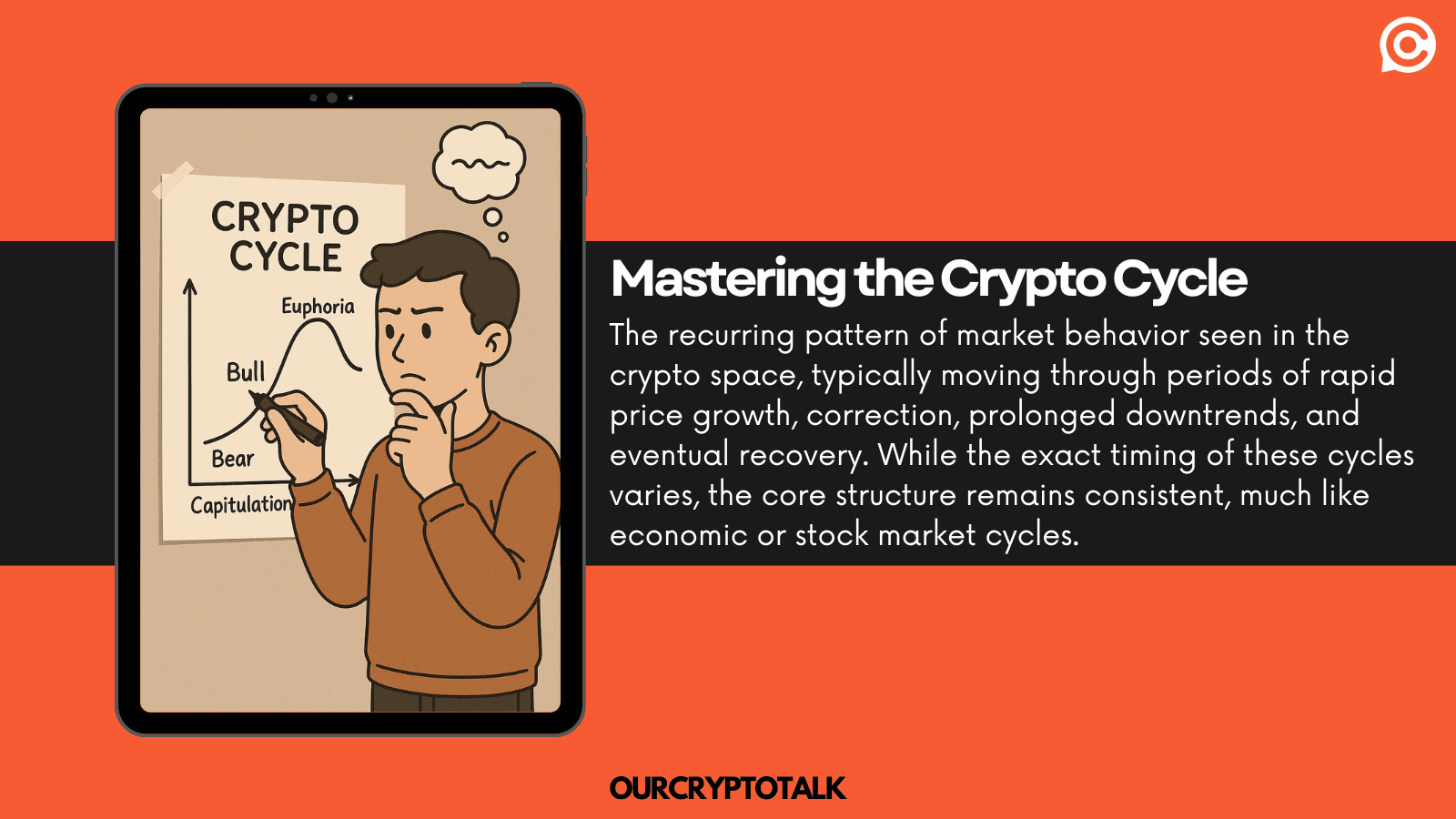
The crypto cycle refers to the recurring pattern of market behavior seen in the crypto space, typically moving through periods of rapid price growth, correction, prolonged downtrends, and eventual recovery. While the exact timing of these cycles varies, the core structure remains consistent, much like economic or stock market cycles.
At the heart of the crypto cycle is investor psychology. Optimism and greed drive the bull market, while fear and capitulation dominate the bear. Technological progress, token incentives, halving events, and macroeconomic conditions all add fuel or friction at various points.
Unlike traditional markets that rely on quarterly earnings or GDP data, crypto markets respond rapidly to narratives. A single protocol upgrade or ETF approval can ignite a rally, just as a hack or regulation can trigger a steep decline. This makes the cycle faster and more sentiment-driven than in traditional finance.
While not all assets move at the same pace, most follow a macro-pattern: enthusiasm builds, prices rise, corrections follow, and eventually, innovation leads to a new cycle. Recognizing these patterns doesn’t mean predicting exact tops or bottoms, but it does help align expectations and strategies.
The Four Phases of a Crypto Market Cycle
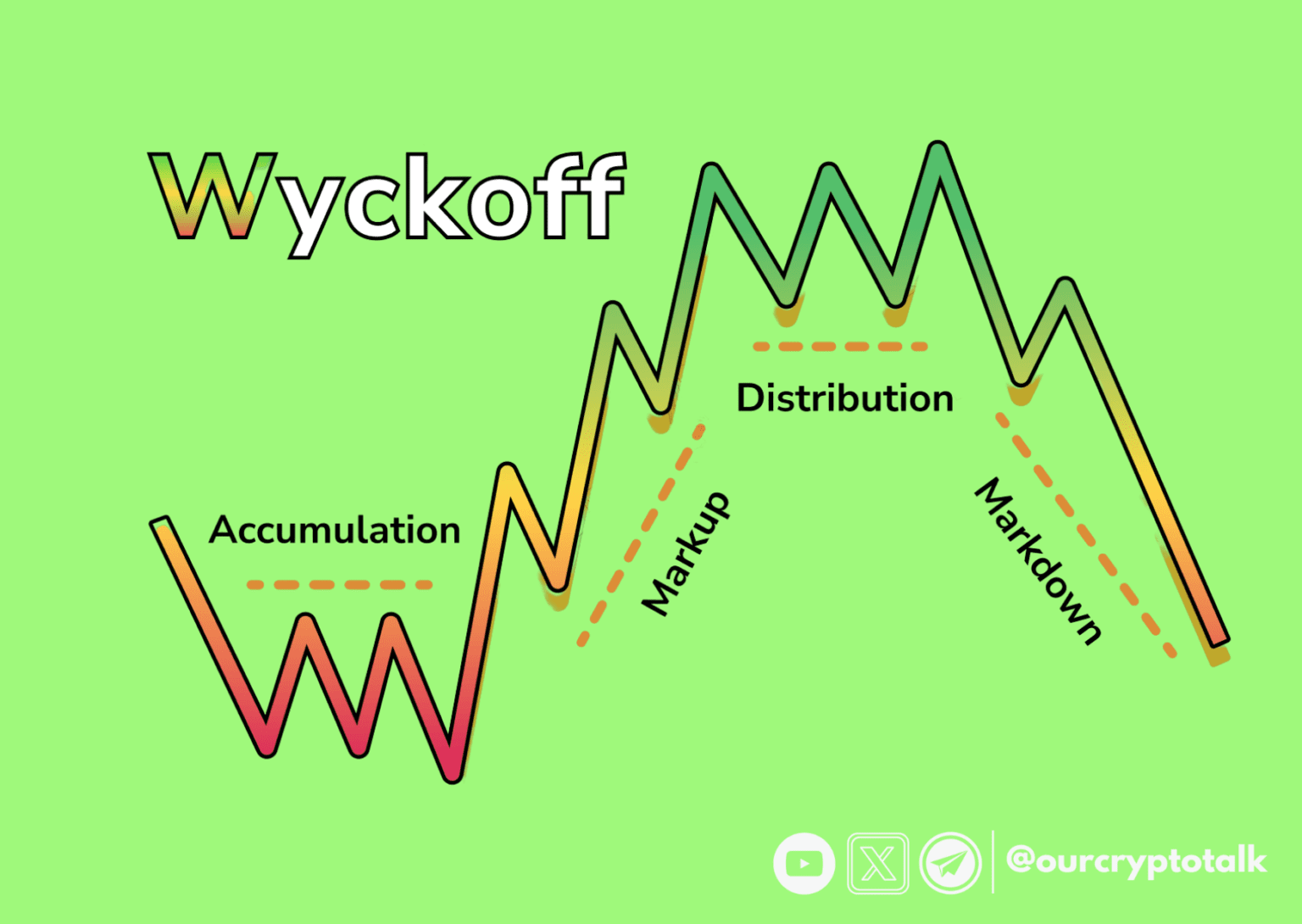
Most crypto cycles can be broken down into four distinct phases, each with its own mood, momentum, and opportunities:
1. Accumulation Phase
This phase begins after a prolonged bear market, when prices have bottomed out and sentiment is still low. Most people have exited the market, and the headlines are quiet. Smart money—long-term believers, funds, and builders—begin accumulating quality assets quietly.
- Prices remain flat or mildly bullish
- Volatility is low
- Retail interest is minimal
- Fundamentals begin improving under the radar
This is the phase of preparation. Projects build, upgrade, and reposition without fanfare. For savvy investors, this is often the most strategic entry point.
2. Expansion Phase / Markup
Momentum starts building as confidence returns. The market sees higher highs and higher lows. More participants return, and narratives like Layer 2 scaling, AI tokens, or restaking gain traction.
- Volume increases
- Institutional and retail demand grows
- Media attention starts returning
- Token launches and funding rounds pick up
This is when altcoins often outperform Bitcoin. The gains are broad-based, and sentiment swings from cautious optimism to full-blown excitement.
3. Distribution Phase
Eventually, euphoria kicks in. Prices rise rapidly. “Crypto is the future” dominates headlines. Valuations often detach from fundamentals. Everyone wants in—retail, celebrities, even governments.
- Parabolic price action
- Meme coins and low-cap tokens rally
- New retail inflow peaks
- Projects launch without clear utility
This is the phase where smart money begins to sell or rotate into stable assets. The cycle’s top is forming, though most won’t see it until hindsight.
4. Capitulation / Markdown Phase
When the hype can no longer sustain the valuations, a crash or steady decline begins. Negative news compounds losses. Projects disappear. Sentiment flips.
- Sharp or prolonged corrections
- Panic selling
- Exit scams and failed projects
- Investors leave or go silent
This is where losses are locked in and confidence breaks. Yet it also sets the stage for the next accumulation.
Each of these phases feeds into the next, creating the rhythmic motion we call the crypto cycle.
How Long Does a Crypto Cycle Last?
While there’s no fixed timeline, most full crypto cycles tend to last around 3 to 4 years, heavily influenced by Bitcoin’s halving—an event that occurs every four years and reduces Bitcoin’s mining reward by half. Historically, these halvings have triggered the beginning of bull markets approximately 6–12 months later.

A typical crypto cycle might unfold like this:
- Year 1: Bear Market and Accumulation
Prices decline, builders stay, speculators leave. - Year 2: Early Recovery and Quiet Growth
Projects improve, layer-1s stabilize, and early signs of adoption re-emerge. - Year 3: Bull Market Takes Off
Major altcoins and NFTs run, retail returns, and FOMO peaks. - Year 4: Crash and Reset
Overleveraged positions unwind, and weak tokens collapse.
However, cycles can now be influenced by more than just halvings. Macroeconomic conditions, like interest rate changes, inflation, or geopolitical events, also play a growing role. Additionally, increasing institutional involvement may elongate or compress cycles compared to previous years.
Importantly, different assets may peak and bottom at different times. Bitcoin often leads, followed by Ethereum, and then altcoins. Understanding this staggered movement within the broader cycle can provide clearer positioning during each phase.
Key Triggers That Start a New Cycle
Crypto cycles don’t begin randomly—they’re sparked by clear catalysts. While the market often seems chaotic, the start of a new cycle usually comes down to a handful of macro and sector-specific events aligning.

1. Bitcoin Halving Events
Historically, the strongest bull runs in crypto start 6–12 months after a Bitcoin halving. These events reduce the supply of new BTC entering circulation, making it scarcer. Lower supply and sustained or rising demand usually act as a launchpad.
2. Monetary Policy & Liquidity Conditions
Global macroeconomic policies can kickstart a new cycle. When central banks lower interest rates or inject liquidity into markets, investors search for higher-yielding, risk-on assets. Crypto becomes attractive in such conditions.
3. Technological Breakthroughs & Upgrades
Major upgrades like Ethereum’s transition to proof-of-stake or the rise of Layer 2s create new narratives and market excitement. These moments attract both developers and investors, helping the market turn from stagnation to growth.
4. Institutional Adoption or Regulatory Clarity
When large players or governments signal openness to crypto—through ETF approvals, clear regulations, or custody solutions—confidence returns. That confidence often becomes the fuel for a full-blown rally.
5. User Growth and Real-World Use Cases
Sometimes, the market turns simply because user adoption accelerates. DeFi summer, NFT booms, or new use cases like decentralized AI or DePIN can shift sentiment and capital.
While no single event flips the market overnight, it’s usually a combination of the above that lights the spark. Recognizing these early gives investors a massive edge.
How Long Does a Crypto Cycle Last?
Crypto cycles are shorter and more volatile than traditional market cycles. But they still follow a rhythm—booms fueled by liquidity and innovation, followed by busts driven by speculation and leverage.
Typical Length: 3–4 Years
The average crypto cycle lasts around 3 to 4 years. This includes one year of accumulation, one to two years of uptrend, several months of distribution, and a year of downturn. Bitcoin’s halving every four years aligns well with this rhythm.
Example:
- 2013 Cycle: Peak in Dec 2013, correction lasted through 2014–2015
- 2017 Cycle: Peak in Jan 2018, bottomed in late 2018, uptrend began in 2020
- 2021 Cycle: Topped in Nov 2021, bear market lasted through 2022–2023
- 2025 Cycle: Halving happened in April 2024, market traditionally to top in Q4 2025
Why It Feels Shorter Than It Is
The high volatility and 24/7 nature of crypto compress price action. A few weeks can feel like a year, and a parabolic uptrend may last just months. This leads to emotional overreactions that can distort long-term planning.
Outliers and Macro Shocks
Cycles aren’t guaranteed to last a set period. Black swan events like the COVID-19 crash or regulatory clampdowns can shorten or extend phases. Likewise, global liquidity events can override the natural flow.
Time matters, but so does context. Understanding both helps avoid getting caught at the wrong end of the cycle.
Investor Psychology During Different Phases
Crypto cycles are driven as much by emotion as by data. Fear, greed, disbelief, and hope are the silent forces behind every pump and dump. Recognizing how sentiment evolves is critical to surviving the volatility.

1. Accumulation Phase – Disbelief & Apathy
In this phase, most investors have checked out. The media is negative, prices are flat, and there’s no hype. Smart money quietly accumulates. This is when conviction is hard—but rewarding.
Common sentiment: “It’s probably dead.”
2. Uptrend Phase – Optimism to Euphoria
As prices recover, early optimism returns. Narratives like AI, DeFi, or NFTs spark momentum. At peak euphoria, people chase pumps, ignore fundamentals, and feel invincible.
Common sentiment: “This time it’s different.”
3. Distribution Phase – Complacency & Denial
Smart money exits while retail keeps buying. Prices range sideways or hit lower highs. Investors tell themselves it’s a “healthy correction.” But underneath, momentum is fading.
Common sentiment: “It’s just consolidating before the next leg.”
4. Downtrend Phase – Fear & Capitulation
When the selling begins, panic takes over. Leverage unwinds, media turns bearish, and most portfolios bleed. This is when many quit the space entirely—just before accumulation quietly begins again.
Common sentiment: “I’ll never touch crypto again.”
By observing sentiment across communities, search trends, and social media engagement, it’s possible to gauge where we are in the emotional cycle—even if prices aren’t clear.
How To Spot Which Phase You’re In
No one rings a bell when a cycle turns. But by tracking a combination of indicators, you can develop a feel for which phase you’re currently in—and adjust your strategy accordingly.
1. Look at Price Structure
- Accumulation: Long sideways ranges, low volume
- Uptrend: Higher highs, higher lows, rising volume
- Distribution: Choppy range after strong rally
- Downtrend: Lower highs, sharp corrections
Chart patterns often give the first clue.
2. Analyze Social Sentiment
- Is crypto trending on X or YouTube?
- Are influencers overly bullish or quiet?
- Are new wallets rising or flat?
In accumulation, sentiment is quiet. In distribution, it’s loud and overconfident. Tools like LunarCrush or Santiment can offer real-time insight here.
3. Watch for On-Chain Activity
- Are whales buying or selling?
- Are stablecoin inflows rising?
- Is user activity growing?
On-chain behavior often shifts before price action. When smart money moves, it’s worth paying attention.
4. Compare to Historical Cycles
Each cycle has similar emotional and price rhythms. Mapping where we are against past market structures (like the 2017 or 2020 cycle) can offer directional clues—even if the timing isn’t perfect.
5. Macro Conditions and Newsflow
A crypto cycle doesn’t operate in isolation. Rate cuts, ETF approvals, tech breakthroughs—these can shift the cycle’s pace or trigger a new one altogether.
Spotting the phase isn’t about precision—it’s about probability. The goal is not to time the exact top or bottom, but to position based on informed patterns rather than emotional guesses.
Crypto Cycles vs Traditional Market Cycles
While crypto and traditional markets both move in cycles, their pace, volatility, and structure differ significantly. Understanding these differences helps investors set more realistic expectations.
1. Speed and Volatility
Crypto cycles unfold faster. Traditional market cycles may span 7–10 years, but a full crypto cycle — from bear to bull — often completes in 3–4 years. Price swings in crypto are also more extreme, with Bitcoin or altcoins regularly seeing 80%+ drawdowns and 10x rallies.
2. Fundamentals vs Sentiment
Traditional markets are more anchored in fundamentals like earnings, interest rates, or GDP. Crypto is heavily sentiment-driven, with news, social media, and narratives (like AI, DePIN, or NFTs) moving prices far more than cash flows or revenue models.
3. Regulatory Influence
Regulations in traditional finance offer a level of market stability. In crypto, the regulatory landscape is still evolving. Announcements from the SEC, ETF approvals, or sudden crackdowns often become major catalysts, influencing cycles.
4. Liquidity and Participants
Retail dominates crypto, while institutions still dominate traditional markets. This retail-heavy nature means crypto cycles can get overheated quickly — especially during phases driven by hype.
Despite the similarities, crypto cycles remain more reflexive and aggressive. Being prepared for rapid changes is essential.
Key Differences In a Table
| Aspect | Crypto Markets | Traditional Markets |
|---|---|---|
| Speed and Volatility | Faster cycles (3–4 years); high volatility with 80%+ drawdowns and 10x rallies | Slower cycles (7–10 years); moderate volatility |
| Fundamentals vs Sentiment | Driven more by sentiment, narratives, and social media trends | Anchored in fundamentals like earnings, interest rates, and GDP |
| Regulatory Influence | Evolving regulation; highly reactive to news like SEC moves or ETF approvals | Stable regulatory environment; less prone to sudden shifts |
| Liquidity and Participants | Retail-dominated, leading to faster hype cycles and sharp moves | Institution-heavy, creating more measured and stable market movements |
| Trading Hours | 24/7 global trading, including weekends and holidays | Limited to business hours, weekdays only (except futures/FX) |
| Market Infrastructure | Still maturing; prone to hacks, exchange collapses, and lack of unified standards | Highly developed; strong protections, clearinghouses, and custodial systems |
| Asset Backing | Many crypto assets are speculative with no intrinsic value or cash flows | Stocks and bonds are backed by real-world earnings, dividends, or debt |
| Transparency and Data | On-chain activity is visible, but financial disclosures are rare or non-existent | Companies must report earnings, follow accounting standards, and disclose data |
How To Position Yourself in Each Phase
Adapting your investment strategy to each phase of the crypto cycle can significantly improve your results and reduce emotional decision-making.
1. Accumulation Phase
This is the silent builder’s season. Sentiment is low, prices are flat, and most investors have left.
Strategy: Dollar-cost average (DCA) into high-conviction assets. Focus on research, build watchlists, and don’t expect quick gains.
2. Uptrend (Bull Market)
Momentum returns, and retail flows back in. Narratives drive speculative pumps.
Strategy: Ride strong trends but manage risk. Take profits in phases and avoid rotating into late-stage hype coins.
3. Distribution Phase
The market shows euphoria, but momentum weakens. Whale activity increases, and news is overly bullish.
Strategy: Scale out gradually. Rotate into stablecoins or defensive positions. Watch for divergence between price and sentiment.
4. Downtrend (Bear Market)
Prices decline steadily, and pessimism dominates. Volumes drop, and many projects die out.
Strategy: Avoid overtrading. Reassess your portfolio. Focus on learning, security, and accumulation when the dust settles.
A dynamic strategy tied to the phase you’re in will always outperform static investing.
TLDR: The Crypto Cycle in a Nutshell
- Crypto cycles move through four phases: accumulation, uptrend, distribution, and downtrend.
- These cycles repeat, driven by halvings, liquidity shifts, and sentiment waves.
- Timing the market is hard, but recognizing the phase can guide smarter moves.
- Traditional cycles are slower and more stable; crypto is faster and sentiment-heavy.
- Adjusting your strategy to each phase is key to long-term survival and growth.
Conclusion: Riding the Crypto Cycle With Discipline
Crypto markets will continue to move in cycles — that’s the nature of emerging, high-growth assets. The trick isn’t to guess the top or bottom but to understand the rhythm of each phase.
Discipline, pattern recognition, and emotional control matter more than perfect timing. Tools like on-chain analytics, market sentiment trackers, and macro indicators help, but ultimately, your behavior in each phase defines your outcome.
Treat each cycle as a learning curve. Survive the downturns, and you’ll be ready for the next breakout.
Frequently Asked Questions
What is the crypto market cycle?
What are the four phases of a crypto cycle?
- Accumulation: After a bear market, prices stabilize, sentiment is low, and smart money accumulates quietly.
- Expansion (Markup): Momentum builds, prices trend upward, retail returns, and narratives (L2s, AI, restaking) fuel growth.
- Distribution: Euphoria sets in. Prices detach from fundamentals, meme coins pump, and smart money begins exiting.
- Capitulation (Markdown): The hype breaks. Corrections or crashes wipe out weak projects, investors panic, and the market resets.
How long does a crypto cycle last?
- Year 1: Bear market and accumulation
- Year 2: Quiet recovery
- Year 3: Bull market peak
- Year 4: Crash and reset
What triggers a new crypto cycle?
- Bitcoin Halvings: Reduced supply sparks post-halving rallies.
- Monetary Policy: Rate cuts and liquidity injections push risk assets higher.
- Tech Breakthroughs: Major upgrades (Ethereum PoS, Layer 2s) ignite new narratives.
- Institutional Adoption: ETF approvals, custody solutions, regulatory clarity.
- User Growth: Booms in NFTs, DeFi, AI tokens, or DePIN adoption.
How does investor psychology shape crypto cycles?
- Accumulation: Disbelief and apathy – “Crypto is dead.”
- Uptrend: Optimism turns into euphoria – “This time it’s different.”
- Distribution: Complacency and denial – “It’s just a healthy correction.”
- Downtrend: Fear and capitulation – “I’ll never touch crypto again.”
How can I tell which phase of the cycle we’re in?
- Price structure: Sideways ranges (accumulation), higher highs (uptrend), parabolic tops (distribution), sharp sell-offs (downtrend).
- Social sentiment: Are influencers loud or quiet? Is crypto trending on X/YouTube?
- On-chain activity: Whale moves, stablecoin inflows, active addresses.
- Historical mapping: Compare price action to past cycles (2017, 2021).
- Macro context: Rate cuts, ETF approvals, or regulation shifts.
How do crypto cycles differ from traditional market cycles?
| Aspect | Crypto Markets | Traditional Markets |
|---|---|---|
| Speed & Volatility | 3–4 yrs; 80% drawdowns & 10x rallies | 7–10 yrs; moderate swings |
| Drivers | Sentiment, narratives, social media | Earnings, GDP, interest rates |
| Regulation | Evolving, highly reactive | Stable, predictable |
| Liquidity & Participants | Retail-dominated | Institution-dominated |
| Trading Hours | 24/7, global | Weekdays, limited hours |
What’s the best strategy for each phase?
- Accumulation: DCA into high-conviction assets; research and patience.
- Uptrend: Ride momentum but take profits in phases.
- Distribution: Scale out, rotate into stables or safer assets.
- Downtrend: Avoid overtrading; focus on learning, security, and selective accumulation.
What’s the big takeaway on crypto cycles?
In this article
What Is the Crypto Cycle?The Four Phases of a Crypto Market CycleHow Long Does a Crypto Cycle Last?Key Triggers That Start a New CycleHow Long Does a Crypto Cycle Last?Investor Psychology During Different PhasesHow To Spot Which Phase You’re InCrypto Cycles vs Traditional Market CyclesHow To Position Yourself in Each PhaseTLDR: The Crypto Cycle in a NutshellConclusion: Riding the Crypto Cycle With DisciplineFrequently Asked Questions