Flying Tulip (FT) Review: Is FT Worth Buying in 2026?
Explore the Flying Tulip DeFi ecosystem, $FT tokenomics, fee-funded buybacks, key risks, and long-term growth potential in 2026.


Author: Akshat Thakur
Why Unified Onchain Financial Systems Are Hard to Get Right
Most DeFi platforms still operate through separate products. Spot trading, lending, and derivatives often use independent liquidity pools and collateral systems. Users have to move assets between them, pay additional fees, and maintain idle balances that could otherwise support multiple positions.
This fragmentation creates capital inefficiency. Static AMM curves can struggle with changing market conditions, while delayed oracle updates can expose shared collateral to sudden liquidations.
Fee generation is another challenge. Many protocols rely heavily on token incentives rather than consistent trading and borrowing demand.
Large fundraising rounds can also create misleading signals. TVL may rise quickly when users deposit capital for incentives, only to fall when rewards decline.
Building a centralized-exchange-like experience onchain introduces additional complexity because one stressed market, inaccurate price feed, or overleveraged position can affect other parts of the system.
Flying Tulip approaches this problem through a unified financial system that connects trading, lending, derivatives-style products, and its native ftUSD stablecoin through shared collateral, pricing, and risk infrastructure.
The concept is ambitious, but its success depends on whether users actually use multiple products within the ecosystem and generate enough recurring fees to support the model.
What Is Flying Tulip?
Flying Tulip is an onchain financial platform designed to bring several financial products under one system. Its product suite includes spot trading through a hybrid AMM and order-book-style Trade engine, lending, leveraged and total-return products, insurance-style Perpetual PUTs, and the native ftUSD stablecoin.
The project was founded by Andre Cronje, known for his work on Yearn, Keep3r, and the Fantom and Sonic ecosystems.
Flying Tulip raised approximately $200 million through a private SAFT-style round in late 2025 at a reported $1 billion token valuation. Subsequent institutional and public-sale activity increased total commitments. Its public sale and token generation event centered on February 2026. The platform has expanded across Ethereum, Sonic, BNB Chain, and related deployments.
Cumulative protocol fees had reached approximately $185,000 by late November. The project also reported more than 2.2 million FT purchased through fee-funded buybacks, alongside additional burns connected to Perpetual PUT withdrawals. Some updates placed these additional burns around 15 million FT.
The product suite expanded throughout 2026, with Trade, TRS, Swap, Lend, ftUSD staking products, Rewards, and Witnessnet becoming part of the ecosystem.
Flying Tulip combines Andre Cronje’s DeFi experience with a full-stack financial platform and a principal-protection mechanism for eligible primary-sale buyers. The key question is whether its live usage and fee generation can justify the scale of its fundraising and token valuation.
How Flying Tulip Works
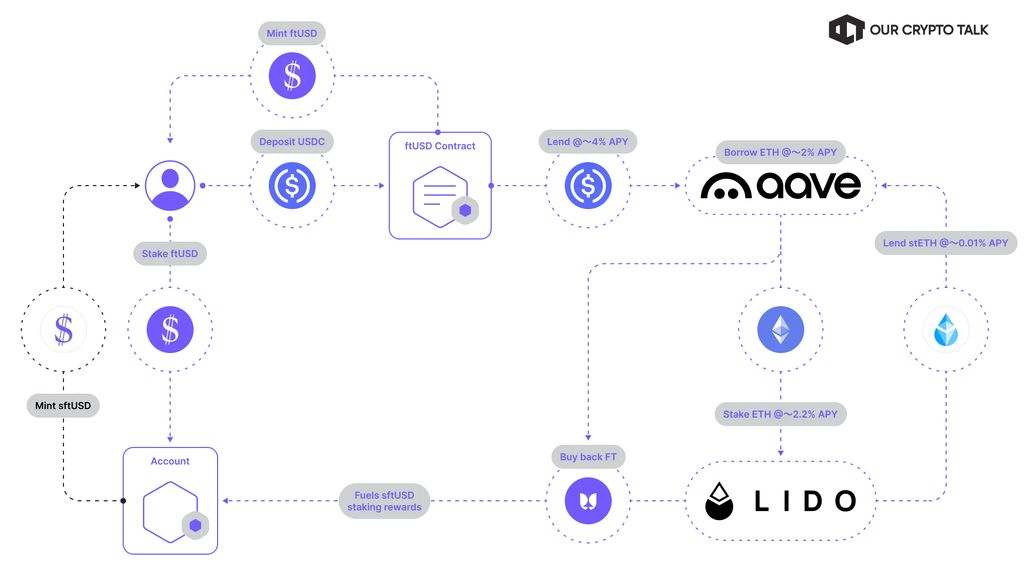
Flying Tulip is built around a shared account and collateral system. Users deposit assets into the platform, where capital can support lending, liquidity provision, and derivatives-style exposure. This approach aims to reduce the need to move funds between separate products.
The individual products serve different functions. Lend allows users to deposit assets and borrow against approved collateral. Trade provides a hybrid trading venue, while Swap handles token exchanges and routing. TRS offers total-return exposure. Together, these products are intended to operate within the broader shared financial system.
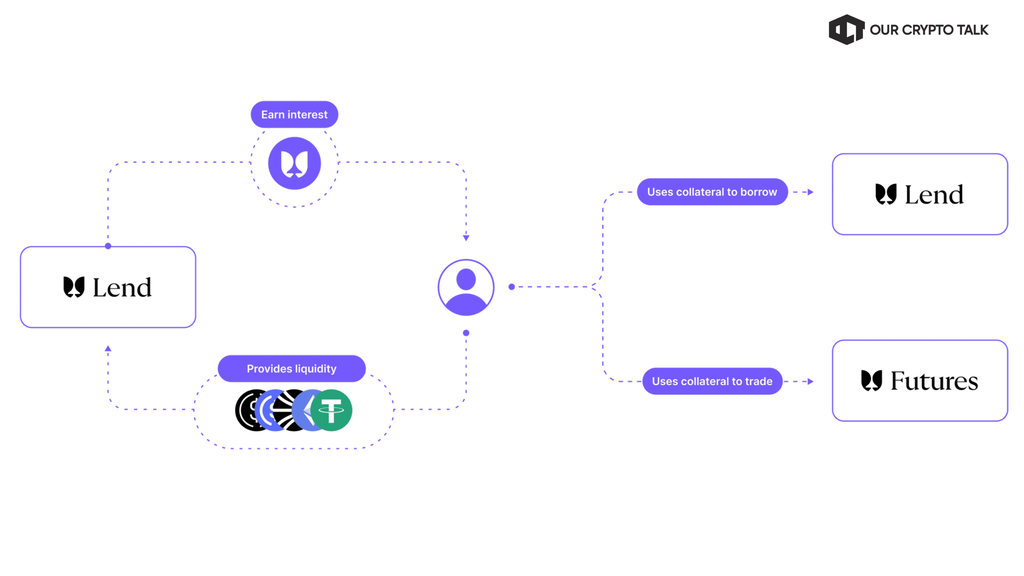
ftUSD is the platform’s native dollar-denominated stablecoin. Holders can stake it into sftUSD to earn yield, with additional auto-compounding options such as ssftUSD. This creates a stablecoin and yield layer that connects with the lending and trading products.
Flying Tulip also includes Perpetual PUTs for eligible primary-sale participants. These positions provide a redemption mechanism through which holders can burn FT and seek to recover their original principal from segregated backing, subject to the protocol’s NAV calculations and withdrawal conditions.
The protection is therefore conditional, not an unconditional guarantee for every FT holder.
The platform’s fee and yield mechanisms also support token buybacks. Revenue from trading and lending activity can fund open-market FT purchases, while certain PUT withdrawals generate additional burns. The scale of these mechanisms depends on actual product activity.
Since its February 2026 launch, Flying Tulip has expanded its product offering across three chains. Lend and ftUSD account for much of the visible deposit activity, while buybacks and PUT-related burns providae additional token mechanisms.
The next major test is whether trading and leveraged activity can grow enough to generate meaningful fee revenue beyond lending deposits and stablecoin supply.
Technology & Architecture
Flying Tulip’s central design is a shared credit and pricing infrastructure that connects multiple financial products instead of operating them as independent applications.
Its Trade engine combines AMM-style liquidity with order-book-style execution. The system uses a regime-aware curve intended to respond to changing market conditions rather than relying entirely on a fixed constant-product formula. This approach aims to improve execution as liquidity and trading flow change.
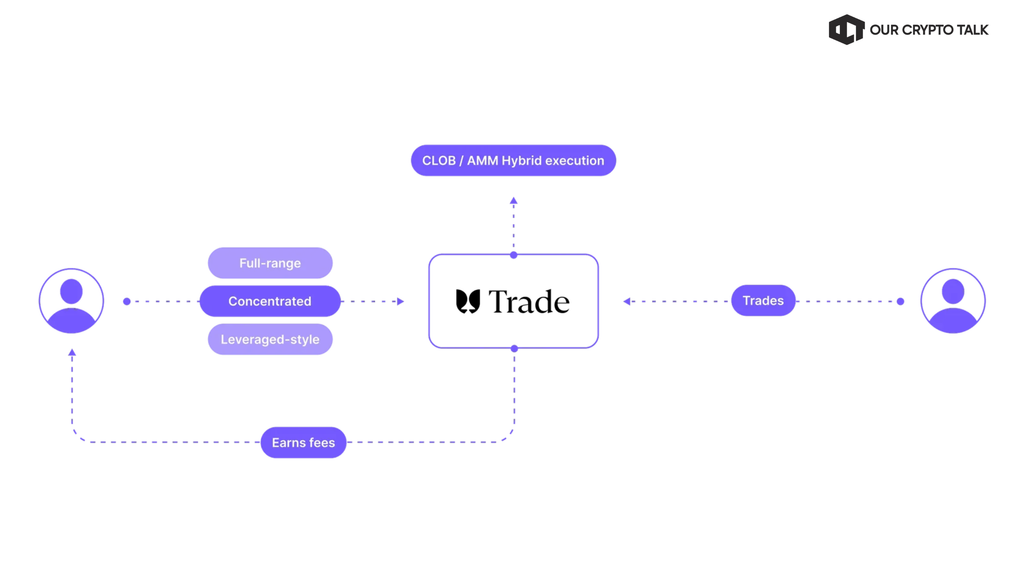
Lending also uses liquidity-aware risk management. Instead of relying exclusively on static loan-to-value limits, parameters consider available market depth and the potential price impact of liquidating collateral. Cross-collateral credit allows deposits to support multiple product paths within the system.
ftUSD acts as a settlement asset and can generate yield through staking products such as sftUSD and ssftUSD. Perpetual PUTs encode primary-sale redemption rights through onchain mechanisms, while Witnessnet provides signed external reports that smart contracts can verify when they need offchain price or event information.
The platform’s multi-chain architecture uses OFT-style bridging patterns to support FT and related product balances across Ethereum, Sonic, and BNB Chain. This expands accessibility but also introduces additional bridge and cross-chain operational risks.
By late 2026, the live product stack included Lend, ftUSD and its staking variants, Trade, TRS, Swap, PUT mechanisms, Rewards, Witnessnet, and BNB Chain expansion.
Other parts of the broader vision remain incomplete or under development, including deeper central limit order book liquidity, permissionless market creation, additional derivatives such as futures, perpetuals and options, proprietary AMM and trading products, a native chain instance, and insurance modules.
Team & Backers
Flying Tulip is founded and publicly led by Andre Cronje, the builder behind Yearn Finance, Keep3r, the original Fantom technical architecture, and later Sonic-related work. The project is presented as a Cronje-led protocol team rather than a large executive organization. Public updates focus more on engineering, product launches, and onchain metrics than on a conventional C-suite roster.
The project attracted substantial institutional capital. Its late-2025 seed round raised approximately $200 million at a $1 billion token valuation. Reported participants included Brevan Howard Digital, CoinFund, DWF Labs, FalconX, Hypersphere, Lemniscap, Nascent, Republic Digital, Selini, Sigil Fund, Susquehanna Crypto, Tioga Capital, and Virtuals Protocol.
Further institutional commitments followed in early 2026, including investments from Amber Group, Fasanara Digital, and Paper Ventures. These brought disclosed institutional capital above $225 million. Public sale activity through CoinList-style and other channels expanded total commitments further under the same valuation framework.
The funding and token distribution structure is unusual. Primary buyers received FT through Perpetual PUT positions, giving them an onchain route to redeem toward their original principal. Team members did not receive a free liquid allocation at TGE. Instead, team exposure is tied to revenue-funded buybacks under a disclosed allocation split. This makes Flying Tulip a heavily funded, institutionally backed DeFi project rather than a protocol relying mainly on community emissions to bootstrap growth.
Flying Tulip Tokenomics (FT)
FT is an omnichain token deployed across Ethereum, Sonic, BNB Chain, and other listed networks using a LayerZero OFT-style framework. Project documentation describes a large pre-mint at deployment, with no additional inflation. Burns permanently reduce the available supply.
The nominal maximum supply originally stood at 10 billion FT. However, unallocated and unwithdrawn tokens do not necessarily enter the market, while permanent burns continue to reduce supply. This makes the effective circulating figure more relevant than the original maximum when assessing market pressure.
Primary issuance took place through Capital Allocation at $0.10 per FT, equivalent to 10 FT for every dollar contributed.
Allocated tokens were issued into Perpetual PUT positions. Unlike a conventional token launch, there was no standard investor cliff schedule or freely tradable team allocation at TGE.
Unallocated FT remains in the investment and PUT reserve. It does not enter circulation unless capital is allocated to it.
Foundation, team, and incentives exposure is linked to protocol revenue-funded buybacks, with the disclosed split set at 40% for the foundation, 40% for the team, and 20% for incentives.
This is a revenue-linked allocation mechanism rather than a conventional upfront distribution. User rewards can also come from tokens acquired through fee-funded buybacks.
There is no standard multi-year team or investor vesting calendar. The main supply-release mechanism is withdrawal from Perpetual PUT positions.
When a primary holder withdraws FT, the withdrawn tokens can become tradable and the corresponding PUT protection ends. Released backing is then used to bid for and burn FT at the withdrawal NAV.
The buyback mechanism creates measurable demand when protocol fees and PUT withdrawals generate sufficient activity. However, it does not automatically give FT holders a claim on all protocol revenue.
Secondary holders remain dependent on product adoption and the balance between buyback demand and potential selling from primary holders exiting their PUT positions.
Is Flying Tulip Safe?
Flying Tulip has subjected important contracts to external security reviews. A Sherlock audit contest covering the ftPUT contracts before launch reported zero valid Medium or High severity findings after judging, following earlier private review cycles. The project also operates a Sherlock bug bounty program, with advertised critical vulnerability payouts of up to $1 million in USDC.
These measures provide some reassurance, but they do not eliminate smart-contract risk. Flying Tulip operates a broad contract surface spanning lending, ftUSD, Trade, TRS, swaps, PUT settlement, oracles, bridges, and Witnessnet data verification. Shared collateral can improve capital efficiency, but it also means failures in connected components may have wider consequences.
Perpetual PUT redemptions depend on segregated backing, NAV calculations, and sufficient withdrawal liquidity. Primary buyers have an onchain path to redeem toward their original principal under the applicable terms. Secondary-market FT buyers do not receive the same protection. The distinction matters when evaluating the token’s downside risk.
The multi-chain design introduces additional bridge and omnichain assumptions. Stablecoin and lending products carry their own peg, collateral, and utilization risks. Oracle reliability and offchain data quality also become increasingly important as the protocol expands into stock- and ETF-linked collateral.
No major core protocol exploit that halted the system was prominently reported during the research window from its February 2026 launch through late November 2026. That is a constructive operating record for a relatively young protocol, but it should not be treated as proof of long-term security.
Flying Tulip has stronger security measures than an unaudited launch with no public contest or bug bounty. However, it remains a complex DeFi system with smart-contract, bridge, stablecoin, oracle, shared-margin, and redemption risks. Users should also distinguish between primary-sale FT positions with PUT rights and ordinary FT purchased on the secondary market. Audits are point-in-time reviews, not permanent insurance.
Flying Tulip vs Competitors
Flying Tulip is positioning itself as a shared-collateral financial venue rather than a single-purpose lending or derivatives protocol. Its model combines lending, stablecoin settlement, spot trading, total-return products, and Perpetual PUTs under a common credit and pricing layer. The closest comparisons are therefore specialized DeFi leaders that dominate individual parts of this market.
Flying Tulip vs Competitors
| Project | Use Case | Chain | Product Status | Token Utility |
|---|---|---|---|---|
|
Flying Tulip (FT)
| Shared-collateral suite covering lending, ftUSD, Trade, TRS, and PUTs | Ethereum, Sonic, BNB Chain | Multi-product suite live since February 2026; Witnessnet live | Fee- and PUT-funded buybacks; revenue-linked team and foundation allocations |
|
Aave
| Variable-rate pooled lending and borrowing | Multiple EVM chains | Mature lending protocol | AAVE governance and safety-module staking |
|
Morpho
| Optimized peer-to-pool lending and vault markets | Major EVM deployments | Live competitor for institutional and DeFi lending flows | MORPHO governance and incentives |
|
Hyperliquid and hybrid perps venues
| Onchain perpetuals and trading infrastructure | Native or multi-chain trading stacks | Established trading venues | Venue tokens linked to fees, buybacks, or governance |
Aave and Morpho have a clear advantage in lending depth and established market activity. Hyperliquid-style venues lead in onchain derivatives trading and liquidity. Flying Tulip is pursuing a different strategy: connecting these product categories through shared collateral and pricing, with the aim of making capital more efficient across the system.
That approach could reduce the need to move funds between separate protocols. However, the scale gap remains significant. Flying Tulip’s TVL and fee generation are still small compared with the specialized incumbents it wants to compete with.
Strengths & Risks
Flying Tulip has several factors working in its favor. Andre Cronje’s track record in DeFi architecture gives the project visibility and attracts attention from experienced builders. It also secured substantial institutional capital and launched a multi-product suite across Ethereum, Sonic, and BNB Chain.
Lend, ftUSD, Trade, TRS, and Perpetual PUT mechanics are live. The project has also established fee-funded open-market FT buybacks, while PUT withdrawals have contributed to permanent token burns. Its central thesis is that shared collateral can support several financial products without requiring users to split capital across separate systems. Witnessnet and additional modules could expand the range of supported assets and data sources.
The main concern is whether usage can catch up with the ambition. Protocol TVL remains in the low tens of millions, modest compared with the project’s funding and valuation narrative. A multi-product architecture also creates a wider smart-contract, oracle, bridge, and shared-margin risk surface.
FT trades near its $0.10 primary-sale price and remains below its 2026 all-time high. That performance has not yet established strong secondary-market demand. Cumulative fees of approximately $185,000 are still limited in absolute terms, so the long-term buyback thesis needs substantially more activity to become meaningful.
Competition is another challenge. Aave and Morpho already have deep lending markets, while established perps venues attract significant trading volume. Meanwhile, withdrawals from Perpetual PUT positions can release additional FT into the market, partly offsetting the impact of buybacks and burns.
The bullish case rests on a live product suite, experienced leadership, and a coherent capital-efficiency model. The bearish case rests on modest adoption, limited fee generation, complex risk exposure, and competition from protocols with much deeper liquidity. Both are supported by the current picture: Flying Tulip is mechanically interesting, but its economic scale remains early.
Should You Buy FT? (OCT Verdict)
For builders and power users, Flying Tulip is worth exploring if shared collateral across lending, ftUSD, and trading products fits your needs. Witnessnet may also be relevant for applications that require verified offchain data. Using the protocol does not necessarily require holding FT.
Short-term traders should pay close attention to protocol fee growth, buyback activity, Lend and ftUSD deposits, and Perpetual PUT withdrawal rates. FT should not be treated like a highly liquid blue-chip DeFi token. Its price has already moved from the primary-sale level to its 2026 high and back toward $0.10, while liquidity remains thinner than that of established competitors.
Long-term investors may want to wait for stronger evidence that fee-funded buybacks can absorb the FT released through PUT withdrawals. Growth in TVL alone is not enough. Trading activity and usage across multiple products need to increase, showing that users are adopting the unified system rather than depositing mainly into lending and stablecoin products.
Until those metrics improve, FT is better viewed as a speculative position than a core DeFi holding. DYOR, and remember that fee-funded buybacks and primary-sale PUT rights do not give ordinary token holders equity-like claims on the protocol’s full economics.
Is Flying Tulip worth buying? Only as a speculative bet on sustained fee growth and multi-product adoption, not as a low-risk investment backed by the project’s $1 billion valuation at its initial raise.
Final Verdict: Is Flying Tulip a Buy in 2026?
Flying Tulip is an ambitious attempt to bring lending, stablecoin settlement, spot trading, and derivatives under one shared onchain financial system. It has live products, substantial institutional backing, and functioning mechanisms that connect protocol activity to FT buybacks and burns.
The challenge is proving that this architecture can attract enough users and trading volume to support its token economics. Current TVL and cumulative fees remain modest compared with the project’s funding and long-term ambitions. Competition from deeper, specialized protocols is also difficult to ignore.
FT therefore remains a high-risk bet on the capital-efficiency thesis. The project has made meaningful progress on its product infrastructure, but token demand still needs to demonstrate that it can outpace PUT-related supply dynamics and support a larger valuation. It is not yet a proven blue-chip DeFi allocation.
Frequently Asked Questions
What is Flying Tulip in crypto?
How does Flying Tulip work?
What is the FT token used for?
What is ftUSD in Flying Tulip?
Is Flying Tulip available on multiple blockchains?
Is Flying Tulip safe to use?
Is FT a good investment in 2026?
In this article
Why Unified Onchain Financial Systems Are Hard to Get RightWhat Is Flying Tulip?How Flying Tulip WorksTechnology & ArchitectureTeam & BackersFlying Tulip Tokenomics (FT)Is Flying Tulip Safe?Flying Tulip vs CompetitorsStrengths & RisksShould You Buy FT? (OCT Verdict)Final Verdict: Is Flying Tulip a Buy in 2026?