Quantus (QTC) Review: Is QTC Worth Buying in 2026?
Quantus (QTC) review 2026: Explore its quantum-resistant technology, tokenomics, mining, privacy features, and key investment risks.


Author: Kritika Gupta
Quantus is a Proof-of-Work blockchain that uses post-quantum signatures to protect digital assets against future quantum threats. This review examines its technology, QTC tokenomics, adoption, and risks to assess its case as quantum-resistant money.
Why Quantus’s Quantum-Resistant Approach Is Hard to Get Right
Post-quantum cryptography replaces vulnerable elliptic-curve schemes, including ECDSA, with alternatives designed to withstand quantum attacks. NIST standardized one such signature scheme, ML-DSA, formerly CRYSTALS-Dilithium, under FIPS 204. These signatures introduce substantial storage and bandwidth costs.
An ML-DSA-87 signature occupies approximately 4,627 bytes, compared with about 65 bytes for the ECDSA representation cited in the research. Its public key occupies roughly 2,592 bytes, versus the cited 33-byte classical key representation.
Exact comparisons depend on the scheme and encoding. With fixed block sizes and intervals, larger signatures reduce transaction capacity. Quantus’s whitepaper estimates that replacing Bitcoin’s signatures with ML-DSA-65, without increasing block size, would reduce throughput from roughly 10 TPS to around 1.1 quantum-secure transactions per second, or QTPS.
Production experience cannot yet establish resistance to a cryptographically relevant quantum computer, or CRQC. The supplied research cites Google’s 2026 work placing one estimate for breaking secp256k1 below 500,000 physical qubits, alongside open efforts reporting comparable or lower estimates.
These estimates depend on assumptions about hardware and error correction; they do not demonstrate an operational attack. The research identifies no publicly demonstrated CRQC.
Existing blockchains also face a difficult migration. Holders would need to move funds into quantum-resistant address types, while lost coins cannot migrate. Estimates cited in the research place lost Bitcoin between 2.3 million and 3.7 million BTC, potentially leaving substantial value exposed if attackers can recover the relevant private keys.
Bitcoin’s gradual SegWit adoption illustrates how slowly network-wide changes can spread. Adoption creates another hurdle. Bitcoin and Ethereum already attract much of the sector’s liquidity, development activity, and user attention.
A money-focused Proof-of-Work chain without smart contracts or DeFi depends on demand for payments, savings, and custody. Miners earn block subsidies and transaction fees, but sustained usage becomes increasingly important as subsidies decline.
What Is Quantus?
Quantus is a Proof-of-Work Layer-1 blockchain built with Substrate. It targets quantum-resistant peer-to-peer payments and caps QTC supply at 21 million coins. Every account uses ML-DSA-65 or ML-DSA-87 signatures, with no classical signature fallback. The project launched mainnet on 9 September 2026 at approximately 08:51 UTC.
Christopher Smith, who uses @YuviLightman on X, serves as CEO and founder. Joseph Mattia serves as COO and co-founder. Quantus Labs LLC, a Wyoming company, operates the project. Its central thesis is that a blockchain should adopt NIST-standard lattice signatures from launch instead of relying on a future migration.
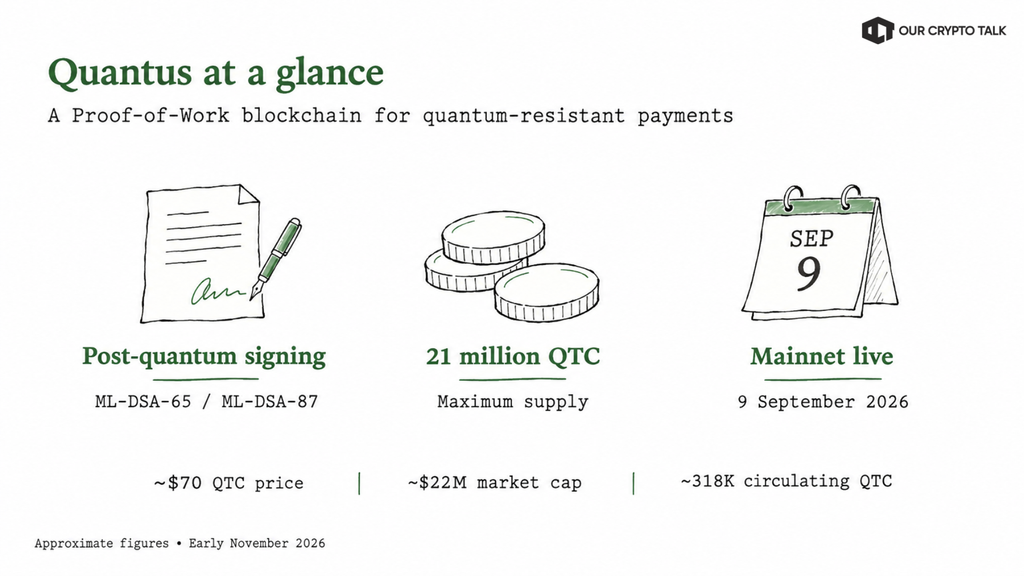
The supplied early-November 2026 snapshot places QTC near $70, with approximately 318,000 circulating coins and a circulating market capitalization around $22 million. Maximum supply stands at 21 million, while tracker rankings place the project in the low thousands.
Trading venues include SafeTrade, where the asset uses the QUANTUS identifier, BigONE, and venues using NEAR Intents. Several unrelated assets also use QTC, so readers should verify the network and asset before trading.
Late-October snapshots reported hashrate near 30 TH/s. Earlier activity figures ranged from several hundred to approximately 1,000 daily active accounts. These figures describe a small network relative to established blockchains, regardless of QTC’s market performance.
How Quantus Works
Users create accounts with ML-DSA keys. Addresses begin with qz and derive from a Poseidon hash of the public key. Standard transfers remain transparent and require an ML-DSA signature.
Wormhole transfers use zero-knowledge proofs to obscure the direct connection between an encrypted sending address and a credit elsewhere. Amounts remain visible, and the supplied research describes the privacy protection as probabilistic. Users should therefore distinguish transaction-link privacy from complete concealment of transaction data.
GPU miners produce blocks through QPoW, which uses Poseidon2. The protocol targets 12-second blocks, although observed averages in the supplied snapshots reached approximately 14–15 seconds.
The block subsidy follows the formula (21,000,000 − current supply) / 50,000,000. It produced roughly 0.305 QTC per block shortly after launch and declines smoothly without halvings. Miners receive the full subsidy, with no ongoing developer tax. The protocol also burns part of transaction fees.
Users can optionally set a delay window that allows them to cancel a pending transfer. High-security accounts restrict outgoing activity to delayed transfers and incorporate a guardian. Guardians can cancel pending transfers or support recovery under the account’s configured rules.
The project offers public-beta mobile wallets for iOS and Android, alongside cold-wallet and Keystone hardware support. Core signing, mining, and transparent transfers have operated since mainnet launch. Wormhole privacy and aggregation components remain under active development, so their availability should not imply that every performance target or security review is complete.
Technology & Architecture
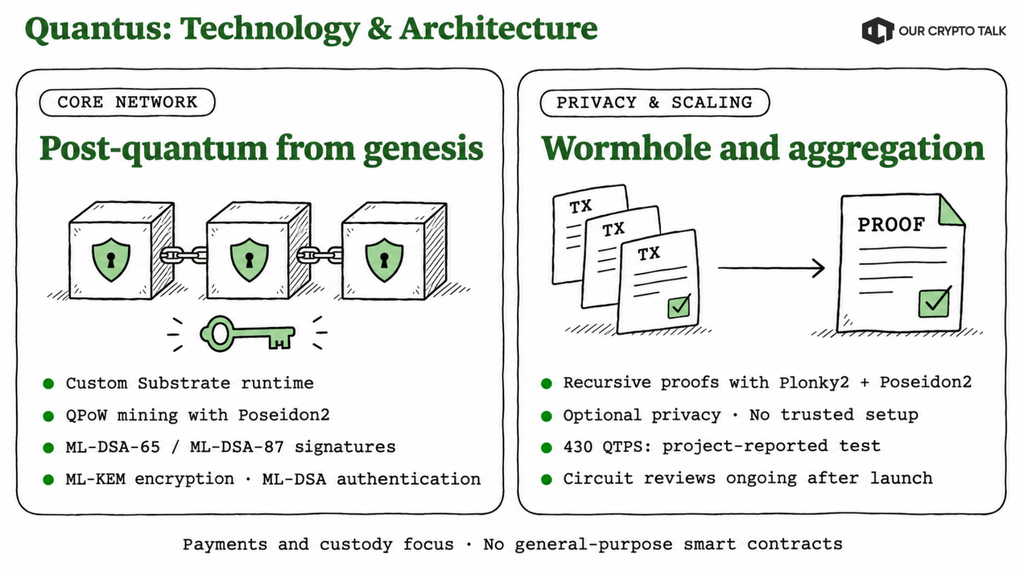
Quantus runs a custom Substrate runtime and uses pure Proof-of-Work consensus. Its QPoW algorithm relies on Poseidon2 rather than Bitcoin’s SHA-256. The project selected Poseidon2 for its efficiency inside zero-knowledge circuits.
Peer-to-peer networking uses ML-KEM for encryption and ML-DSA for authentication. Account signatures exclusively use ML-DSA-65 or ML-DSA-87, and the supplied research states that the runtime contains no classical signature types. Quantus stores state in a Poseidon-hashed trie.
The project describes its privacy and scaling architecture as recursive STARKs built with Plonky2 and Poseidon2, without a trusted setup. Wormhole supports privacy, while aggregation aims to reduce the throughput costs of large post-quantum signatures.
Quantus reports a tested figure of 430 QTPS under specific conditions. Readers should treat that figure as a project-reported benchmark rather than an independently established measure of sustained mainnet throughput.
Quantus does not support general-purpose smart contracts. Its architecture prioritizes payments, custody, and optional privacy rather than an application ecosystem.
Like Bitcoin, Quantus combines Proof-of-Work, a 21 million supply cap, and a monetary focus. It differs through its hashing algorithm, larger signatures, shorter block intervals, native post-quantum signing, and optional zero-knowledge privacy.
The whitepaper, version 0.4.1, and published audit reports provide the relevant basis for assessing its throughput, privacy, and circuit-security claims. The supplied research notes that several zero-knowledge circuit reviews still carried draft or in-progress labels after mainnet launch.
Team & Backers
Christopher Smith leads Quantus as CEO and founder, while Joseph Mattia serves as COO and co-founder. Jonathan Angle appears as a whitepaper co-author and communications contributor. Quantus Labs LLC is the operating company.
Public accounts describe private angel funding beginning around late 2024. One co-founder account mentions an initial investment following a Token2049 conversation. The supplied primary-source research does not establish the financing structure, exact amount raised, or a complete list of institutional backers.
Claims linking specific high-profile investors to Quantus require confirmation from the company or the investors themselves. The team has published open-source code, released regular blog updates, and engaged multiple security reviewers, but these activities do not independently verify funding claims.
Quantus Tokenomics (QTC)
Token Overview
QTC is the native coin of the Quantus blockchain. It has no separate token contract on another network. Maximum supply stands at 21,000,000 QTC.
The early-November 2026 snapshot records approximately 318,000 circulating QTC, or roughly 1.5% of the maximum. At a price near $70, circulating market capitalization stood around $22 million.
Reported all-time highs differ substantially across sources and timeframes, ranging from the high $90s to approximately $186 in early October. These conflicting figures require caution when comparing drawdowns, although the supplied research consistently describes substantial declines from peak prices.
Mining emissions decline smoothly without halvings. Transaction fees provide an additional source of miner income, while the protocol burns a portion of those fees. QTC holders do not receive a stated dividend or direct revenue distribution.
Token Allocation
Quantus minted 27% of maximum supply at genesis, equivalent to 5,670,000 QTC, for investors, the team, and the company. Mining accounts for the remaining 73%, or 15,330,000 QTC.
Most of the genesis allocation goes to investors, founders, and team members under vesting arrangements. A smaller portion supports company, treasury, and liquidity needs. The supplied draft does not specify the exact allocation within those categories; the whitepaper and on-chain schedules contain the detailed splits.
The protocol imposes no ongoing developer tax on block rewards. That distinction does not remove the ownership concentration associated with the genesis allocation.
Vesting & Unlock Pressure
Most genesis allocations carry a one-year cliff from mainnet launch, followed by linear vesting over three years. An on-chain vesting pallet enforces the schedule. A smaller liquidity tranche vested earlier.
Larger grants begin releasing after September 2027. The supplied research also records earlier treasury movements into bridge liquidity.
The key supply risk comes from the gap between the small circulating float and the much larger allocated supply. Unlocks increase the amount holders can potentially sell, although the schedule alone cannot establish how much will reach the market.
Token Utility
Users pay network fees and transfer value with QTC, while miners earn it through block production. The project also positions the coin as a store of value. Quantus offers no staking yield or general-purpose smart-contract utility.
Part of transaction fees leaves circulation through burning. The remaining fee income benefits miners rather than providing a direct payout to all coin holders.
The supplied research characterizes current demand as more closely tied to speculation and the quantum-security thesis than to substantial payment activity. Broader utility depends on whether users and institutions choose Quantus for transfers or quantum-resistant custody.
Is Quantus Safe?
Quantus has commissioned independent reviews of several core components. Neodyme reviewed its ML-DSA/Dilithium implementation and HD-wallet library in a report dated December 2025. The team states that it addressed the findings, including memory-zeroization issues.
Equilibrium/Eiger reviewed Poseidon2, QPoW, and related blockchain primitives. Additional circuit reviews appear in draft or completed form. An Immunefi audit competition in August 2026 also produced valid reports that the project says it addressed before launch.
The supplied research identifies no publicly reported post-launch exploit through early November 2026. That finding does not establish comprehensive security, particularly while newer privacy and aggregation components continue to evolve.
Economic risks also matter. Liquidity remains thin and depends on a small number of venues, while early miners and treasury-related addresses hold concentrated positions. The young network’s mining distribution also warrants monitoring.
Audits examine particular code versions and components. Users should check the current review status, understand guardian and recovery permissions, and protect recovery phrases before relying on the network for custody.
Quantus vs Competitors
Quantus vs Competitors
| Project | Market Cap (approx.) | Use Case | Chain / Type | Key Metric | Product Status | Token Utility |
|---|---|---|---|---|---|---|
| Quantus (QTC) | ~$22M | Quantum-secure money + optional privacy | Substrate PoW L1 | ~430 QTPS claimed; 12–15 s blocks | Mainnet live Sept 2026 | Medium of exchange, mining reward, fees |
|
Bitcoin (BTC)
| ~$1.5T+ | Sound money | Bitcoin PoW L1 | ~7–10 TPS; 10 min blocks | Mature | Medium of exchange, store of value |
|
Monero (XMR)
| ~$6–8B | Private money | Monero PoW L1 | Privacy-focused; ~2 min blocks | Mature | Medium of exchange, mining reward |
|
Zcash (ZEC)
| ~$10B+ (varies) | Optional privacy money | Zcash PoW L1 | Shielded pool; ~75 s blocks | Mature | Medium of exchange, mining reward |
| Other PQC / hybrid L1s | Varies | Quantum claims + apps | Mixed | Depends on design | Mostly early or hybrid | Often app or staking utility |
These approximate figures reflect the supplied research snapshots. The metrics also measure different properties: Quantus’s claimed QTPS benchmark does not provide a direct comparison with observed transaction activity or competitors’ block intervals.
Quantus’s main distinction is native post-quantum account signatures from genesis. That avoids a later signature migration for assets already on its network. Legacy chains face coordination and performance challenges if they adopt larger post-quantum signatures, but they retain substantial advantages in liquidity, usage, and network recognition.
Strengths & Risks (Bull vs Bear Case)
The bullish case starts with a functioning network that requires ML-DSA signatures from its first block. Quantus avoids the account-migration problem that established chains would face when changing signature systems. Open GPU mining distributes 73% of maximum supply over time, and miners receive the full subsidy without a developer tax.
Zero-knowledge aggregation could help offset signature size if the project delivers its performance targets securely. NEAR Intents integration and references to Project Eleven could also support access or custody adoption, although readers should verify each relationship’s scope. Reported hashrate in the tens of TH/s and multiple active pools provide early evidence of mining participation.
The bearish case centers on limited usage, thin liquidity, and future supply. The 27% genesis allocation substantially exceeds the current circulating float, with larger unlocks beginning after the one-year cliff. Modest trading depth can amplify price moves and complicate exits.
Privacy and scaling components introduce additional execution risk while development and review work continue. Mining concentration also deserves attention: the supplied research notes that one pool exceeded 50% of recent blocks during an observed period.
Quantus must compete with Bitcoin’s established monetary network and liquidity. Miners currently receive subsidies and fees, but declining emissions make sustained demand increasingly important. Quantum-resistant signatures alone do not guarantee sufficient usage, token demand, or a durable security budget.
Should You Buy QTC? (OCT Verdict)
Builders and developers can inspect the open-source Substrate runtime, ML-DSA libraries, and zero-knowledge circuits. Quantus offers scope for infrastructure research and contributions, although its lack of general-purpose smart contracts limits application development.
Short-term traders face a small float, limited liquidity, and strong sensitivity to the quantum-security narrative. Trading depth, venue access, and future unlocks matter more than headline market capitalization alone. Those constraints support a watch or avoid stance depending on individual risk tolerance.
Long-term investors need to assess two separate assumptions: whether the quantum threat develops quickly enough to influence custody decisions, and whether Quantus captures that demand. QTC remains a speculative, early-stage asset. A small allocation would still carry substantial technical, liquidity, adoption, and dilution risk.
Final Verdict: Is Quantus a Buy in 2026?
Quantus has launched a Proof-of-Work network with native NIST-standard ML-DSA account signatures. Optional privacy and transaction-recovery features broaden its product beyond basic transfers, although development and security-review work continue.
The investment case remains less established than the core product. Usage and liquidity are limited, while larger vested allocations begin unlocking in 2027. Quantus could benefit if demand for quantum-resistant custody grows, but it must convert that concern into sustained network activity. QTC currently fits the profile of a speculative early-stage asset.
Frequently Asked Questions
What is Quantus Network?
How does Quantus work?
What is the significance of ML-DSA signatures in Quantus?
What is QTC used for?
Is Quantus safe?
How is Quantus different from Bitcoin?
Is QTC a good investment?
In this article
Why Quantus’s Quantum-Resistant Approach Is Hard to Get RightWhat Is Quantus?How Quantus WorksTechnology & ArchitectureTeam & BackersQuantus Tokenomics (QTC)Token OverviewToken AllocationVesting & Unlock PressureToken UtilityIs Quantus Safe?Quantus vs CompetitorsStrengths & Risks (Bull vs Bear Case)Should You Buy QTC? (OCT Verdict)Final Verdict: Is Quantus a Buy in 2026?Frequently Asked Questions