TensorCash (TSC) Review: Is TSC Worth Buying in 2026?
TensorCash (TSC) review 2026: Explore its proof-of-inference technology, tokenomics, mining rewards, risks, and whether TSC is worth buying.


Author: Akshat Thakur
Why Useful Proof-of-Work and Verifiable AI Inference Chains Are Hard to Get Right
Most useful proof-of-work and AI-compute chains face the same challenge: making computational work commercially valuable and difficult to fake. They must attract paying inference customers, keep verification affordable for independent nodes, and prevent mining power from concentrating among a few operators.
GPU compute alone does not prove which AI model generated an answer. Some systems rely on capacity scores, periodic checks, or stake-weighted votes. These approaches do not necessarily establish which model ran, which sampling settings it used, or how the output was generated. Without independently verifiable proofs, miners could substitute cheaper models or different inference engines.
Full deterministic replay can be expensive or unreliable across different GPUs. Statistical verification is more practical, but it must account for floating-point differences without creating opportunities to manipulate results. Building a proof that is both efficient and trustworthy remains a major engineering challenge.
Economics presents another problem. If mining rewards provide most of the income, miners may prioritize earning subsidies over serving real customers. Centralized inference APIs still compete on price, latency, reliability, and convenience. A decentralized network must prove that buyers will pay for its verified outputs.
TensorCash approaches this problem by making open-model inference the block-producing work itself. The same computation generates a proof of which model ran. Its long-term success depends on whether this verification system can attract sustained paid demand while keeping the network secure and decentralized.
What Is TensorCash?
TensorCash is a Bitcoin Core-derived Layer 1 blockchain that uses proof of inference instead of conventional hash-based proof-of-work. Miners run registered open-source language models, generate answers with verifiable sampling proofs, and use that work to compete for blocks.
The project was authored pseudonymously by Imosuke Takakuni and launched its mainnet in June 2026. It launched without a premine or token sale, with new TSC entering circulation through mining rewards. Its goal is to combine verifiable AI inference with a native financial and settlement layer.
Hundreds of mining addresses have participated, with earlier snapshots reporting around 850 addresses across multi-week periods. Multiple independent pools operate on the network, and registered models include Qwen3-8B and Qwen3.8-27B. Third-party services such as Bob Labs and AskTilly also provide interfaces for accessing inference generated through the network.
TensorCash’s central proposition is that AI inference can serve two purposes: producing useful answers and securing the blockchain. Whether that translates into lasting token value depends on adoption, paid inference demand, and the reliability of its verification system.
How TensorCash Works
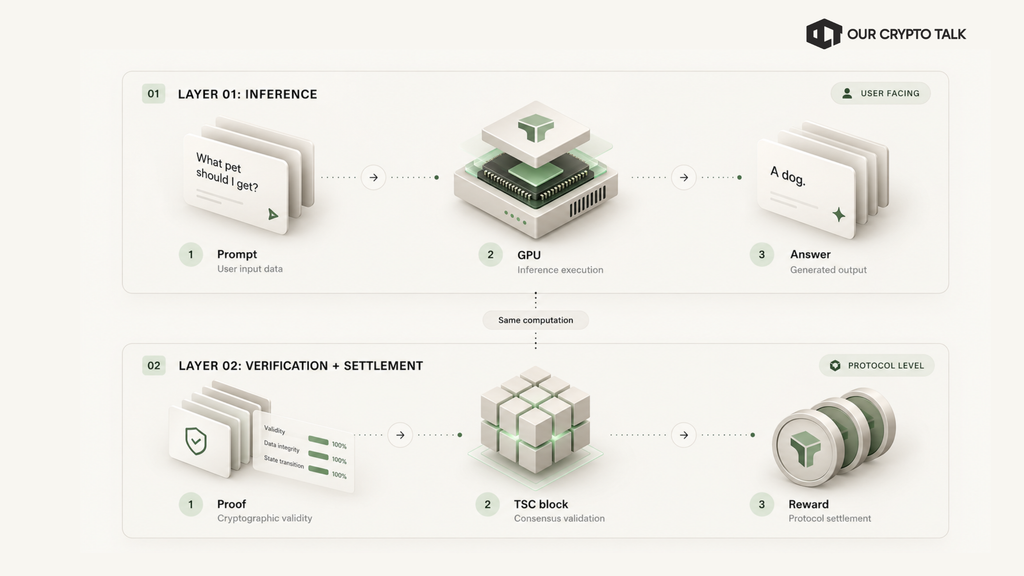
TensorCash connects AI inference to block production. A user or application submits a prompt through an interface such as Bob Labs or AskTilly. A miner runs a registered open-source model using an adapted inference engine, such as vLLM or llama.cpp, that records the information needed to construct a sampling proof.
The generation process uses randomness derived from chain state and context. This creates a verifiable link between the model’s output and the sampling process. The resulting proof competes for the next block under the network’s base target and model-adjusted difficulty. Buyers and independent verifiers can also check the proof.
Miners receive TSC block rewards for successful block production. When customers pay for inference, miners may also earn TSC payments for serving their requests. This creates a potential link between useful compute demand and miner revenue, although block subsidies remain a separate economic incentive.
Multiple registered models can compete at the same block height. Model registration requires a sponsor to post a 5 TSC deposit, followed by a 100-block registration window in which the model must receive support in at least 50 blocks. Model-adjusted difficulty aims to make work from different models comparable.
Verification uses several levels of checks. Initial structural and statistical screening can run on CPUs, followed by proof-of-work checks and more intensive GPU replay against calibrated statistical boundaries. Full verification provides a deeper check when needed. This layered approach aims to balance independent verification with the cost of reproducing AI inference.
The network also supports multiple roles. Users request inference, miners provide compute, sponsors register models, and independent nodes verify proofs and maintain consensus. Mining pools aggregate work through established mechanisms such as PPLNS.
TensorCash has expanded its reported compute activity, model registrations, and third-party inference access since launch. However, network generation and paid customer usage are different metrics. The key commercial question is how much activity comes from customers willing to pay rather than miners producing inference primarily to earn block rewards.
Technology & Architecture
TensorCash retains the core structure of a Bitcoin-derived blockchain, including the UTXO model, transaction graph, digital signatures, and peer-to-peer propagation. Its main change is replacing conventional hash-based mining with proof of inference.
Blocks include a commitment to the inference proof, a model-adjusted target, and a Wesolowski verifiable delay function intended to bind the work to elapsed time. Difficulty adjustment follows an ASERT-style approach with separate network and model targets. The design also supports post-quantum spending paths using ML-DSA from genesis. TensorCash does not include a general-purpose smart-contract virtual machine, keeping its execution surface narrower than that of programmable Layer 1s.
Beyond consensus, the chain includes financial primitives for native assets such as stablecoins, shares, bonds, and funds. These can use versioned legal documents, issuer control units, deposits, and KYC support through zero-knowledge eligibility proofs. Bilateral settlement supports transactions such as spot trades, repos, and forwards.
The financial layer also includes AI-compute derivatives, including options and contracts for difference tied to network difficulty, settled in TSC without an external price oracle. OTC coordination uses Nostr-backed discovery, encrypted sessions, and scriptless cosigning, alongside cross-chain swap support. Order-book DEX designs with front-running resistance through key-splitting remain an area of development.
Compared with Bittensor-style networks, which emphasize specialized subnets, staking, and incentive markets, TensorCash focuses on a scarce native asset, Bitcoin-style settlement, and proofs connecting inference to model identity. Its architecture is deliberately narrower than a general execution environment.
Team & Backers
TensorCash is publicly associated with pseudonymous founder and author Imosuke Takakuni. Official materials list takakuni@tensorcash.org as a contact and explicitly describe the name as a pseudonym. The project emphasizes verifying the code rather than relying on the founder’s identity. Public statements describe a small core group focused on consensus development, with early work self-funded and ongoing development supported through the same mining activity available to the wider network.
There has been no disclosed token sale, premine, ICO, IDO, presale, or venture-capital round. According to official materials, all new TSC enters circulation through mining. The project also warns users against anyone claiming to sell official token allocations.
Bob Labs operates mining infrastructure and provides chat and API access to inference. AskTilly offers an inference marketplace and app. Other independent mining pools include Aria, LuckyPool, Suprnova, and Tiger. These are ecosystem participants, not publicly identified core-team equity holders or formal protocol investors.
TensorCash follows a Bitcoin-derived fair-launch model rather than the typical VC-backed AI-crypto structure. There is no disclosed insider allocation table or investor vesting schedule, and issuance follows consensus rules.
The trade-off is that the project lacks a disclosed external funding reserve. Development depends on mining activity, community participation, and the incentives available to operators. Early miners may also have accumulated substantial holdings while competition was lower. The absence of insider allocations removes one source of dilution risk, but it does not eliminate supply concentration or governance concerns.
TensorCash Tokenomics (TSC)
Token Overview
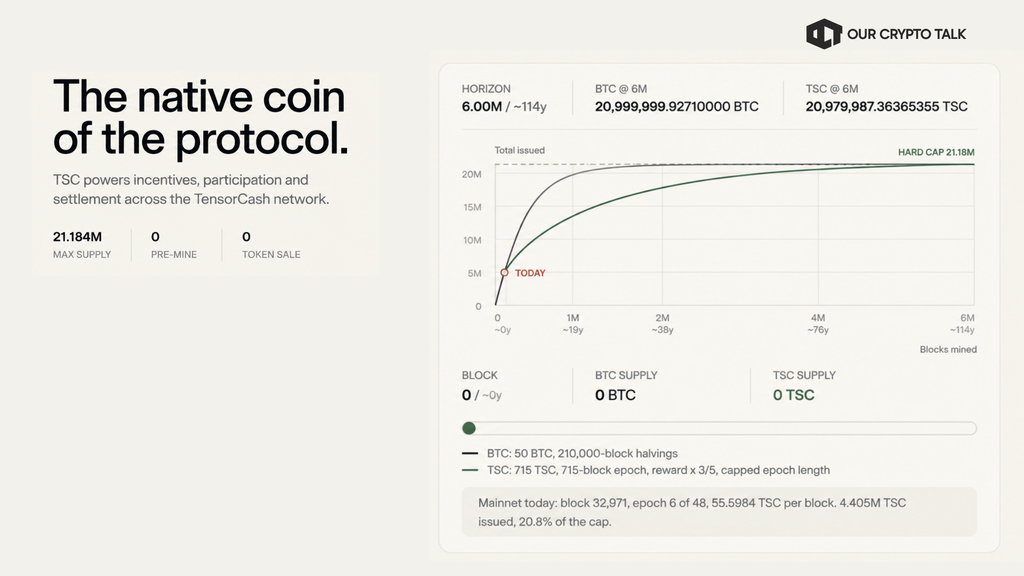
TSC is the native coin of the TensorCash Layer 1, with an exact hard cap of 21,184,153.03530240 TSC. The network launched without a premine or token sale, and all issuance occurs through mining under an epoch-based emission schedule.
By late October 2026, around blocks 32,900 to 33,000, approximately 4.40 million to 4.41 million TSC had been issued. That represents roughly 20.8% of the maximum supply. The current block subsidy was reported at 55.5984 TSC, with the network still in epoch 6.
The initial subsidy was 715 TSC per block for a short first epoch. At each epoch boundary, the reward is multiplied by 3/5, retaining 60% of the previous subsidy, while epoch lengths increase until they reach their cap. The schedule contains 48 non-zero subsidy epochs before block rewards reach zero.
This structure front-loads issuance to attract early miners and bootstrap network capacity. Over time, rewards decline and issuance slows, although a substantial portion of the remaining supply will still enter circulation through mining.
Token Allocation
All TSC supply is allocated through mining emissions. There is no published allocation for investors, the team, a foundation, or an ecosystem fund, consistent with the project’s stated no-premine and no-sale model.
However, fair launch does not mean equal distribution. Early epochs issued a significant amount of TSC when mining participation and competition were lower. Miners who entered early may therefore hold a larger share of the supply than later participants.
Onchain activity has also shown meaningful holdings outside addresses used purely for mining, including holdings associated with OTC and peer-to-peer transactions. These transfers can broaden distribution, but they do not necessarily establish how widely the supply is held.
Top-address concentration and pool distribution remain important metrics to monitor. The lack of a formal insider allocation removes the risk of scheduled team or investor distributions, but early-miner concentration can still create substantial selling pressure.
Vesting & Unlock Pressure
TSC has no conventional team or investor vesting schedule because the project has disclosed no such allocations. Instead, new supply enters the market continuously through mining rewards.
Coinbase outputs follow Bitcoin-style maturity rules, typically requiring 100 blocks before they can be spent. This delays miners’ access to newly earned coins but does not create a long-term vesting restriction.
The next major emission reduction was expected around block 45,045, when the block subsidy would fall from approximately 55.60 TSC to 33.36 TSC. Each reduction lowers the rate of new issuance, potentially easing dilution over time.
Early mining rewards helped bootstrap the network and create circulating supply for trading and OTC activity. The same front-loaded distribution also means later holders face potential selling from early participants who accumulated coins at lower network competition.
Approximately 79% of the maximum supply remained unissued as of late October 2026. That supply is not an immediate unlock cliff, but it represents a long-term stream of potential new market supply. The effect on price will depend on miner selling, demand for TSC, and whether paid inference and other network activity grow alongside emissions.
Token Utility
TSC serves several functions across the network. It pays transaction fees, funds mining rewards, and can be used to settle verified inference through services such as Bob Labs and AskTilly. It also supports deposits for native asset issuance and model registration, with the latter requiring a 5 TSC deposit that is returned or burned under defined conditions.
The coin also acts as margin or collateral for onchain AI-compute derivatives, including options and contracts for difference linked to network difficulty.
The distinction between mining rewards and commercial revenue is important. Block subsidies currently provide the main economic incentive for miners. Paid inference and fee markets exist, but reported activity remains early and has not approached the scale of the security budget provided by emissions.
The inference produced during mining has measurable computational value, but that does not automatically mean end-users are paying enough for answers to sustain the network independently. Long-term utility depends on whether TensorCash can attract repeat customers who value verifiable open-model inference and are willing to pay for it.
For TSC holders, the strongest long-term case would involve growing inference payments, useful financial applications, and transaction demand that gradually supplements mining emissions. Until then, token economics remain primarily driven by the subsidy schedule and demand for the coin itself.
Is TensorCash Safe?
TensorCash uses a Bitcoin-derived foundation, including the UTXO model, transaction rules, and peer-to-peer networking. Its narrower design avoids a general-purpose smart-contract virtual machine, reducing exposure to some categories of vulnerabilities common in complex DeFi applications. The network also supports post-quantum spending paths using ML-DSA and Witness v2 addresses from genesis.
One positive signal is its reported handling of invalid mining work. In July 2026, the network rejected blocks from a miner that submitted cheaper FP8 computation while claiming BF16 work. Full re-execution reportedly scored the work as invalid, and the blocks received no reward. Independent nodes can run a layered verification process, from quick statistical checks to model replay calibrated for floating-point differences.
By late October 2026, no major chain-halting exploit or consensus-breaking incident had been prominently reported in the available research. The network had continued producing blocks through multiple upgrades, including proof-version changes, multi-model support, and financial primitives. However, a short operating history is not enough to establish long-term security.
Miner concentration remains a concern. Early issuance and periods of concentrated pool activity can weaken decentralization, even if the inference proofs themselves work as intended. A network can verify model computation correctly while still depending heavily on a limited number of miners or pool operators.
The proof-of-inference system also introduces newer security assumptions. Verification relies on statistical boundaries, calibrated floating-point noise models, model registry integrity, and the difficulty of constructing convincing fake inference trajectories. These mechanisms have less historical testing than conventional hash-based proof-of-work.
Liquidity and operational maturity add further risk. TensorCash is only a few months old, trading venues are limited, and secondary-market order books can be shallow. Its front-loaded emission also creates ongoing incentives and potential selling pressure from early miners.
TensorCash vs Competitors
Its closest comparisons highlight three different approaches: Bitcoin secures the network through hashing, Bittensor coordinates AI work through subnet incentives, and centralized inference providers compete on performance and service reliability.
TensorCash vs AI Compute Competitors
| Project | Use Case / Focus | Mechanism / Chain Type | Key Differentiation | Product Status |
|---|---|---|---|---|
|
TensorCash
| Verifiable open-model LLM inference that simultaneously secures the chain | Bitcoin Core-derived L1 with proof-of-inference (model sampling proofs as PoW) | Same GPU forward pass produces both a paying answer and a model-identity receipt that any node can check; multi-model registry with adjusted difficulty; built-in financial primitives without a general VM | Live mainnet (June 2026); multi-model mining (e.g. Qwen3 series); early third-party inference surfaces |
|
Bittensor
| Broad decentralized AI marketplace across specialized subnets (inference, training, other ML tasks) | Custom L1 with Yuma Consensus; miners produce work, validators score it, stake-weighted emissions | Flexible subnet architecture for many AI tasks; quality scored by validators rather than cryptographic model-identity proofs of a specific open model | Mature ecosystem with 100+ subnets; significant adoption and ongoing subnet innovation (including inference-focused ones) |
|
Pearl
| Useful proof-of-work via matrix multiplication (core AI operation) | Bitcoin-fork L1 where PoW is matrix multiplication instead of hashing | Makes the mining work itself a fundamental AI primitive with low proving overhead; closer to “compute as security” than model-specific inference | Live (2026); focused on useful AI-related compute rather than full model serving + receipts |
|
Nosana
| Decentralized GPU marketplace specialized in AI inference jobs | Solana-based job marketplace; hosts offer GPUs, users submit inference workloads | Cost-efficient GPU rental for inference with on-chain job matching and settlement; less emphasis on proving which exact model ran | Live inference marketplace; focuses on accessible GPU supply rather than chain security via inference proofs |
TensorCash’s differentiator is the link between inference and consensus. A registered model’s forward pass can produce useful output, contribute to block production, and generate a receipt that buyers or independent nodes can verify. The chain also includes native financial tools without a general-purpose smart-contract VM.
Strengths & Risks: The Bull and Bear Case
The bullish case begins with a fair launch. TensorCash has no premine or token sale, avoiding large insider allocations and conventional investor unlock schedules. Its proof-of-inference design ties registered open-model computation to block production, while the same proof can serve as a receipt for buyers and independent verifiers.
Multi-model mining is live, and reported network compute has grown since the June 2026 mainnet launch. The network also supports native assets, bilateral settlement, and AI-compute derivatives. Its decision to avoid a general-purpose smart-contract VM limits exposure to some categories of DeFi vulnerabilities. Post-quantum spending support has also been available from genesis.
Independent mining pools and third-party inference services such as Bob Labs and AskTilly provide early signs of ecosystem participation. If paid inference demand expands, TSC could gain utility beyond mining rewards and transaction fees.
The bearish case is that commercial inference remains small relative to the mining subsidy. Miners still depend primarily on block rewards, which means the network has not yet demonstrated that customer payments can become a major part of its security economics.
Mining concentration has appeared in early network data, and limited exchange coverage and thin liquidity increase price volatility and exit risk. TensorCash must also compete with centralized APIs that already offer mature infrastructure, low latency, and established customer relationships.
Its verification model has shown useful behavior, including the reported rejection of invalid quantized work. However, statistical proof-of-inference is a newer consensus approach without the long adversarial history of conventional hash-based proof-of-work. Its security assumptions and decentralization still need time to mature.
The design is distinctive, and the emission schedule is clearly defined. Commercial adoption and decentralized compute remain the two major tests.
Should You Buy TSC? The OCT Verdict
For builders and miners, TensorCash is worth exploring if you operate GPUs or want to experiment with verifiable open-model inference. Mining profitability depends on the current subsidy, network difficulty, model requirements, pool fees, electricity costs, hardware depreciation, and the opportunity cost of using your GPUs elsewhere. Any inference revenue should be treated separately from block rewards when estimating returns.
For short-term traders, TSC is a high-risk asset. Thin liquidity and limited exchange availability can amplify price swings and make exits costly. Market movements may reflect speculative demand more than growth in paid inference activity.
For long-term investors, the most important signal is whether verified inference develops into a meaningful source of revenue. Watch paid inference volume relative to block subsidies, miner and pool concentration, registered model activity, and the growth of independent verification. Until commercial demand becomes more substantial, TSC remains an experimental investment rather than an established AI infrastructure asset.
Is TensorCash worth buying? That depends on whether you believe verified open-model inference can attract durable demand and whether the current price compensates for the risks. Review the code and whitepaper, run a node or verifier if possible, and compare real inference payments with mining emissions before considering exposure. Any position should reflect the possibility of substantial losses.
Final Verdict: Is TensorCash a Buy in 2026?
TensorCash brings a distinctive idea to the AI-crypto sector. It makes open-model inference part of proof-of-work, connects computation to model-identity proofs, and combines that design with a Bitcoin-derived base and native financial tools.
The main uncertainty is economic rather than conceptual. Paid inference demand remains early, mining rewards dominate miner incentives, and secondary-market liquidity is limited. The novel verification system and concentration risks also need more time and adversarial testing.
For most investors, TSC is better treated as a high-risk watchlist asset than a clear buy at this stage. Stronger evidence of recurring paid inference, broader independent mining participation, and sustainable demand beyond block subsidies would make the long-term case more convincing.
Frequently Asked Questions
What is TensorCash (TSC)?
How does TensorCash work?
What is the TSC token used for?
What is the maximum supply of TSC?
Is TensorCash a fair-launch crypto project?
Is TensorCash safe to invest in?
How is TensorCash different from Bittensor?
Is TSC a good investment in 2026?
In this article
Why Useful Proof-of-Work and Verifiable AI Inference Chains Are Hard to Get RightWhat Is TensorCash?How TensorCash WorksTechnology & ArchitectureTeam & BackersTensorCash Tokenomics (TSC)Is TensorCash Safe?TensorCash vs CompetitorsStrengths & Risks: The Bull and Bear CaseShould You Buy TSC? The OCT VerdictFinal Verdict: Is TensorCash a Buy in 2026?