Teller (DEBIT) Review: Is DEBIT Worth Buying in 2026?
Teller ( $DEBIT ) review 2026: Explore its fixed-term lending model, AI agent, tokenomics, risks, and whether DEBIT is worth buying.


Author: Akshat Thakur
Why Fixed-Term and Hybrid Credit DeFi Lending Are Hard to Get Right
Most DeFi lending protocols face similar problems. Borrowing demand often comes from leveraged trading and looping rather than genuine credit needs.
Long-tail collateral introduces oracle and liquidity risks, while continuous loan-to-value monitoring can trigger liquidations during volatile markets, even when borrowers intend to repay.
Fixed-term lending removes some of that pressure but creates a different risk. If a borrower fails to repay at maturity, the collateral still needs to be sold or auctioned.
Lenders must recover their principal, and the protocol needs a reliable settlement process. Avoiding mid-term margin calls does not eliminate default risk.
Hybrid credit models face additional complications. Combining crypto collateral with traditional credit assessments introduces underwriting, regulatory, and operational dependencies.
Unsecured loans also require reliable borrower screening and a way to handle defaults that smart contracts alone cannot provide.
Teller approaches this market through isolated lending pools and fixed-term loans, while Debit AI adds an agent layer for onchain actions and third-party credit pre-qualification.
The model has a clear product focus, but its success depends on actual loan utilization, repayment performance, and recurring revenue rather than incentives or AI-agent activity alone.
What Is Teller?
Teller is a multi-chain, non-custodial lending protocol that allows users to borrow against supported crypto assets through isolated markets and fixed-term loans. The project has operated in different forms since approximately 2019–2020.
Unlike conventional DeFi lending markets, its loans do not trigger price-based margin calls during the agreed term. Borrowers repay at maturity, while unpaid positions are resolved through collateral settlement, typically involving an auction-style process.
The protocol is led by founder and CEO Ryan Berkun. Its deployments have covered Ethereum, Base, Arbitrum, Polygon, HyperEVM, and other networks. Product updates have also discussed BNB Chain collateral listings and experimental access to Solana-based assets through partners such as Rome.
Teller reports more than $80 million in cumulative loan volume across its supported markets. Lifetime lending volume and current locked capital measure different things, and both are important when assessing the protocol’s present scale.
The newer part of the ecosystem is Debit AI, a conversational agent designed to help users execute financial actions and explore credit opportunities. Its native token, $DEBIT, is primarily positioned as a credit mechanism for agent usage, with staking, discounts, and governance also appearing in secondary coverage.
Teller is an established lending product with a newer AI interface and a relatively young token. Its investment case requires separating the protocol’s lending history, current utilization, and the demand for DEBIT credits.
How Teller Works
Lenders deposit assets into isolated pools or create lending offers through the marketplace. Borrowers select supported collateral and take loans with defined terms and interest rates.
During the loan period, price movements do not trigger continuous health-factor liquidations. If the borrower repays on time, the collateral is released. If repayment fails, the protocol uses its maturity-based settlement process to recover funds from the collateral, often through an auction.
This structure gives borrowers more predictable repayment conditions than continuously monitored lending markets. It also shifts much of the liquidation risk to maturity, where collateral value and auction liquidity determine how much lenders can recover.
Teller supports additional strategies through integrations with Uniswap-style liquidity routes, allowing users to build leveraged positions, loops, and shorts within a transaction flow. Isolated markets allow long-tail assets to have separate risk parameters, reducing the chance that one problematic collateral asset directly affects every lending pool.
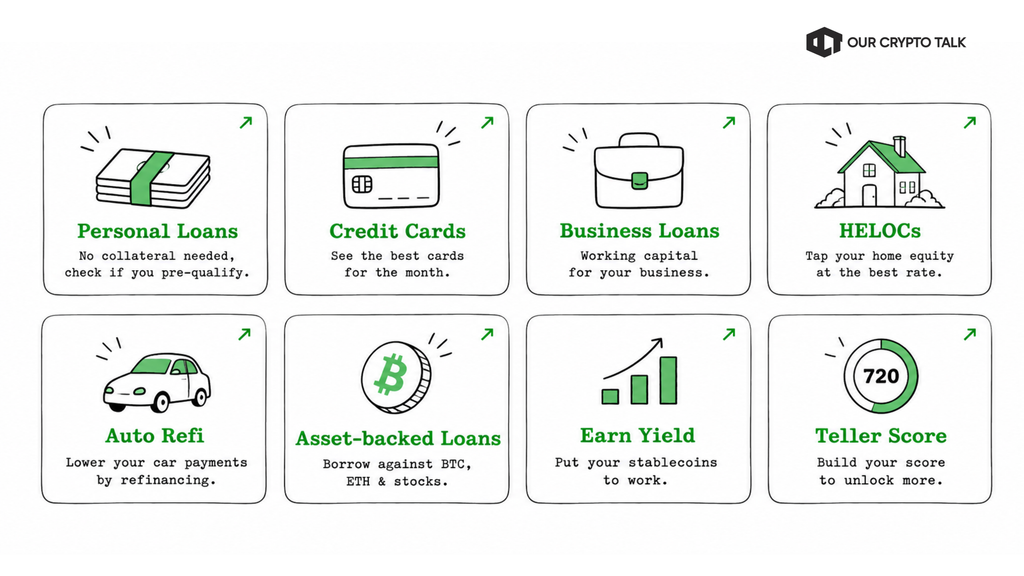
Debit AI adds a natural-language interface to the ecosystem. Users can ask the agent to borrow, swap, bridge, compare yields, or manage positions on platforms such as Aave.
It can also help users explore traditional credit pre-qualification. The agent is accessible through its own interface and MCP-compatible clients, including Claude and ChatGPT, subject to permissions and spending limits. Agent runs consume DEBIT credits.
Technology & Architecture
Teller’s core architecture revolves around isolated lending pools and fixed-term loans. Collateral is held within individual markets, keeping much of the associated risk separated from other pools.
Instead of continuously liquidating positions based on oracle-driven health factors, the protocol uses maturity-based settlement.
This design changes how credit risk is managed. Borrowers avoid mid-term liquidations caused by temporary price movements, but lenders remain exposed to collateral depreciation and insufficient auction liquidity when a loan reaches maturity.
The protocol operates across multiple EVM networks, with integrations supporting lending strategies, swaps, and collateral management. Debit AI adds an automation layer that can interact with services such as Aave.
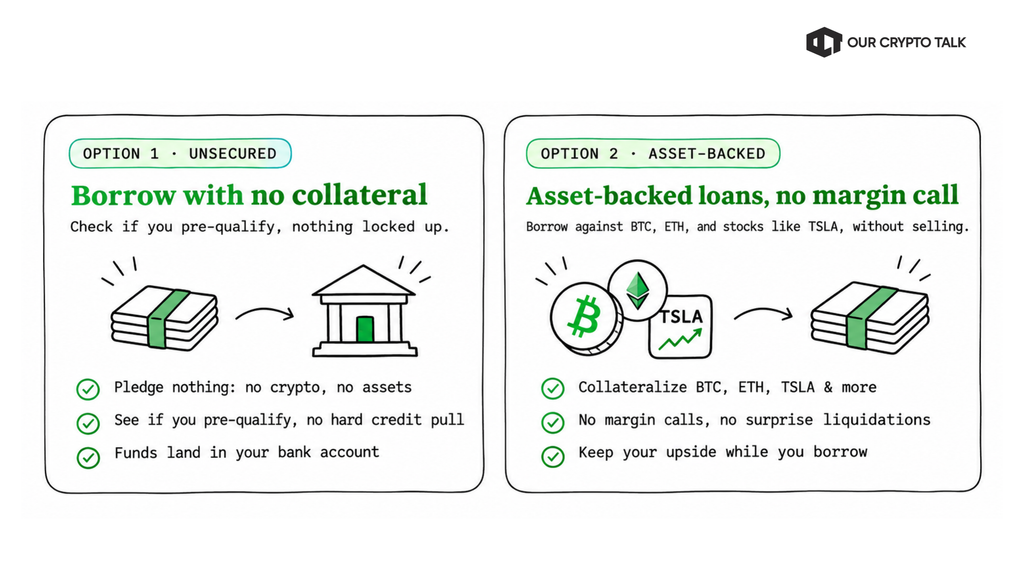
Teller Score provides a reputation-based mechanism for credit access, while third-party lending partners handle certain no-collateral pre-qualification pathways.
The architecture is therefore lending-first. Debit AI provides an automation and distribution layer on top of the credit infrastructure. Its long-term value will depend on whether that interface brings more users, more lending activity, and recurring demand for DEBIT.
Team & Backers
Teller is led by founder and CEO Ryan Berkun, who has been associated with the protocol from its early unsecured-credit experiments through its fixed-term lending products and the newer Debit AI layer.
The project has institutional funding from both crypto-focused and traditional finance investors. An initial $1 million seed round around July 2020 involved Framework Ventures, ParaFi Capital, Maven 11, and Creative Destruction Lab, among others.
In February 2022, Teller raised a further $6.85 million strategic round led by Blockchain Capital. Participants included Franklin Templeton, Toyota Ventures, Bessemer Venture Partners, Upstart, Signum Capital, Framework Ventures, and ParaFi Capital, alongside additional investors and angels. Total disclosed equity-style funding stands at approximately $7.9 million.
This investor base gives Teller a longer institutional funding history than many newer DeFi projects. The involvement of traditional finance firms is also relevant for a protocol focused on credit markets. However, funding does not guarantee lending utilization, repayment performance, or adoption of the newer AI agent.
It is also important to separate the company’s historical equity funding from DEBIT tokenomics. Investors in Teller’s earlier funding rounds do not necessarily have the same allocation or unlock arrangements as holders of the 2026 token. Institutional backing provides credibility, but DEBIT’s value still depends on its own utility and demand.
Teller Tokenomics (DEBIT)
Token Overview
DEBIT has a fixed maximum supply of 100 million tokens. Approximately 17.22 million, or 17.22% of the total supply, was circulating at and after launch. Most of the supply therefore remains subject to vesting and release schedules.
The token is primarily associated with BNB Chain trading venues, while Teller’s lending products operate across multiple EVM networks. In early November 2026, DEBIT traded around $1.20 to $1.40, with a circulating market capitalization of approximately $20 million to $24 million.
The token remains below its September 2026 all-time high near $4.30. Its fully diluted valuation is several times higher than its circulating market capitalization because most tokens have not yet entered circulation. This difference is important when assessing the current price, particularly with substantial team and investor allocations still locked.
Token Allocation
DEBIT’s published distribution is divided across investors, the team, community programs, liquidity, foundation reserves, and protocol development.
Investors
12-month cliff, followed by 12-month linear vesting
Team
12-month cliff, followed by 36-month linear vesting
Community
Remaining allocation released linearly over 36 months
Liquidity
Remainder released during months 1–3
Foundation
Remainder released linearly over 36 months
Reserve
Released through month 15
Protocol
Remainder released linearly over 36 months
Investors and the team control approximately 45.21% of the maximum supply. Community and protocol allocations together account for around 24.72%, supporting user incentives and ecosystem programs.
The published schedule indicates that full unlocking is expected approximately four years after launch. This creates a longer supply timeline that investors need to consider when comparing circulating market capitalization with fully diluted valuation.
Is Teller Safe?
Teller has a longer security history than many tokens and AI-agent products launched in 2026. Sherlock published a Teller Finance audit report in April 2024 and later conducted additional security contests, including work related to lender-group updates. Project-adjacent materials also reference insurance-style coverage.
These are useful security signals, but audits do not guarantee that every deployed contract is secure. The scope, date, and contract versions covered by each report matter, particularly because Teller operates across multiple networks and supports a wide range of collateral assets.
The lending model also introduces risks that are not limited to smart-contract vulnerabilities. Fixed-term loans avoid mid-term price-based liquidations, but borrowers can still default. If collateral loses substantial value before maturity or an auction attracts insufficient bids, lenders may not recover their full principal.
Isolated markets help contain exposure to individual assets, but they do not eliminate liquidity and underwriting risks within those pools. Long-tail collateral can be especially difficult to value and liquidate during market stress.
No major public protocol-halting exploit was prominently reported for the live Teller stack during the research window. That is encouraging, but it does not establish that the protocol is risk-free.
Teller vs Competitors
Teller takes a different approach from the large DeFi lending markets. Its focus is fixed-term, isolated loans combined with an AI agent that connects onchain lending to third-party traditional credit services. It is not designed to compete directly with every feature of a continuous money market.
Teller vs Lending Competitors
| Project | Use Case | Chain | Product Status | Token Utility |
|---|---|---|---|---|
|
Teller (DEBIT)
| Fixed-term isolated loans; Debit AI agent; TradFi pre-qual path | Multi-chain EVM (Base-heavy today) | Live lending + AI agent; token since Aug 2026 | AI usage credits, staking, governance |
|
Aave
| Variable-rate pooled money market with health-factor liquidations | Many EVM chains | Mature blue-chip lending | AAVE governance and safety-module staking |
|
Morpho
| Efficient peer-to-pool / vault lending on top of major markets | Major EVM deployments | Live and competitive with Aave-scale flows | MORPHO governance and incentives |
|
Maple / similar credit desks
| Underwritten or institutional fixed credit | Selected chains | Niche institutional credit | Protocol-specific credit tokens |
Aave and Morpho compete through deep liquidity, flexible borrowing, and competitive interest rates. Teller differentiates itself through fixed loan terms, isolated collateral markets, and the absence of mid-term price-based liquidations. Debit AI adds another layer by allowing users to access lending and financial actions through a conversational interface, including third-party unsecured credit pre-qualification.
The difference is product structure rather than scale. Teller’s current TVL and active loans remain considerably smaller than those of major lending protocols. Its opportunity depends on attracting borrowers who value predictable loan terms and agent-assisted financial access.
Strengths & Risks: The Bull and Bear Case
Teller has a longer operating history than most AI-credit tokens launched in 2026. Its fixed-term lending model offers a clear alternative to continuous health-factor liquidation, allowing borrowers to maintain positions through market volatility. Isolated pools also help contain exposure to individual collateral assets.
The project has institutional backing from investors including Framework Ventures, Blockchain Capital, ParaFi Capital, Maven 11, Franklin Templeton, and Toyota Ventures.
Its reported cumulative loan volume above $80 million suggests the lending stack has supported meaningful activity over several years.
Debit AI expands the product’s reach through conversational interfaces and MCP integrations, potentially bringing in users who would not interact directly with Teller’s lending interface.
The bearish case starts with current token supply. Token supply adds another concern. Only around 17.22% of DEBIT’s maximum supply is circulating, leaving substantial investor and team allocations subject to future unlocks.
Agent activity also needs to translate into recurring paid usage. If users experiment with the product but do not continue running agents, demand for DEBIT credits may remain limited.
Aave and Morpho already have established liquidity and borrower networks. Teller must demonstrate that its fixed-term model attracts enough repeat borrowing to compete for users.
Its no-collateral credit pathways also depend on third-party lenders, meaning those activities do not automatically become protocol-level lending revenue.
The lending product can be useful and commercially established while the token remains difficult to value. DEBIT still needs stronger evidence of utilization, recurring agent spending, and value accrual relative to its future supply.
Should You Buy DEBIT? The OCT Verdict
For builders and borrowers, Teller is worth considering if you need fixed-term loans, isolated collateral markets, or borrowing without mid-term price-based liquidations.
Debit AI may also offer a more accessible way to interact with lending and yield strategies. These products can be evaluated independently of DEBIT ownership.
For short-term traders, monitor token unlocks, agent adoption, active loans, and TVL across Teller’s deployments. DEBIT should not be treated like a liquid, established money-market token. Its market price can move faster than the underlying lending business.
For long-term investors, the key is whether circulating supply growth is matched by higher loan utilization and recurring agent-credit demand.
Look for evidence that paid agent activity and protocol economics can support token demand as investor and team allocations unlock. Until that relationship becomes clearer, DEBIT is difficult to justify as a core holding in the DeFi credit sector.
DYOR. Lending activity and AI-credit demand are separate economic drivers, and both need to grow for the token thesis to strengthen.
Final Verdict: Is Teller a Buy in 2026?
Teller is a functioning fixed-term lending protocol with a multi-year operating history, institutional backers, and a newer AI interface through Debit. Its lending model offers a genuine alternative to continuously liquidated money markets, while the agent layer could make financial actions more accessible.
DEBIT’s investment case is less established. Current TVL and active loans remain modest, most of the token supply is still locked, and agent-credit demand needs to prove it can generate recurring usage. The company’s lending history does not automatically translate into token value.
DEBIT is best treated as a high-risk access token tied to a specialized credit and AI-agent ecosystem, not as a direct proxy for the wider DeFi lending market. Stronger loan utilization, sustained agent spending, and transparent value accrual would make the long-term case more convincing.
Frequently Asked Questions
What is Teller Finance (DEBIT)?
How does Teller lending work?
What makes Teller different from Aave and Morpho?
What is Debit AI?
What is the total supply of DEBIT tokens?
What is the utility of the DEBIT token?
Is Teller Finance safe to use?
Is DEBIT a good investment in 2026?
In this article
Why Fixed-Term and Hybrid Credit DeFi Lending Are Hard to Get RightWhat Is Teller?How Teller WorksTechnology & ArchitectureTeam & BackersTeller Tokenomics (DEBIT)Is Teller Safe?Teller vs CompetitorsStrengths & Risks: The Bull and Bear CaseShould You Buy DEBIT? The OCT VerdictFinal Verdict: Is Teller a Buy in 2026?