Derive (DRV) Review: Is DRV Worth Buying in 2026?
Derive (DRV) review 2026: Explore its onchain options exchange, tokenomics, buybacks and key risks to assess whether DRV is worth buying.


Author: Kritika Gupta
Why Onchain Options and Derivatives Liquidity Are Hard to Get Right
Onchain options protocols have struggled to retain professional market makers. Early automated market makers faced adverse selection, where better-informed traders left liquidity providers holding unfavorable positions. Order books and vaults addressed some of these problems, but thin liquidity, high collateral requirements and incentive-driven activity remained common.
Centralized matching infrastructure adds operational risk during market stress. Token unlocks and emissions can also exceed fee generation, weakening the investment case even when the underlying exchange attracts users.
Derive approaches these problems through an options-focused exchange with supporting perpetual futures, spot trading, lending and vaults. It combines offchain matching, portfolio margin and onchain settlement verification to support fast execution and more efficient collateral use. Its long-term position depends on whether onchain options demand grows and market makers remain active without continuous subsidies.
What Is Derive?
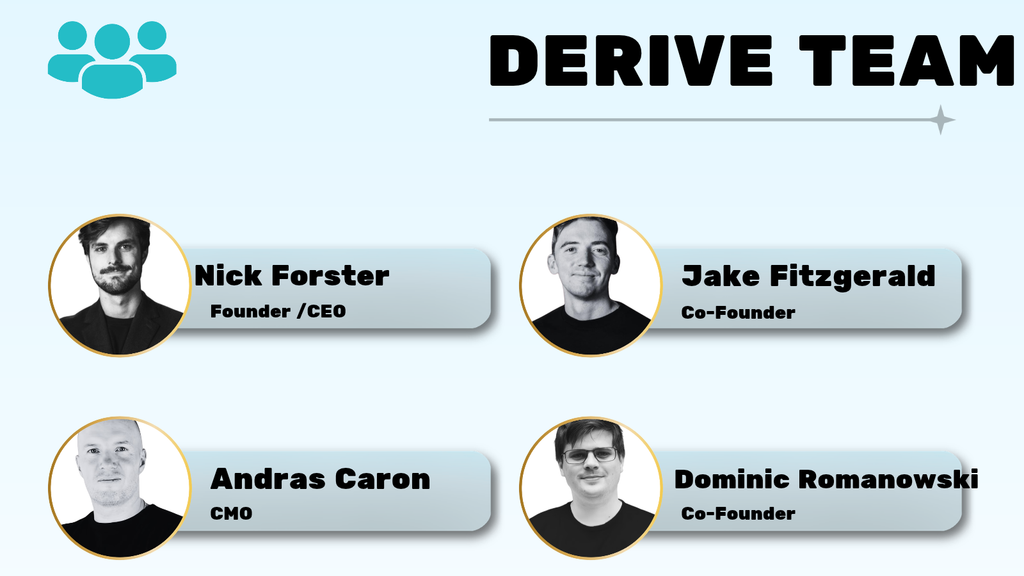
Derive is a self-custodial exchange for crypto options, perpetual futures, spot trading, lending and vaults. It began as Lyra Finance in 2021 on Optimism. Its co-founders include Nick Forster, a former equity options trader at Susquehanna, alongside Michael Spain, Jake Fitzgerald and Dominic Romanowski.
The project rebranded to Derive in 2024 as it expanded beyond options. In January 2025, LYRA holders migrated to DRV at a 1:1 ratio, with additional airdrop components. DRV supports governance, staking, fee discounts and protocol-funded buybacks.
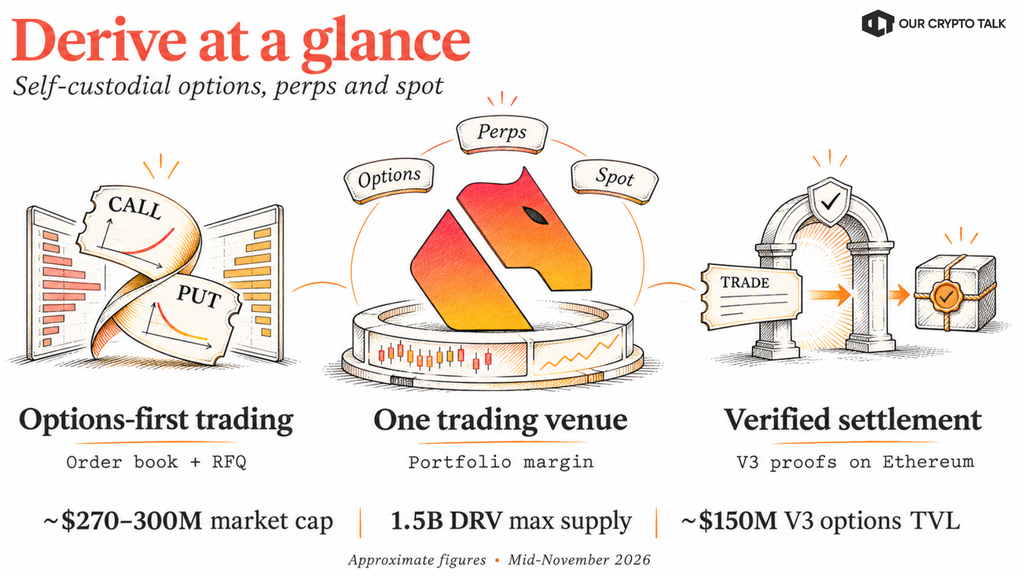
In October 2026, Derive migrated from its OP Stack rollup, Derive Chain, to V3, a zero-knowledge architecture that settles on Ethereum. As of 19 November 2026, Derive accounted for 90.6% of the onchain options premium volume tracked by DefiLlama over the previous 30 days, with $124.86 million out of $137.77 million. Over the same period, Derive V3 recorded $3.35 billion in options notional volume, bringing its cumulative V3 options notional volume to $4.78 billion.
DefiLlama’s 19 November 2026 UTC snapshot put Derive V3 Options’ total value locked at $154.43 million. DefiLlama tracked approximately $16 million in cumulative fees across Derive versions. A share of trading fees funds DRV buybacks, and the Derive DAO treasury holds the repurchased tokens.
On 19 November 2026, CoinGecko showed DRV trading at $0.2782, with a market capitalization of $295.53 million and $5.32 million in 24-hour trading volume. CoinGecko listed 1.062 billion DRV in circulation, equivalent to about 70.8% of the 1.5 billion DRV maximum supply.
Migration detail: Derive made DRV claimable on 15 January 2025. Its launch guide says 56.38% of the existing LYRA supply was allocated to the 1:1 migration, including migration bonuses, and 7.71% of the new DRV supply was allocated to the user airdrop
How Derive Works
Users connect a wallet and deposit supported collateral into a trading subaccount. Orders pass through an offchain order book, which the project describes as matching at sub-millisecond speeds. Large trades and multi-leg strategies can use a request-for-quote system to obtain prices from counterparties.
Matched trades settle under the protocol’s margin and risk rules. Standard margin supports cross-collateral positions, while scenario-based portfolio margin evaluates risk across a portfolio. Offsetting positions can therefore require less collateral than they would if assessed separately.
V3 products include dated options on BTC, ETH, HYPE and selected alternative assets, alongside perpetual futures, spot markets, lending and vault functionality. Institutional users can also access the venue through partners providing multiparty computation custody arrangements.
The team continues to operate the matching and API infrastructure. V3 changes how trading state and custody are verified, bringing settlement verification to Ethereum without removing operational dependence on the offchain trading layer.
Reported activity includes connections to dozens of market makers, continued integrations and weekly buybacks funded by protocol fees. Derive holds a substantial share of tracked onchain options activity, but its absolute volume remains much smaller than centralized venues such as Deribit. The team has described real-world asset markets as forthcoming rather than live.
Technology & Architecture
Derive V3 runs its risk engine, margin calculations and settlement logic inside a zero-knowledge virtual machine using SP1. It batches state updates and produces proofs that Ethereum L1 verifies. Matching remains offchain, while Celestia provides data availability.
This architecture replaces the earlier OP Stack rollup, which handled settlement and more of the protocol’s state. The aim is to retain fast trading while using Ethereum to verify the correctness of state transitions.
Portfolio margin and multi-asset collateral operate within defined risk universes for each subaccount. These boundaries determine which positions and collateral can be evaluated together. Official documentation and a ZKSecurity audit describe the V3 contracts, with the team stating that critical audit findings were addressed.
Derive uses a central-limit order book and RFQ system rather than relying on an options AMM. Its claimed differentiation among order-book derivatives venues is the combination of portfolio margin and zk-verified settlement.
Matching and sequencing still involve centralized infrastructure. The architecture should therefore be assessed alongside actual execution quality, market depth and uptime during volatile periods. Settlement proofs alone do not establish institutional trading performance.
Team & Backers
Public materials identify Nick Forster as Derive’s co-founder and CEO. He previously traded equity options at Susquehanna International Group. Other co-founders include Michael Spain, Jake Fitzgerald and Dominic Romanowski, who has been associated with the Foundation.
The project raised approximately $3.3 million in a 2021 seed round involving Framework Ventures, ParaFi Capital, GSR and other participants. A later strategic round followed. The supplied disclosures do not fully establish the financing structure or all commercial terms of subsequent private allocations.
Derive has repeatedly stated that contributor compensation and protocol development are aligned through DRV rather than a separate equity layer holding the protocol’s intellectual property. The Derive Foundation and related entities support governance and operations under DAO direction.
Public disclosures also describe custody integrations, including Fireblocks-related arrangements, and market-making relationships. These should be distinguished from investment backing. Current headcount and the full terms of commercial relationships are not publicly detailed.
Continuity from the Lyra period provides a multi-year development history. The team’s continued control of matching infrastructure remains a separate operational consideration.
Derive Tokenomics (DRV)
DRV is an ERC-20 token and is also deployed across chains using LayerZero’s Omnichain Fungible Token standard. A strategic mint approved in 2025 increased maximum supply from 1 billion to 1.5 billion tokens. Mid-November 2026 trackers reported circulating supply between roughly 950 million and slightly above 1 billion.
The token traded near $0.28 at the time of the supplied figures, below its reported September 2026 high of approximately $0.58. Its reported all-time low was around $0.012 in 2025. Contract addresses are published for Ethereum and other supported chains.
The initial distribution included a 1:1 migration from LYRA, alongside airdrop and bonus components for users and stakers. Later disclosures describe allocations for migration, ecosystem and community incentives, the team, the Foundation, market makers and strategic participants. Percentage tables differ across sources because of the strategic mint and treatment of vesting allocations, making primary documentation and governance proposals the appropriate references.
Significant allocations unlocked at or near the January 2025 token generation event. Remaining team, ecosystem and strategic allocations follow multi-year schedules, with some trackers showing vesting into the late 2020s or 2031. Governance has reduced staking and reward emissions, but ongoing issuance remains part of the supply picture.
Onchain snapshots have also shown substantial holdings concentrated in top wallets. Concentration creates potential selling and governance risks, although wallet-level data requires interpretation because contracts, custodians and exchanges may aggregate holdings.
DRV holders can stake into non-transferable stDRV for governance participation. Other uses include fee discounts and staking rewards. The protocol also buys DRV on the open market using a portion of fees.
The buyback allocation has changed through governance. Different proposals and periods have directed 25–50% of protocol fees toward buybacks, with recent periods cited at 35% or higher. A separate portion has historically supported an insurance fund.
Protocol revenue comes from trading, liquidation fees and related activity. Buybacks create token demand, but they do not constitute a guaranteed cash distribution to every holder.
Is Derive Safe?
Derive V3’s core contracts and protocol logic received a ZKSecurity audit. The team states that critical findings were addressed. Earlier versions were reviewed by Sigma Prime, Paladin and other auditors.
The supplied research identifies no major publicly reported exploit or insolvency event across the protocol’s Lyra and Derive history. That record provides useful context, but it does not establish that the newer V3 architecture carries the same operating history as earlier versions.
Users remain exposed to smart-contract failures, oracle problems, margin-model errors and liquidations. V3 also depends on proving infrastructure, while the centralized matching and API layer creates operational dependencies. Audits address particular code and assumptions rather than eliminating these risks.
DRV and exchange markets have liquidity across centralized and decentralized venues, but available depth varies. Token concentration adds a separate risk for holders. Geographic restrictions also limit access, including exclusions for U.S. persons, Australian tax residents and Ontario residents.
Before depositing collateral, users should understand the withdrawal process, upgrade and administrative controls, proof-related dependencies and relevant audit findings. Self-custody through protocol contracts does not remove the possibility of trading losses or failures in the systems governing those contracts.
Derive vs Competitors
Derive’s main competitive position is its reported leadership in tracked onchain options premium and notional volume. Its trading model combines an order book, RFQ execution and portfolio margin.
Derive compared with other onchain options protocols
Derive emphasizes active options trading and capital efficiency for hedged portfolios. Yield-focused protocols serve a different user need, while AMM designs use different mechanisms to supply liquidity. Fee-funded buybacks also distinguish DRV’s economic model from tokens primarily used for incentives or governance.
The comparison remains approximate. Entries such as “lower” and “growing” do not provide a consistent quantitative valuation or activity benchmark. Derive’s onchain market share should also be considered alongside the much larger options activity on centralized exchanges.
Strengths & Risks (Bull vs Bear Case)
The bullish case starts with an operating product and reported leadership in onchain options activity. Portfolio margin can improve collateral efficiency, while fee generation supports recurring buybacks. Market-maker connectivity and custody integrations could help Derive attract more professional trading activity.
V3 adds Ethereum-verified settlement to the product’s architecture. The broader protocol also has roughly five years of operating history without a major publicly reported security incident, although V3 itself has a much shorter record.
The bearish case centers on whether token demand can absorb remaining unlocks and emissions. Concentrated holdings may amplify selling pressure, and buyback demand depends on trading activity remaining strong.
Derive also competes with centralized exchanges that have deeper options markets, alongside other onchain venues. Matching infrastructure remains centrally operated, the zk architecture introduces execution dependencies, and geographic restrictions constrain access. Sustainable fee growth matters more than temporary volume generated by incentives.
Should You Buy DRV? (OCT Verdict)
Builders and developers can consider Derive where they need options infrastructure or volatility products. The relevant checks are API reliability, available liquidity, margin behavior and whether the settlement model meets their application’s requirements.
Short-term traders should watch trading activity, actual buyback purchases, market depth and upcoming unlocks. These factors provide a more useful basis for assessing conditions than assuming exchange growth will immediately translate into token gains.
Long-term investors should monitor whether fees and buybacks grow faster than the effective supply available to the market. Derive has a functioning product, but the token thesis also requires durable demand, competitive execution and manageable dilution.
DRV remains a speculative asset whose suitability depends on risk tolerance and time horizon. This is not financial advice. Independent research should include primary disclosures, current onchain data and the potential for a complete loss of invested capital.
Final Verdict: Is Derive a Buy in 2026?
Derive has established a substantial position in tracked onchain options trading. Portfolio margin, order-book execution and Ethereum-verified settlement give it a defined product proposition, while protocol-funded buybacks connect trading activity to DRV demand.
The investment case remains conditional. Onchain options are still small relative to centralized markets, V3 needs a longer operating record, and remaining supply can offset buyback demand. Derive is an established operating project within its niche, but DRV remains a speculative investment whose case depends on sustained fee growth and disciplined supply management.
Frequently Asked Questions
What is Derive?
How does Derive work?
What is Derive V3?
What is DRV used for?
Is Derive safe?
How is Derive different from Deribit and other onchain options protocols?
Is DRV worth buying in 2026?
In this article
Why Onchain Options and Derivatives Liquidity Are Hard to Get RightWhat Is Derive?How Derive WorksTechnology & ArchitectureTeam & BackersDerive Tokenomics (DRV)Is Derive Safe?Derive vs CompetitorsStrengths & Risks (Bull vs Bear Case)Should You Buy DRV? (OCT Verdict)Final Verdict: Is Derive a Buy in 2026?Frequently Asked Questions