Auki (AUKI) Review: Is AUKI Worth Buying in 2026?
Auki (AUKI) review 2026: What drives token demand, and whether AUKI is worth buying given ongoing unlocks and thin liquidity.


Author: Kritika Gupta
Why Spatial Computing and Machine Perception for Physical AI Are Hard to Get Right
A robot and a pair of AR glasses can scan the same room and disagree about where they are. GPS performs poorly indoors and lacks the centimeter-level precision these devices often need. Centralized visual positioning systems can depend on camera feeds, giving the operator control over spatial data from private venues.
Even after a venue is mapped, someone has to keep the map current. Many early spatial computing and AR projects stalled at the demo stage because devices struggled to agree on their position, integrations were expensive, and there was no reliable way to fund ongoing compute and storage. Decentralized physical infrastructure networks, or DePIN, face another constraint. Operators need enough revenue to keep nodes online, and paid usage needs to grow enough to support rewards without relying indefinitely on token issuance.
Auki organizes maps around individual venues, which it calls domains. Its commercial test is whether venues and robotics operators keep paying for positioning, map reconstruction, and coordination once their pilots end.
What Is Auki?
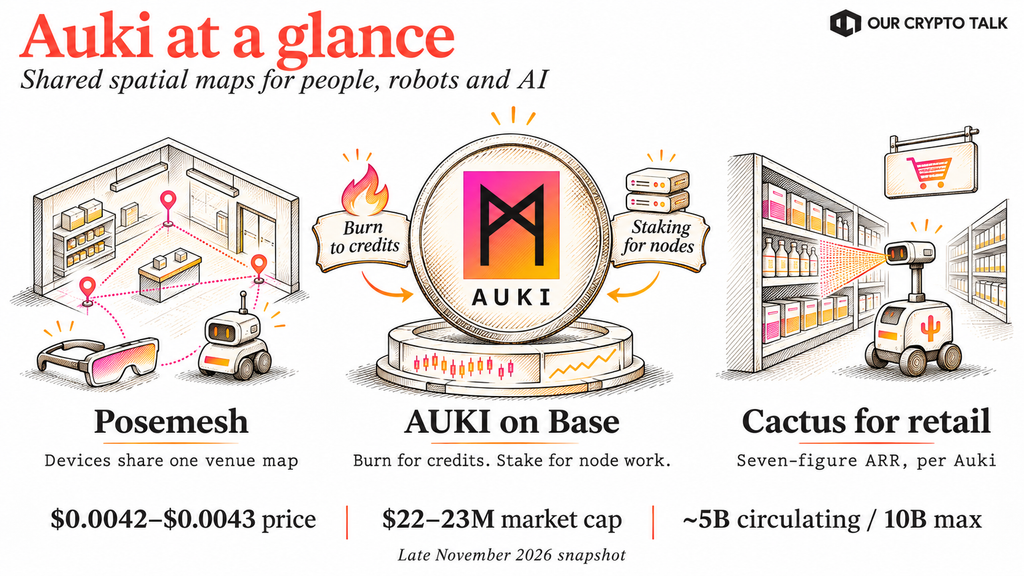
Auki Labs is a Hong Kong-based company founded in 2019 by Nils Pihl, its CEO. Company materials list Santeri Aramo as a co-founder who later became an advisor. Auki Labs develops the posemesh, a decentralized spatial computing protocol that lets robots, phones, glasses, and AI agents share a map of a physical space while keeping raw camera feeds within the domain or peer group. The company calls this its “real-world web.”
Cactus, Auki’s retail software, is its most developed commercial product. In updates from late 2025 and 2026, Auki reported seven-figure annual recurring revenue, paid pilots spanning thousands of locations, and robot integrations involving manufacturers including Unitree. Earlier company and ecosystem figures put the network at roughly 700 domains, 300 servers, and several hundred SDK users. Those figures lack an independent audit at scale.
AUKI launched on Base in August 2024 as an ERC-20 token. Users burn it to acquire network credits, and node operators stake it to qualify for work. The late-November 2026 market snapshot puts AUKI at about $0.0042–$0.0043, with a market cap of roughly $22–23 million, about 5 billion tokens circulating, and a maximum supply of 10 billion. Trading volume was low, and the token’s January 2025 high was about $0.06.
How Auki Works
A domain is a persistent digital map of a venue. It is divided into partitions and holds layers for what objects are, where they sit, and how they appear. Venue operators or community members use mobile mapping tools and portal kits to create the map and establish coordinate anchors. Devices using Auki’s SDK can then reference the same points as they move through the space.
Users burn AUKI to obtain non-transferable credits for services such as positioning queries, map reconstruction, data access, and compute tasks like pathfinding. Operators can run domain servers or specialize in reconstruction, motion, or compute. They stake AUKI to qualify for work through the protocol’s reputation system. Each burn is paired with a smaller mint that funds operator rewards. A networking layer called Hagall handles real-time communication between participants.
Cactus uses the domain as a store map that staff and robots can consult to find products, generate task lists, and coordinate work. Auki says Cactus has progressed to paid deployments and that some retailers use its spatial data as an authoritative source for other enterprise systems. Reconstruction nodes and broader public node participation are at an earlier stage than the retail product.
A device still needs adequate map coverage and a responsive connection to a domain server. Continuous autonomous navigation across many unrelated sites would require a level of coverage the network has yet to demonstrate.
Technology & Architecture
The posemesh does most spatial work off-chain. Base handles token accounting, staking, burns, and rewards through an ERC-20 contract with upgradeable components. A bridged version of AUKI also exists on peaq.
Domain operators control their map data. Reconstruction nodes turn scans into point clouds or 3D representations known as Gaussian splats. Motion and compute nodes handle positioning and geometry queries, while a discovery service uses a distributed hash table design to help participants find network resources.
Keeping raw imagery within a domain or peer group gives venues more control over their data than a centrally hosted visual positioning system. The posemesh also extends beyond basic peer-to-peer AR libraries by adding persistent maps, reputation-based staking, and a payment system for shared services.
OpenZeppelin found in 2023 that the system remained centralized in practice. The team controlled multiparty computation wallets with privileged roles, and Auki Labs operated the relay layer. The company describes decentralization as a multiyear effort. Its claims about centimeter-level indoor accuracy and interoperability between robots draw on company demonstrations and pilot reports. Independent benchmarks at scale remain limited.
Team & Backers
Nils Pihl leads Auki Labs as founder and CEO. Public company materials identify Santeri Aramo as a co-founder who later took an advisory role. They also list leads across robotics, finance, business development, and engineering. Third-party trackers estimate the company has roughly 30 employees. Independent information about earlier roles held by key team members is limited.
Auki Labs raised approximately $13 million in a 2022 seed round led by Animoca Brands, Kenetic, Shima Capital, and Outlier Ventures, with participation from other Web3 funds. The company had previously raised a smaller pre-seed round. Public disclosures have yet to confirm a later priced round of comparable scale. Auki Labs remains privately held, and AUKI is separate from company equity.
Auki Tokenomics (AUKI)
Token Overview
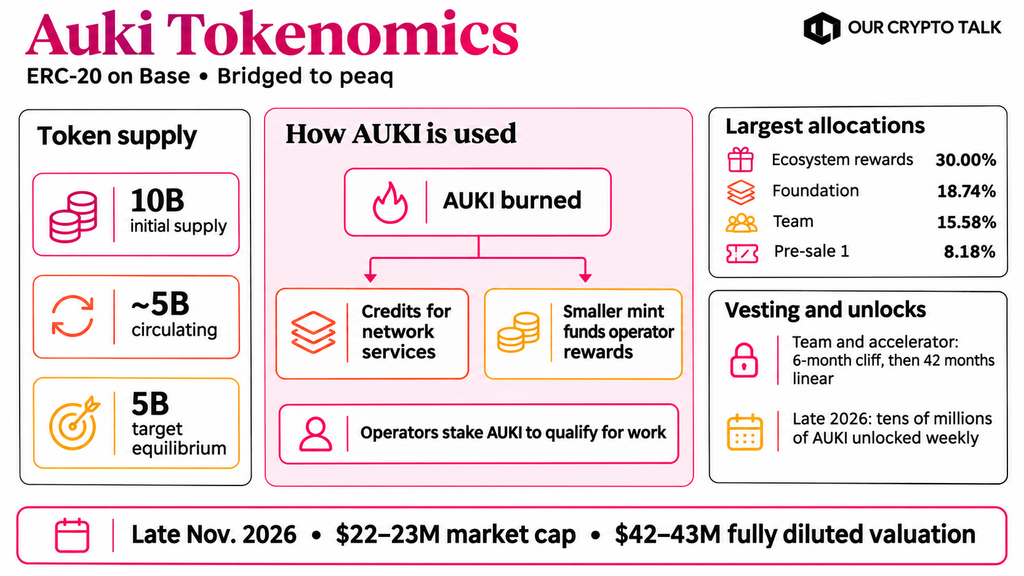
AUKI is an ERC-20 token on Base at 0xf9569cfb8fd265e91aa478d86ae8c78b8af55df4, with a bridged representation on peaq. The protocol minted 10 billion tokens initially. Its supply model is designed to move toward an equilibrium of 5 billion as service-related burns exceed the smaller mints that accompany them.
In late November 2026, reported circulating supply was near 5 billion AUKI, with a market cap of roughly $22–23 million and a fully diluted valuation of about $42–43 million. The token traded more than 90% below its January 2025 high near $0.06, with thin volume relative to its market cap.
Token Allocation
The whitepaper assigns 4.60% of the initial supply to seed and pre-seed participants, with 48-month linear vesting. Early Bird received 4.38% and Pre-sale 1 received 8.18%, both vesting linearly over 36 months. Pre-sale 2 received 2.73%, with 24-month linear vesting. The KOL and community pre-sales received 0.34% and 0.15% respectively, each vesting linearly over 12 months. Project materials put private-sale proceeds at roughly $18.8 million before launch.
Advisors received 2.30%, vesting linearly over 24 months. The accelerator received 6.00% and the team received 15.58%, each subject to a six-month cliff followed by 42 months of linear vesting.
Token infrastructure received 7.00%, unlocked at the token generation event. Ecosystem rewards account for 30.00%, with 36-month linear vesting. The foundation received 18.74%, vesting linearly over 84 months.
Vesting & Unlock Pressure
Most allocations vest daily on linear schedules. Team and accelerator vesting began after their six-month cliffs. Late-2026 unlock trackers showed that the amounts becoming available each week were still in the tens of millions of AUKI.
With close to half the maximum supply circulating, a release of the same size represents a smaller share of the float than it did at launch. It can still be large relative to daily trading volume. Unlocks make tokens available for sale, and actual selling can put pressure on a thin market. Burns can offset some of the growth in circulating supply.
Token Utility
Developers and domain owners burn AUKI at a dollar-denominated rate to acquire credits for network services. Operators stake tokens to qualify for work and earn rewards funded by the smaller mint that accompanies each burn. Project materials also describe governance as a use for AUKI.
Dune and DefiLlama track activity associated with credit purchases and token burns. Recent quarterly burns were worth a few thousand to the low tens of thousands of dollars, below earlier peaks. Most reported commercial revenue comes from Cactus software sales. The figures leave open how much of that business will translate into sustained purchases of posemesh credits, which drive usage-based burns.
Is Auki Safe?
OpenZeppelin audited Auki’s core token, burn, reward, staking, and proxy contracts in November 2023. It reported zero critical or high-severity findings, two medium-severity findings that were resolved, and several low-severity findings. Auki maintains a bug bounty, and public reports cited in the research show no major exploit of its token contracts.
The audit also identified privileged roles and a company-operated relay. The practical risks extend to the operators who control map data and the services devices rely on for discovery and real-time connectivity. Large wallets hold a substantial share of the token supply, though project materials identify many as vesting or custody addresses. Modest liquidity on decentralized exchanges can also make larger trades difficult to execute.
The audit provides a record of the contracts and controls reviewed in 2023. Evaluating current exposure also requires checking who holds upgrade permissions, how many independent operators support a deployment, and how much liquidity is available for the intended trade.
Auki vs Competitors
Auki vs. Competitors
| Project | Market Cap (approx.) | Use Case | Chain or Type | Key Metric | Product Status | Token Utility |
|---|---|---|---|---|---|---|
|
| ~$22–23M | Collaborative spatial maps for robotics, XR, and retail | Base + off-chain | Domains and Cactus locations, company-reported | Cactus live with paid deployments and pilots. Node participation remains limited. | Burn for credits, stake to qualify for node work |
|
| Private | Centralized visual positioning and AR mapping | Proprietary | Large real-world AR user base | Production | No token |
|
| Private | Centralized visual positioning | Proprietary | Device-scale coverage | Production | No token |
|
| Varies | Decentralized spatial streaming for XR | Various | Reported node count | Early stage | Streaming and rewards |
|
| Higher than AUKI | High-precision GNSS positioning | Various | Base-station density | Production | Station rewards |
Niantic, Google, and Apple offer centrally managed positioning with broader production coverage. Mawari focuses on delivering XR content, while GEODNET improves satellite positioning through a network of reference stations. Auki combines venue-controlled maps with shared positioning and compute services that developers can pay for with credits. Its model depends on venues building and maintaining their maps and generating enough recurring demand to support operators.
Strengths & Risks (Bull vs Bear Case)
The bull case starts with Cactus. Paid retail deployments and company-reported seven-figure ARR give Auki an existing customer base for spatial software. Auki also reports leads from robot manufacturers. If more venues maintain shared maps and more robots and glasses use them, recurring credit purchases could fund operator rewards and increase net token burns.
The bear case is that Cactus succeeds as retail software while demand for posemesh credits stays low. Protocol burns are modest, scheduled unlocks continue, and limited trading liquidity can amplify selling pressure. Auki also relies on a small set of parties for parts of its discovery and relay infrastructure, while well-funded competitors already offer centralized positioning at scale. A stronger token case would require sustained paid usage that can absorb unlock pressure, alongside wider participation by independent operators.
Should You Buy AUKI? (OCT Verdict)
Builders who need venue-controlled indoor maps have a concrete starting point in Auki’s SDK and retail deployments. Coverage and server latency at the intended site matter more to that decision than network-wide domain counts.
For short-term traders, thin liquidity and scheduled unlocks matter when sizing a position or assessing a potential catalyst. For long-term investors, the evidence to watch is whether credit purchases grow across multiple quarters, net burns offset more of the supply entering circulation, and independent operators take on more of the network’s work. This review is for research purposes. Do your own research before making a trading or investment decision.
Final Verdict: Is Auki a Buy in 2026?
Auki has built a retail product with paid deployments and company-reported recurring revenue. Venue-controlled maps give retailers and robotics developers a practical way to share spatial data, and wider use by robots and AR devices could generate recurring demand for positioning and compute.
AUKI remains speculative at the reported usage levels. Protocol burns are modest relative to scheduled unlocks, trading liquidity is thin, and the network still depends on a limited operator base. The clearest evidence of a stronger investment case would be sustained growth in paid protocol usage as more independent operators join.
Frequently Asked Questions
What is Auki?
How does the posemesh work in practice?
What does Cactus do for retailers?
What is the AUKI token used for?
Is Auki safe given its audit and centralization notes?
How does Auki differ from centralized visual positioning systems?
Is AUKI a good investment based on current revenue and unlocks?
In this article
Why Spatial Computing and Machine Perception for Physical AI Are Hard to Get RightWhat Is Auki?How Auki WorksTechnology & ArchitectureTeam & BackersAuki Tokenomics (AUKI)Is Auki Safe?Auki vs Competitors Strengths & Risks (Bull vs Bear Case)Should You Buy AUKI? (OCT Verdict)Final Verdict: Is Auki a Buy in 2026?Frequently Asked Questions