Destra Network ($DSYNC) Review
Destra Network Review: A Layer-2 solution decentralizing DNS, cloud hosting, GPU/TPU compute, and AI-driven orchestration.


Author: Akshat Thakur
Introduction
Destra Network positions itself as a foundational Layer-2 solution for decentralized infrastructure, aiming to replace the centralized backbone of today’s internet with a robust, censorship-resistant, and privacy-first ecosystem. While blockchain has made major strides in decentralizing financial applications, the web stack domains, storage, DNS, cloud services, and computational resources remains reliant on centralized providers like ICANN, AWS, or Google Cloud. Destra’s mission is to fully decentralize this stack by offering services like decentralized DNS, cloud hosting, GPU/TPU networks, and AI-driven traffic management.
Destra seeks to solve this contradiction by building a comprehensive decentralized stack that includes decentralized DNS, hosting, CDN, object storage, GPU/TPU networks, and AI-driven resource allocation. Its innovative Proof of Sync consensus validates not just transactions but also computational contributions, rewarding participants fairly. By combining blockchain, AI, and distributed computing, Destra aims to create a resilient, censorship-resistant, and scalable Web3 infrastructure layer
Problem Statement
- Centralization of Internet Infrastructure
Although applications may run on blockchains, they still rely on centralized DNS, RPC endpoints, and cloud servers. This centralization exposes them to outages, government takedowns, and monopolistic control. - Censorship and Privacy Risks
Centralized providers can monitor user behavior, restrict access, or comply with government censorship. This undermines user sovereignty and poses risks to free expression and data security. - Downtime and Reliability Issues
Centralized cloud services have suffered multiple high-profile outages. When these occur, Web3 applications built on them also go offline, undermining reliability and trust in decentralization. - GPU/TPU Underutilization
Traditional blockchain mining wastes GPU resources on repetitive hashing. At the same time, researchers and AI developers face GPU shortages and exorbitant costs, highlighting inefficiencies in global resource allocation. - Barriers for AI and Scientific Computing
Access to high-performance compute clusters for machine learning, simulations, or research is heavily restricted and priced for large enterprises. Startups and individuals remain locked out of advanced computational capabilities. - Fragmented Web3 Infrastructure Solutions
While projects like IPFS, Filecoin, and ENS exist, they operate in isolation. Developers face friction stitching together storage, naming, and compute solutions, slowing mainstream adoption.
Solutions Provided by Destra
- Decentralized Web Stack
Destra offers decentralized DNS, hosting, RPC endpoints, and ENS gateways to replace centralized infrastructure. By aligning with standards like ERC-137 and ERC-1185, it ensures compatibility with Ethereum naming while making domains censorship-resistant. - Proof of Sync Consensus
This novel consensus mechanism validates synchronization of computational tasks, not just blockchain transactions. Nodes are rewarded for verifiable contributions, whether they provide GPU cycles, bandwidth, or storage capacity. - Global GPU/TPU Network
Idle GPUs and TPUs can be contributed to Destra’s network. AI-driven task allocation ensures workloads such as training LLMs, climate modeling, or 3D rendering are distributed efficiently, creating a democratized, global high-performance compute grid. - AI-Powered Traffic and Resource Management
Destra integrates machine learning for predictive resource allocation, load balancing, and anomaly detection. This maximizes uptime, mitigates attacks, and ensures smooth performance. - Decentralized CDN and Storage
Leveraging IPFS-inspired systems, Destra offers distributed object storage and a decentralized CDN. This enables faster, censorship-resistant delivery of web content, NFTs, dApp frontends, and research data. - Economic Incentives and Dual Rewards
Contributors to Destra’s infrastructure are rewarded in both $DSYNC tokens and ETH fees collected from service users. This dual-reward system strengthens incentives and ensures long-term sustainability.
Problem–Solution Overview
Technology and Architecture
- Destra Chain: A Layer-2 blockchain built on Ethereum, designed for infrastructure services rather than financial transactions. It integrates Proof of Sync consensus, zero-knowledge proofs, homomorphic encryption, and advanced cryptographic techniques to secure data and processes.
- Proof of Sync: Validates not just data transactions but synchronization and performance of resource nodes, rewarding accurate contributions and penalizing inefficiencies.
- GPU/TPU Network: Distributed computational clusters that can handle bio-simulations, AI model training, video rendering, astrophysics simulations, and cryptographic workloads.
- Decentralized DNS & ENS Gateway: A decentralized naming system that aligns with ERC-137 and ERC-1185 standards, ensuring domain ownership, censorship resistance, and global accessibility.
- AI Algorithms: Enable predictive resource allocation, anomaly detection, and intelligent routing to maintain uptime and optimize network performance.
Technology & Architecture
Tokenomics
- Native Token: Destra Network Token ( $DSYNC )
- Utility:
- Payment for decentralized services (hosting, storage, GPU/TPU compute)
- Governance and voting on network policies
- Rewards for resource contributors (validators, storage providers, GPU/TPU donors)
- Incentives for staking and network security
- Rewards: Resource contributors earn in both DES tokens and ETH generated from the suite of Destra services .
Market Performance
📊 Market Performance
Team
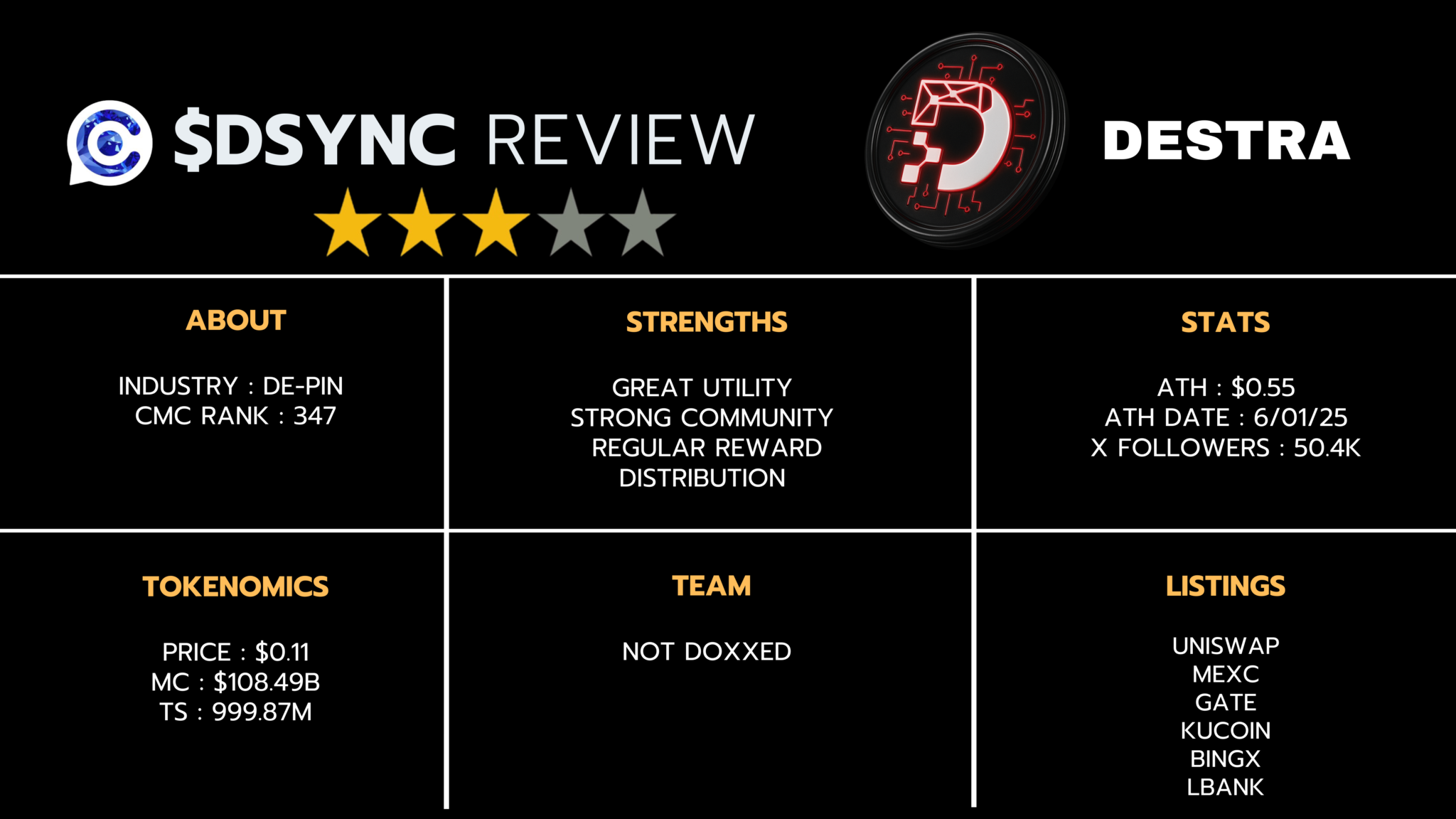
Details on individual team members remain limited, and while Destra provides technical documentation and outlines a broad vision for decentralized infrastructure, this offsets concerns around transparency.

Project Analysis
Comparative Overview
- Vs. Filecoin/IPFS: While Filecoin focuses on decentralized storage, Destra offers an integrated stack including DNS, GPU/TPU computing, and AI-driven orchestration.
- Vs. Akash Network: Akash provides decentralized cloud compute, but Destra extends this with Proof of Sync, decentralized DNS, and TPU networks tailored for AI workloads.
- Vs. Ethereum L2s: Most Ethereum L2s focus on financial scalability; Destra is purpose-built for infrastructure scalability, making it a complement rather than a competitor.
Strengths
- Comprehensive decentralized web stack beyond finance
- Unique Proof of Sync consensus aligning efficiency with fairness
- Integration of AI algorithms for traffic and resource management
- GPU/TPU democratization for AI and scientific workloads
- Incentive system rewarding contributors in DES and ETH
Challenges
- Still early in adoption with limited real-world usage metrics
- Highly ambitious scope spanning multiple infrastructure services
- Competes with specialized players (Filecoin, Akash, Arweave)
- User onboarding may be complex given breadth of offerings
Destra Network vs Decentralized Infrastructure
Akash Network –> Arweave –> Theta Network –>| Project | Core Focus & Innovation | Compliance / Identity | Performance & Notes |
|---|---|---|---|
|
| Full-stack decentralized infrastructure: DNS, CDN, hosting, storage, GPU/TPU compute; Proof of Sync consensus; AI-driven resource allocation | Permissionless; no KYC; community-first governance | Early-stage but ambitious; holistic infra approach; dual rewards (DES + ETH); positioned for enterprise + AI workloads |
|
| Decentralized object storage and content addressing | Permissionless | Proven adoption; strong storage market; lacks compute/DNS integration |
|
| Decentralized cloud compute marketplace; focuses on CPU-based workloads | Permissionless | Growing adoption; cheaper cloud alternative; limited GPU/TPU support |
|
| Permanent, immutable storage layer for Web3 | Permissionless | Strong niche in archival storage; not optimized for compute or dynamic workloads |
|
| Transaction scalability for Ethereum-based dApps | Permissionless | Strong DeFi adoption; focus is scaling transactions, not infra-level decentralization |
|
| Decentralized naming protocol; alternative to ICANN | Permissionless | Secure domain root zone; narrower scope; lacks compute/storage/CDN |
|
| Decentralized CDN and video streaming infrastructure | Permissionless | Focused on media delivery; strong partnerships; not a general-purpose infra solution |
Conclusion
Destra Network represents one of the most ambitious attempts to decentralize internet infrastructure. By addressing the contradiction of decentralized apps running on centralized services, it introduces a holistic stack that includes DNS, cloud hosting, GPU/TPU networks, and AI-driven orchestration. Its Proof of Sync consensus is designed to validate both data and computational tasks, ensuring fairness and efficiency, while its tokenomics model rewards contributors with both DES tokens and ETH.
Compared to competitors like Filecoin and Akash, Destra offers a broader, more integrated solution. While challenges remain such as achieving adoption, scaling complex services, and competing with entrenched Web2 providers the project’s vision positions it as a potential cornerstone of Web3 infrastructure.
Explore More Reviews to Level Up Your DYOR Game.
Frequently Asked Questions
What is Destra Network’s main goal?
How does Destra differ from Filecoin or Akash Network?
What is Proof of Sync consensus?
How are contributors incentivized?
What kind of workloads can Destra’s GPU/TPU network handle?
Is Destra only for Web3 projects?
How does AI improve Destra’s network performance?
What risks does Destra face?
In this article
Technology & Architecture 📊 Market PerformanceDestra Network vs Decentralized Infrastructure