What Is Layer 2 in Crypto?
Layer 2 crypto solutions are transforming blockchain scalability. Explore top L2 projects, how they work, and why they’re crucial.


Author: Chirag Sharma
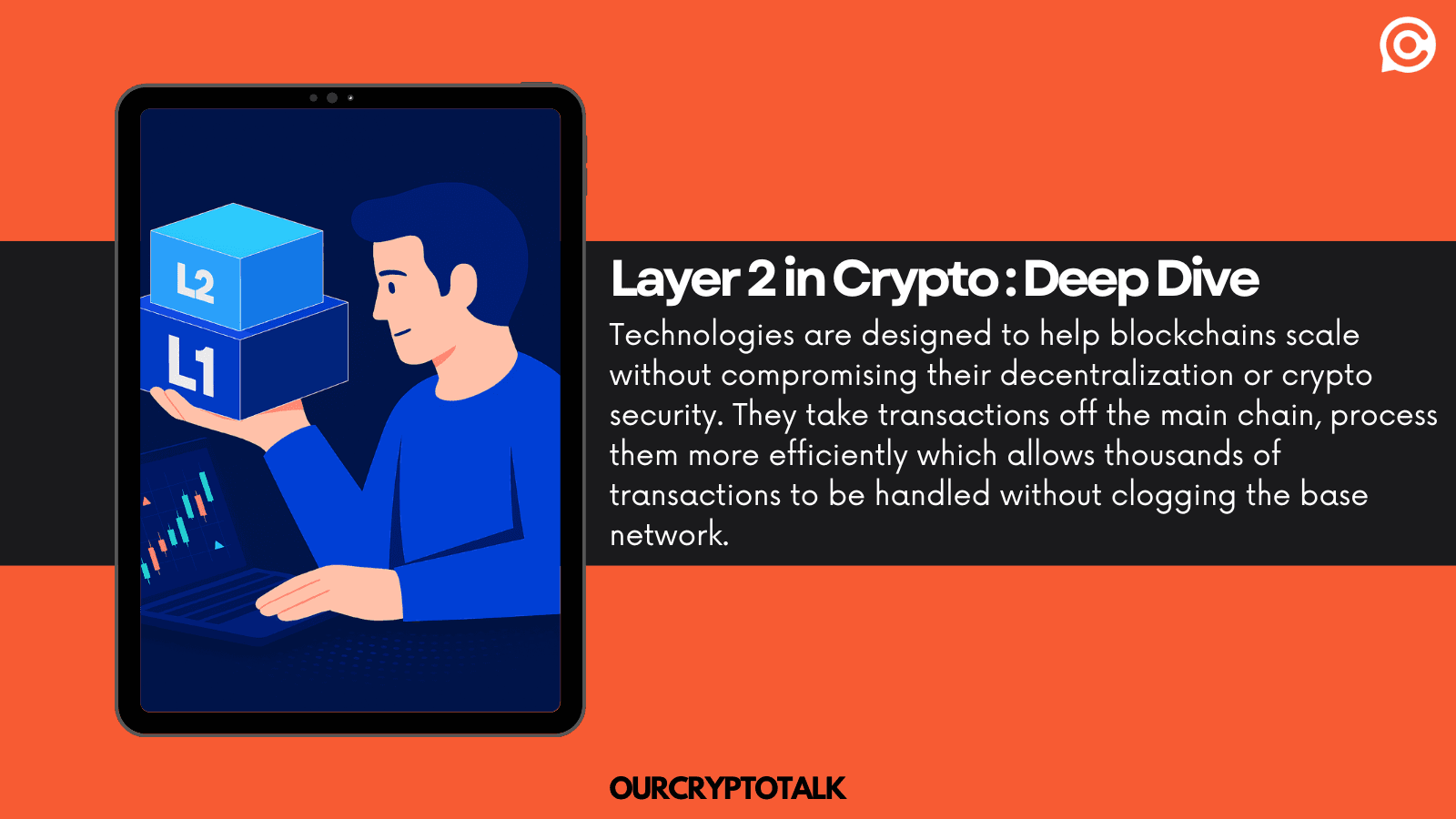
Layer 2 in blockchain technologies are designed to help blockchains scale without compromising their decentralization or crypto security. In simple terms, Layer 2 refers to protocols built on top of a Layer 1 blockchain. They take transactions off the main chain, process them more efficiently, and then settle the results back on the Layer 1. This approach allows thousands of transactions to be handled without clogging up the base network.
Think of it like a flyover road in a busy city. Instead of every vehicle being stuck in ground-level traffic, some are diverted onto the flyover, easing congestion and allowing everyone to move faster.
Some of the most common Layer 2 models include:
- Rollups: These batch transactions together. Rollups come in two main flavors—optimistic and zero-knowledge (ZK).
- State channels: These are like private lanes for two users to transact frequently without needing to post every update on-chain.
- Sidechains: Independent chains that run alongside the main blockchain, periodically syncing up with it.
The real power of Layer 2 becomes obvious when you look at Ethereum’s gas fees. In 2021, during NFT and DeFi booms, users paid over $100 just to approve a single transaction. Today, thanks to L2s, that same transaction can cost a few cents and confirm in seconds.
Whether you’re minting NFTs, playing Web3 games, or sending cross-border payments, Layer 2 is making it all faster, cheaper, and more accessible.
Origins of Layer 2 in Cryptocurrency
The idea of scaling beyond Layer 1 isn’t new. The conversation started back in the early days of Bitcoin.
In 2015, Joseph Poon and Thaddeus Dryja proposed the Lightning Network, a Layer 2 solution for Bitcoin. Its goal was to move small transactions off the Bitcoin blockchain and only settle final outcomes on-chain. This allowed Bitcoin users to send and receive funds instantly, without waiting for block confirmations.
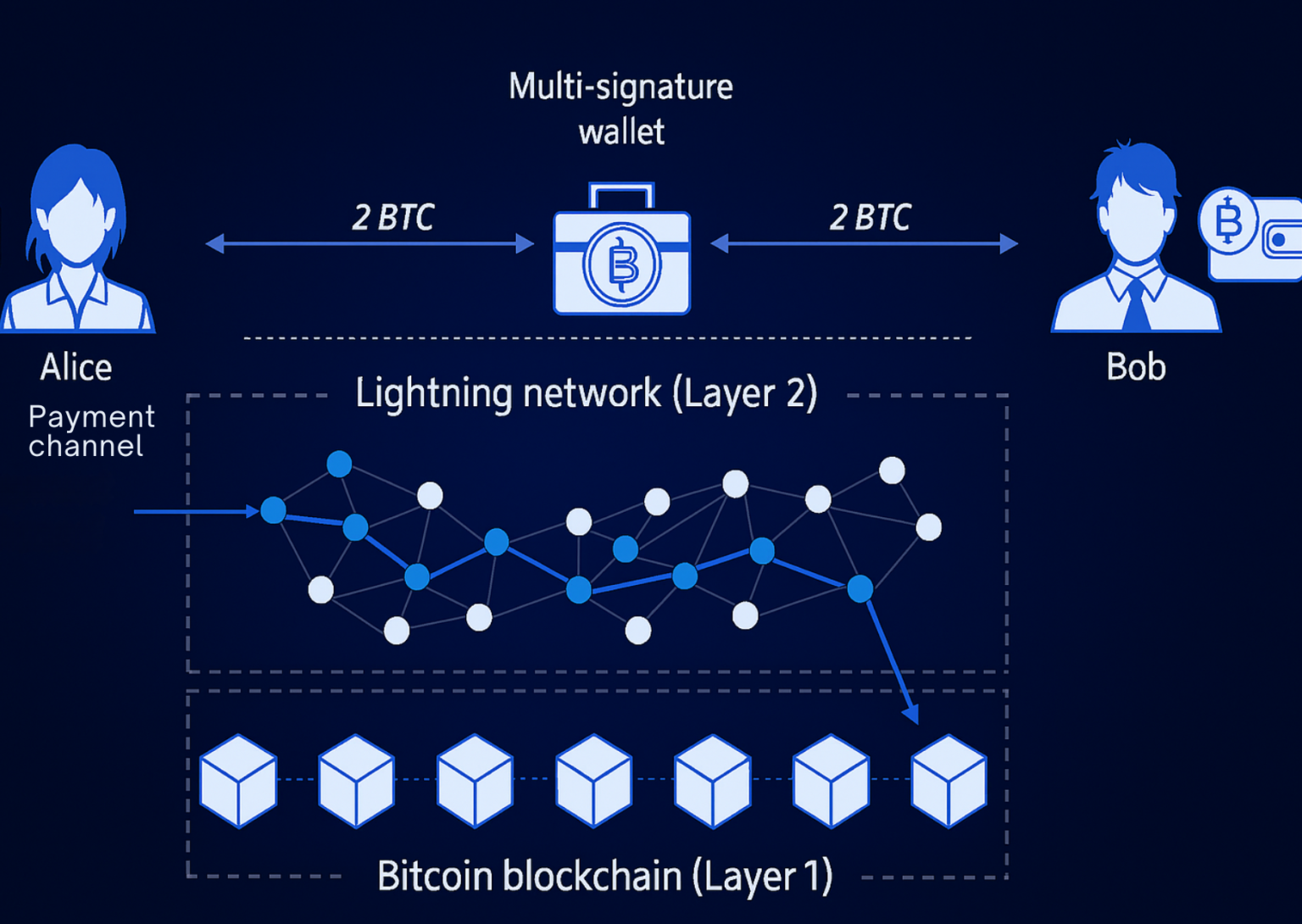
Ethereum’s path was similar but even more urgent. Vitalik Buterin, in his 2014 whitepaper, had already acknowledged the scalability problem. As Ethereum became home to ICOs, games, and DeFi protocols, the need for an off-chain solution became critical.
By 2017, developers introduced Plasma, which proposed the use of hierarchical chains that could operate independently but still anchor to Ethereum. Plasma laid the groundwork, but its complexity and data availability issues made it difficult to scale effectively. Still, it sparked the interest of many researchers and teams who would go on to build today’s rollups.
Another major influence was cryptography—especially zero-knowledge proofs ( ZK Proofs ), which had existed in academic circles since the 1980s. Blockchain researchers started adapting these tools to verify transactions without revealing all the underlying data.
Some important early milestones include:
- Raiden Network (2017): An early attempt to bring state channels to Ethereum.
- zkRollups research (2018): Led by figures like Barry Whitehat and John Adler.
- The rise of sidechains: Projects like Polygon PoS introduced hybrid models that offered scalability with a separate validator set.
In many ways, the birth of Layer 2 was a response to real-world pain points—network congestion, sky-high fees, and the inability of Layer 1s to keep up with user demand.
The Need for Layer 2: Scalability Challenges in Blockchain
Let’s be honest—blockchains were not built for mass adoption in their original form.
Ethereum can handle around 15 to 30 transactions per second. Compare that with Visa’s 24,000 TPS, and the gap is clear. This limited capacity causes bottlenecks, especially during periods of high demand.
A few memorable moments that exposed these limitations:
- CryptoKitties in 2017: A simple NFT game that slowed Ethereum to a crawl.
- DeFi summer of 2020: Platforms like Uniswap and Aave became unusable for small users due to $50–$100 gas fees.
- NFT minting frenzies: Artists and collectors often found themselves paying more in fees than for the artwork itself.
These issues aren’t just annoyances—they limit the types of applications that can be built. Micropayments, on-chain gaming, and social platforms all become impractical when a single click costs as much as a meal.
Layer 2 solves these challenges by:
- Offloading transactions: Transactions are processed on L2 and only the results are posted to the main chain.
- Reducing fees: Batch processing and rollups allow costs to drop from dollars to cents.
- Increasing throughput: Some rollups can process thousands of TPS.
- Preserving decentralization: Because the main chain still verifies data, security remains strong.
Without L2, the blockchain world would stay niche. With it, use cases like gaming, payments, and decentralized identity are finally able to thrive.
Here’s a breakdown of how L2 stacks up in solving real issues:
| Problem | Layer 1 Limitation | Layer 2 Solution |
|---|---|---|
| High Gas Fees | Costs can spike over $100 | L2s bring fees down to under $0.10 |
| Low Throughput | 15–30 TPS for Ethereum | L2s support thousands of TPS |
| Poor User Experience | Long wait times and failed txns | Near-instant finality and confirmations |
| Environmental Impact | PoW was energy-intensive | Most L2s operate on greener PoS infrastructure |
Evolution of Layer 2 Technologies
Layer 2 has evolved fast—from theoretical frameworks to robust infrastructure with billions in TVL (Total Value Locked). What started as state channels and sidechains has now expanded into advanced rollups, application-specific L2s, and modular solutions tailored for performance and security.
Let’s look at the journey:
1. State Channels
Early efforts like Bitcoin’s Lightning Network and Ethereum’s Raiden Network introduced off-chain transaction channels. These were ideal for micro-payments but limited in scope. Channels worked well for two-party interactions but struggled with composability and complex smart contract use cases.
2. Plasma
Plasma was one of the earliest Ethereum L2 designs. It enabled child chains that periodically submitted summaries to Ethereum. While the idea was solid, Plasma lacked proper data availability and required long withdrawal times. The concept eventually lost momentum, but it influenced today’s rollup architecture.
3. Sidechains
Sidechains like Polygon PoS and Gnosis Chain brought attention to alternative chains that could sync with Ethereum but rely on their own validators. These offered speed and low fees but were often criticized for weaker security.
4. Rollups Take Over
The real breakthrough came with rollups. These compress hundreds of transactions and post a proof on Ethereum.
- Optimistic Rollups assume transactions are valid by default. Fraud proofs are used to challenge suspicious activity.
- ZK Rollups use cryptographic proofs to instantly validate correctness, allowing faster withdrawals and better security.
Each type has pros and cons. Optimistic rollups (like Arbitrum and Optimism) offer simplicity and EVM compatibility. ZK rollups (like zkSync and Starknet) bring efficiency and cryptographic rigor but are harder to build.
5. Modular and App-Specific Rollups
In 2024 and beyond, we’re seeing a shift toward app-specific rollups. Instead of competing on one shared L2, dApps now launch their own L2 chains using frameworks like OP Stack and zkStack. Coinbase’s Base, for example, is built on the OP Stack, while zkSync’s Hyperchains allow developers to deploy sovereign ZK-powered chains.
Layer 2 is no longer a one-size-fits-all solution. It’s now a design space with custom tooling, incentives, and governance models.
Key Projects and Technologies
Here’s a quick overview of the major L2 players shaping the space. Each project tackles scalability in a unique way while serving different audiences.
| Project | Type | Launch Year | Key Features | Notable Use Cases |
|---|---|---|---|---|
| Arbitrum | Optimistic Rollup | 2021 | High EVM compatibility, strong adoption | GMX, Radiant, TreasureDAO |
| Optimism | Optimistic Rollup | 2021 | OP Stack modularity, retroactive rewards | Velodrome, Base (Coinbase chain) |
| zkSync Era | ZK Rollup | 2023 | zkEVM, native account abstraction | NFT platforms, payment rails |
| Starknet | ZK Rollup | 2022 | STARK proofs, Cairo smart contract language | dYdX (initially), real-time games |
| Polygon zkEVM | ZK Rollup | 2023 | Full EVM equivalence, part of Polygon ecosystem | DeFi, stablecoin rails |
| Linea | ZK Rollup | 2023 | zkEVM backed by ConsenSys | MetaMask integration, DeFi |
| Base | Optimistic Rollup | 2023 | Built by Coinbase, OP Stack architecture | Onboarding new users to crypto |
Arbitrum leads in TVL and ecosystem activity, but zkSync and Starknet are gaining momentum with superior cryptographic performance. Polygon continues to bridge the rollup and sidechain worlds with a cohesive ecosystem. And Base is onboarding millions thanks to Coinbase’s user base.
The Layer 2 race is heating up, but it’s not a zero-sum game. Multiple L2s can thrive by optimizing for different use cases—games, payments, identity, or high-frequency DeFi.
Benefits of Layer 2 Solutions for Users and Developers
Layer 2 solutions offer real utility across the board. Whether you’re a casual user or a protocol developer, the benefits are hard to ignore.
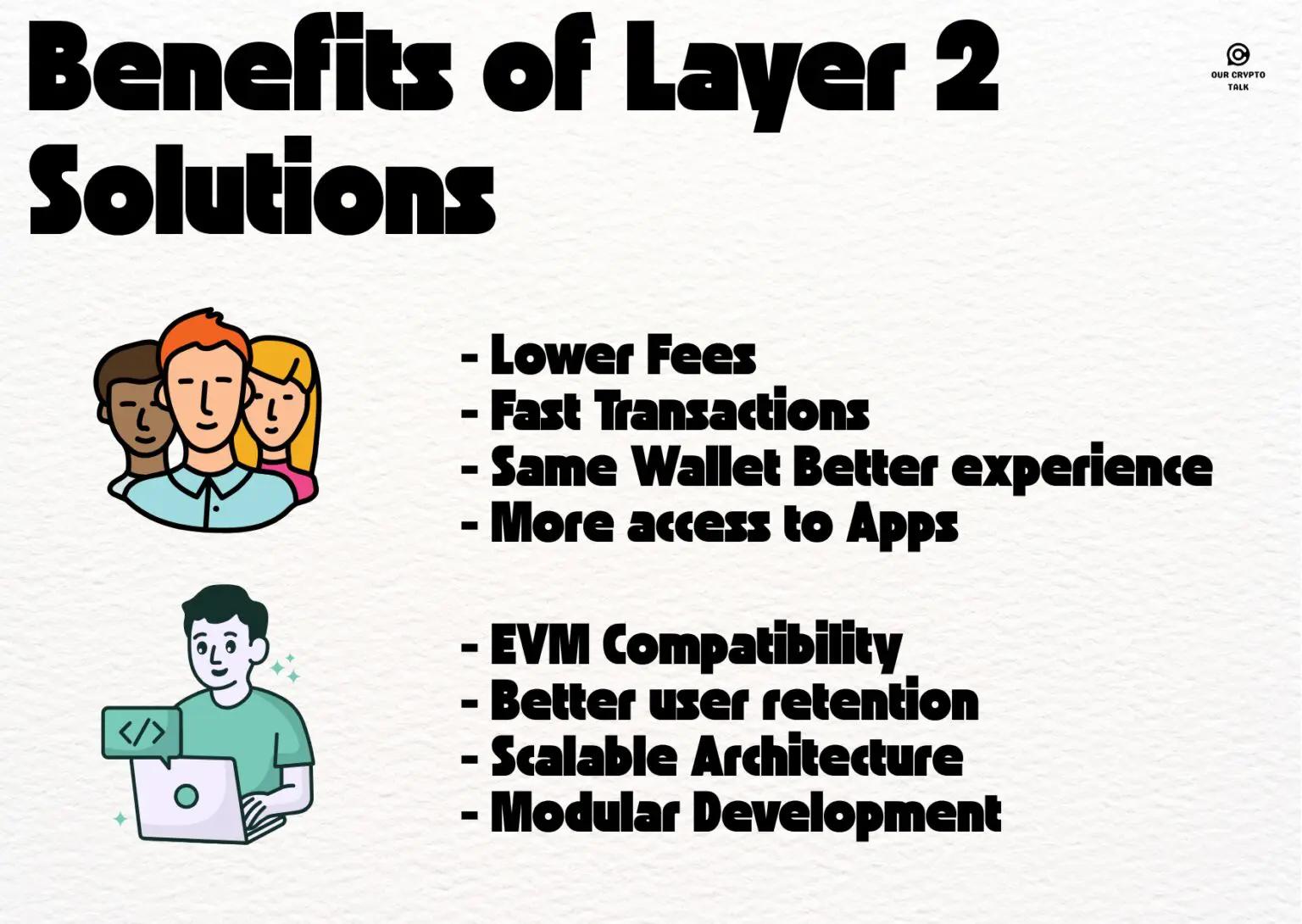
For Users:
- Lower Fees: Instead of paying $20 or more for a swap, users on L2s pay just a few cents. This opens up crypto to people in emerging markets and makes micro-transactions viable again.
- Faster Transactions: Confirmation times are reduced from minutes to seconds. For traders, this speed matters. For gamers and creators, it’s the difference between engaging and frustrating.
- Same Wallet, Better Experience: Most L2s are compatible with MetaMask and other Web3 wallets. You don’t need to learn anything new—just bridge and go.
- More Access to Apps: As more dApps move to L2s or launch directly on them, users can interact with new experiences that would be impossible on L1 due to cost or speed.
For Developers:
- EVM Compatibility: Most rollups support Solidity and existing Ethereum tooling. No need to rebuild your stack from scratch.
- Scalable Architecture: You can now build dApps with real-world usage in mind. Think millions of users, not thousands.
- Better User Retention: Lower gas fees mean users are more likely to complete actions—whether that’s minting NFTs, staking tokens, or voting on governance proposals.
- Modular Deployment: Projects can launch their own L2 using OP Stack, zkStack, or other modular toolkits. This allows for greater control over fees, tokens, and upgrades.
Layer 2 is not just about speed and cost. It’s about unlocking new possibilities. Real-time blockchain games, pay-per-stream content, Web3 social platforms—none of these could function at scale without Layer 2 infrastructure.
Risks and Tradeoffs in Layer 2 Crypto
Layer 2 scaling sounds like a perfect solution—but it’s not without compromises. Let’s break down the risks and tradeoffs users and builders should be aware of.
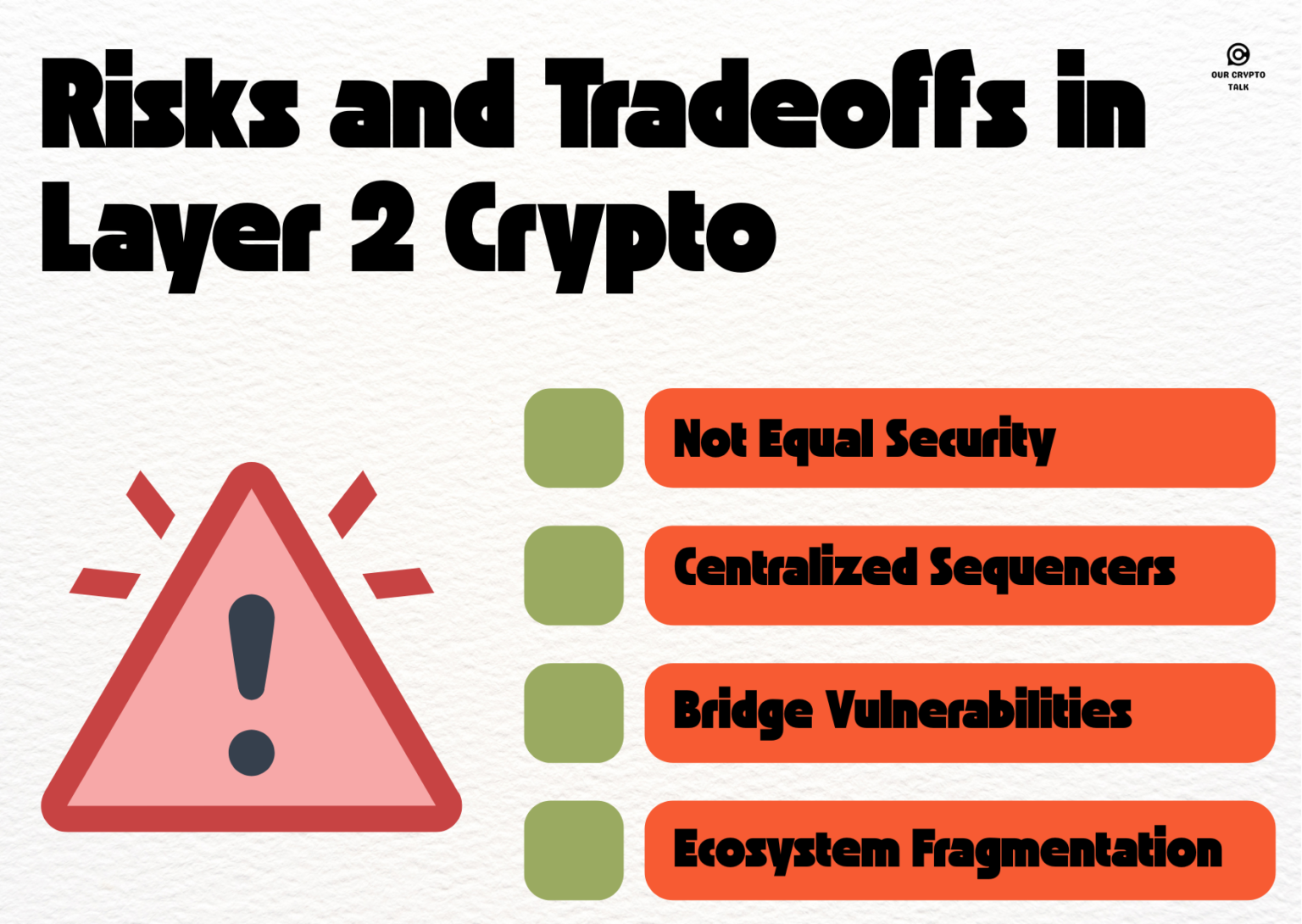
1. Security Isn’t Always Shared Equally
While rollups inherit Ethereum’s base-layer security, sidechains and some custom-built L2s often rely on their own validator sets or sequencers. If that infrastructure is poorly designed or malicious, user funds could be at risk.
Even rollups that anchor to Ethereum still rely on their own fraud or validity proof mechanisms. If those mechanisms fail (or are not fully decentralized), trust assumptions creep in.
2. Centralized Sequencers
Most Layer 2 Crypto platforms use a centralized sequencer to order transactions. This brings efficiency but creates a single point of failure. If the sequencer goes offline—or worse, acts maliciously—transaction ordering can be manipulated, or the network may temporarily stall.
While teams are working toward decentralizing sequencers, we’re not there yet. As of mid-2025, even top rollups like Optimism and zkSync still rely on a centralized setup.
3. Bridge Vulnerabilities
To use Layer 2s, users often need to bridge assets between chains. Bridges are historically the most exploited part of the crypto stack. If a bridge gets hacked, user funds on Layer 2 can be drained even if the L2 itself remains secure.
Bridges introduce technical complexity and require users to manage cross-chain assets carefully. Some ecosystems, like Base and Polygon, are building native bridges to reduce this risk—but it’s far from eliminated.
4. Ecosystem Fragmentation
With so many Layer 2s launching, liquidity and users are now spread thin. This fragmentation means apps often need to deploy on multiple L2s just to stay competitive. It also complicates things for users, who must juggle bridges, gas tokens, and wallet settings across chains.
Unified standards and cross-chain messaging protocols are improving, but fragmentation will likely get worse before it gets better.
The Future of Layer 2 Crypto
The road ahead for Layer 2 Crypto is packed with momentum. Scaling Ethereum is no longer a dream—it’s already happening. But what’s next?
1. Decentralization of Sequencers
Teams are racing to solve the centralized sequencer problem. Optimism is exploring shared sequencer networks. zkSync is building towards a decentralized proof marketplace. Starknet is working on sequencer committees. These upgrades will make L2s more censorship-resistant and secure.
Expect new L2s in the future to launch with decentralized sequencing from day one.
2. Unified Rollup Ecosystems
Modular architecture is giving rise to shared ecosystems. The OP Stack, for example, allows multiple L2s like Base, Zora, and Mode to interoperate more easily. This shared tooling encourages a common standard, which could eventually lead to smoother cross-rollup UX.
Projects might stop competing on infrastructure and start competing on value—apps, incentives, and community strength.
3. L3 and App Chains
We’re moving from monolithic L2s to application-specific rollups and even L3s. Think of L3 as rollups on top of rollups. These allow projects to define custom rules for privacy, performance, and governance.
Instead of launching on a public L2, a dApp might spin up its own mini-chain. It will still inherit Ethereum’s security but will have full flexibility over user experience and economics.
4. ZK Rollup Dominance?
ZK rollups are likely to dominate the long-term future. They’re more secure, faster to withdraw, and better suited for privacy use cases. Once development tooling matures, ZK rollups may become the default scaling solution—not just for Ethereum, but for other chains as well.
That said, Optimistic rollups are evolving too, especially with faster fraud proofs and modular governance.
Our Take and Final Thoughts
Layer 2 is a fundamental evolution in how we interact with blockchains.
Ethereum couldn’t serve the world with $40 fees and 10 TPS. But with rollups, app chains, and zk-powered L2s, we’re finally seeing real-world scalability. You can mint NFTs, trade, or play games without breaking the bank.
Still, it’s not a one-chain-to-rule-them-all scenario. In fact, fragmentation might increase as more custom chains pop up. But this isn’t necessarily bad. Just like the internet evolved into a network of interconnected services, the crypto space is becoming a modular mesh of app-specific systems that talk to each other.
So, where do we stand?
- If you’re a user: Start experimenting with L2s. Use zkSync, bridge to Base, explore apps on Arbitrum. It’s faster, cheaper, and usually safer than mainnet.
- If you’re a builder: Think modular. Build for scale and resilience, not just TVL.
- If you’re an investor: Understand that L2s aren’t just speculative plays—they are infrastructure. Look for projects with real usage, strong development teams, and long-term roadmaps.
Layer 2 Crypto is no longer the future. It’s the present—and the gateway to everything Web3 wants to become.
TL;DR
Layer 2 Crypto solutions help Ethereum scale without compromising security
- They reduce transaction fees and increase speeds significantly
- Rollups—Optimistic and ZK—are the most widely used Layer 2 types
- Popular L2s include Arbitrum, Optimism, Base, Starknet, and zkSync
- L2s inherit security from Ethereum but often rely on centralized sequencers
- Bridges used in L2s are a major attack vector and usability hurdle
- The ecosystem is currently fragmented, with liquidity spread across chains
- Future improvements include decentralized sequencers and unified standards
- ZK rollups are expected to dominate due to faster finality and better security
- Layer 2 Crypto is no longer emerging tech—it’s now powering real-world usage
Frequently Asked Questions
What is Layer 2 in blockchain?
Think of it like a flyover road in a crowded city—instead of everyone stuck in traffic (L1), some traffic moves to the flyover (L2), making the whole system faster.
What are the main types of Layer 2 solutions?
- Rollups: Bundle many transactions together. Includes Optimistic Rollups (e.g., Arbitrum, Optimism) and ZK Rollups (e.g., zkSync, Starknet).
- State Channels: Off-chain transaction “lanes” between two parties, later settled on-chain (e.g., Raiden, Lightning).
- Sidechains: Independent chains (e.g., Polygon PoS, Gnosis Chain) that run alongside L1 and sync periodically.
Why do we need Layer 2 solutions?
- CryptoKitties (2017) slowed Ethereum dramatically.
- DeFi Summer (2020) saw $50–$100 gas fees.
- NFT mints in 2021 cost more in gas than art itself.
| Problem | Layer 1 Limitation | Layer 2 Solution |
|---|---|---|
| High Gas Fees | $50–$100 per txn | L2 fees under $0.10 |
| Low Throughput | 15–30 TPS | Thousands of TPS |
| Poor UX | Long wait & failed txns | Near-instant confirmations |
| Environmental Impact | PoW was energy-heavy | Most L2s run on PoS |
How did Layer 2 evolve in crypto history?
- 2015: Bitcoin’s Lightning Network proposed off-chain micropayments.
- 2017: Ethereum’s Plasma concept introduced child chains (later abandoned, but inspired rollups).
- 2017: Raiden Network tested state channels on Ethereum.
- 2018: zkRollup research emerged, leveraging zero-knowledge proofs.
- 2021–2023: Rollups like Arbitrum, Optimism, zkSync, Starknet launched with billions in TVL.
Which are the most important Layer 2 projects today?
| Project | Type | Launch | Key Features | Notable Use Cases |
|---|---|---|---|---|
| Arbitrum | Optimistic Rollup | 2021 | High EVM compatibility | GMX, Radiant, TreasureDAO |
| Optimism | Optimistic Rollup | 2021 | OP Stack modularity | Velodrome, Base |
| zkSync Era | ZK Rollup | 2023 | zkEVM, account abstraction | NFTs, payments |
| Starknet | ZK Rollup | 2022 | STARK proofs, Cairo language | dYdX, gaming |
| Polygon zkEVM | ZK Rollup | 2023 | Full EVM equivalence | DeFi, stablecoins |
| Base | Optimistic Rollup | 2023 | Built by Coinbase | Onboarding new users |
What benefits does Layer 2 offer?
- Gas fees drop from dollars to cents.
- Transactions confirm in seconds.
- Same wallets (e.g., MetaMask) work seamlessly.
- Access to cheaper gaming, NFTs, and DeFi apps.
- EVM-compatible, no need to rebuild tooling.
- Can scale to millions of users.
- Higher user retention with lower fees.
- Option to launch custom L2s via OP Stack or zkStack.
What are the risks and tradeoffs of using Layer 2?
- Security Variance: Rollups inherit Ethereum’s security, but sidechains rely on their own validators.
- Centralized Sequencers: Most rollups still depend on a single sequencer (a temporary centralization risk).
- Bridge Vulnerabilities: Cross-chain bridges are frequent hacking targets.
- Ecosystem Fragmentation: Users juggle bridges, tokens, and settings across different L2s.
What’s next for Layer 2 technology?
- Decentralized Sequencers: Shared or committee-based transaction ordering for censorship-resistance.
- Unified Rollup Ecosystems: OP Stack and zkStack enable cross-rollup standards.
- L3 & App Chains: dApps launch custom rollups for privacy, governance, and UX control.
- ZK Rollup Dominance: Expected to become the default for scalability and privacy.
What’s the key takeaway on Layer 2?
➡️ L2 is no longer “the future”—it’s already powering today’s Web3 economy.
In this article
Origins of Layer 2 in CryptocurrencyThe Need for Layer 2: Scalability Challenges in BlockchainEvolution of Layer 2 TechnologiesKey Projects and TechnologiesBenefits of Layer 2 Solutions for Users and DevelopersRisks and Tradeoffs in Layer 2 CryptoThe Future of Layer 2 CryptoOur Take and Final ThoughtsTL;DRFrequently Asked Questions