Top 7 stablecoin payment gateways in 2026: fees, chain support, settlement speed, and setup for businesses accepting USDC and USDT.

Author: Akshat Thakur
Businesses processed over $18 billion in stablecoin card spend in early 2026 (Source: Nasdaq ). B2B stablecoin payments grew 733 percent year over year. This is not early adoption anymore. It is a shift in how companies move money and why more are evaluating the top 7 stablecoin payment gateways as part of their core payment stack.
Cost is the first driver. Card networks still charge 2.5 to 3.5 percent plus fixed fees. Stablecoin gateways usually sit between 0.1 and 0.5 percent. For high-volume businesses, that gap directly impacts margins.
Settlement speed is the second. Traditional payments take one to five business days. Stablecoin transactions settle in seconds or minutes on chains like Solana, Base, and Tron. That removes delays in cash flow and makes capital usable almost instantly.
Cross-border payments push the shift further. Businesses can send and receive funds globally without currency conversion layers, correspondent banks, or cut-off times. Payments move 24/7 with consistent settlement. Regulation also played a role in 2026. The GENIUS Act gave U.S. businesses clearer rules around stablecoin usage. It reduced compliance risk and made providers more comfortable integrating these rails.
Operational feedback is consistent. Businesses report lower fees, faster settlement, and fewer failed payments. Most still keep traditional rails, but high-volume flows are increasingly routed through stablecoins.
The difference between blockchain and traditional systems is now practical, not theoretical. If you want a deeper comparison, see blockchain payments vs traditional payments. The infrastructure has caught up. Gateways now handle compliance, conversion, and reporting. The decision is no longer whether to use stablecoins, but which provider from the top 7 stablecoin payment gateways to use.
We ranked these top 7 stablecoin payment gateways using live data from March 2026. All numbers come from official pricing pages, on-chain data, integration docs, and our own sandbox testing. We also spoke with businesses processing between $500K and $50M monthly in stablecoins. No sponsorships or paid placements. This is based on real usage.
Six factors decided the rankings. Fees came first. We measured total transaction cost, including network fees, across USDC and USDT. Even small differences matter at scale.
Chain and stablecoin support came next. We verified which networks actually settle quickly in production, not just what is listed in docs. Speed was checked on-chain. Only gateways consistently settling within seconds or minutes ranked higher.
Setup was tested directly. We rated it based on how long it took a mid-sized team to go live in sandbox. Some platforms look simple but require heavy backend work. We also mapped each gateway to real use cases. E-commerce, high-volume B2B, treasury management, and global payouts all have different requirements.
We ignored marketing claims. Some gateways advertise zero fees but add spreads. Others support multiple stablecoins but only on expensive chains. We focused on what shows up in actual transactions. The goal is simple. Give you a framework you can apply to your own business. The rankings reflect current conditions, but the criteria stay consistent.
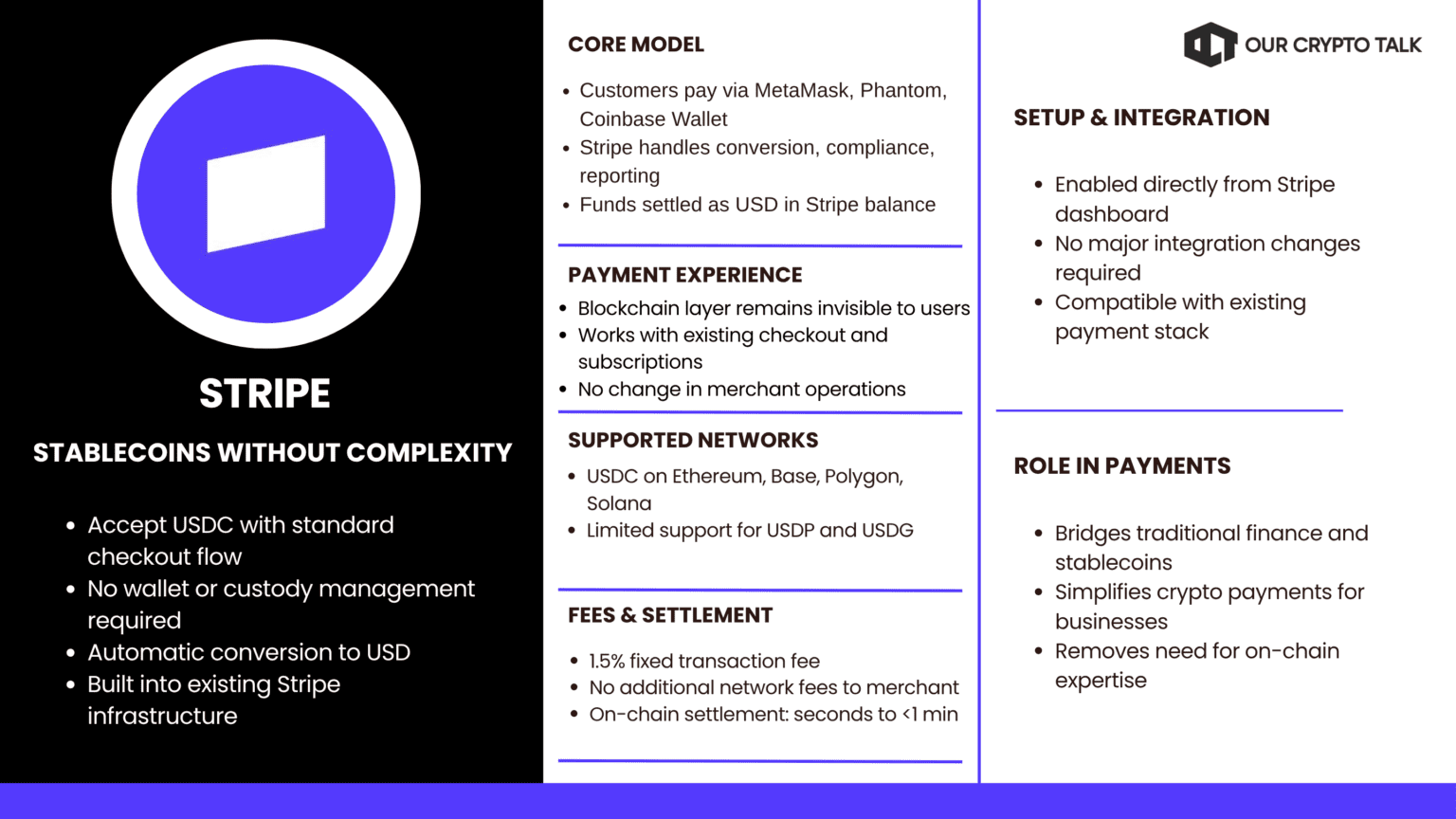
Stripe moved early and made stablecoin payments feel like a normal checkout flow. After Stripe re-entered the crypto space with USDC support in 2025, it integrated stablecoins directly into its core stack. Businesses accept USDC and receive USD in their Stripe balance. The blockchain layer stays invisible. Among the top 7 stablecoin payment gateways, it is the most familiar for traditional businesses.
Customers pay from standard wallets like MetaMask, Phantom, or Coinbase Wallet. Merchants do not manage wallets or custody. Stripe handles conversion, compliance, and reporting inside the same dashboard used for cards.
Fees are fixed at 1.5% per transaction. There are no extra network fees passed to the merchant. It supports USDC on Ethereum, Base, Polygon, and Solana, along with limited USDP and USDG support. Settlement on-chain takes seconds on Base and Solana, and under a minute on Ethereum or Polygon. Funds are converted to USD and typically available within one to two business days.
Setup is simple. Businesses already using Stripe can enable it from the dashboard without changing their integration. It works with existing checkout flows and subscriptions.
This makes Stripe a strong option for e-commerce, SaaS, and subscription businesses that want stablecoin acceptance without changing their accounting or operations.
The limitation is scope. Stablecoin payments are currently restricted to US-based businesses. There is also a $10,000 cap per transaction, and no chargeback or dispute support for crypto payments.
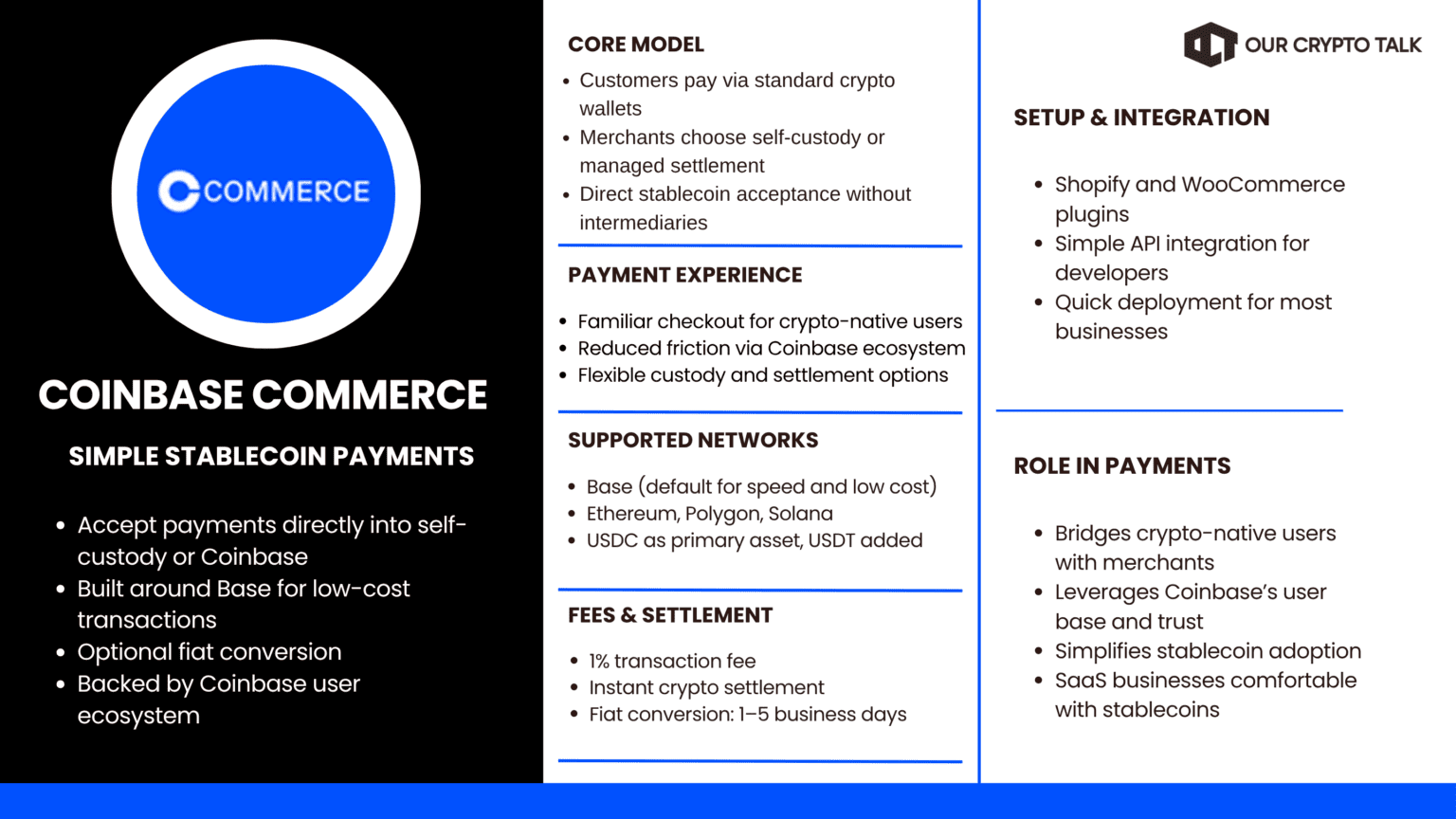
Coinbase Commerce, now expanded as Coinbase Payments in 2026, focuses on simple stablecoin acceptance with optional self-custody. Businesses can receive payments directly into their own wallets or use Coinbase-managed settlement. The system is built around Base, which keeps costs low and speeds high.
The advantage is distribution and trust. Coinbase brings over 100 million verified users, which reduces friction at checkout. Customers can pay using familiar wallets, and merchants can choose whether to hold stablecoins or convert to fiat.
Fees are set at 1% per transaction. USDC is the primary asset, with USDT added in early 2026. Base is the default network for lowest cost and fastest settlement, often completing in under a second. Ethereum, Polygon, and Solana are also supported, with slightly higher fees and slower finality.
Setup is straightforward. Shopify and WooCommerce plugins can go live quickly, while API integrations remain manageable for development teams. The platform works well for crypto-native e-commerce, SaaS businesses, and companies comfortable handling stablecoins directly.
The tradeoff is flexibility. Support is still centered around USDC and Base. Businesses that need wider stablecoin options or deeper multi-chain support may find it limiting.
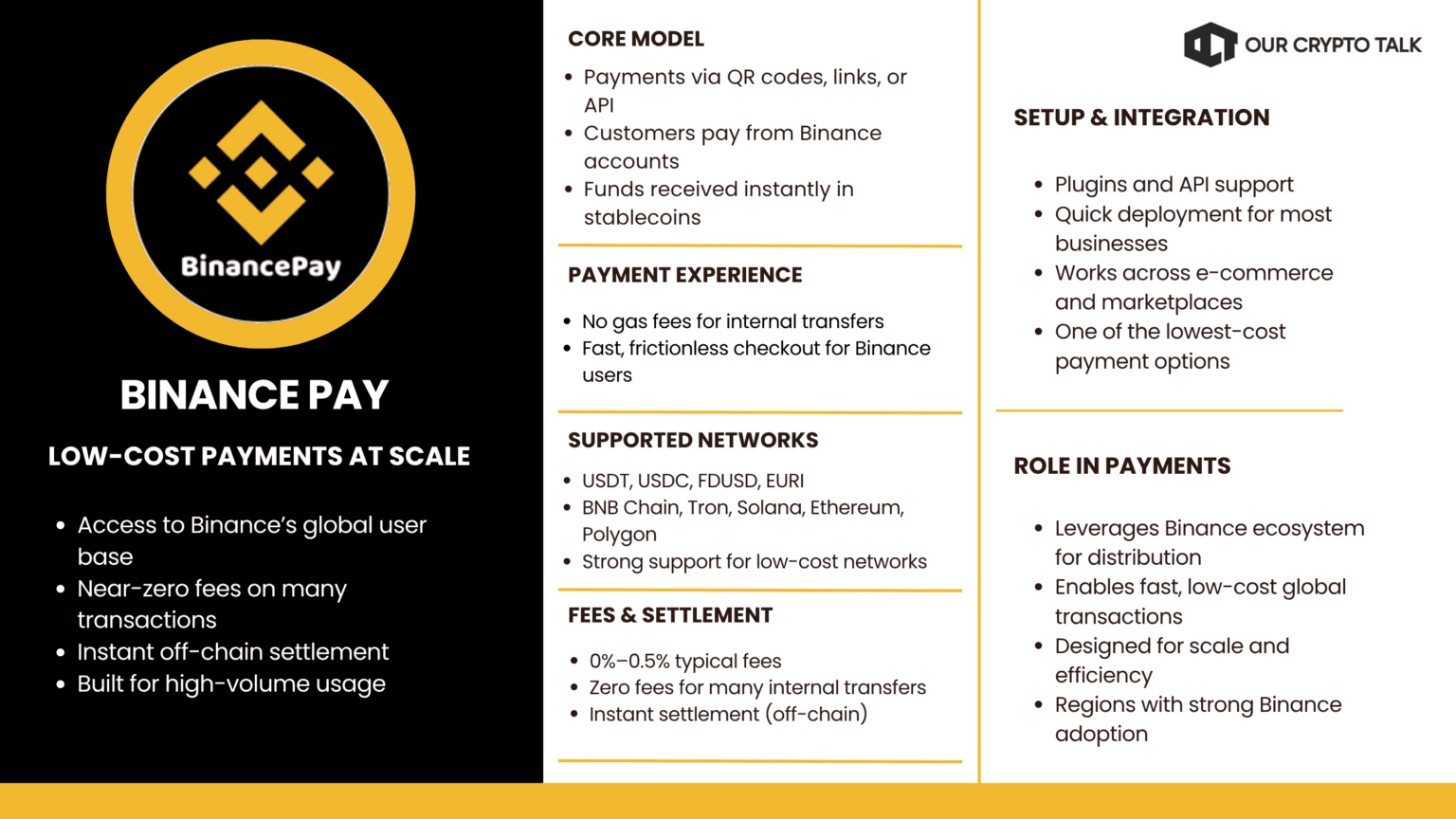
NOWPayments focuses on flexibility. It supports a wide range of assets and handles conversion automatically, so businesses do not need to build their own crypto infrastructure.
Merchants can accept hundreds of cryptocurrencies and settle in a preferred stablecoin or fiat. This is useful for businesses with a global customer base where payment preferences vary. The system handles routing and conversion in the background.
Fees are straightforward. Single-currency payments cost 0.5%. Transactions that require conversion cost 1%. Network fees are separate but remain low on chains like Tron and Solana. New merchants also get zero network fees on USDT TRC20 for the first two months.
Stablecoin coverage is broad. The platform supports over 30 stablecoins across more than 18 blockchains, including Tron, Solana, Polygon, Ethereum, and BNB Chain. Settlement is near-instant on faster networks, especially Tron and Solana. Merchants can hold crypto or enable automatic fiat payouts, often within the same or next day.
Setup is simple. Plugins for Shopify, WooCommerce, and other platforms allow quick deployment. API integration is also manageable for teams that need more control.
NOWPayments works best for e-commerce and subscription businesses that want to accept both stablecoins and other crypto assets without limiting payment options.
The tradeoff is custody. Funds pass through NOWPayments during processing and conversion. Higher transaction volumes also require KYC, which may not suit businesses that want full control over funds.
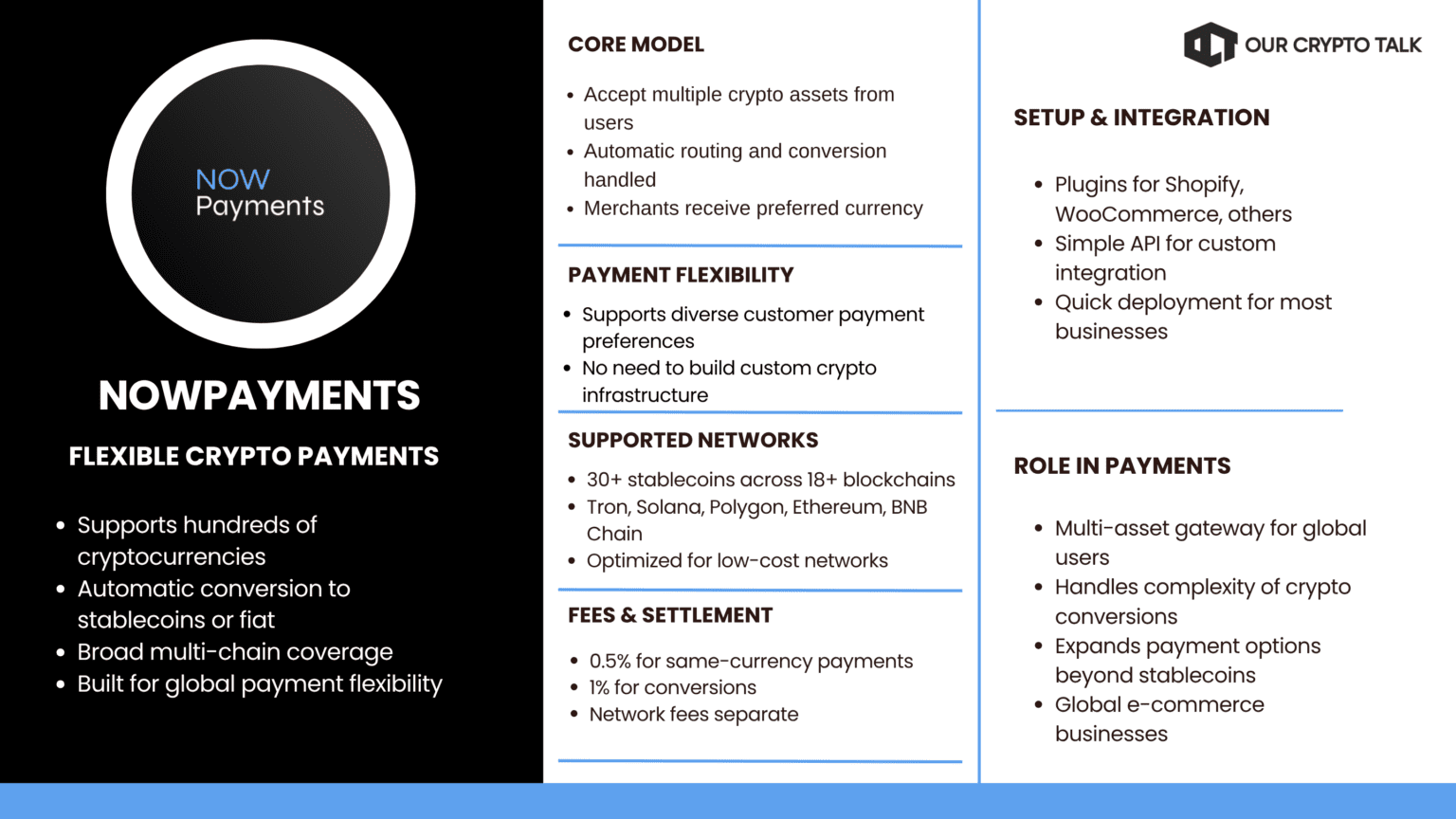
BitPay is one of the oldest crypto payment processors still active in 2026. It focuses on reliability and fiat settlement, which makes it a familiar choice for established businesses.
Merchants can accept stablecoins alongside Bitcoin and other assets, with the option to convert everything into fiat. Funds can be settled directly to a bank account in over 200 countries, which removes the need to manage crypto balances internally.
Fees follow a volume-based structure. Businesses under $500K monthly volume pay 2% plus ~$0.25 per transaction. Fees drop to 1.5% between $500K and $1M, and to 1% above $1M. This makes it more competitive at higher volumes but expensive at lower tiers.
Stablecoin support includes USDC and USDT across networks like Solana, Ethereum, and Polygon. Crypto settlements complete quickly on-chain, while fiat payouts usually arrive within one to two business days.
Setup is simple. BitPay offers mature plugins for Shopify, Magento, WooCommerce, and other platforms. API access is also available for custom integrations.
This gateway fits enterprise merchants and large online retailers that want predictable fiat settlement and a trusted provider.
The downside is cost and restrictions. Fees are higher than most stablecoin-first gateways, especially at lower volumes. BitPay also applies stricter policies to certain industries and transaction types, which can limit flexibility.
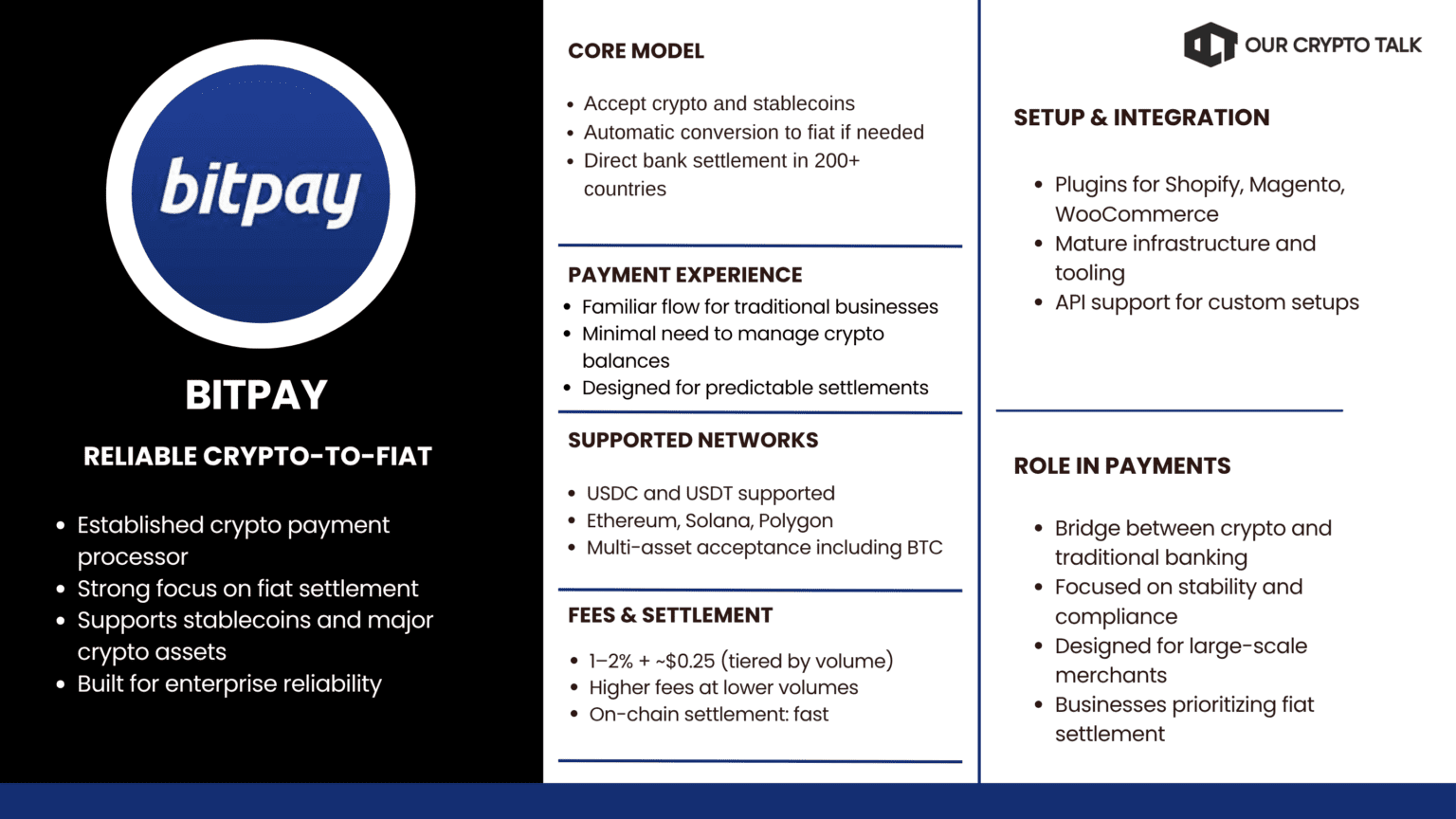
CoinsPaid focuses on high-volume stablecoin flows. It combines payment acceptance with mass payouts, which makes it useful for businesses that both collect and distribute funds.
Fees stay competitive. Most merchants pay between 0.8% and 1.2% depending on volume and settlement method. There are no setup or monthly fees. Network costs are separate and depend on the chain used.
Stablecoin support centers on USDT and USDC, with additional options available. The platform runs across more than 20 blockchains, with strong coverage on low-cost networks like Tron, Solana, and BNB Chain. Settlement is near-instant on these chains.
The payout system is a key feature. Businesses can send stablecoins or fiat to suppliers, affiliates, and contractors at scale. This makes CoinsPaid suitable for operations with frequent outbound payments.
Setup is more involved. The platform is API-first, which gives flexibility but requires development time. Pre-built modules are available, but it still takes longer than plug-and-play solutions.
CoinsPaid fits businesses like iGaming platforms, forex brokers, and affiliate networks where both inflows and outflows matter.
The tradeoff is custody and compliance. Funds move through the platform during processing, and regulatory requirements can be stricter depending on the region.
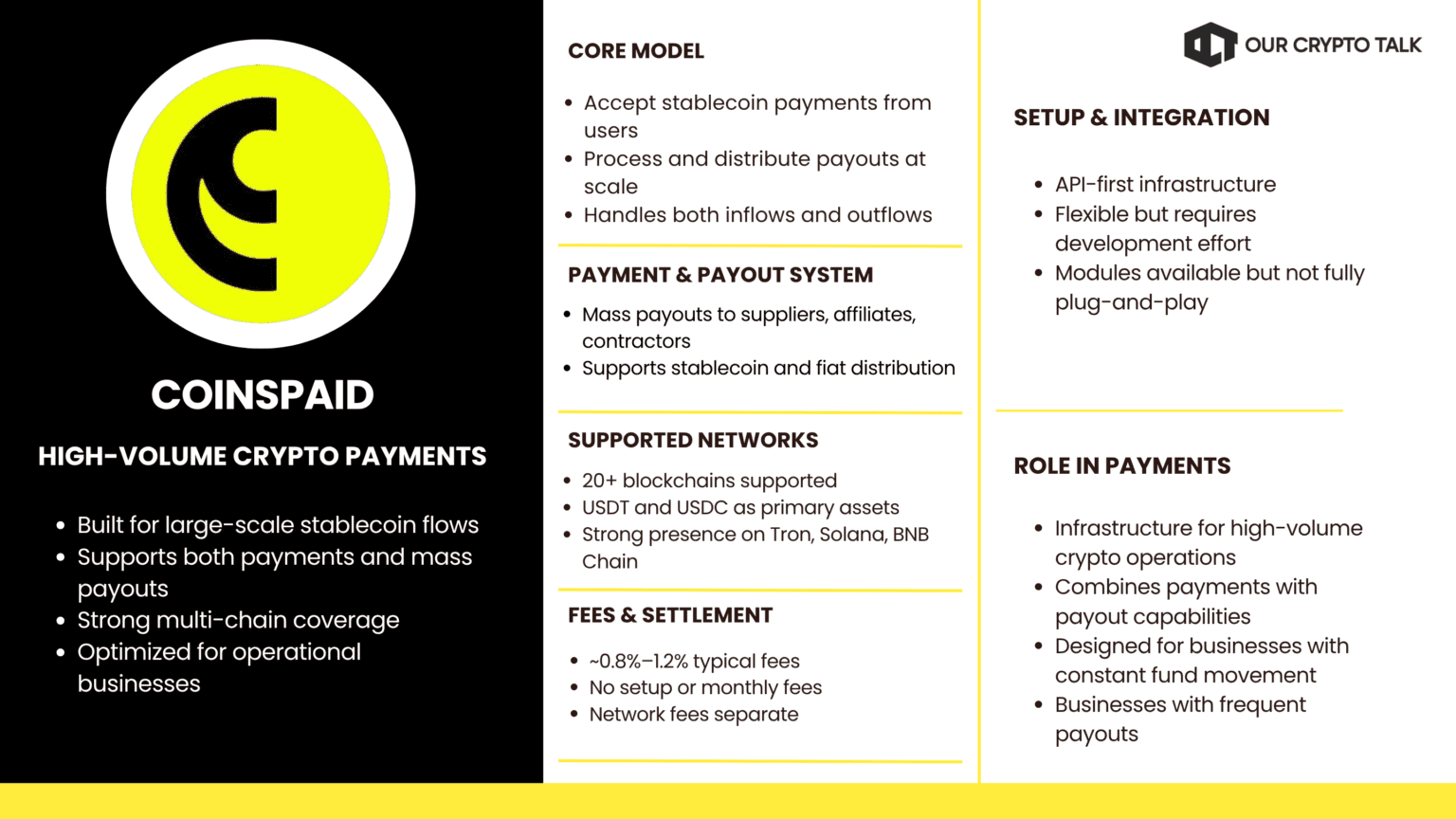
Binance Pay operates at scale. By March 2026, it supports over 20 million merchants and connects directly to Binance’s global user base. That reach reduces friction at checkout, especially in regions where crypto usage is already high.
Businesses accept payments through QR codes, invoice links, or APIs. Customers pay from their Binance accounts, and funds arrive instantly in stablecoins. Merchants can hold crypto or convert to fiat where supported.
Fees are low. Most transactions fall between 0% and 0.5%. Internal transfers between Binance users often have zero fees and no gas costs. High-volume merchants can negotiate lower rates.
Stablecoin support includes USDT, USDC, FDUSD, and EURI across BNB Chain, Tron, Solana, Ethereum, and Polygon. Settlement is near-instant on low-cost networks like Tron and Solana.
Setup is simple. Plugins and APIs allow quick deployment for most businesses. It works well for global e-commerce, marketplaces, and companies operating in regions with strong Binance adoption.
The limitation is dependency. Fiat settlement often requires using Binance accounts, which adds operational steps. Regulatory access also varies by country, which can restrict availability for some businesses.
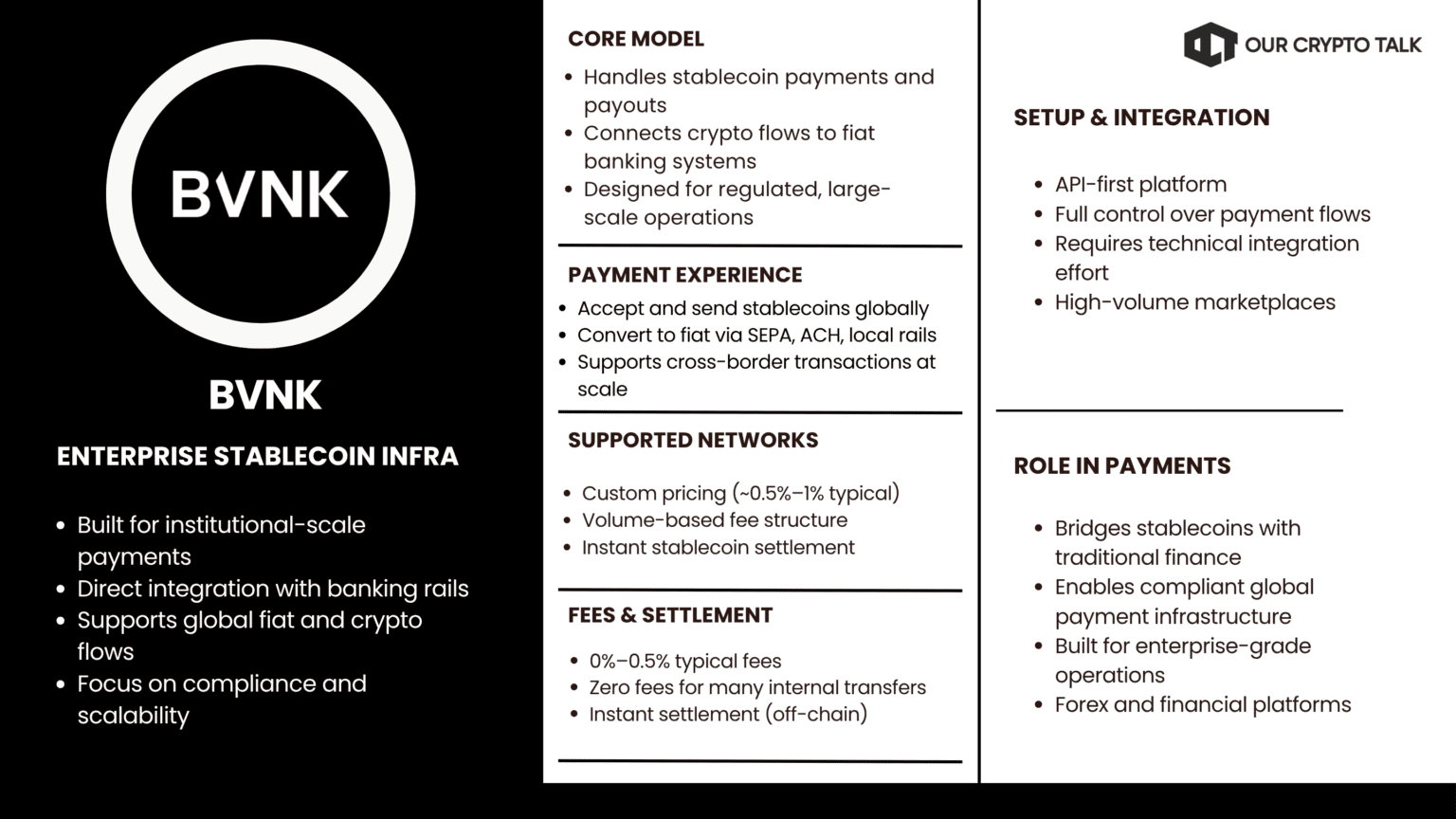
BVNK focuses on enterprise stablecoin payments with direct links to traditional banking rails. In March 2026, Mastercard acquired BVNK to expand its stablecoin settlement capabilities, which signals where institutional adoption is heading.
The platform handles both incoming payments and large-scale payouts while staying fully compliant. It connects crypto flows with fiat rails across more than 130 countries, which makes it suitable for businesses operating globally.
Fees are custom and volume-based. Most clients fall between 0.5% and 1.2% depending on volume and settlement preferences. Network fees apply separately based on the chain used.
Stablecoin support includes USDT and USDC across Ethereum, Solana, Base, Tron, and Polygon. On-chain settlement completes quickly, while fiat conversion to SEPA, ACH, or local bank accounts is handled within standard banking timeframes.
Setup requires more effort. BVNK uses an API-first approach that gives full control but needs technical resources to integrate properly. It is not designed for plug-and-play deployment.
BVNK fits high-volume marketplaces, forex platforms, and enterprises that need compliant cross-border payments with both crypto and fiat settlement.
The tradeoff is accessibility. The platform targets large businesses, which means custom pricing, onboarding requirements, and stricter compliance. Smaller merchants may find simpler gateways easier to implement.
Note: Fees as of March 2026. Some gateways offer volume discounts not reflected here.
At a $1,000 transaction size, Binance Pay is the cheapest option among these stablecoin payment processors, often landing close to zero cost for internal transfers. NOWPayments follows at around $5 if no conversion is required. Coinbase Commerce and BVNK sit in the middle, while Stripe and BitPay are more expensive at smaller volumes due to fixed pricing and tiered structures.
Hidden costs show up in conversion and settlement. Fiat off-ramps usually add 0.5% to 2% depending on the provider. NOWPayments and CoinsPaid may include spreads during conversion. BitPay and Stripe can also carry higher effective costs when settlement involves banking rails. CoinsPaid may charge inactivity fees, and BVNK typically requires custom agreements with minimum volume expectations.
At higher volumes, the gap widens. Some providers in the top 7 stablecoin payment gateways become more competitive as pricing scales or becomes negotiable.
BitPay, CoinsPaid, and BVNK become more competitive as fees drop with scale or negotiation. Fixed-rate gateways like Stripe and Coinbase Commerce become relatively expensive once monthly volume crosses mid-six figures. Binance Pay and NOWPayments remain cost-efficient, but may require tradeoffs in custody, compliance, or ecosystem dependency.
The right gateway depends on volume, settlement preference, and compliance needs. Match these to real fees and settlement times, not marketing claims.
For freelancers or solo operators, simplicity and low cost matter most. Binance Pay and NOWPayments fit well. Binance Pay offers 0% to 0.5% fees with instant internal transfers, while NOWPayments charges 0.5% to 1% and supports a wider range of chains and assets. Both are easy to set up and work without heavy onboarding at low volumes.
Small e-commerce businesses need clean accounting and fast integration. Stripe and Coinbase Commerce are the strongest options. Stripe charges a flat 1.5% with automatic fiat settlement, while Coinbase Commerce sits at 1% and works efficiently on Base for low-cost transactions. Both integrate quickly with common storefronts.
Crypto-native businesses benefit from flexibility. Binance Pay, Coinbase Commerce, and NOWPayments allow you to hold stablecoins, manage wallets directly, and avoid forced conversions. Fees stay under 1% on fast chains, and the setup scales with higher transaction volume.
Enterprise and high-volume operations prioritize reliability and compliance. BVNK and BitPay are better suited here. BVNK offers custom pricing with strong banking integrations, while BitPay provides predictable fiat settlement with volume-based fee reductions.
Regulation also matters in 2026. The GENIUS Act clarified stablecoin usage in the United States, making adoption easier. Still, businesses should confirm local requirements before scaling.
Test at least two providers from the top 7 stablecoin payment gateways with real transactions before committing. Track fees, settlement speed, and operational effort. The right choice should reduce cost without adding complexity.
All the opinions in this article are that of the author and in no way are financial advice. Our Crypto Talk and the author always suggest you do your own research in crypto and to never take anything as financial advice that you read on the internet. Check our Terms and conditions for more info.


AI Needs Cheap Inference. Can Orbio Deliver?
Web3 Gaming Comeback 2026: GTA 6 Hype vs 99% Crashes
Layer 2 Projects Shutting Down: Who’s Next After Blast?
Embodied Data Pyramid and Decentralized Data Layer for Robotics
AI Needs Cheap Inference. Can Orbio Deliver?
Web3 Gaming Comeback 2026: GTA 6 Hype vs 99% Crashes
Layer 2 Projects Shutting Down: Who’s Next After Blast?
Embodied Data Pyramid and Decentralized Data Layer for Robotics