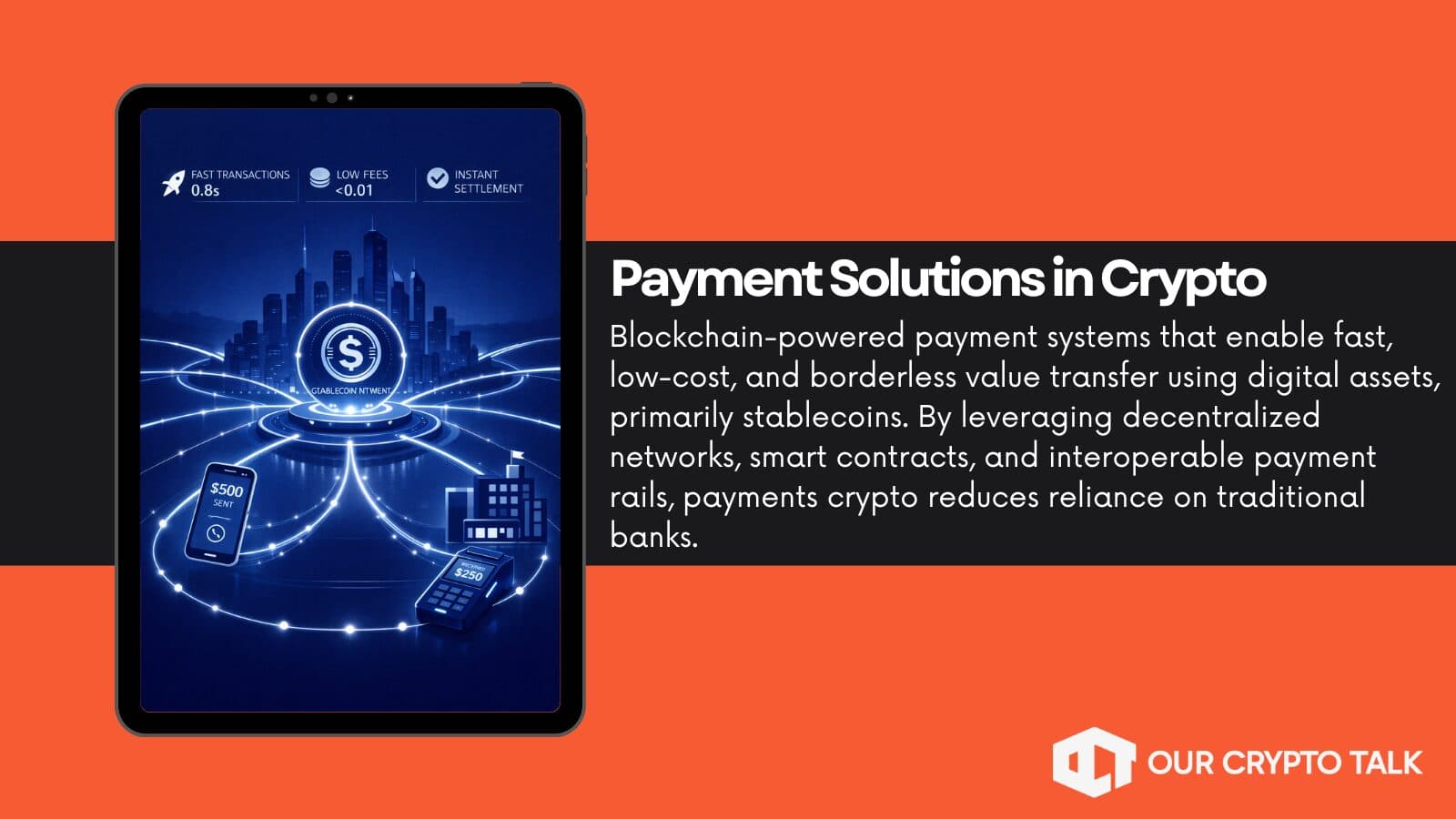
Payment Solutions in Crypto
Payment solutions crypto are transforming transactions through stablecoins and real-time settlement Explore projects, trends, and risks.
 Chirag Sharma
Dec 25, 2025, 2:52 PM UTC

Author: Chirag Sharma
Payments have always been the backbone of any financial system.Yet even in 2025, moving money across borders remains slow, expensive, and fragmented. That is where payment solutions in crypto enters the picture. At its core, payments crypto combines blockchain infrastructure with modern payment rails to enable faster, cheaper, and more inclusive value transfer. It removes dependency on intermediaries, cuts settlement time from days to seconds, and opens access to global payments for individuals and businesses that traditional banking still underserves.
This shift is not theoretical anymore. Stablecoins now process trillions of dollars annually. Crypto debit cards are accepted at millions of merchants. Enterprises increasingly use blockchain rails for payroll, remittances, and cross-border settlements. What started as an experiment has quietly matured into a parallel payments stack.
Understanding how payments crypto evolved, and why it is accelerating now, is essential for anyone looking to navigate the next phase of digital finance.
The Evolution of Crypto Payment Solutions
The story of payments crypto begins in 2009 with Bitcoin.

Bitcoin was designed as a peer-to-peer electronic cash system, enabling users to transact without banks. While revolutionary, early Bitcoin payments faced clear limitations:
- Slow confirmation times
- High fees during congestion
- Extreme price volatility
These constraints made Bitcoin impractical for everyday commerce, despite its ideological breakthrough.
The next major leap came with Ethereum.
Ethereum introduced smart contracts, transforming crypto payments from simple transfers into programmable money. Payments could now be conditional, automated, and embedded into applications. This laid the foundation for decentralized finance and expanded the scope of what payments crypto could achieve.
The real inflection point arrived in the early 2020s with the rise of stablecoins.
Assets like Tether (USDT) and Circle (USDC) pegged crypto value to fiat currencies, removing volatility from day-to-day transactions. This single innovation unlocked real-world usability:
- Merchants could price goods confidently
- Businesses could manage cash flow
- Remittances became predictable and fast
At the same time, traditional payment giants began experimenting with crypto rails. Integrations with Visa and Mastercard enabled crypto-linked cards, allowing users to spend digital assets at point-of-sale terminals worldwide.
Cross-border payments changed dramatically. What once required multiple correspondent banks and days of settlement could now clear in seconds, often at a fraction of the cost.
By 2025, payments crypto has evolved into a hybrid system:
- Blockchain handles settlement and transparency
- Legacy rails handle merchant acceptance
- Stablecoins act as the bridge between worlds
Rather than replacing traditional finance overnight, payments crypto is quietly upgrading it from the inside.
Key Technologies Powering Payment Solutions in Crypto
Blockchain as Settlement Infrastructure
Public blockchains provide immutable, transparent ledgers that enable trust-minimized transactions. In payments crypto, blockchains increasingly act as settlement layers rather than user-facing interfaces.
Stablecoins as Digital Cash
Stablecoins dominate transactional volume.
USDT and USDC now function as digital dollars, moving across borders instantly while maintaining price stability. They power:
- B2B invoices
- Payroll streams
- Global remittances
- On-chain commerce
This has positioned stablecoins as the default medium of exchange within payments crypto ecosystems.
Layer-2 Scaling Solutions
To support retail-scale volume, Ethereum relies heavily on Layer-2 networks such as Optimism and Arbitrum.
These networks reduce fees and increase throughput, making high-frequency payments viable without sacrificing security.
High-Performance Layer-1s
Chains like Solana offer near-instant finality and low costs, attracting payment-heavy applications such as wallets, POS integrations, and streaming payments.
Interoperability Protocols
Interoperability has become critical.
Protocols such as Polkadot and Cosmos enable assets and data to move seamlessly across chains, reducing fragmentation and improving liquidity routing for payments crypto.
AI and Automation
Artificial intelligence now plays a subtle but powerful role:
- Real-time fraud detection
- Transaction risk scoring
- Smart routing for lowest fees
These layers make payments crypto safer and more efficient without adding friction for users.
Why This Matters
Together, these technologies have transformed payments crypto from an experimental concept into production-grade financial infrastructure.
What once struggled with speed, usability, and trust now rivals traditional payment systems on performance, while outperforming them on cost and accessibility.
Leading Payment Solutions In Crypto Projects
As payments crypto matures, a clear pattern is emerging.
The projects gaining traction are not chasing hype. They are solving specific payment problems at scale.
Below are some of the most relevant payment-focused crypto projects in 2025, each approaching the space from a different angle.
Telcoin: Mobile-First Payments for Global Remittances
Telcoin focuses on one of the most overlooked financial segments globally: mobile users in underserved regions.
Instead of competing directly with banks, Telcoin partners with telecom operators to deliver low-cost crypto-powered remittances straight to mobile wallets. This model removes the need for traditional bank accounts, which remains a major barrier in many emerging economies.
Key strengths of Telcoin include:
- Telecom-native integrations across multiple regions
- Stablecoin-based transfers with minimal fees
- Fast settlement compared to legacy remittance services
For payments crypto, Telcoin represents a crucial narrative. Adoption does not always start in developed markets. Often, it accelerates where traditional infrastructure is weakest.
Zebec Network: Real-Time Payroll and Streaming Payments
Zebec Network takes a fundamentally different approach.
Instead of batch payments, Zebec enables continuous money flow. Salaries, subscriptions, and invoices can be streamed per second using stablecoins. This has major implications for how work is paid globally.
Why Zebec matters for payments crypto:
- Salaries settle in real time instead of monthly cycles
- Freelancers gain instant access to earned income
- Enterprises reduce reconciliation overhead
Zebec’s integration with Visa and Mastercard-backed debit cards bridges crypto and fiat seamlessly. Users can receive crypto-native payments while spending in traditional environments without friction.
This is payments crypto moving beyond transfers and into cash-flow redesign.
RealLink: Social, Payments, and Incentives Combined
RealLink blends social interaction with payments crypto.
Its ecosystem connects content creation, social engagement, and payments through reward-driven mechanics. Users earn tokens through participation while transacting seamlessly within the network.
Key elements of RealLink’s model:
- Social-to-earn incentives
- Integrated cross-chain payment gateways
- Built-in consumer applications
While still early-stage, this approach highlights an important trend. Payments crypto is increasingly embedded into user experiences, not presented as a standalone financial tool.
Ultima: End-to-End Crypto Payments Ecosystem
Ultima focuses on full-stack adoption.
Rather than offering a single product, Ultima delivers:
- Wallet infrastructure
- Crypto debit cards
- Marketplaces for digital and physical goods
This approach reduces friction by keeping users within one ecosystem. Payments crypto becomes intuitive when users do not need to stitch together multiple services.
Ultima’s debit card acceptance across more than 100 countries shows how crypto payments quietly integrate into existing commerce without disrupting consumer habits.
Stable: Infrastructure-First Payments Crypto
Stable takes an infrastructure-first approach.
Built as a Layer-1 focused on stablecoin settlement, StableChain prioritizes speed, low fees, and reliability. Its goal is not branding or consumer apps, but enterprise-grade payment rails.
This appeals to:
- Global merchants
- Cross-border B2B settlements
- High-volume payment processors
In the payments crypto stack, infrastructure providers like Stable often operate behind the scenes while enabling massive transaction volumes.
Amp: Collateralized Payments for Merchants
Amp solves a critical merchant concern: payment finality.
Through the Flexa network, Amp acts as collateral that guarantees instant, fraud-resistant payments. Merchants receive confirmation immediately, even if the underlying crypto settlement completes later.
Why this matters:
- Eliminates chargeback risk
- Improves merchant confidence
- Enables acceptance at physical retail locations
Amp demonstrates how payments crypto adapts to real-world business constraints rather than expecting merchants to change behavior.
Common Themes Across Successful Payments Crypto Projects
Despite different approaches, these projects share key characteristics:
- Focus on real-world payment pain points
- Use of stablecoins as the primary settlement asset
- Seamless bridges between crypto and fiat systems
- Emphasis on UX simplicity
Payments crypto adoption is no longer about ideology. It is about execution.
Projects that integrate invisibly into daily workflows are the ones gaining momentum.
Where Payment Solutions in Crypto Are Struggling
Despite progress, challenges remain.
- Stablecoin trust depends on reserve transparency
- Wallet UX is still intimidating for non-native users
- Fragmented liquidity across chains adds complexity
- Merchant education lags behind infrastructure readiness
These frictions explain why payments crypto adoption feels uneven. The technology is ready. Distribution and usability are catching up.
Why This Phase Is Critical
Payments crypto is moving from experimentation to consolidation.
The winners of this cycle will likely be those that:
- Build quietly
- Integrate deeply
- Scale without breaking UX
Core Challenges Slowing Payment Solutions in Crypto
Despite rapid progress, payments crypto is not without friction. Understanding these constraints is critical to separating sustainable adoption from short-term narratives.

Stablecoin Risk and Trust
Stablecoins are the backbone of payments crypto, but they are not risk-free.
- Depegging events during market stress can undermine confidence
- Reserve transparency varies by issuer
- Regulatory scrutiny continues to intensify
Even brief instability can disrupt merchant operations and user trust, making resilience and disclosures non-negotiable.
Security and Smart Contract Vulnerabilities
Crypto payments rely heavily on smart contracts and wallets, which remain prime attack vectors.
- Contract exploits
- Phishing attacks
- Wallet draining malware
Billions have been lost across the ecosystem over the past few years. While infrastructure is improving, mainstream users still perceive crypto payments as risky, slowing adoption.
Scalability and Network Congestion
Layer-2 solutions and high-throughput chains have reduced costs, but congestion still appears during peak activity.
- Fee spikes during market volatility
- Delayed confirmations at scale
- Fragmented liquidity across chains
For payments crypto to rival traditional systems, performance must remain consistent even under stress.
User Experience Gaps
Perhaps the biggest hurdle is usability.
Wallet setup, private key management, and gas fees remain confusing for non-native users. Until crypto payments feel as simple as tapping a card or scanning a QR code, adoption will grow slower than infrastructure readiness.
The Global Regulatory Landscape for 2026
Regulation has shifted from uncertainty to structured oversight.
In the United States, the GENIUS Act established clear rules around stablecoin issuance, reserve backing, and compliance. This provided institutions with the clarity needed to engage confidently with payments crypto.
Europe implemented MiCA, requiring licensing for crypto service providers and enforcing consumer protection standards. While compliance costs increased, the framework legitimized crypto payment firms across the region.
In Asia-Pacific, countries like Singapore continue to issue regulated payment licenses, positioning themselves as hubs for crypto-enabled finance.
Key regulatory trends shaping payments crypto:
- Stablecoin oversight as a priority
- AML and KYC enforcement through digital identity
- Cross-border regulatory cooperation
- Clearer tax treatment for crypto transactions
While fragmentation remains globally, regulation is no longer the existential threat it once was. Instead, it is shaping a safer, institution-ready payments ecosystem.
Future Trends Defining Payments Crypto
Stablecoins as Global Settlement Rails
Stablecoins are on track to dominate cross-border flows.
As settlement assets, they outperform traditional systems in speed, cost, and availability. Over the next decade, stablecoins could quietly replace correspondent banking for international payments.
Embedded and Invisible Payments
Payments crypto is increasingly embedded directly into applications.
Social platforms, marketplaces, and games now integrate crypto payments without forcing users to think about blockchains. When payments disappear into the background, adoption accelerates.
AI-Driven Payments and Agentic Commerce
AI agents will soon manage autonomous transactions.
From subscription renewals to supply-chain settlements, AI will optimize routing, detect fraud, and execute payments programmatically. This convergence of AI and payments crypto unlocks entirely new business models.
Tokenization and Instant Settlement
Tokenized real-world assets will increasingly settle via crypto rails.
Bonds, invoices, and commodities can be exchanged instantly, removing intermediaries and reducing settlement risk. Payments and ownership transfer will blur into a single action.

Conclusion: The Road Ahead for Payment Solutions Crypto
Payments crypto has quietly crossed a critical threshold.
What began as an alternative experiment now functions as a parallel financial layer, processing trillions in value, supporting enterprises, and expanding access where traditional systems fall short.
The path forward is not without challenges. Security, usability, and regulatory alignment remain works in progress. Yet the momentum is unmistakable.
As infrastructure matures, regulation stabilizes, and user experience improves, payments crypto is no longer optional for global commerce. It is becoming foundational.
Over the next decade, the most impactful transformation may not be speculative price action, but the normalization of crypto as a default settlement layer for global payments.
Those who understand this shift early will not just adapt.
They will help shape the future of how value moves worldwide.
TL;DR — Payments Crypto Becomes Core Infrastructure
- Payments crypto is modernizing finance with faster, cheaper, and borderless transactions.
- Stablecoins are the backbone, enabling price-stable transfers for real-world use cases.
- Blockchain payment rails reduce settlement times from days to seconds.
- Cross-border remittances and payroll are seeing the fastest adoption globally.
- Projects now focus on solving concrete payment problems, not speculation.
- Layer-2s and high-speed chains make retail-scale payments economically viable.
- UX and security remain the primary barriers to mass adoption.
- Regulation in 2025 is clearer and more supportive than in prior cycles.
- Embedded and invisible payments are emerging as the next growth phase.
- Payments crypto is shifting from an alternative system to foundational infrastructure.
In this article
The Evolution of Crypto Payment SolutionsKey Technologies Powering Payment Solutions in Crypto Leading Payment Solutions In Crypto ProjectsCore Challenges Slowing Payment Solutions in CryptoThe Global Regulatory Landscape for 2026Future Trends Defining Payments CryptoConclusion: The Road Ahead for Payment Solutions Crypto