BIO surged 105% in April 2026, sparking DeSci interest. Discover 7 DeSci altcoins ranked by real research funded, FDV and key risks.

Author: Arushi Garg
Something unusual happened in mid-April 2026. BIO Protocol jumped roughly +105% between April 13–16, after announcing an AI-generated peptide targeting ADHD (OX2R-004). The headline number was the speed: the compound was designed in 24 hours, compressing what usually takes months in early-stage drug discovery. But the more important signal wasn’t the price spike in DeSci Altcoins.
And it wasn’t isolated. It was the volume. BIO saw $720M in trading volume against a ~$68M market cap. That’s a ~10x turnover ratio. Historically, that kind of activity signals speculative churn, but it also tells you attention has shifted within DeSci Altcoins.
Other DeSci Altcoins moved too:
This looks less like a single-token pump and more like capital rotation into a narrative. BIO is not coming from nowhere. It hit an all-time high near $0.88 in January 2025, then dropped to around $0.018 in March 2026, a 90%+ drawdown. The current move is a recovery inside a volatile sector, not a clean breakout.
Zooming out, the entire DeSci Altcoins sector sits around ~$315M total market cap, with BIO holding roughly 20% share. Still tiny. Still early. But now there’s a difference.
For the first time, projects are not just talking about decentralizing science, they’re producing outputs:
That shift from theory to execution is why “best desci altcoins 2026” is trending right now.
Before looking at specific tokens, it helps to understand the system they’re built on. Traditional science is slow and fragmented: funding cycles can take months or even years through grants, much of the research is locked behind paywalls, and scientists often don’t fully own the intellectual property they create. DeSci (Decentralized Science) aims to fix this by making research more open, faster to fund, and directly owned by its creators.
An IP-NFT works like a digital ownership certificate for research. A scientist can take a dataset, compound, or experimental result, tokenize it as an NFT, and have that token represent the underlying intellectual property rights. If the research later becomes commercially valuable, the NFT holders can participate in that upside, aligning incentives between researchers, funders, and contributors..
A BioDAO is a decentralized autonomous organization designed to fund scientific research in a specific niche. Instead of relying on traditional grant systems, these DAOs pool capital from token holders who collectively decide which projects deserve funding. Each BioDAO focuses on a defined area. For example, VitaDAO targets longevity research, HairDAO focuses on hair loss, and AthenaDAO funds women’s health initiatives. This specialization allows communities to back research they care about directly.
Token holders play an active role in how a BioDAO operates. They vote on which proposals receive funding, decide how treasury funds are allocated, and help guide the long-term direction of the organization. In practice, this turns research funding into a transparent, community-driven process rather than one controlled by institutions.
BIO Protocol sits on top of this ecosystem as the infrastructure layer. A simple way to think about it is as a venture studio for science. Each BioDAO operates like a startup focused on a single problem area, while BIO provides the tools and framework to launch, fund, and scale these organizations.
This includes infrastructure for creating new BioDAOs, fundraising mechanisms like Ignition sales, AI-powered research tools through BioAgents, and a commerce layer called Biofy that connects research to real-world products.
BioAgents are a key part of what makes this system different. These are AI-driven tools designed to assist in scientific work, from molecule design and data analysis to generating new hypotheses.
The ADHD peptide announced in April 2026 came from this layer, showing how AI can compress early-stage discovery timelines dramatically. That shift is what makes DeSci stand out right now. It’s no longer just about funding research more efficiently. It’s starting to actively accelerate the pace of discovery itself.
Below are the top desci coins to watch, ranked by sector importance, real-world output, and ecosystem maturity.
Category: DeSci Infrastructure / BioDAO Launchpad
One-liner: They fund and accelerate biotech research using AI and DAOs and already generated a peptide in 24 hours.
What it does:
BIO acts as the infrastructure layer of the DeSci ecosystem. It connects BioDAOs, helps launch new ones, and provides shared tools like BioAgents for AI-driven research and Biofy as a commerce layer for science-backed products.
Has it funded real science?
Yes. The OX2R-004 peptide, generated in April 2026, is one of the clearest examples of AI-assisted drug discovery in DeSci so far.
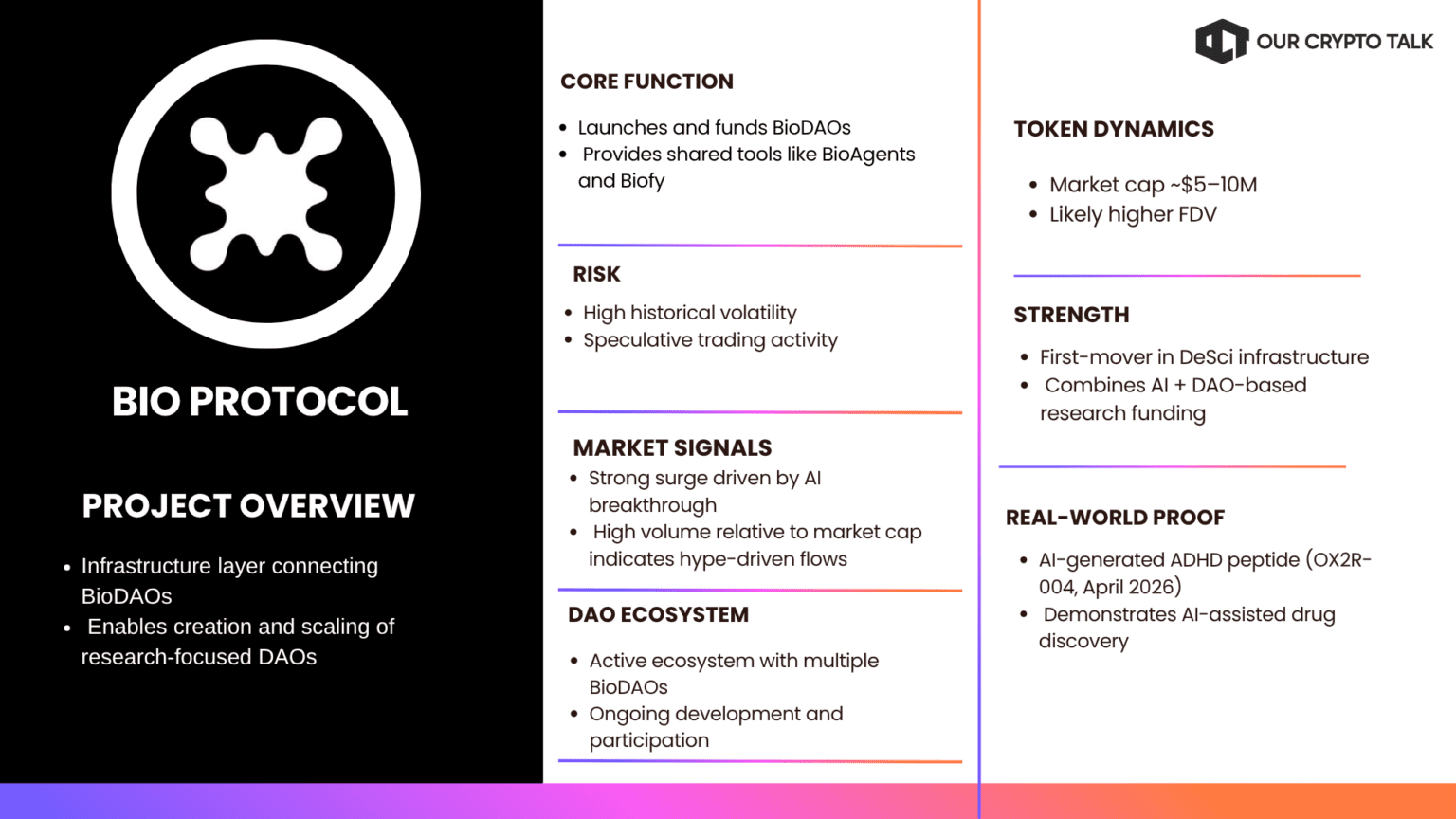
BIO Protocol sits at the center of the DeSci stack, acting as the infrastructure layer that connects and launches BioDAOs. Instead of focusing on a single research area, it provides the tools, funding rails, and coordination needed to turn decentralized science into a functioning ecosystem. Think of it as the platform where multiple scientific “startups” are created and scaled.
What separates BIO from most DeSci tokens is execution. The AI-generated ADHD peptide (OX2R-004) is one of the first clear examples of on-chain coordinated research producing a tangible scientific output. The question now is whether this becomes a repeatable model or remains an early proof of concept.
Category: Decentralized Knowledge Graph / Data Verification
One-liner: They organize and verify scientific and AI data using a decentralized knowledge graph powering trust in research data.
What it does:
OriginTrail builds a decentralized knowledge graph that structures and verifies data across industries, including scientific datasets. It’s used in supply chains, AI systems, and research environments where data integrity is critical.
Has it funded real science?
Not directly. It supports scientific research by providing data infrastructure and verification layers, including participation in EU-backed initiatives.
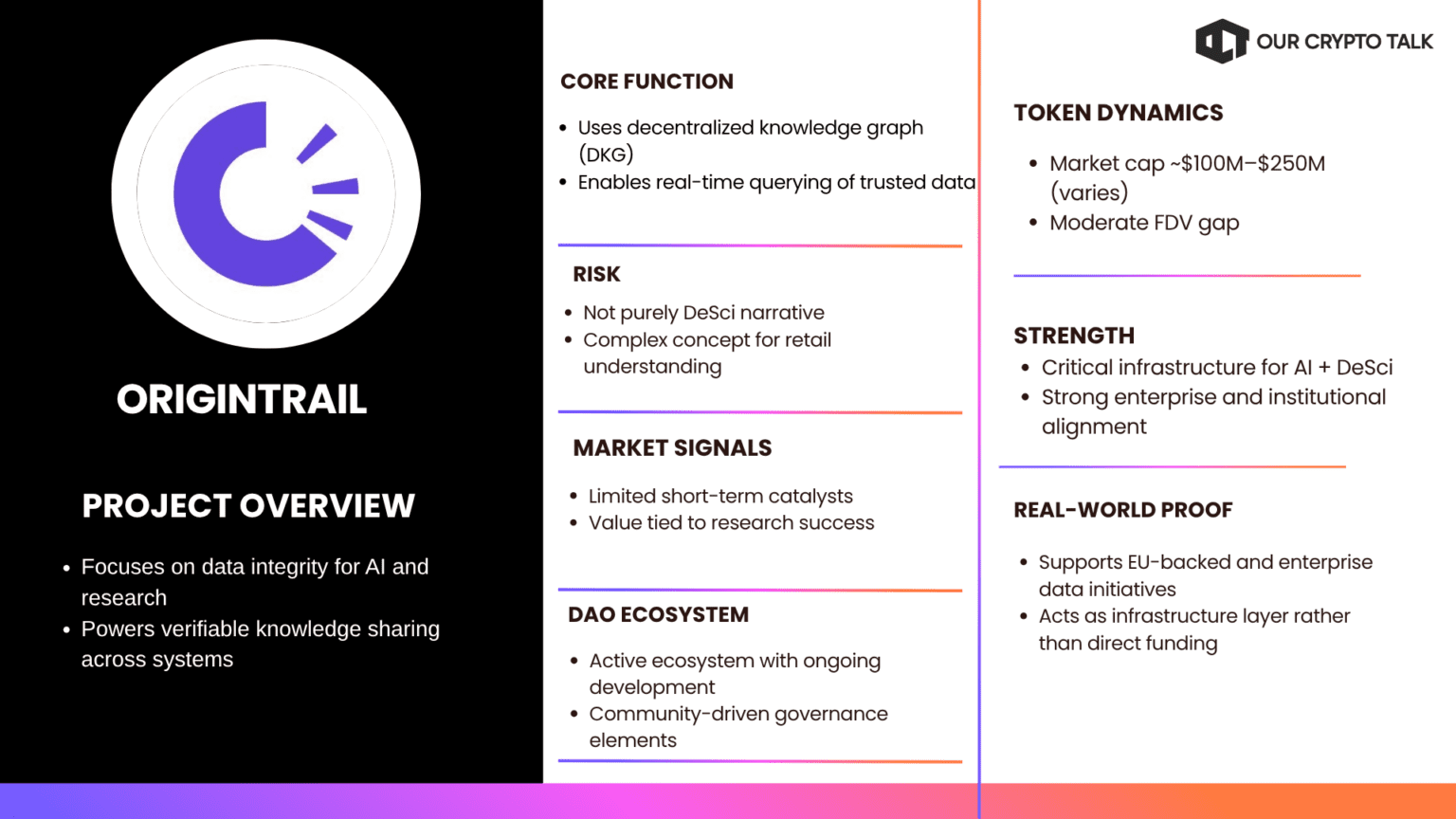
OriginTrail plays a different role in the DeSci landscape. Rather than funding research directly, it focuses on organizing and verifying data through its decentralized knowledge graph. This makes it a foundational layer for both AI systems and scientific research, where data reliability is critical.
Its value comes from enabling trust. In a world where AI models depend on massive datasets, OriginTrail ensures that information is verifiable and traceable. While it doesn’t produce research outputs itself, it supports the infrastructure that makes reproducible science and reliable AI possible.
Category: Longevity Research (BioDAO)
One-liner: They fund longevity research through a DAO and have already backed over 24 real-world projects.
What it does:
VitaDAO is a community-governed DAO focused on extending human lifespan. It funds early-stage research in aging, biotech, and therapeutics using the IP-NFT model.
Has it funded real science?
Yes. VitaDAO has funded 24+ research projects with over $4.2M deployed, including collaborations with universities and biotech labs.
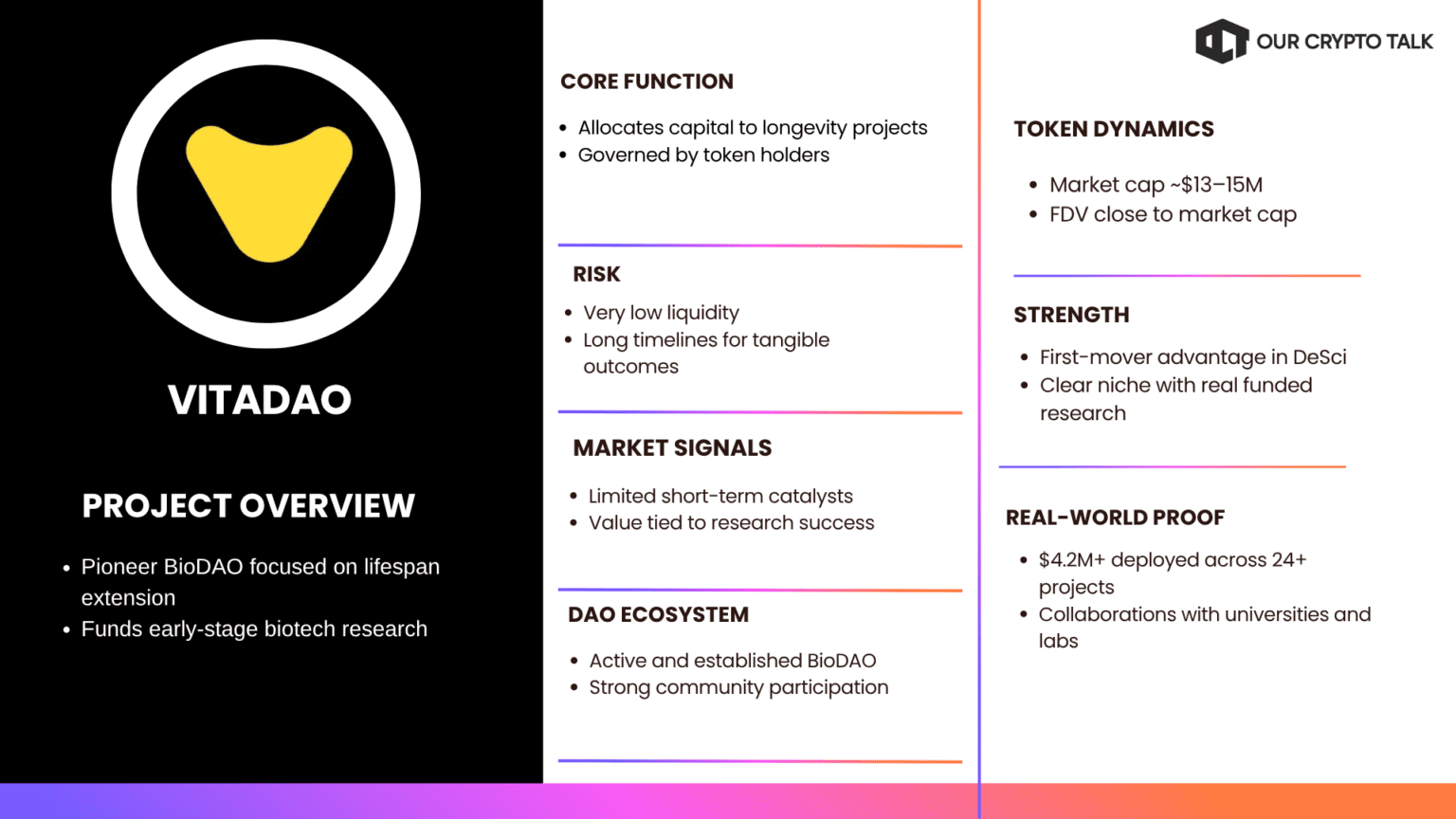
VitaDAO is one of the earliest and most established BioDAOs, focused on longevity research. Its model is simple: pool capital from a global community and fund early-stage biotech projects that aim to extend human lifespan. Over time, it has built a portfolio of research initiatives rather than relying on a single breakthrough.
What stands out is the track record. With over 24 funded projects and millions deployed, VitaDAO has already demonstrated that decentralized funding can support real scientific work. The trade-off is time, longevity research takes years, so value creation is gradual rather than immediate.
Category: Open Science Publishing
One-liner: They reward scientists for publishing and reviewing research turning open science into an incentivized system.
What it does:
ResearchCoin powers ResearchHub, a platform where researchers can publish papers, peer review work, and earn tokens for contributing to scientific knowledge.
Has it funded real science?
Yes, indirectly. It supports scientific output by incentivizing publication, peer review, and collaboration, rather than funding experiments directly.
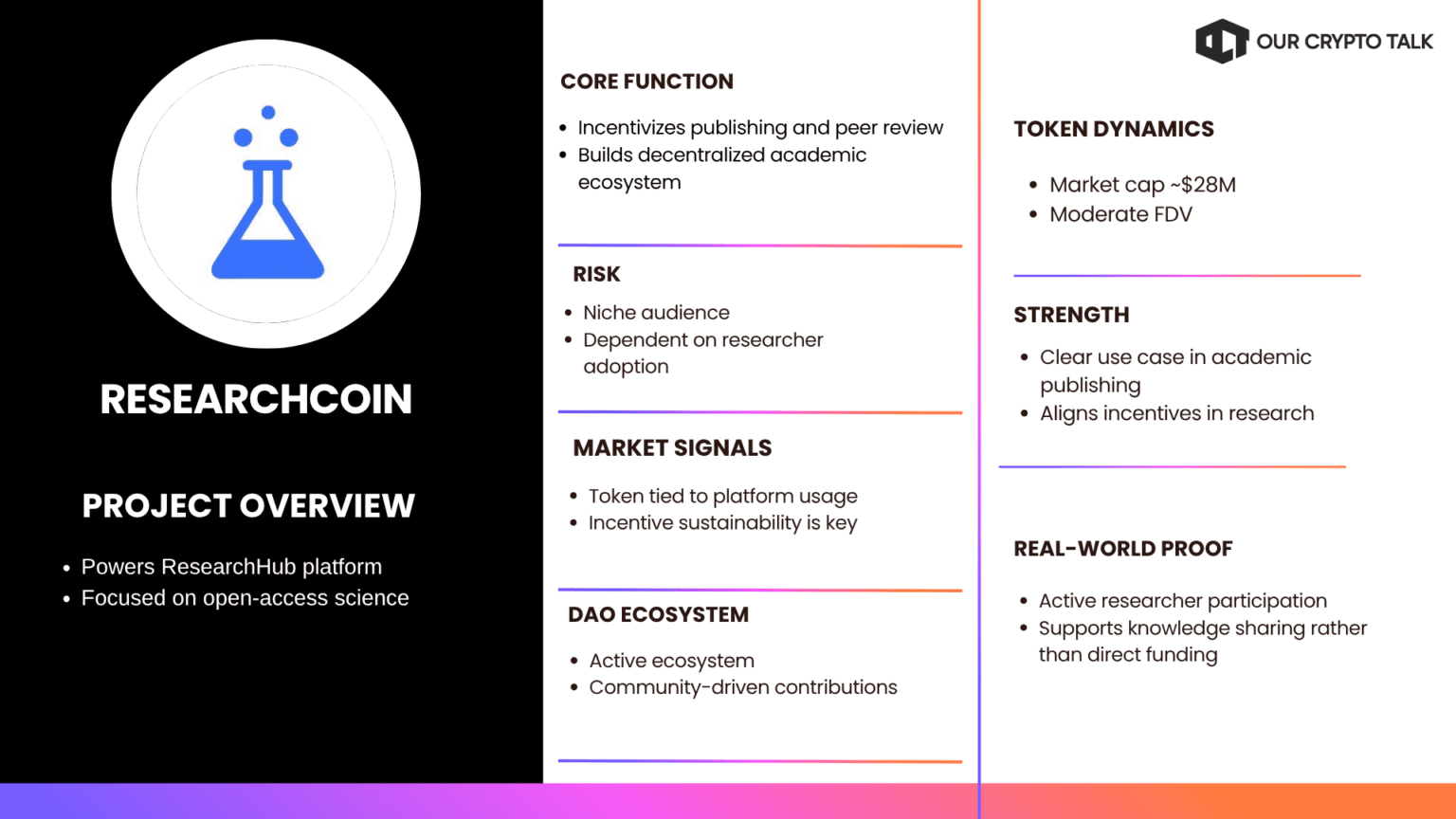
ResearchCoin powers ResearchHub, a platform designed to rethink how scientific knowledge is shared. Instead of relying on traditional journals, it rewards researchers for publishing, reviewing, and curating content. The goal is to make science more open, accessible, and collaborative.
This approach doesn’t fund experiments directly, but it addresses a different bottleneck: information flow. By incentivizing peer review and knowledge sharing, ResearchCoin strengthens the research ecosystem itself. Its success depends on whether enough researchers adopt the platform to make it a standard.
Category: Hair Loss Research (BioDAO)
One-liner: They fund research into hair loss treatments through a community-run DAO.
What it does:
HairDAO focuses on androgenetic alopecia (baldness), funding early-stage research into hair follicle regeneration and genetic therapies.
Has it funded real science?
Yes. The DAO has supported initial lab experiments related to hair growth and tissue research, though still at a pre-clinical stage.
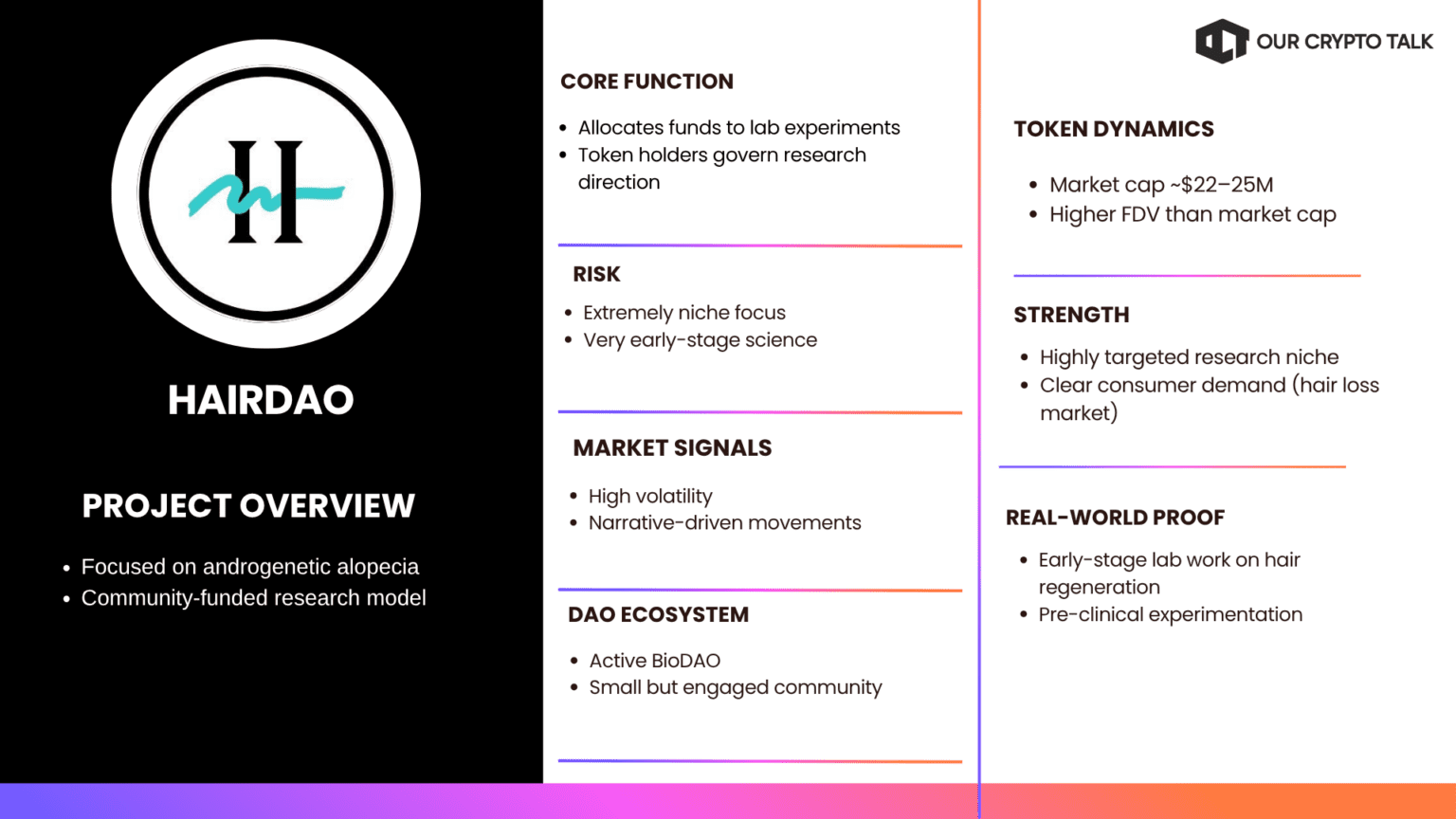
HairDAO takes a highly focused approach by targeting hair loss research, specifically androgenetic alopecia. It operates as a community-funded biotech initiative, where contributors pool resources to support early-stage experiments and lab work.
The niche focus is both its strength and its limitation. Hair loss is a large and relatable market, which helps drive interest. However, the science is still in early stages, and meaningful breakthroughs take time. For now, it represents a targeted experiment in how decentralized funding can tackle specific medical problems.
Category: Women’s Health
One-liner: They fund women’s health research through a BioDAO model.
What it does:
AthenaDAO focuses on underfunded areas like:
Has it funded real science?
Not clearly documented at scale yet.
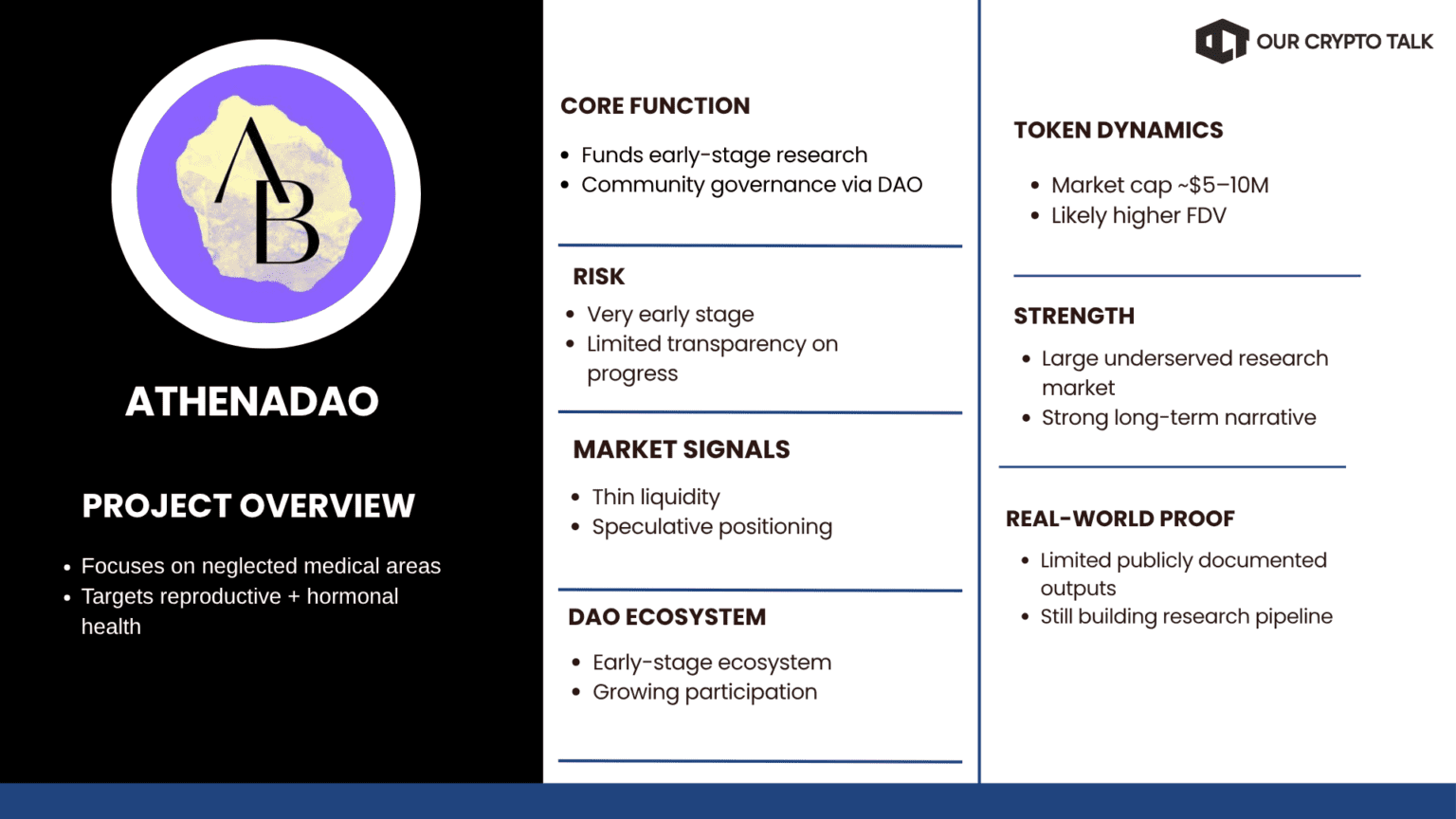
AthenaDAO focuses on women’s health, an area historically underfunded in traditional research systems. By using a DAO model, it allows a global community to direct capital toward studies that might otherwise be overlooked, particularly in reproductive and hormonal health.
The opportunity here is significant, but the project is still early. Compared to more established BioDAOs, AthenaDAO has fewer publicly visible research outputs so far. Its long-term potential depends on building a stronger pipeline of funded work and demonstrating measurable progress.
One-liner: They aggregate encrypted healthcare data to power AI-driven medical research.
What it does:
Galeon builds a privacy-preserving data network that allows hospitals and healthcare providers to contribute anonymized patient data for research and AI model training.
Has it funded real science?
Yes, indirectly. It enables research by providing structured, secure medical datasets used in AI diagnostics and healthcare studies.
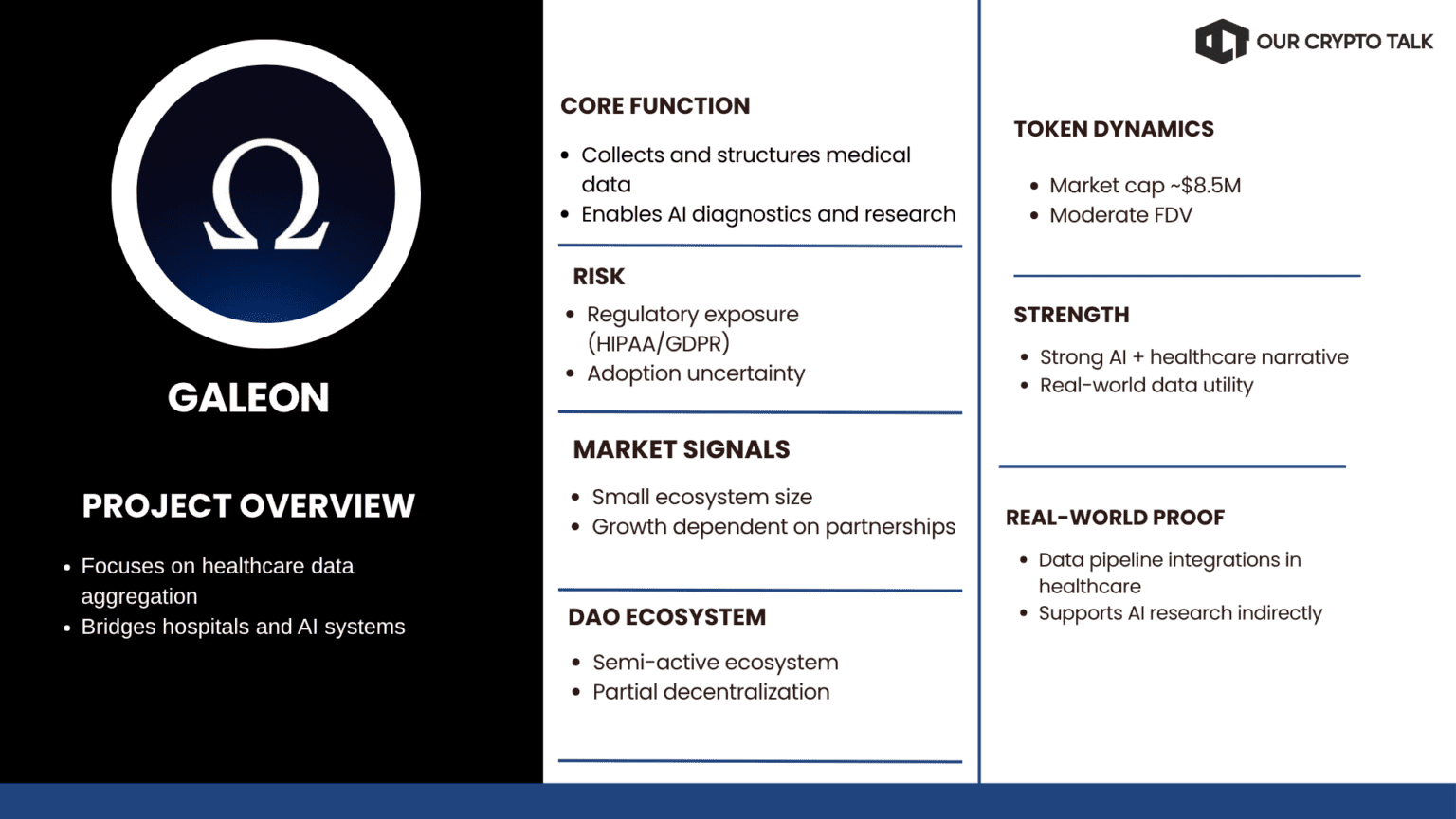
Galeon operates at the intersection of healthcare data and AI. Its core idea is to aggregate encrypted medical data from hospitals and make it usable for research and diagnostics, while preserving patient privacy. This positions it as a data layer rather than a funding DAO.
Real-world utility comes from integration. By enabling structured, privacy-compliant data access, Galeon supports AI-driven medical research and diagnostics. The challenge is adoption, success depends on partnerships with healthcare institutions and navigating complex regulatory environments.
If you’re exploring decentralized science altcoins, the goal is to filter hype from actual execution. Start with the most important question: has the project funded real research? Not just a roadmap or a promise, look for a specific output you can name, whether that’s a study, dataset, or experimental result. Next, check whether the DAO is active. Governance matters more here than in most sectors, because inactive communities don’t fund anything meaningful.
You should also compare market cap to fully diluted valuation (FDV). A large gap between the two can signal future dilution as more tokens enter circulation. Token unlock schedules are equally important, since sudden increases in supply can trigger sell pressure. Beyond tokenomics, ask whether there’s a realistic path from research to a usable product. Funding experiments is one thing; translating them into real-world impact is another.
Finally, verify everything. Look for published data, on-chain records, or official announcements that confirm the research activity. If you can’t trace the output, it likely doesn’t exist. This is the simplest way to separate strong projects from narrative-driven ones.
DeSci may be gaining attention, but it remains a high-risk sector with structural weaknesses that haven’t gone away. Narrative decay is the first concern. Crypto narratives rotate quickly, and DeSci Altcoins have already gone through boom-and-bust cycles. BIO’s 90% decline before its recent rally is a clear reminder of how fast sentiment can reverse. The current momentum in DeSci Altcoins could mark the beginning of a more sustained cycle, or it could fade just as quickly once attention shifts elsewhere.
Liquidity is another major constraint. Most DeSci Altcoins operate at relatively small market caps, which makes trading conditions fragile. Even though BIO recorded $720M in daily volume, that figure represents roughly 10 times its market cap. This kind of activity often reflects speculative churn rather than deep, stable liquidity, meaning entering and exiting positions can be difficult without impacting price.
Regulation is the third layer of risk. DeSci sits at the intersection of multiple complex domains, including securities law, healthcare regulation, and data privacy frameworks like HIPAA and GDPR. There is still no clear guidance on how regulators will treat IP-NFT ownership or DAO-governed biotech funding models. That uncertainty introduces long-term legal and compliance risks across the entire sector.
Disclaimer: Not financial advice. Always do your own research.
The DeSci narrative is back, but this time it comes with real data and measurable progress behind it. Over the past few years, the sector has moved through clear phases. In 2023 and 2024, it was mostly ideas and experimentation. By 2025, early funding models and BioDAOs started to take shape. Now in 2026, we are finally seeing tangible outputs, from funded research initiatives to AI-assisted breakthroughs like peptide design.
That said, this space is still early and highly volatile. The same conditions that create upside also introduce risk, especially with thin liquidity and narrative-driven price swings. What has changed is that DeSci is no longer purely theoretical. There is now a growing track record of projects that are actually funding and producing scientific work.
If you’re exploring the best DeSci altcoins in 2026, keep your focus simple. Ask whether the project has funded real science and whether you can verify it. That one filter cuts through most of the noise and helps you identify the few projects that are building something meaningful.