The Polymarket Edge shows how ArAIstotle analyzes resolution criteria, RRI, and RFS scores to uncover hidden risks in prediction markets.
The Polymarket Edge starts with a simple observation: the crowd is almost always wrong on one thing, resolution.
Not direction. Not vibes. Resolution. The specific, contractual, word-for-word conditions that determine whether a Polymarket bet pays out at $1.00 or goes to zero.
That is the gap ArAIstotle exploits. Once you understand how to read the terminal, you will never look at a prediction market the same way again.
ArAIstotle is an AI layer on top of the Facticity AI Truth Terminal. It scans active @Polymarket markets in real time, builds its own probability from source data, then compares that estimate against the crowd price.
The output is binary: the market is either overpricing or underpricing reality.
Most tools stop at the crowd price. ArAIstotle adds a layer most traders ignore: the quality of the resolution criteria.
Primary Question
The Polymarket Edge is understanding that the exact Polymarket question matters more than the headline. Pay attention to every word. “Conflict ends by December 31” is not the same as “ceasefire declared.” Every word in this line is load-bearing.
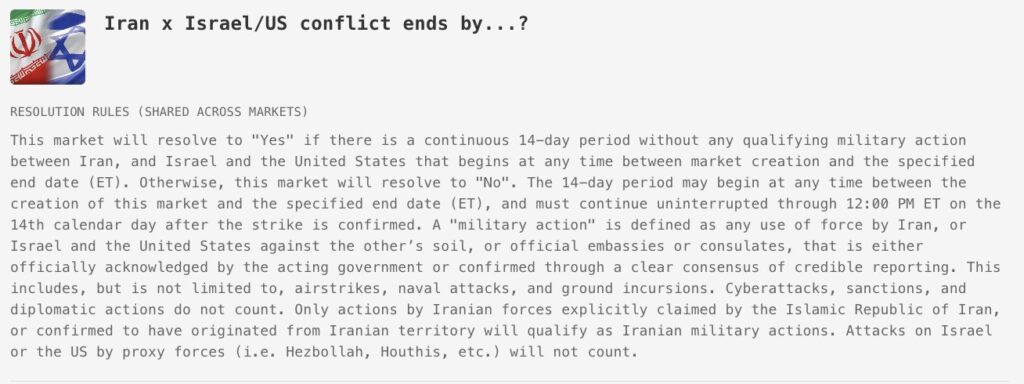
Market (Crowd) vs ArAIstotle
The crowd shows current Polymarket implied probability, plus the bid, ask, and spread. A tight spread means the market is active and liquid. A wide spread means thinner liquidity and higher execution risk.
Below it, ArAIstotle shows its own independent probability estimate. When you see “Agrees,” the AI aligns with the crowd. When you see “Disagrees,” there is a divergence worth examining.
The pricing signal label tells you the conclusion:
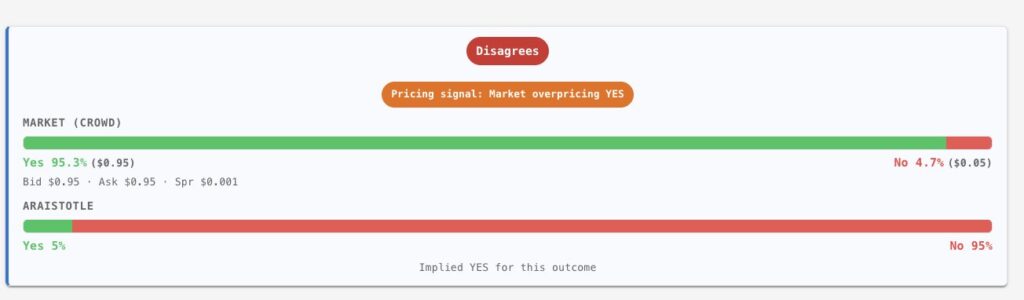
Disambiguation
This is underrated. This is where the real edge lives.
The Polymarket Edge comes from identifying ambiguity before the market does. ArAIstotle breaks down every ambiguous term in the resolution criteria and flags where disputes are likely to occur. It runs a four-step resolution test and asks whether each condition can be objectively confirmed.
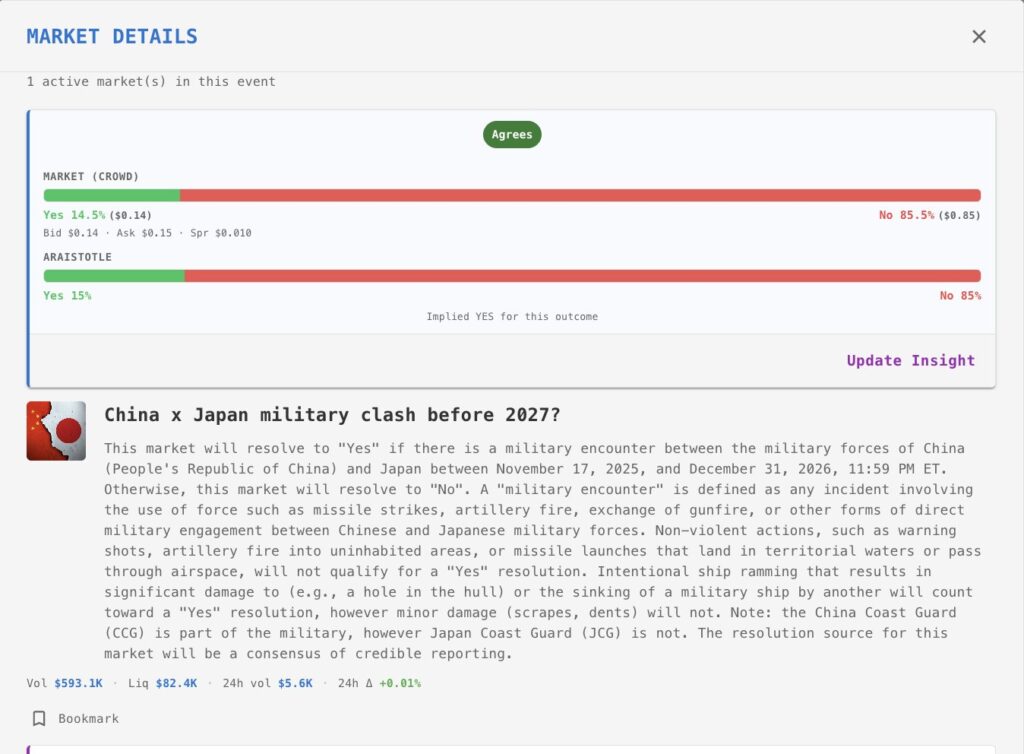
On the China x Japan market, it flags: “significant damage” has no defined threshold, “consensus of credible reporting” does not specify which sources count, and the China Coast Guard counts as military while the Japan Coast Guard does not. That asymmetry is not in the headline. Most traders never see it.
News Feed
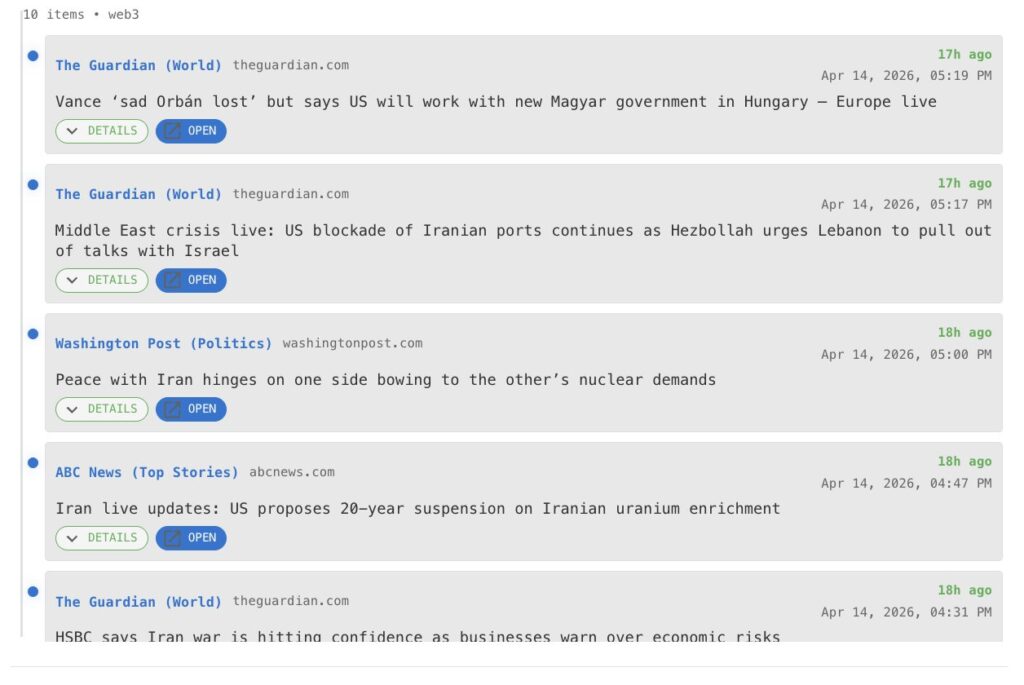
ArAIstotle pulls 10 recent news items it used to build its probability. This tells you which real-world signals moved the needle. Read it before you place anything.
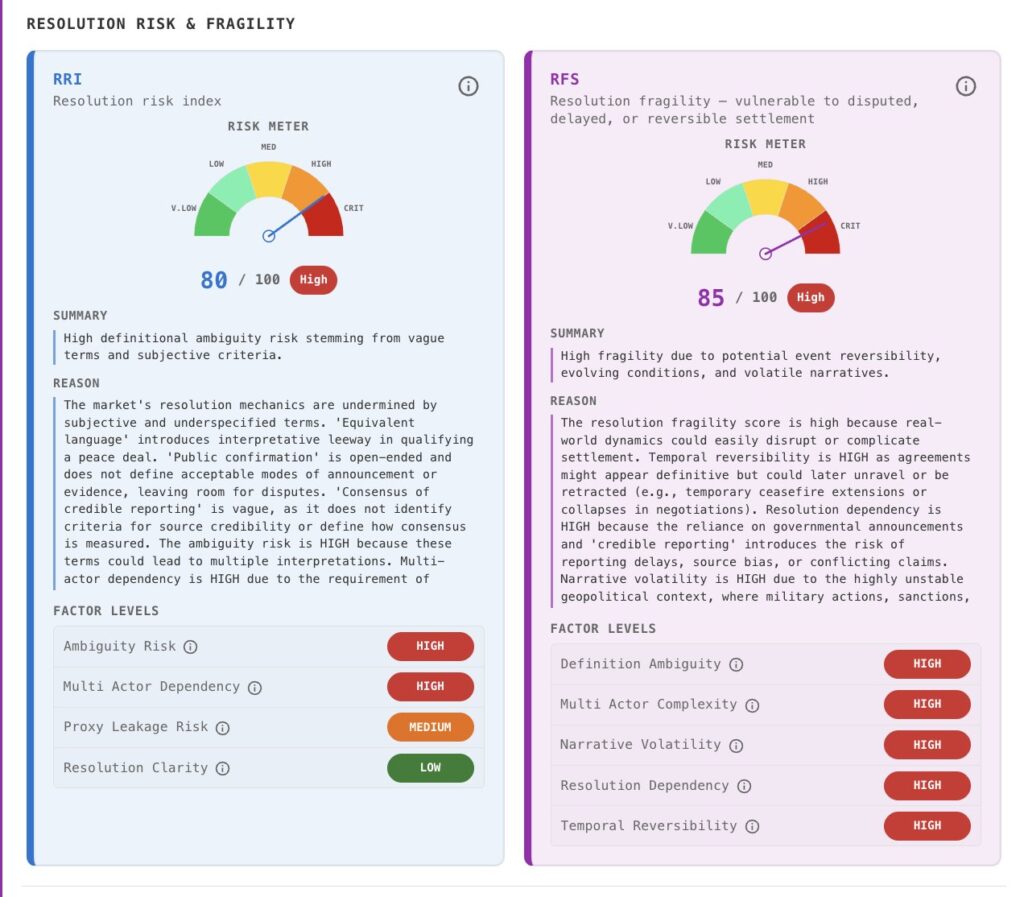
RRI: Resolution Risk Index (0 to 100)
Measures how likely the market is to end in a dispute. High score means the resolution criteria are vague, multi-source dependent, or open to interpretation.
RFS: Resolution Fragility Score (0 to 100)
The Polymarket Edge recognizes that clear resolution criteria do not always mean a safe settlement. This metric measures how vulnerable the final outcome is to reversal or contested evidence after the market resolves. A market can have clear criteria and still be fragile if the underlying real-world situation remains volatile enough to change.
A low score on both is what you want. High scores on both means the market carries hidden structural risk that the crowd price almost never reflects.
When ArAIstotle agrees with the crowd, there is no pricing divergence to exploit on the primary bet. Both are saying a military clash is unlikely.
The money move here is not the YES/NO bet. It is using the disambiguation to find hidden tail risk in your NO position.
The RRI flags Multi Actor Dependency as HIGH and Proxy Leakage Risk as HIGH. The RFS flags Temporal Reversibility and Resolution Dependency both as HIGH.
What that means practically: if you are holding NO and a Senkaku Island incident occurs involving the China Coast Guard, your position is at risk even if Japan’s Self-Defense Forces are not involved.
The crowd holding NO at $0.85 has not thought through that scenario. ArAIstotle’s disambiguation makes it visible.
On an Agrees market, you use the tool to stress-test your position, not to find a new one.
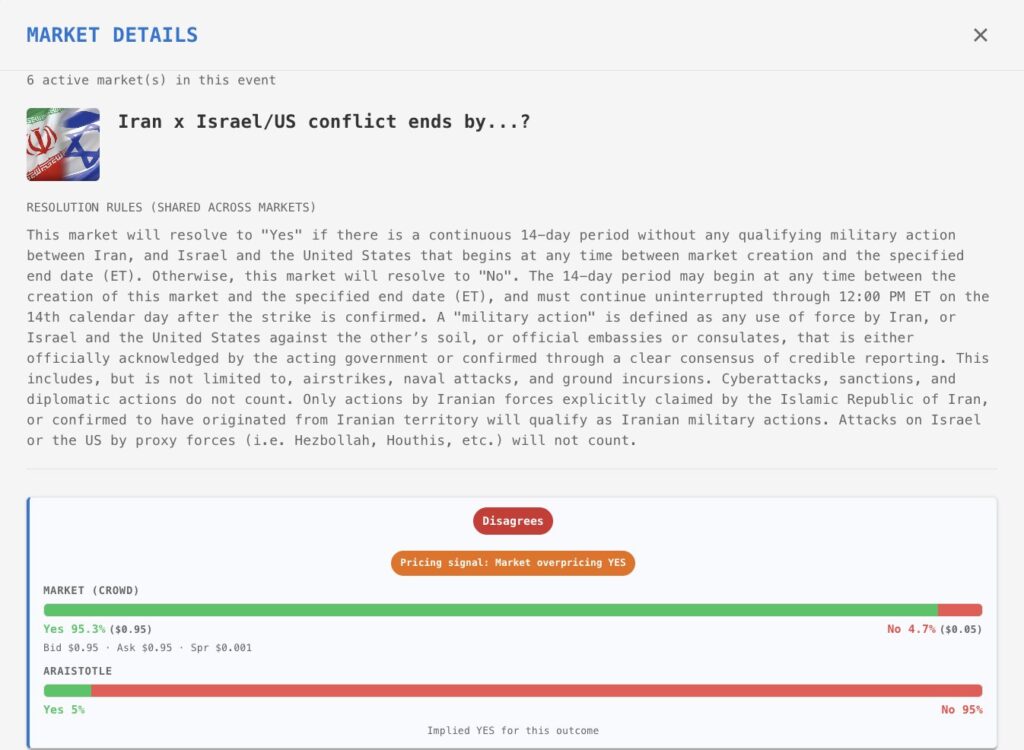
This is the most interesting market on the terminal right now. A 91-point divergence.
The crowd is almost certain the conflict ends by December 31. ArAIstotle says it almost certainly does not.
Why the gap? The resolution criteria requires a continuous 14-day ceasefire. Not an announcement. Not a pause. A verified, uninterrupted two-week period with no qualifying military action.
The news feed ArAIstotle pulled shows: US-Israeli strikes in Iran starting February 28, 2026, active US blockades in the Strait of Hormuz, and Lavrov in China to discuss Iran. None of that reads like a conflict trending toward 14 consecutive quiet days.
The crowd is pricing “ends” loosely. ArAIstotle is pricing the exact resolution text.
NO contracts sit at roughly $0.03 each. If the conflict does not produce a verified 14-day ceasefire before December 31, those positions resolve at $1.00. That is a 33x return.
The Polymarket Edge is understanding how settlement risk affects probabilities. The RFS score of 81/100 actually strengthens the NO position. Temporal Reversibility is HIGH, meaning that even if a ceasefire is declared, fighting can resume on day 12 and invalidate the resolution condition. The bar for YES to pay out is therefore much higher than many traders assume.
With $41M in volume and nearly $1M in liquidity, you can enter a meaningful position without moving the price.
You are not looking at every market. You are looking for three things:
Prediction markets are not about picking the right outcome. They are about reading the resolution criteria more carefully than everyone else.
When ArAIstotle agrees with the crowd, use the disambiguation to find tail risk in your position.
When ArAIstotle disagrees, that is where the asymmetric bets are.
The Iran market is not a trade because the news looks bad for peace. It is a trade because the crowd is pricing a loose reading of the question and ArAIstotle is pricing the specific words that determine the payout.

➜ Covering DeFAI | AI agents | On-chain intelligence ➜ Strategic Advisor: @useOttoAI and @ArAistotle
https://t.co/3gb8oP82Rf


Tokenization of RWA yields onchain might be the biggest opportunity that no one has noticed
Cold Wallet Safety 2026: Are Hardware Wallets Still Safe?
One Token, Multiple Products. Can Zylo Deliver?
The Rise of NEAR Protocol 2026: Inside the 530% Rally and the ETF
Tokenization of RWA yields onchain might be the biggest opportunity that no one has noticed
Cold Wallet Safety 2026: Are Hardware Wallets Still Safe?
One Token, Multiple Products. Can Zylo Deliver?
The Rise of NEAR Protocol 2026: Inside the 530% Rally and the ETF