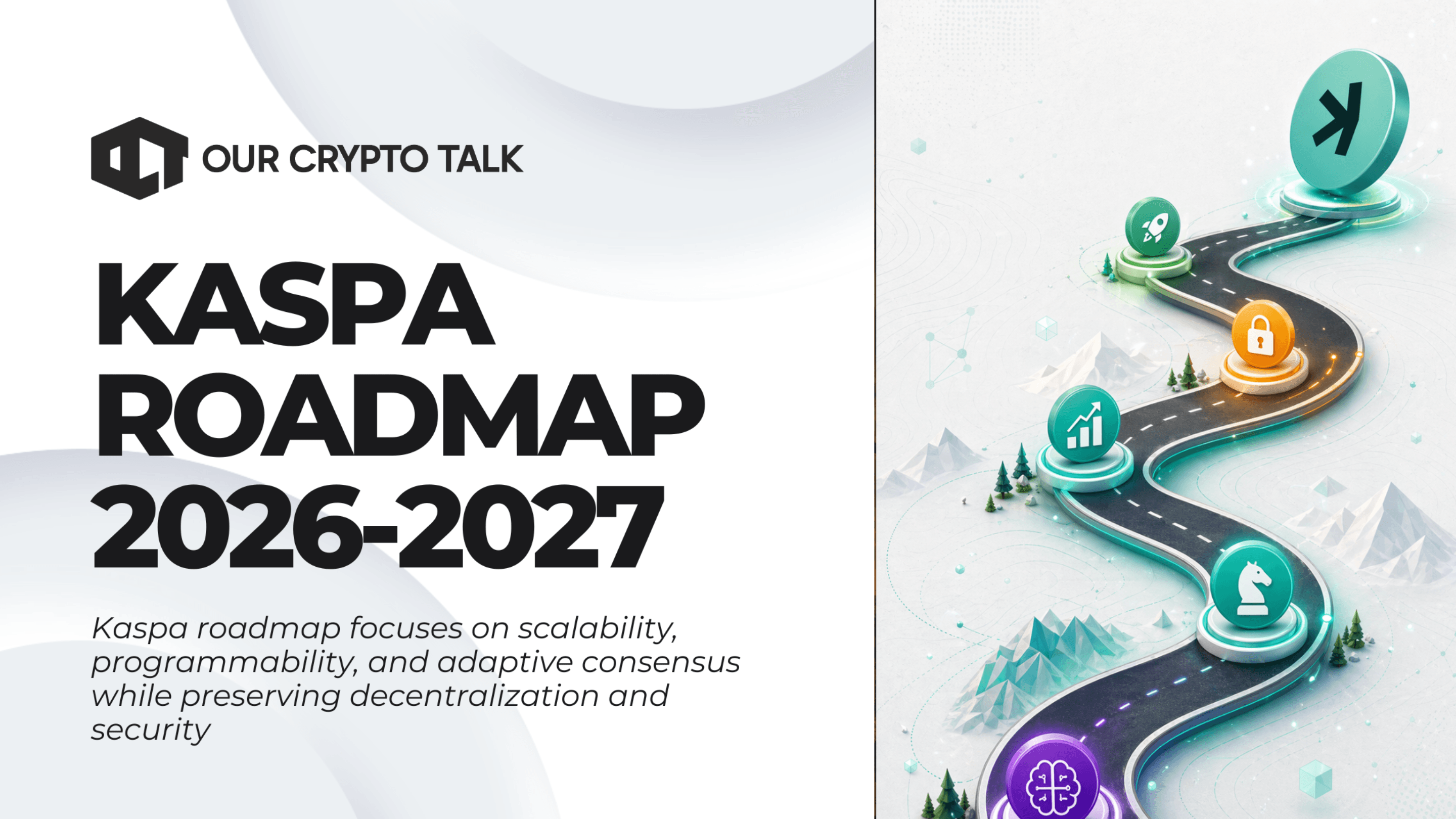
Kaspa roadmap 2026-2027: Covenant Hardfork, DAGKnight, 100 BPS, VProgs, and every upgrade explained with timelines and what each means for KAS.

Author: Kritika Gupta
On June 5–20, 2026, Kaspa will activate its most important upgrade yet, the Covenant Hardfork, bringing native assets, programmable covenants, and zero-knowledge verification to its high-speed blockDAG network. This milestone sits at the center of the Kaspa Roadmap 2026, which builds on a proven execution track record that already includes 10 blocks per second throughput and real-world transaction scale.
Kaspa has carved out a unique place in the cryptocurrency space as a pure proof-of-work Layer 1 blockchain built on a blockDAG (Directed Acyclic Graph) structure rather than a traditional linear chain. Instead of prioritizing smart contracts from day one, Kaspa first focused on delivering speed, security, and decentralization through its GHOSTDAG consensus protocol. Now, the 2026-2027 roadmap shifts focus toward kaspa upcoming upgrades spanning programmability, adaptive consensus, and long-term scalability.
As of April 2026, Kaspa stands at a pivotal moment. The network has already proven its ability to ship major upgrades on schedule, processing hundreds of millions of transactions with record single-day volumes. Now, the 2026-2027 roadmap shifts focus from pure speed toward programmability, adaptive consensus, and long-term scalability. Key milestones include the Covenant (Toccata) Hardfork, progressive block-rate increases, the DAGKnight consensus upgrade, research-stage verifiable programs (vProgs), ecosystem expansion through Layer 2 solutions like Igra and Kasplex, and a major supply compression event.
Importantly, these upgrades are not speculative promises. They build directly on delivered milestones and reinforce Kaspa’s commitment to simplicity, security, and on-chain verifiability. This article provides a complete, section-by-section breakdown of what is coming, when it is expected, and what it means for miners, developers, users, and the broader ecosystem.
Kaspa’s track record of execution sets it apart in a space filled with unfulfilled roadmaps. The project has consistently delivered on ambitious technical targets, proving that its blockDAG architecture can handle real-world scale without compromising decentralization or security.
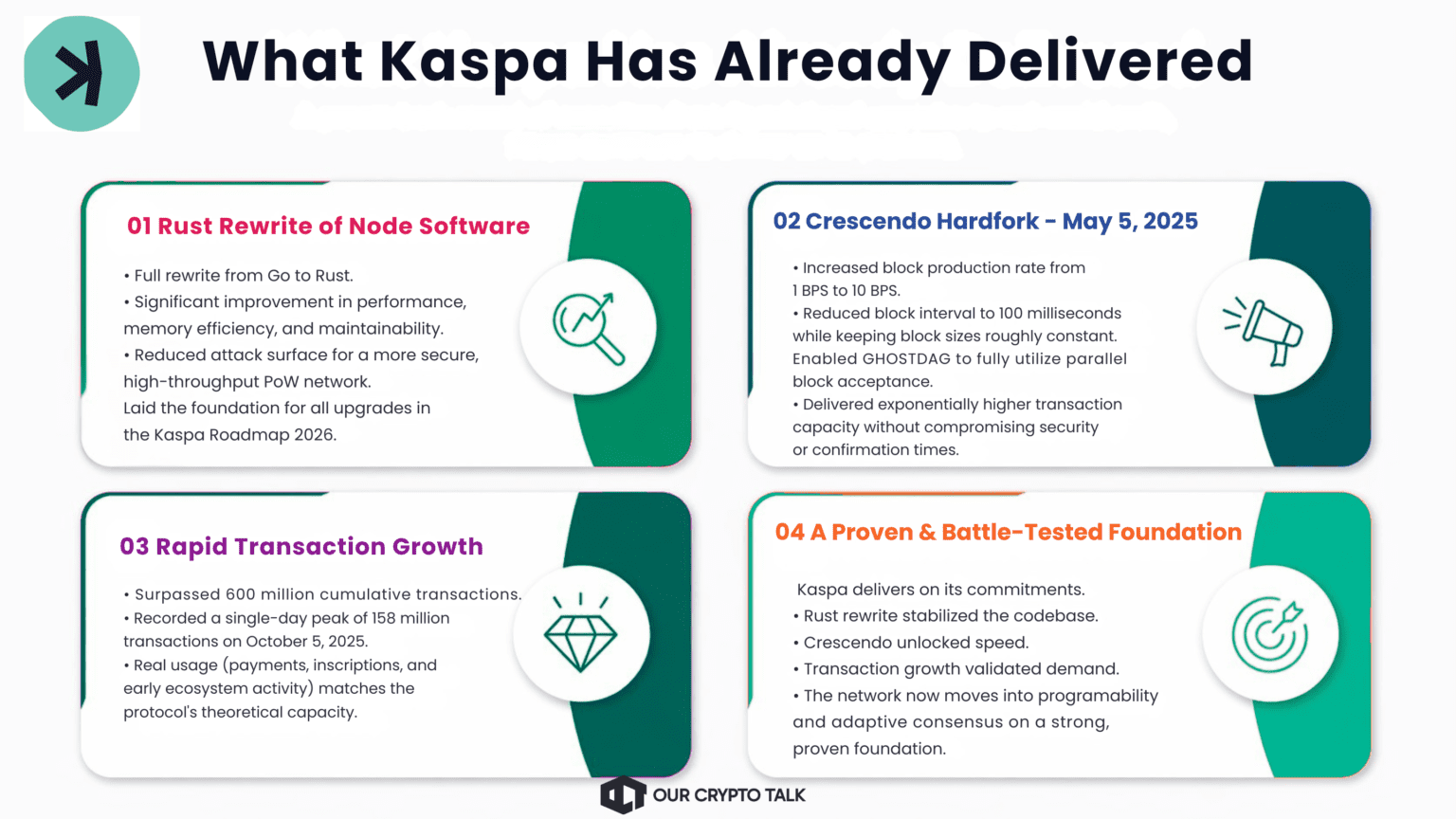
To begin with, one foundational achievement was the full Rust rewrite of the node software, which replaced the previous Go implementation. This transition significantly improved performance, memory efficiency, and long-term maintainability. At the same time, it reduced the attack surface, which is critical for a high-throughput proof-of-work network. Consequently, this rewrite laid the groundwork for all subsequent upgrades in the Kaspa Roadmap 2026.
Next, the Crescendo Hardfork activated on May 5, 2025, marking the network’s most important throughput upgrade to date. It increased the block production rate from 1 block per second to 10 BPS. More importantly, tightening block intervals to 100 milliseconds while keeping block sizes roughly constant allowed GHOSTDAG to fully utilize parallel block acceptance. As a result, the network achieved exponentially higher transaction capacity without sacrificing confirmation times or security assumptions.
Following this upgrade, adoption accelerated rapidly. The network surpassed 600 million cumulative transactions and recorded a single-day peak of 158 million transactions on October 5, 2025. These metrics clearly demonstrated that real usage, including payments, inscriptions, and early ecosystem activity, had begun to match the protocol’s theoretical capacity.
Taken together, these milestones highlight a clear pattern. Kaspa delivers on its commitments. The Rust rewrite stabilized the codebase, Crescendo unlocked speed, and transaction growth validated demand. Therefore, as the network moves into more complex areas such as programmability and adaptive consensus, it does so on a proven and battle-tested foundation.
The Covenant Hardfork, also known as Toccata or the Covenant-Centric Hardfork, represents Kaspa’s most significant functionality upgrade since Crescendo. Initially targeted for May 5, 2026, the mainnet activation timeline has now shifted to approximately June 5–20, 2026 after finalizing sequencing architecture for ZK systems. Meanwhile, Testnet 12 is already running the complete feature set, and developers completed the feature freeze in mid-April.
This hardfork introduces three major capabilities simultaneously while preserving Kaspa’s pure proof-of-work design and lightweight node requirements.
First, native assets will bring KRC-20 tokens directly onto Layer 1. Currently, KRC-20 tokens rely on inscription-style mechanisms and external indexers. However, after the hardfork, token creation, transfers, and atomic operations will become part of consensus rules. As a result, users will benefit from lower fees, trustless atomic swaps, and seamless integration without bridges or wrapped assets. This upgrade unlocks DeFi primitives, loyalty systems, and utility tokens directly on Kaspa.
Second, Covenants++ expands programmability through enforceable spending conditions. Instead of enabling full Turing-complete smart contracts, Kaspa introduces bounded programmability that prioritizes security and auditability. These covenants enable use cases such as escrow systems, vaults, time-locked transfers, and programmable wallets with multi-step execution rules.
Third, the network introduces native support for Groth16 zero-knowledge proofs. This allows on-chain verification of proofs without revealing underlying data. As a result, developers can build privacy-focused applications such as shielded transactions and anonymous voting. In addition, this feature enables trust-minimized bridging to other ecosystems.
Alongside these core upgrades, Kaspa introduces SilverScript, a developer-friendly programming language for writing covenant logic, and Computational DAG (CDAG), which tracks execution costs across the blockDAG. Together, these tools ensure fair resource pricing and prevent abuse while maintaining parallel processing efficiency.
Overall, this hardfork transforms Kaspa from a high-speed monetary network into a programmable proof-of-work Layer 1. Users gain faster and cheaper transactions with added privacy features. Developers gain a robust toolkit for building directly on Layer 1. Meanwhile, miners benefit from increased transaction demand that reinforces network activity.
Kaspa Roadmap Timeline: Milestones and Progression
Following the Covenant upgrade outlined in the Kaspa Roadmap 2026, the network will scale throughput through a series of structured block rate increases. Specifically, Kaspa will move from the current 10 blocks per second to 25 BPS, then to 40 BPS, and ultimately target 100 BPS as its long-term objective.
Each increase follows a proportional design. Instead of altering total issuance, the protocol adjusts block rewards on a per-second basis to preserve the overall emission schedule. This ensures that monetary policy remains predictable while the network scales. As a result, Kaspa can increase throughput without introducing inflation shocks or disrupting miner incentives.
These upgrades rely on the inherent advantages of Kaspa’s blockDAG architecture. Because the network processes blocks in parallel rather than in a single linear chain, higher block rates translate directly into higher transaction capacity. This allows Kaspa Roadmap 2026 to scale without the congestion and fee spikes typically seen in traditional blockchains. At full capacity, the 100 BPS target could support thousands of transactions per second under real-world conditions.
However, reaching this milestone depends on two key factors. First, DAGKnight must be deployed to enable adaptive consensus that responds to real network latency. Second, infrastructure across the network must mature, including node performance, bandwidth capacity, and block propagation efficiency.
For this reason, Kaspa will implement each increase only after extensive testing and validation. This phased rollout ensures that scalability progresses without compromising decentralization, security, or network stability.
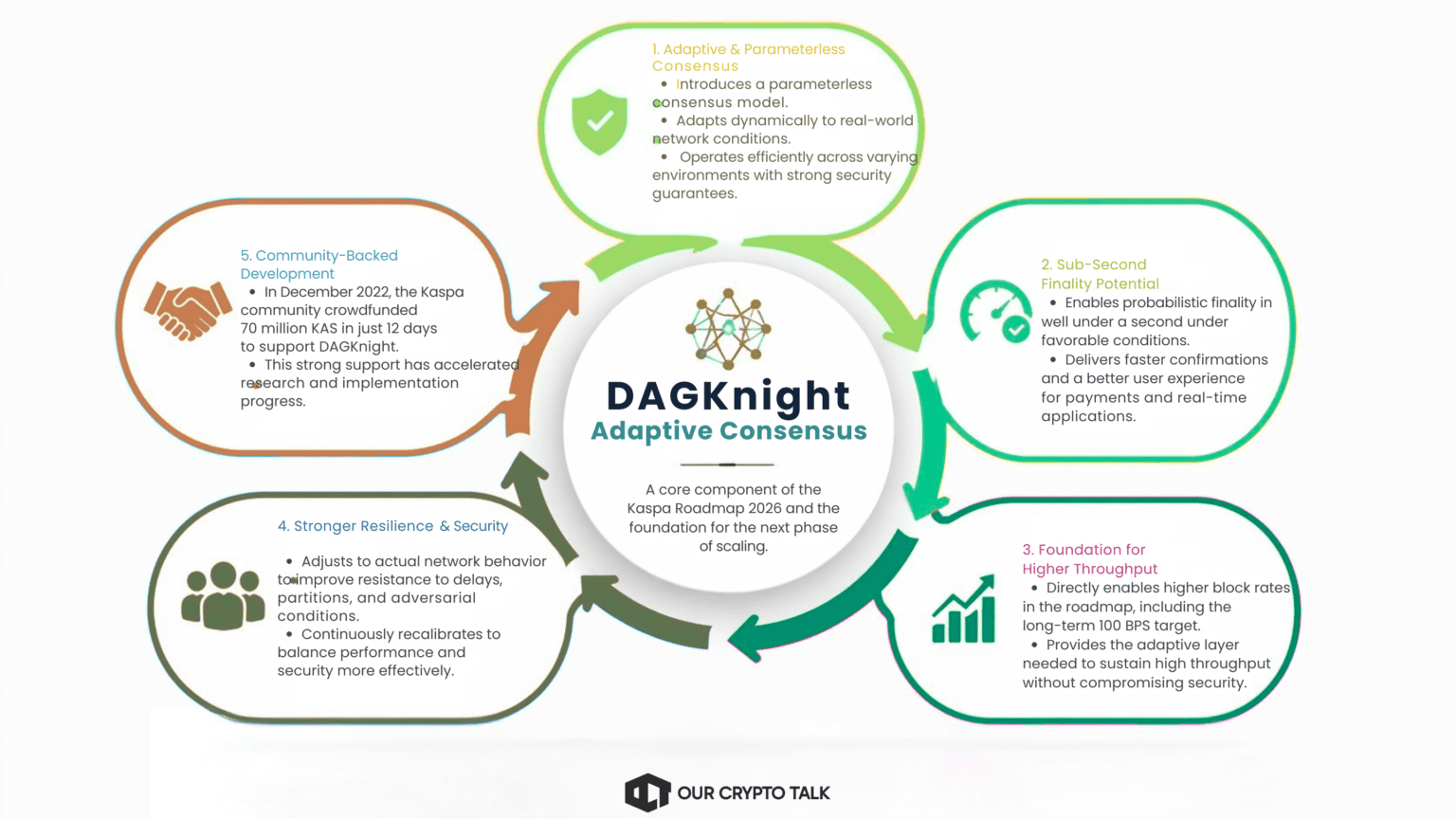
DAGKnight is a core component of the Kaspa Roadmap 2026, introducing a parameterless and adaptive consensus model. Unlike fixed systems, it adjusts dynamically to real network conditions. Following the Covenant hardfork, Kaspa will move toward integrating DAGKnight, its next-generation consensus protocol designed to replace or extend GHOSTDAG. This upgrade represents a structural shift in how the network handles security, latency, and scalability.
At its core, DAGKnight introduces a parameterless consensus model. Instead of relying on fixed assumptions about network conditions, the protocol adapts dynamically to real-world latency and connectivity. This flexibility allows the network to operate efficiently across varying environments while maintaining strong security guarantees. As a result, Kaspa can push throughput higher without depending on overly conservative settings.
One of the most important outcomes of this design is sub-second finality potential. Under favorable conditions, transactions can reach probabilistic finality in well under a second. This significantly improves user experience, especially for payments and real-time applications, while also strengthening confidence in fast confirmations.
In addition, DAGKnight enhances resilience. Because it adjusts to actual network behavior, it improves resistance to delays, partitions, and adversarial conditions. Rather than optimizing for worst-case scenarios at all times, the protocol continuously recalibrates, which allows it to balance performance and security more effectively.
Importantly, DAGKnight is not an isolated upgrade. It directly enables the higher block rates outlined in the roadmap, including the long-term 100 BPS target. Without an adaptive consensus layer, sustaining such throughput would introduce higher risks. Therefore, DAGKnight acts as the foundation for Kaspa’s next phase of scaling.
The development of DAGKnight also reflects strong community alignment. In December 2022, the Kaspa community crowdfunded 70 million KAS in just 12 days to support its research and implementation. This level of participation highlights long-term conviction and has played a direct role in accelerating progress.
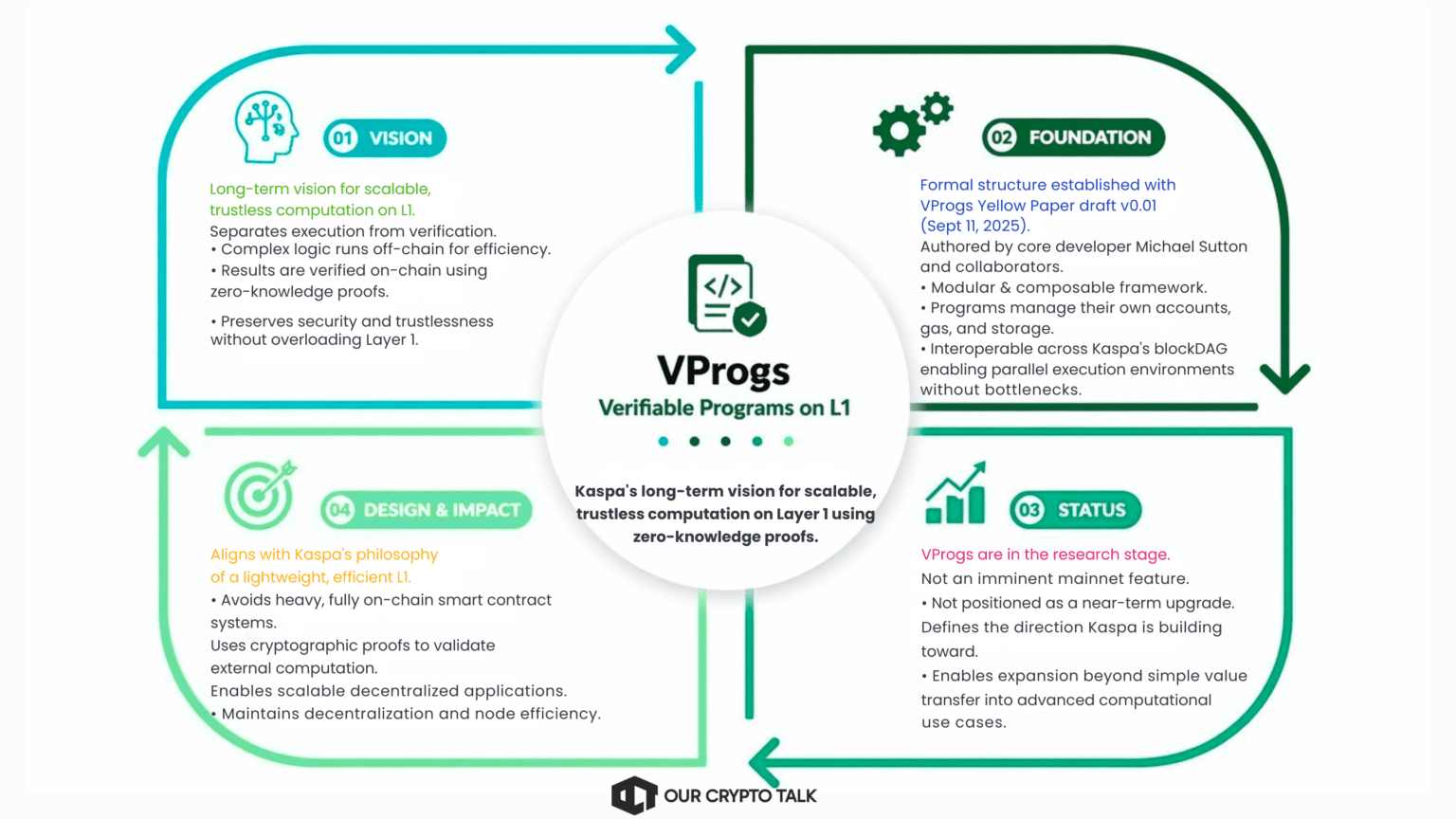
VProgs represent Kaspa’s long-term vision for scalable, trustless computation on Layer 1. Instead of executing every operation directly on-chain, the model separates execution from verification. In practice, complex logic runs off-chain for efficiency, while the network verifies the results on-chain using zero-knowledge proofs. This approach preserves security and trustlessness without overloading the base layer.
The concept gained formal structure with the release of the VProgs Yellow Paper draft v0.01 on September 11, 2025, authored by core developer Michael Sutton and collaborators. The paper outlines a modular and composable framework where individual programs manage their own accounts, gas, and storage. At the same time, these programs remain interoperable across Kaspa’s blockDAG, which allows parallel execution environments to coexist without bottlenecks.
Importantly, VProgs are still in the research stage. They are not an imminent mainnet feature, and the roadmap does not position them as a near-term upgrade. Instead, they define the direction Kaspa is building toward as it expands beyond simple value transfer into more advanced computational use cases.
This design aligns closely with Kaspa’s philosophy. Rather than introducing heavy, fully on-chain smart contract systems, the network aims to keep Layer 1 lightweight while leveraging cryptographic proofs to validate external computation. As a result, VProgs could enable scalable decentralized applications without compromising decentralization or node efficiency.
In summary, VProgs extend the zero-knowledge foundations introduced in the Covenant upgrade into a broader execution model.
Ecosystem expansion plays a critical role in the Kaspa Roadmap 2026. Layer 2 solutions and token standards continue to drive adoption.
To begin with, Igra Network represents a major step forward as the first based rollup built directly on Kaspa. It introduces EVM compatibility, which allows developers to port existing Ethereum-based applications with minimal friction. At the same time, Igra avoids a centralized sequencer model. Instead, it maintains a decentralized architecture that removes single points of failure and reduces censorship risk. This combination makes it particularly well-suited for DeFi, gaming, and NFT applications that require both flexibility and trust minimization.
In addition, Kasplex has already established itself as a functioning Layer 2 environment. Its mainnet launched in August 2025 and has since attracted more than 100 decentralized applications. Today, Kasplex provides smart contract capabilities that are not yet native to Kaspa’s Layer 1. As a result, it serves as an important bridge between current ecosystem needs and the upcoming programmability introduced by the Covenant hardfork. Developers can build and deploy applications now while preparing for deeper Layer 1 integration later.
At the token layer, KRC-20 standards currently operate through inscription-style mechanisms. These rely on off-chain indexing and external infrastructure, which introduces inefficiencies and limitations. However, this will change significantly after the Covenant upgrade. Native Layer 1 support will bring token issuance, transfers, and composability directly into consensus rules. Consequently, this transition will improve efficiency, reduce costs, and enable more seamless integration with other on-chain features such as covenants.
Taken together, these components create a reinforcing growth loop. Layer 2 solutions provide immediate functionality and developer access, while Layer 1 upgrades strengthen long-term scalability and security. As more applications launch and migrate across layers, user activity and network demand are likely to increase in tandem.
The Kaspa Roadmap 2026 also includes a major supply milestone. Kaspa’s total supply is capped at approximately 28.7 billion KAS and follows a chromatic emission schedule that reduces rewards monthly. Instead of relying on abrupt halving events, Kaspa decreases issuance in smaller, consistent steps, which creates a more stable and transparent supply curve.
By July 10, 2026, the network will reach a critical milestone. Roughly 95 percent of the total supply will have already been mined, leaving only about 5 percent to be emitted over the following decades. As a result, daily issuance will decline significantly, tightening the flow of new supply entering the market.
This transition carries important implications. First, it introduces a supply compression dynamic similar to Bitcoin’s halving cycles, but in a more gradual form. Second, it aligns with the broader roadmap, where programmability, Layer 2 expansion, and increased network activity could drive demand at the same time that new supply decreases. Together, these forces may reshape how participants evaluate long-term value.
For miners, this milestone highlights the importance of sustained participation as block rewards diminish over time.
The Kaspa Roadmap 2026 reflects a clear execution-driven strategy. Crescendo delivered real throughput gains, and Covenants are already progressing through testnet toward mainnet. Now, Covenants are live on testnet and moving steadily toward mainnet activation. Each upcoming upgrade builds directly on what already works, which reduces uncertainty and strengthens long-term credibility.
Importantly, the roadmap follows a logical progression. Block rate increases expand capacity, DAGKnight introduces adaptive consensus, and VProgs outline the future of scalable computation. At the same time, Layer 2 ecosystems like Igra and Kasplex continue to mature, which ensures that development and user activity keep pace with protocol improvements.
For readers who want to go deeper, each component of the roadmap has a dedicated explainer. You can explore Covenants and SilverScript for programmability, DAGKnight for consensus evolution, VProgs for long-term computation, Igra and Kasplex for ecosystem growth, KRC-20 for token standards.
Overall, Kaspa is not just outlining a vision. It is executing it step by step, with each milestone reinforcing the next.


Tokenization of RWA yields onchain might be the biggest opportunity that no one has noticed
Cold Wallet Safety 2026: Are Hardware Wallets Still Safe?
One Token, Multiple Products. Can Zylo Deliver?
The Rise of NEAR Protocol 2026: Inside the 530% Rally and the ETF
Tokenization of RWA yields onchain might be the biggest opportunity that no one has noticed
Cold Wallet Safety 2026: Are Hardware Wallets Still Safe?
One Token, Multiple Products. Can Zylo Deliver?
The Rise of NEAR Protocol 2026: Inside the 530% Rally and the ETF