Kaspa TPS explained: 10 BPS, 5,500+ TPS record, sub-7s finality. See how BlockDAG speed works and the roadmap to 100 blocks per second.

Author: Kritika Gupta
Kaspa TPS currently processes 10 blocks per second with a demonstrated capacity of over 5,500 transactions per second, making it the fastest proof-of-work blockchain in operation. However, most readers still confuse blocks per second (BPS) with transactions per second (TPS), and many sources use the two terms interchangeably. This guide clears up that confusion immediately.
In simple terms, Kaspa TPS reflects the network’s real transaction throughput, while BPS measures block production speed. Understanding that distinction is key to evaluating Kaspa’s actual performance in 2026.
This article gives you the exact current real-world speed, explains how Kaspa’s BlockDAG architecture enables that throughput, and breaks down the roadmap from the current 10 BPS to the long-term 100 BPS target.
Kaspa TPS (transactions per second) measures the number of individual transactions the Kaspa network can process each second. Unlike most proof-of-work blockchains that handle single-digit TPS, Kaspa’s BlockDAG architecture enables thousands of transactions per second while maintaining full PoW security.
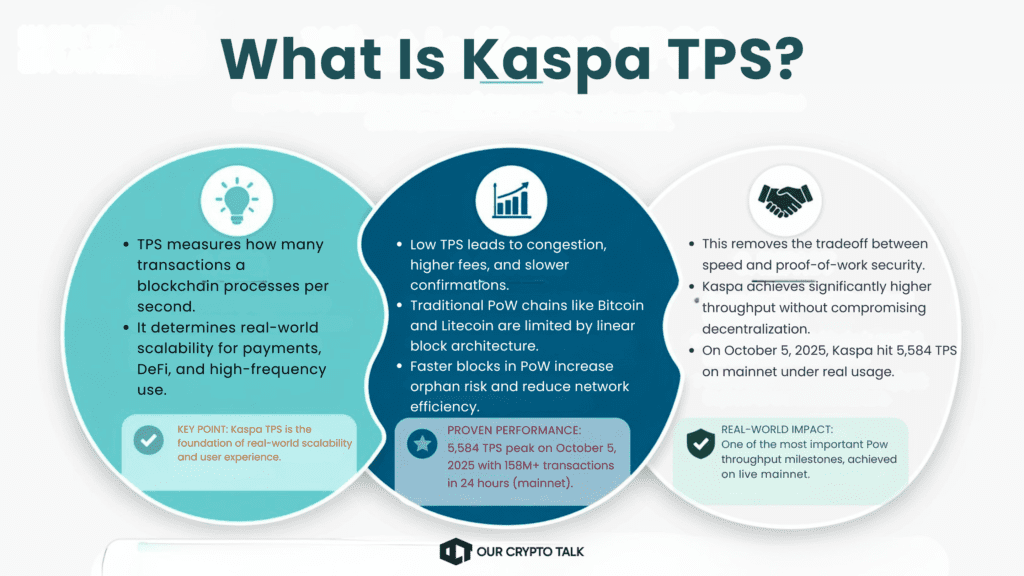
TPS is the metric that determines whether a blockchain can support real-world use at scale. For payments, it affects how quickly users can send and settle transactions. For DeFi, it directly impacts trading speed, liquidations, and throughput during periods of heavy activity. In high-frequency applications, low TPS quickly leads to congestion, rising fees, and slow confirmations.
That is why Kaspa’s performance stands out. Historically, proof-of-work chains have remained relatively slow. Bitcoin processes roughly 7 TPS, while Litecoin handles around 56 TPS. These limits come from the architecture itself. In traditional single-chain PoW systems, faster blocks increase orphaned blocks, which can weaken security assumptions and waste miner work.
Kaspa solves this structural tradeoff with BlockDAG, which allows the network to process multiple blocks in parallel rather than forcing them into a single linear chain. That architectural shift is what unlocks high throughput without compromising proof-of-work security.
The performance is not theoretical. On October 5, 2025, Kaspa recorded a peak of 5,584 TPS, while processing more than 158 million transactions in a single 24-hour period. Importantly, this was not a testnet benchmark or a lab simulation. It was live mainnet traffic under real-world load, which makes it one of the most important throughput milestones in proof-of-work infrastructure.
BPS (blocks per second) measures how many blocks the Kaspa network produces each second. TPS (transactions per second) measures how many individual transactions those blocks can carry. Because each block contains multiple transactions, TPS is always significantly higher than BPS.
Kaspa currently runs at 10 BPS, which means the network produces 10 new blocks every second. However, this does not mean Kaspa processes only 10 transactions per second. Each block can carry multiple transactions, and under heavy network load, that block capacity scales substantially. In live mainnet conditions, this has already translated into more than 5,000 TPS, with a demonstrated peak of 5,584 TPS. Under normal conditions, actual throughput depends on real transaction demand, so daily TPS naturally fluctuates with network usage.
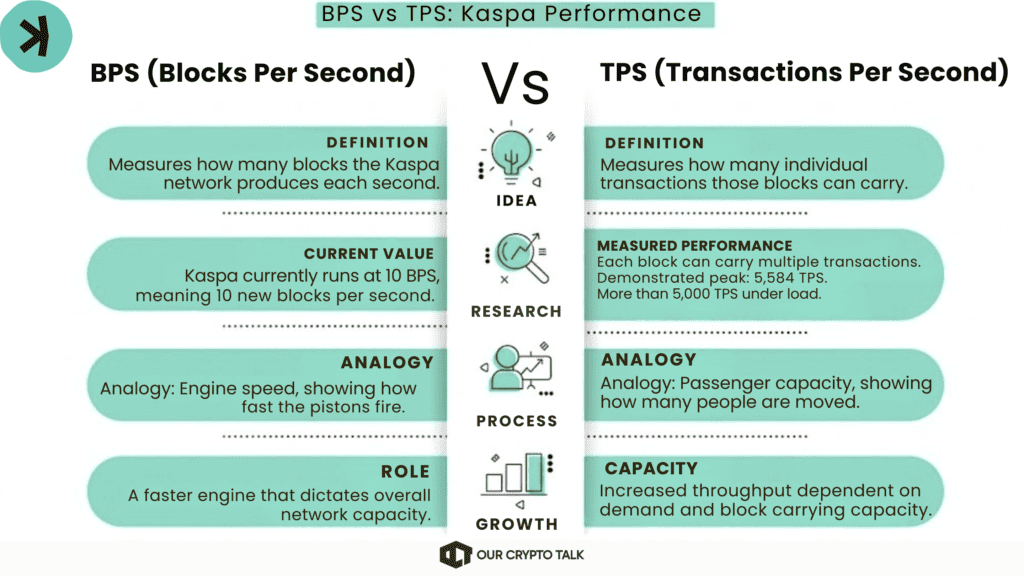
A simple way to understand the difference is through an analogy. BPS is the engine speed, showing how fast the pistons fire, while TPS is the passenger capacity, showing how many people actually get moved. A faster engine increases carrying capacity, but the two numbers do not measure the same thing.
This distinction matters because many readers see “10 BPS” and mistakenly interpret it as “10 TPS.” That is where most of the confusion around Kaspa’s performance begins. In reality, the network produces 10 blocks every second, and each of those blocks can carry hundreds of transactions depending on size and demand.
BPS is not TPS. Kaspa currently produces 10 blocks per second (BPS), and each block carries multiple transactions. Under peak load, this has already delivered 5,584 transactions per second (TPS). So when you see “10 BPS,” do not confuse it with “10 TPS” because the actual throughput is far higher.
Since the Crescendo hardfork in May 2025, Kaspa has operated at a steady 10 blocks per second, establishing its current live baseline. At this throughput level, the network delivers 100-millisecond block times and sub-7-second finality, which means transactions settle far faster than traditional proof-of-work chains. This is the production standard the network runs on today, not a projected target or a controlled benchmark.
The most important real-world data point came on October 5, 2025, when Kaspa set a new throughput record for any proof-of-work blockchain. Over a single 24-hour period, the network processed 158,441,966 transactions, with a peak rate of 5,584 transactions per second. Crucially, this was recorded on live mainnet traffic, not on testnet infrastructure or a simulated load environment.
That said, it is important to separate peak throughput from typical throughput. The 5,584 TPS figure represents a peak achieved under heavy demand, not the network’s average day-to-day usage. As of early 2026, Kaspa processes roughly 386,700 transactions per day on average.
Fees reinforce that scalability story. The average transaction fee remains around $0.00001, which is effectively a fraction of a cent. Even during periods of elevated throughput, fees stayed negligible, with no gas bidding wars or sudden fee spikes like those commonly seen on Ethereum.
Kaspa Speed at a Glance (April 2026)
The reason Kaspa is fast comes down to architecture, not marketing.
Traditional proof-of-work blockchains like Bitcoin rely on a single linear chain, where only one block can be considered the next valid block at any moment. If two miners discover blocks at nearly the same time, the network eventually accepts one and discards the other as an orphan block. That discarded block represents wasted computational work. To keep the orphan rate low and preserve security, traditional PoW systems intentionally slow block production. This is why Bitcoin uses roughly 10-minute block times. In this design, speed and security remain in direct tension: faster blocks usually mean more wasted blocks and weaker security assumptions.
Kaspa removes that bottleneck with a Directed Acyclic Graph of blocks, or BlockDAG. Instead of forcing miners into a single-file chain, BlockDAG allows multiple blocks to be created in parallel, and importantly, the network incorporates all honest blocks into the ledger. This means honest miner work is not discarded simply because another miner found a block at the same time. Rather than producing orphan waste, the network absorbs parallel block creation as part of normal operation.
The consensus layer that makes this possible is GHOSTDAG. It orders these parallel blocks by analyzing the structure of the DAG itself. Blocks that reference each other in expected honest patterns are grouped into the trusted set, while malicious or structurally inconsistent blocks stand out. In practical terms, the protocol can distinguish honest network activity from attacker behavior by looking at how blocks connect and propagate through the graph.
A useful analogy helps clarify this. Traditional blockchains operate like a one-lane road, where every car must wait for the one ahead. By contrast, BlockDAG functions like a multi-lane highway, where many cars move in parallel and an intelligent traffic system, GHOSTDAG, keeps everything ordered without collisions.
In a traditional single-chain PoW system, increasing block speed increases orphan rates, which weakens security. Kaspa’s BlockDAG solves this by incorporating all parallel honest blocks instead of discarding them. As a result, speed and security are no longer in tension, they become complementary.
Kaspa’s scaling roadmap follows a clear progression, and each stage builds directly on the current 10 BPS production baseline.
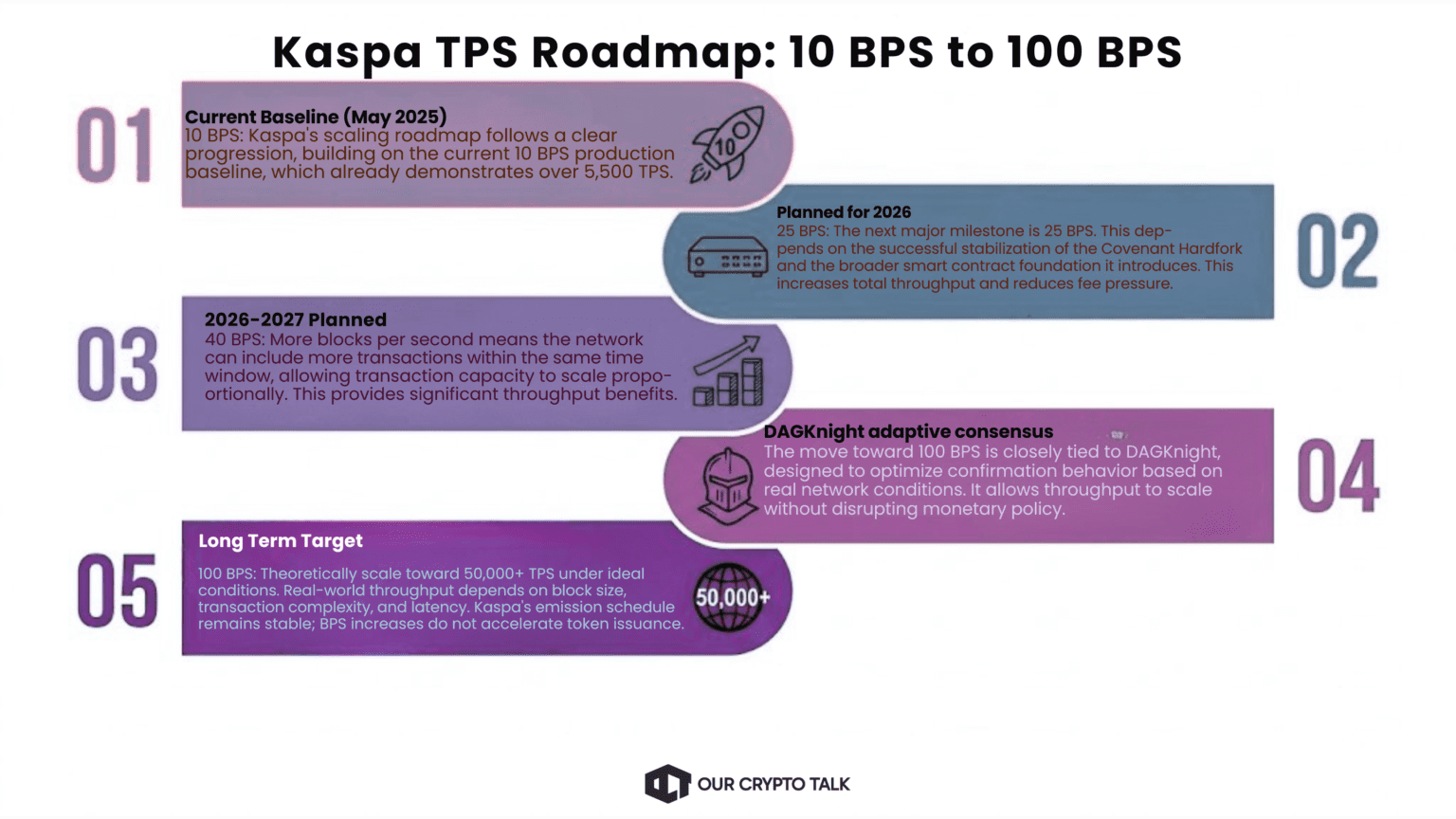
The important point is that each jump in blocks per second scales transaction capacity proportionally. More blocks per second means the network can include more transactions within the same time window, which increases total throughput and reduces fee pressure as usage grows.
Importantly, Kaspa’s emission schedule remains stable because block rewards adjust on a per-second basis rather than a per-block basis. This means increasing BPS does not accelerate token issuance. Instead, it simply increases the number of blocks used to distribute the same per-second emission. From a network design perspective, this allows throughput to scale without disrupting monetary policy.
The next major milestone is 25 BPS, which depends on the successful stabilization of the Covenant Hardfork and the broader smart contract foundation it introduces. Beyond that, the move toward 100 BPS is closely tied to DAGKnight, the adaptive consensus upgrade designed to optimize confirmation behavior based on real network conditions.
In throughput terms, the implications are significant. If the current 10 BPS architecture has already demonstrated more than 5,500 TPS, then a fully optimized 100 BPS environment could theoretically scale toward 50,000+ TPS under ideal conditions. However, it is important not to overstate this figure. Real-world throughput will always depend on factors such as block size, transaction complexity, propagation latency, and actual transaction demand.
These figures should be treated as engineering roadmap targets, not promises. Delivery timelines remain subject to development readiness, infrastructure testing, and community validation.
BPS Scaling Roadmap
Note: TPS estimates are theoretical maximums. Real throughput depends on transaction demand and block utilization.
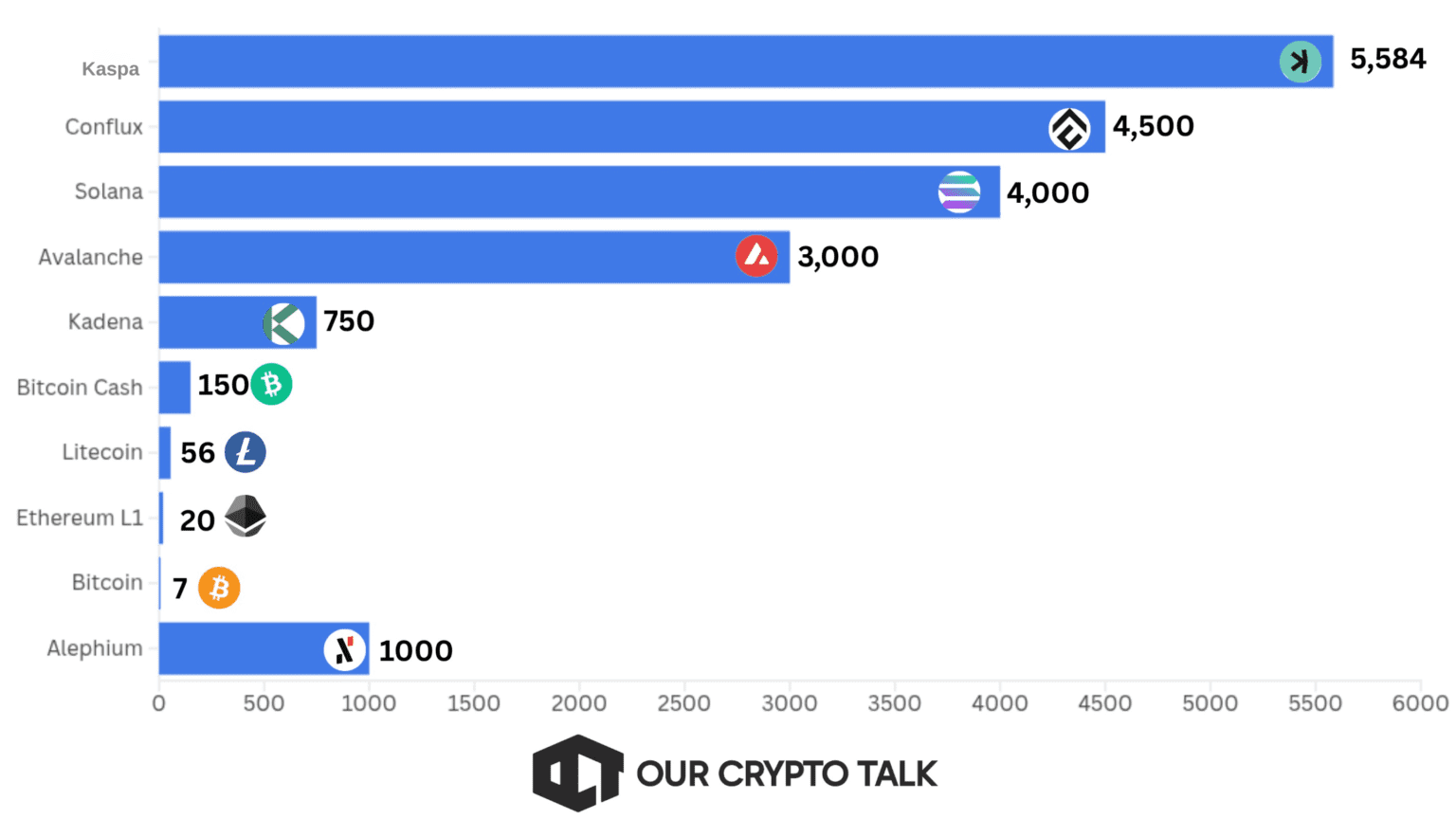
As of 2026, Kaspa is the fastest proof-of-work blockchain by transactions per second, block time, and finality. No other PoW chain comes close to its throughput. That is the most important framing for this section.
Kaspa’s core comparison is first and foremost against other proof-of-work blockchains, not against high-throughput proof-of-stake systems. The real significance of Kaspa’s speed is that it demonstrates a structural point the market long assumed was impossible: proof-of-work does not have to be slow. More precisely, the limitation was never “PoW = slow.” The real limitation was “single-chain PoW = slow.”
Traditional PoW chains like Bitcoin and Litecoin rely on a linear chain structure that forces one valid block at a time. That architecture naturally constrains throughput and increases confirmation time. Kaspa’s BlockDAG model removes that bottleneck by allowing parallel block creation while preserving proof-of-work security.
That is why the performance gap is so wide. For context, it is important to acknowledge that some proof-of-stake systems can achieve higher theoretical throughput. For example, Solana’s theoretical TPS ceiling is significantly higher, and several Ethereum Layer 2 ecosystems can also process transactions at faster headline speeds.
Blockchain Speed Comparison (April 2026)
Note: TPS figures are demonstrated or observed unless marked theoretical. Fees vary with network load.
Kaspa’s throughput is not just a benchmark headline. It directly expands the range of applications the network can support in real-world environments.
For payments, sub-second block production and negligible fees make Kaspa increasingly viable for point-of-sale transactions and micropayments. With 100ms block times, sub-7-second finality, and average fees near $0.00001, the user experience begins to approach the speed expectations of modern payment systems. Existing tools such as OnChain POS and Kaspay POS already demonstrate how this can translate into real merchant-facing infrastructure.
The next major adoption catalyst is programmability. With the Covenant Hardfork on May 5, 2026, Kaspa adds the foundation for smart contract functionality. This matters because higher TPS means smart contract interactions, whether DEX trades, liquidations, lending actions, or yield operations, are far less likely to create congestion as usage grows.
This is particularly important for DeFi.
DeFi applications require sustained throughput for order execution, liquidations, arbitrage, and high-frequency operations. Since current network demand still sits well below Kaspa’s demonstrated capacity, the ecosystem has substantial room to expand before it encounters throughput bottlenecks. That headroom should help the network avoid the early congestion walls that have historically constrained emerging ecosystems.
Fee stability further strengthens this outlook. With high throughput capacity and relatively low current demand, fees should remain negligible for the foreseeable future. Even if transaction demand rises significantly, including several multiples above today’s levels, per-transaction costs are likely to stay trivial.
Taken together, the combination of the 100 BPS roadmap target, DAGKnight adaptive finality, and Covenant-based programmability positions Kaspa as a proof-of-work chain that can increasingly compete on user experience, scalability, and utility, not just on ideological purity.
Kaspa currently runs at 10 BPS, with 5,500+ TPS demonstrated on mainnet and sub-7-second finality. Its speed comes from BlockDAG + GHOSTDAG architecture, which removes the traditional single-chain PoW bottleneck without relying on a proof-of-stake shortcut. Looking ahead, the roadmap from 25 to 100 BPS, supported by DAGKnight adaptive consensus, positions Kaspa for significantly higher real-world throughput over the coming upgrade cycles.
Last updated: April 2026


Tokenization of RWA yields onchain might be the biggest opportunity that no one has noticed
Cold Wallet Safety 2026: Are Hardware Wallets Still Safe?
One Token, Multiple Products. Can Zylo Deliver?
The Rise of NEAR Protocol 2026: Inside the 530% Rally and the ETF
Tokenization of RWA yields onchain might be the biggest opportunity that no one has noticed
Cold Wallet Safety 2026: Are Hardware Wallets Still Safe?
One Token, Multiple Products. Can Zylo Deliver?
The Rise of NEAR Protocol 2026: Inside the 530% Rally and the ETF