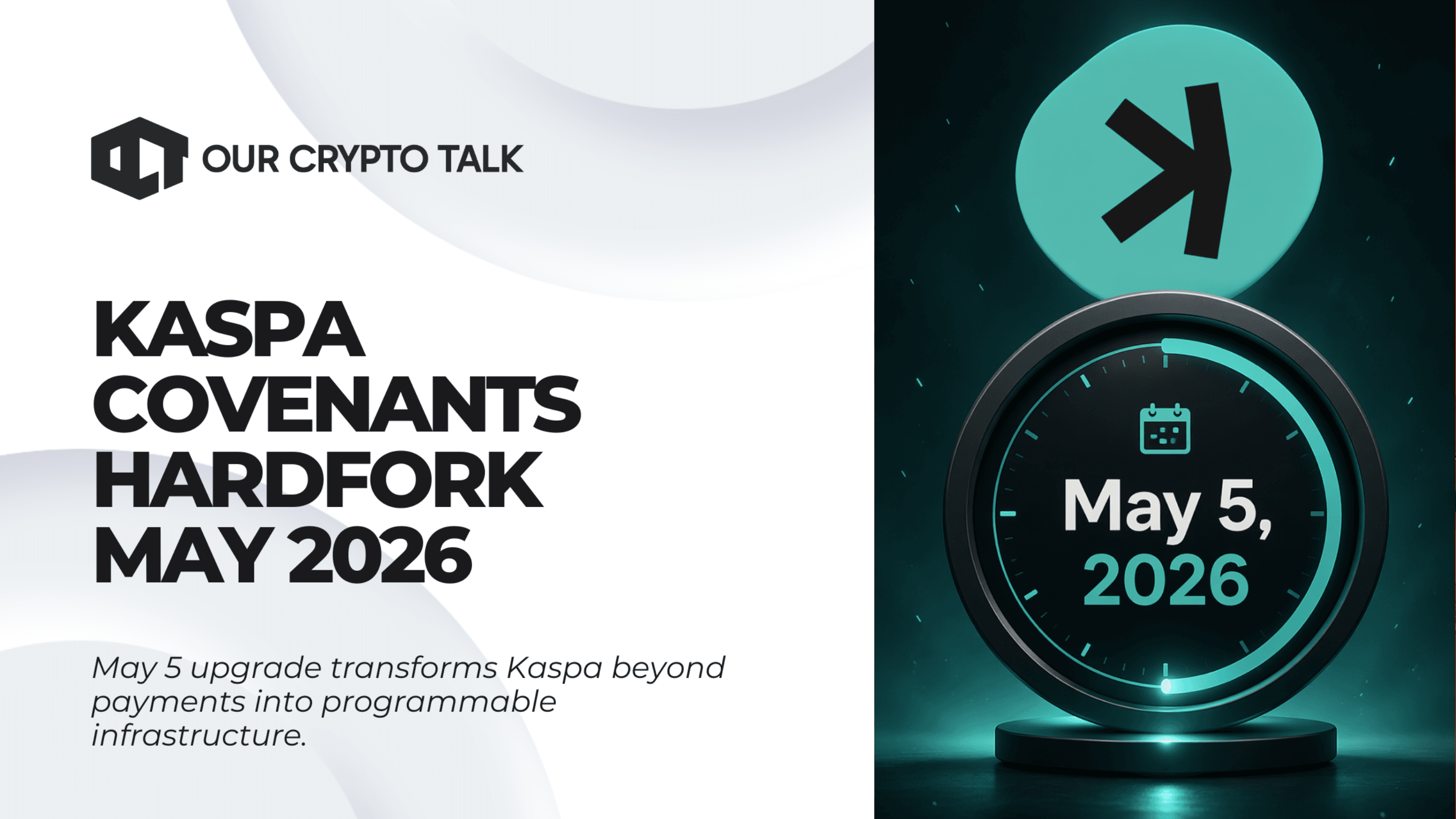
Kaspa Covenants hardfork activates May 5, 2026. Here's what native tokens, SilverScript, and ZK verification mean for KAS holders and developers.

Author: Kritika Gupta
On May 5, 2026, Kaspa activates its biggest upgrade since the Crescendo hardfork, and it changes what the network can do. The Kaspa Covenants Hardfork, arriving in May 2026, introduces three major capabilities at once: native KRC-20 tokens on Layer 1, programmable transaction rules through covenants, and zero-knowledge verification built into the base layer. This is more than a routine network update. It marks Kaspa’s shift from a fast monetary network into a programmable Proof-of-Work blockchain capable of supporting native assets, smart wallet logic, and privacy-focused verification tools.
For KAS holders, the immediate question is simple: does this affect your coins, wallet, or anything you need to do before activation? This guide breaks down exactly what each feature does, what it changes for users, builders, and node operators, and the specific steps you need to take before May 5 to stay prepared for the upgrade.
May 5, 2026 is the key date for Kaspa’s biggest network upgrade since the Crescendo hardfork. The Kaspa Covenants Hardfork is a functionality upgrade, not just a speed upgrade. While Crescendo, activated in May 2025, focused on speed by increasing block production from 1 block per second to 10 BPS, this upgrade is about functionality. Instead of simply making the network faster, the Covenant hardfork expands Kaspa’s capabilities by introducing programmable transaction logic, native token support, and zero-knowledge verification at the base layer.
That distinction matters. Crescendo improved throughput and transaction confirmation speed. The Covenant hardfork changes the scope of the network itself. It pushes Kaspa beyond a high-speed monetary layer and moves it toward becoming a programmable Proof-of-Work blockchain.
Importantly, this is not a chain split. There is no competing version of Kaspa, no new coin, and no separate network emerging from the upgrade. This is a coordinated protocol update where all nodes upgrade to the same software version and continue operating on the same chain.
The upgrade is also not untested. Testnet 12 has been running covenant and zero-knowledge verification tests since early 2026, giving developers and node operators months of validation before mainnet activation.
Key Concept: “Hardfork” sounds dramatic, but it simply means a software upgrade that all nodes adopt together. Unlike controversial Bitcoin forks such as BCH or BSV, this is a planned, community-supported upgrade with no chain split. Think of it as updating your phone’s operating system: new features, same phone.
A covenant on Kaspa is a set of programmable rules attached to a transaction output (UTXO) that controls how, when, and where those funds can be spent next. Instead of coins being freely movable with just a signature, the protocol itself enforces conditions before the transaction can proceed.
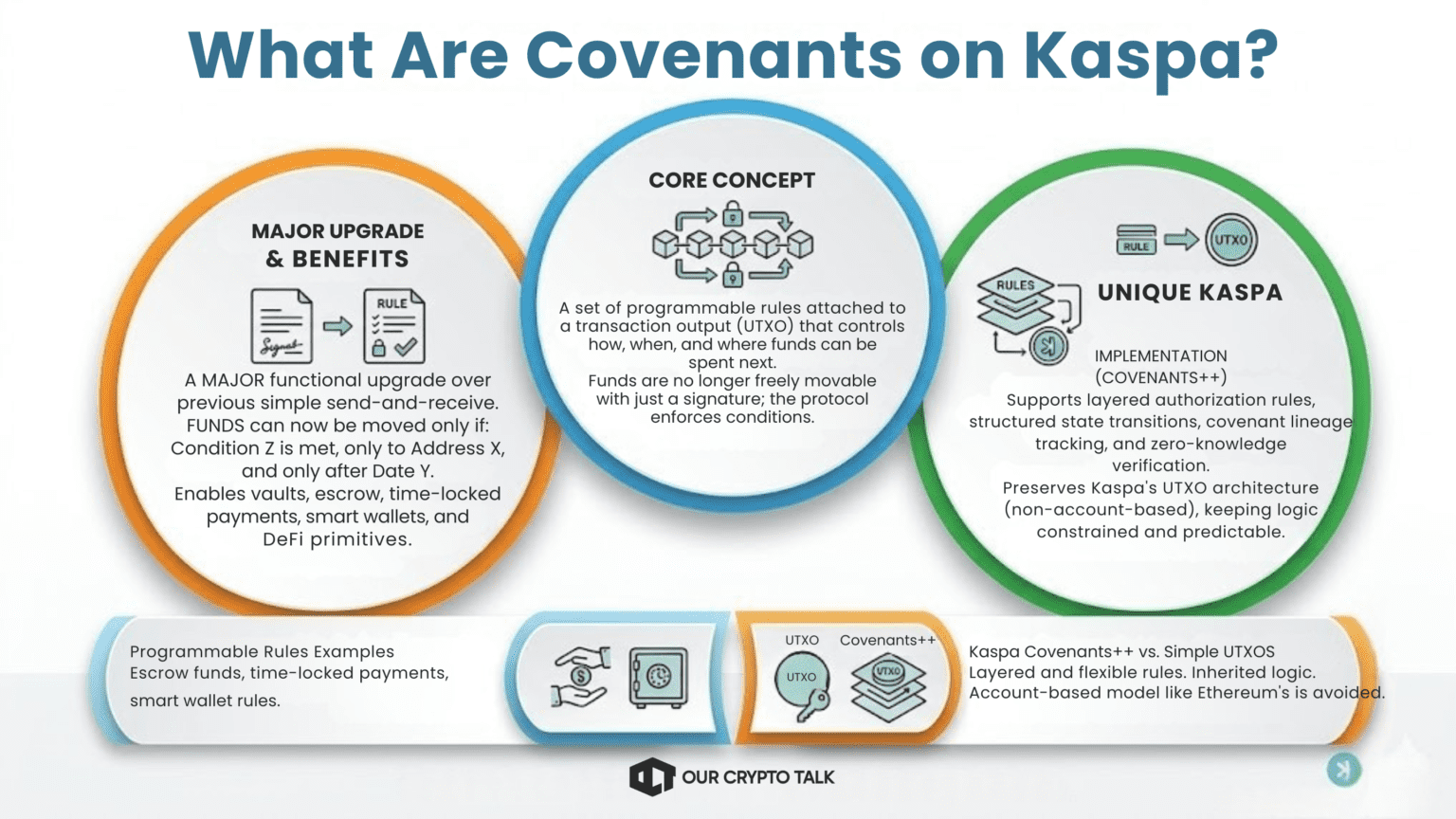
Imagine writing a cheque with built-in conditions: this money can only go to Address X, only after Date Y, and only if Condition Z is met. Covenants bake those rules directly into the transaction itself, so the blockchain enforces the logic at the consensus level rather than relying on an external smart contract system.
This is a major functional upgrade for Kaspa because, until now, the network primarily supported simple send-and-receive transactions. Funds moved from one wallet to another with standard signature checks, but the protocol itself could not impose programmable spending conditions.
With covenants, that changes. Kaspa can now support smart wallets, vaults, escrow flows, time-locked payments, conditional transfers, and other rule-based spending mechanisms. These are the core building blocks needed for more advanced on-chain applications, including early DeFi primitives.
Kaspa’s implementation, known as Covenants++, goes beyond basic covenant designs such as Bitcoin’s debated OP_CTV approach. It supports layered authorization rules, structured state transitions, covenant lineage tracking, and direct integration with zero-knowledge verification. This makes the system significantly more flexible while keeping transaction logic constrained and predictable.
Crucially, Kaspa does not move to an account-based model like Ethereum. The network preserves its UTXO architecture, which means logic remains attached to individual outputs instead of creating a shared global state. This design keeps the system more secure, easier to reason about, and less exposed to the broader attack surfaces often seen in account-based smart contract environments.
The Kaspa Covenants Hardfork introduces three major capabilities at once, each expanding what the base layer can support. Together, these features move Kaspa closer to becoming a fully programmable Proof-of-Work network.
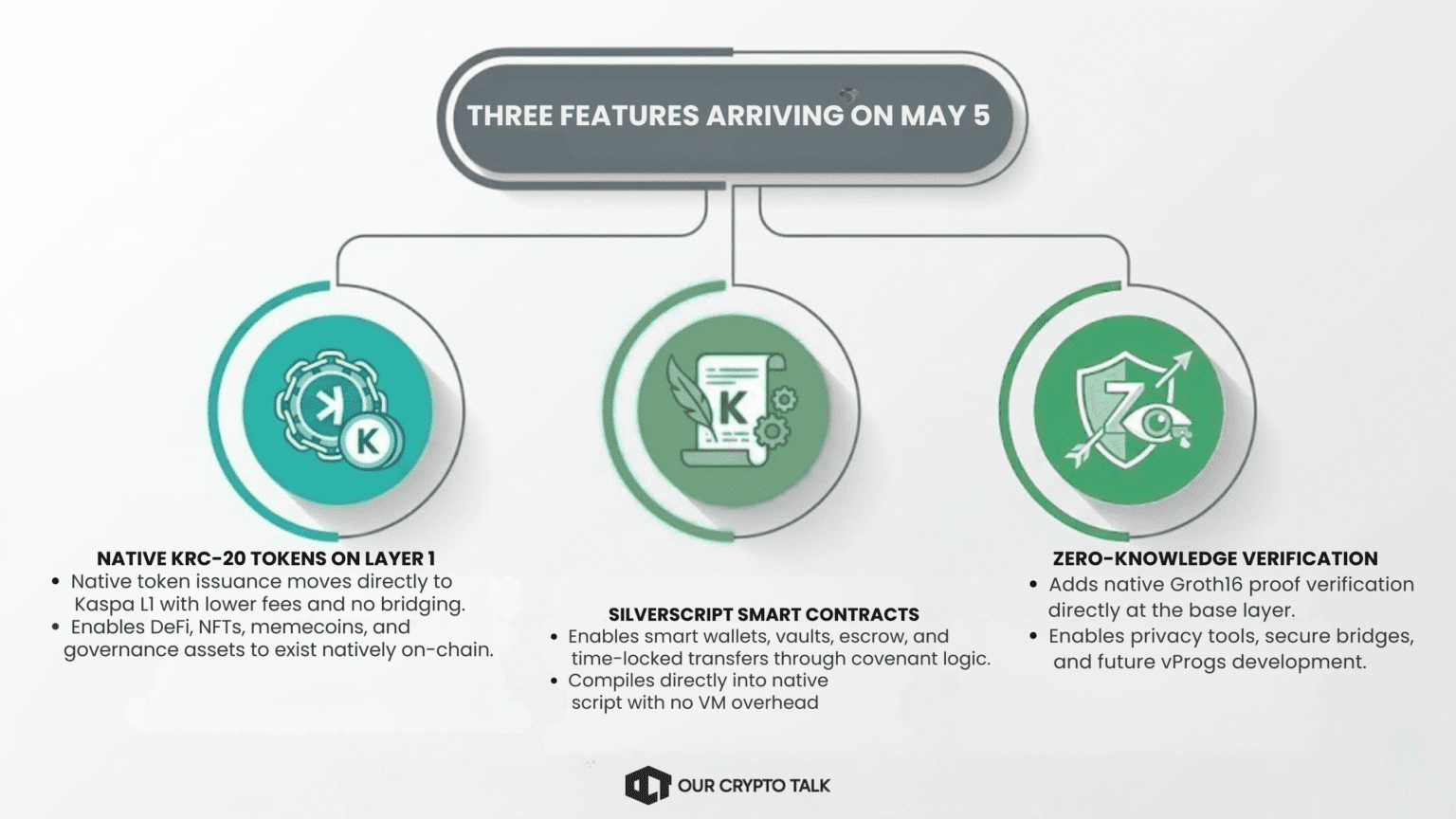
For the first time, developers will be able to issue tokens directly on Kaspa’s base layer. Until now, KRC-20 assets largely relied on inscription-style overlays and external indexers such as Kasplex to interpret token data. After the hardfork, token issuance and transfers become part of native consensus-level support.
For users, this means lower fees, no bridging, and cleaner atomic transfers. Token movements will happen directly inside Kaspa’s transaction model without wrappers, external bridges, or intermediary settlement layers. This is the infrastructure required for DeFi primitives, NFTs, memecoins, governance tokens, and lending platform assets to exist natively on Kaspa L1.
Without native tokens, an ecosystem cannot build meaningful DeFi rails or a sustainable NFT economy. Native assets are the foundational layer for everything that comes after.
The second major feature is SilverScript, Kaspa’s high-level programming language and SDK for covenant-based logic. Think of it as Kaspa’s answer to Solidity, but intentionally more constrained. The goal is not unrestricted smart contract complexity. Instead, SilverScript focuses on predictable, secure transaction logic built around the UTXO model.
Developers can use it to build smart wallets, multi-signature vaults, escrow systems, conditional transfers, time-locked payments, and lightweight DeFi primitives. A major architectural advantage is that SilverScript compiles directly into native Kaspa script, which means there is no virtual machine overhead. It has already been live on Testnet 12, giving builders time to test covenant logic before mainnet activation.
What it does not do is equally important. This is not a full Solidity-like environment. Developers cannot deploy complex state-heavy applications such as an Aave-style lending protocol directly on L1. That level of complexity remains better suited for Layer 2 solutions like Igra Network or Kaspa’s longer-term vProgs roadmap.
The third headline feature is Groth16 zero-knowledge proof verification at the base layer. This allows applications to verify information on-chain without revealing the underlying data. In practical terms, this enables privacy-focused applications, secure verification systems, trust-minimized cross-chain bridges, and verifiable off-chain computation.
This is especially notable because native ZK verification on a Proof-of-Work Layer 1 is rare. Most zero-knowledge infrastructure today exists on PoS ecosystems or Layer 2 rollups. Kaspa is bringing this capability directly to L1. It also lays the technical groundwork for Kaspa’s long-term verifiable programs (vProgs) vision, which remains a future roadmap item rather than an immediate release feature.
Hardfork feature summary at a glance
For most holders, the Kaspa Covenants Hardfork is straightforward. Your KAS stays on the same chain and at the same address. The key is knowing whether you need to update software or simply wait for service providers to handle it.
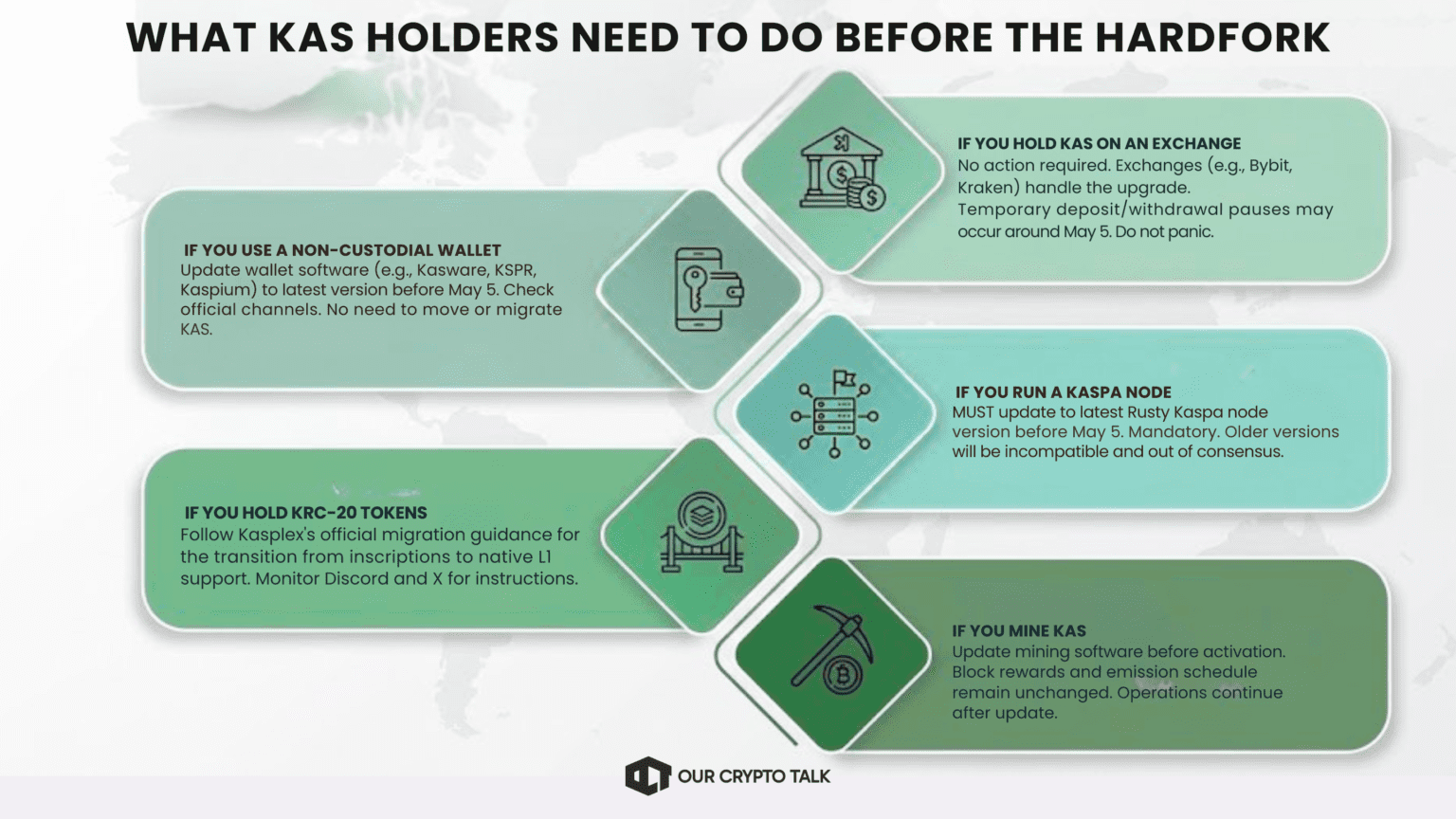
SCAM WARNING: If anyone tells you to “migrate,” “swap,” or “transfer” your KAS tokens to a new address for the hardfork, it is a scam. Hardforks upgrade the network protocol. Your existing KAS remains on the same chain at the same address. No token swap, migration, or deposit is ever required. Kaspa developers will never DM you asking for funds.
The Kaspa Covenants Hardfork changes how Kaspa sits in the Layer 1 landscape.The upgrade expands Kaspa’s functionality while keeping its design philosophy distinct.
Against Bitcoin, the contrast is especially clear. Bitcoin’s ecosystem is still actively debating covenant proposals such as OP_CTV, with programmability remaining limited and highly conservative. Kaspa, by contrast, is shipping Covenants++, native token support, and base-layer ZK verification. Both networks use Proof of Work, but Kaspa now offers a level of constrained programmability that Bitcoin does not currently support.
Against Ethereum, the comparison is different. Ethereum already has a deeply established smart contract ecosystem with mature tooling, liquidity, and developer mindshare. Kaspa is not trying to replicate that model. Its covenant framework is intentionally more constrained, more predictable, and narrower in scope. That design reduces attack surfaces and keeps logic closer to the UTXO model, but it also means less flexibility for complex applications.
Against Solana, the comparison comes down to architecture and tradeoffs. Solana offers high throughput with full smart contract programmability on a PoS chain. Kaspa now offers high throughput with constrained programmability on a PoW chain. The speed narrative overlaps, but the underlying security and execution models remain fundamentally different.
The honest risk is developer adoption. Shipping features is only the first step. The real test is whether builders actually deploy wallets, DeFi primitives, and applications using SilverScript and native KRC-20 rails. While the new tooling lowers the barrier, Kaspa’s developer ecosystem is still far smaller than Ethereum’s or Solana’s, which remains the biggest execution risk after the hardfork.
Post-hardfork competitive comparison across major Layer 1s
The roadmap after May 5 is where the Kaspa Covenants Hardfork moves from a protocol upgrade into an ecosystem test. The immediate priority in May 2026 is network stabilization. Node operators, miners, and exchanges will spend the first few days confirming successful synchronization, monitoring block production, and restoring normal deposit and withdrawal services. This phase is critical because early stability will shape market confidence around the upgrade.
The next major milestone is expected between May and June 2026, when the first SilverScript-powered applicationsbegin going live. Developers already building on Testnet 12 are likely to launch early products such as smart wallets, escrow flows, and vault-based transfer systems. During the same window, the KRC-20 migration from inscription-style overlays to native Layer 1 support should begin under Kasplex coordination.
Further out in 2026, Kaspa’s throughput roadmap remains a major focus. The planned move toward 25 BPS represents the next step in scaling network capacity beyond the current 10 BPS.
Longer term, DAGKnight and vProgs remain the two most important roadmap items. DAGKnight targets faster finality and improved consensus performance, while vProgs represents Kaspa’s research path toward advanced verifiable computation on Layer 1.
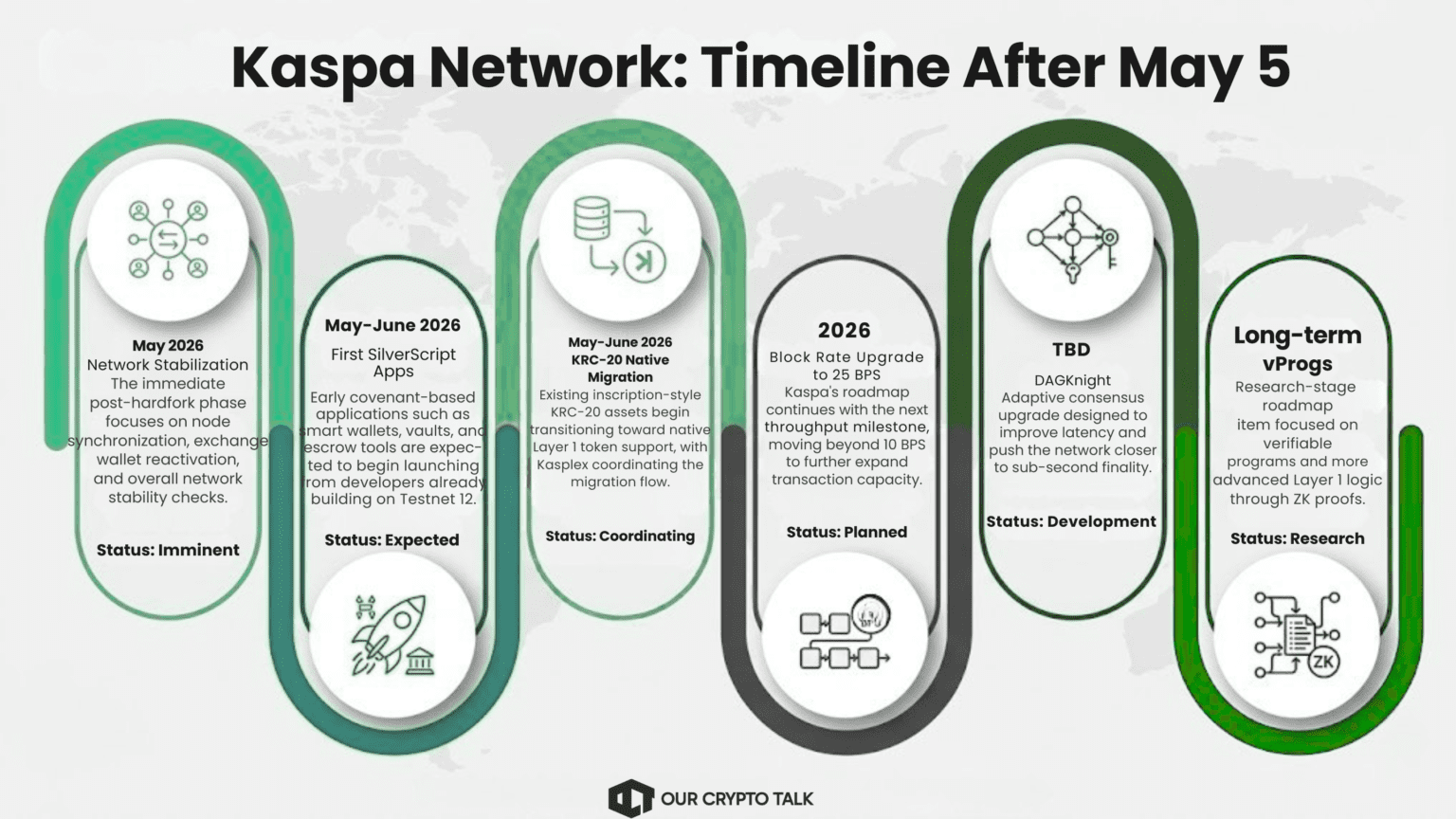
Post-hardfork roadmap at a glance
The Kaspa Covenants Hardfork transforms Kaspa from a fast payment-focused PoW chain into a programmable Layer 1 with native tokens, covenant logic, and zero-knowledge verification. Holders mainly need to update wallets or nodes where required and ignore scam migration messages. What comes next will be the real test: first SilverScript apps, KRC-20 migration, and future throughput upgrades.


AI Needs Cheap Inference. Can Orbio Deliver?
Web3 Gaming Comeback 2026: GTA 6 Hype vs 99% Crashes
Layer 2 Projects Shutting Down: Who’s Next After Blast?
Embodied Data Pyramid and Decentralized Data Layer for Robotics
AI Needs Cheap Inference. Can Orbio Deliver?
Web3 Gaming Comeback 2026: GTA 6 Hype vs 99% Crashes
Layer 2 Projects Shutting Down: Who’s Next After Blast?
Embodied Data Pyramid and Decentralized Data Layer for Robotics