
Learn how the Bitcoin 21 million supply cap creates scarcity, why it matters for inflation, and what it means for Bitcoin’s long-term value.

Author: Arushi Garg
Almost every form of money in history shares the same flaw, governments can create it at will. They print more of it, and central banks expand supply during crises. Over time, purchasing power erodes. The US dollar has lost over 96% of its value since 1913. The pattern repeats across countries and decades, Turkish lira, Argentine peso, Venezuelan bolívar. The Bitcoin 21 million supply cap exists to break this cycle.
Bitcoin operates differently from traditional money. It enforces a fixed supply, making scarcity the core feature rather than a side effect. No authority can create more coins at will.
The system imposes a hard limit of 21 million coins. This article explains why the network sets that cap, why it totals exactly 21 million, how the protocol enforces it, whether it can ever change, and what it means in practice.
Bitcoin begins with a simple idea: money should not be infinitely expandable. When supply can be increased without constraint, value tends to leak over time. Inflation is not an accident in fiat systems. It is a design choice. Central banks target it deliberately, often around 2% per year. That flexibility helps manage recessions, fund stimulus, and stabilize economies. It also guarantees long-term dilution.
Bitcoin rejects that tradeoff. Satoshi Nakamoto designed a system with a fixed supply from day one, not guided by policy or committees, but hardcoded into the protocol and enforced by the network itself, resulting in absolute scarcity.
There will never be more than 21 million Bitcoin. Not approximately. Not “around that number.” Every node on the network enforces this exact limit. Scarcity isn’t a limitation, it’s the point. Bitcoin behaves more like a finite resource than a printable currency. Before you explore the math or code, Bitcoin solves the problem of money that people can create endlessly.
The number 21 million often sounds arbitrary. It isn’t. It emerges from Bitcoin’s issuance design.
Three parameters define the total supply:
Every 210,000 blocks, the reward miners receive is cut in half. This creates a geometric series:
Total supply is calculated as:
Total BTC = 210,000 × (50 + 25 + 12.5 + 6.25 + …)
This infinite series converges neatly:
In practice, Bitcoin cannot divide infinitely. The smallest unit is 1 satoshi (0.00000001 BTC). Because of this rounding, the actual total is: 20,999,999.9769 BTC
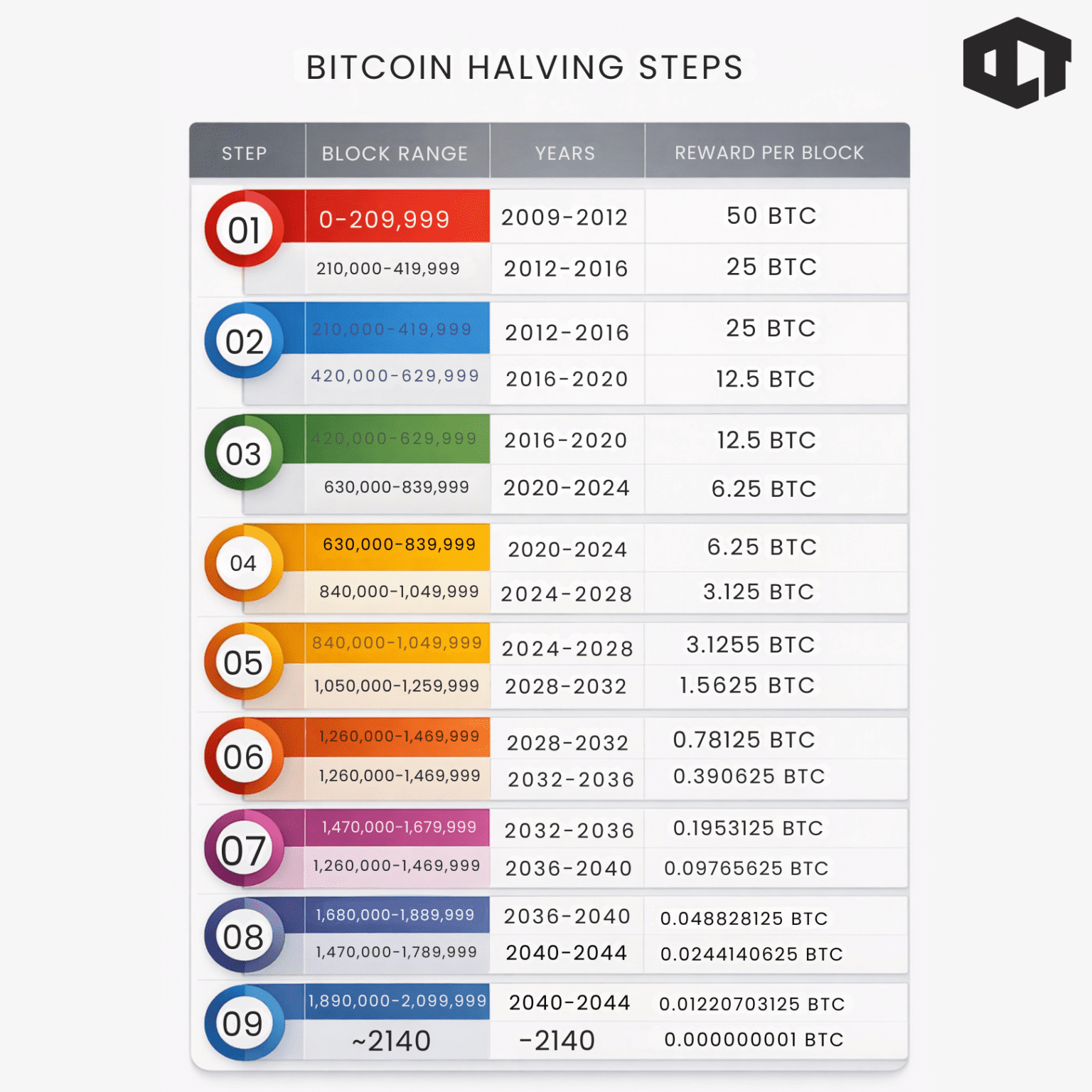
Satoshi didn’t choose 21 million and then justify it with math. He designed the issuance structure first, and it produces exactly 21 million coins. To see the full timeline of halvings and when new supply stops, check out our detailed “How Long Until All Bitcoin Is Mined?” article.
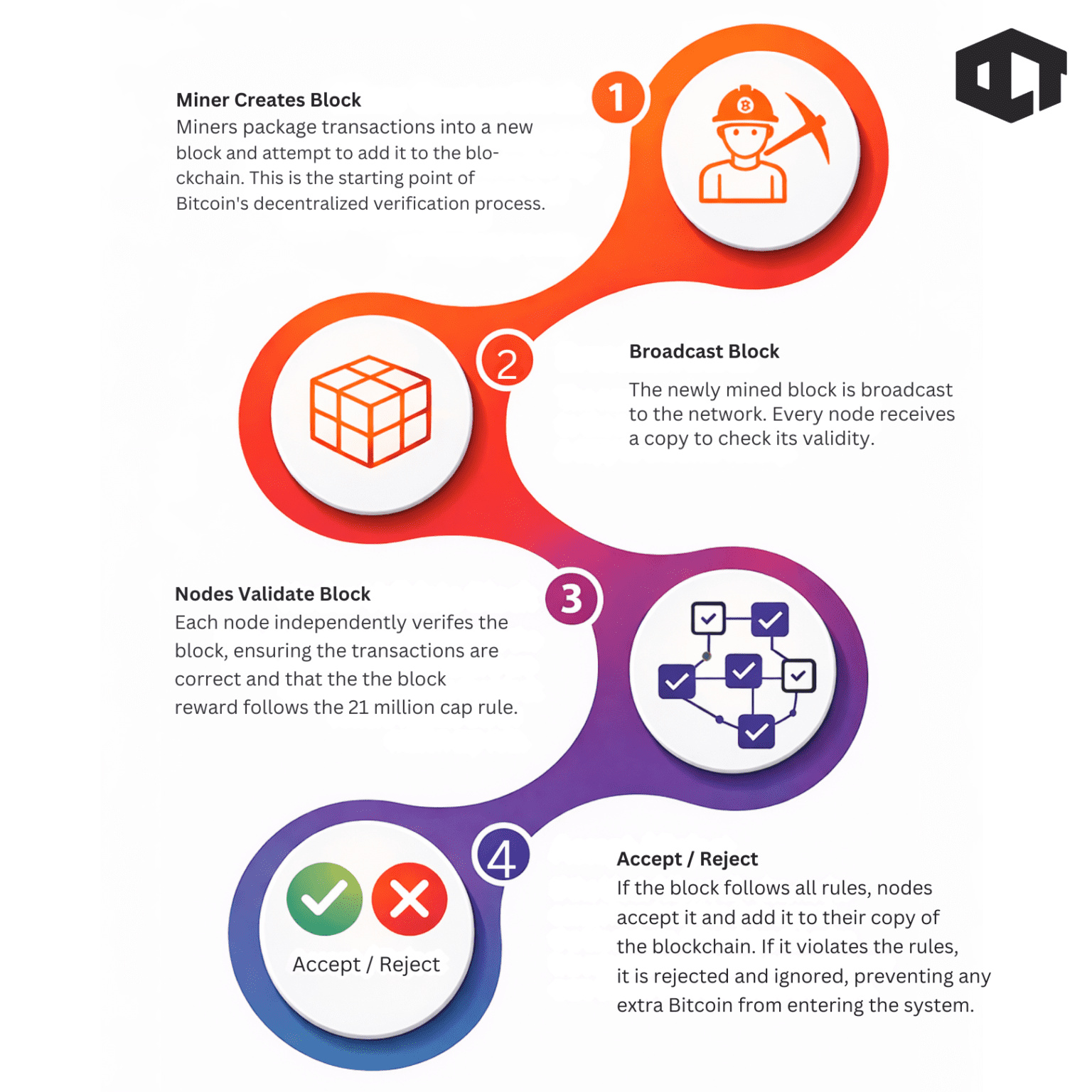
Bitcoin’s supply cap is not enforced by a company, government, or foundation. It is enforced by the network itself. Every Bitcoin node independently verifies every block and every transaction. There are thousands of these nodes running globally. Each one checks the rules.
One of those rules is the block reward. If a miner tries to create a block with more Bitcoin than allowed, every honest node rejects it. The block is invalid. The miner earns nothing. The energy spent is wasted. There is no central authority to override this.
To change the rule, you would need most of the network to agree to run different software. That includes node operators, miners, exchanges, and users. An easy way to think about it: Imagine a system where every participant enforces the law themselves. No central police. No court. Every individual checks every transaction. If something breaks the rules, it is ignored. That is how Bitcoin enforces its supply cap. Through consensus, not trust.
This is the most misunderstood part of Bitcoin. The correct answer has two layers.
Technically: yes.
Practically: no.
Bitcoin is open-source software. Anyone can copy the code, modify it, and propose a new version. That includes changing the supply cap. This change creates a hard fork. If enough people adopt that new version, it becomes a new chain.
In practice, changing the supply cap is extremely unlikely. Incentives strongly discourage this outcome.
Every Bitcoin holder benefits from scarcity. Increasing supply would dilute existing holdings. There is no reason for holders to support a change that makes their assets less scarce.
The network pays miners in Bitcoin. If supply increases, the value of their rewards is likely to decrease. Mining a chain that weakens the asset makes little sense economically.
Even if someone proposes a fork, nodes must choose to run it. The original chain continues to exist. If most nodes reject the change, the fork does not replace Bitcoin. It becomes an alternative version.
This has already happened.
Both forked from Bitcoin with different rules. Neither replaced the original chain. The market chose to stick with Bitcoin’s existing properties.
The 21 million cap is not just a technical parameter. It is a defining property of Bitcoin. Changing it would alter what Bitcoin is. A fork that increases supply may exist. But it would be treated as a different asset, not Bitcoin itself.
Anyone can create a version of Bitcoin with a different supply. Nobody can force the network to adopt it. The supply cap is protected by code, incentives, and collective agreement.
Gold has served as a scarcity standard for thousands of years. But its supply isn’t fixed because new deposits keep emerging. Mining continues. Future technologies could increase supply further. Fiat currencies are explicitly flexible. That flexibility enables economic management but guarantees dilution over time.
Bitcoin is different. Its supply is perfectly predictable. You can calculate how many coins will exist at any point in the future. That level of certainty does not exist in any other asset. This rigidity is both a strength and a limitation. It removes flexibility, but it creates absolute scarcity.
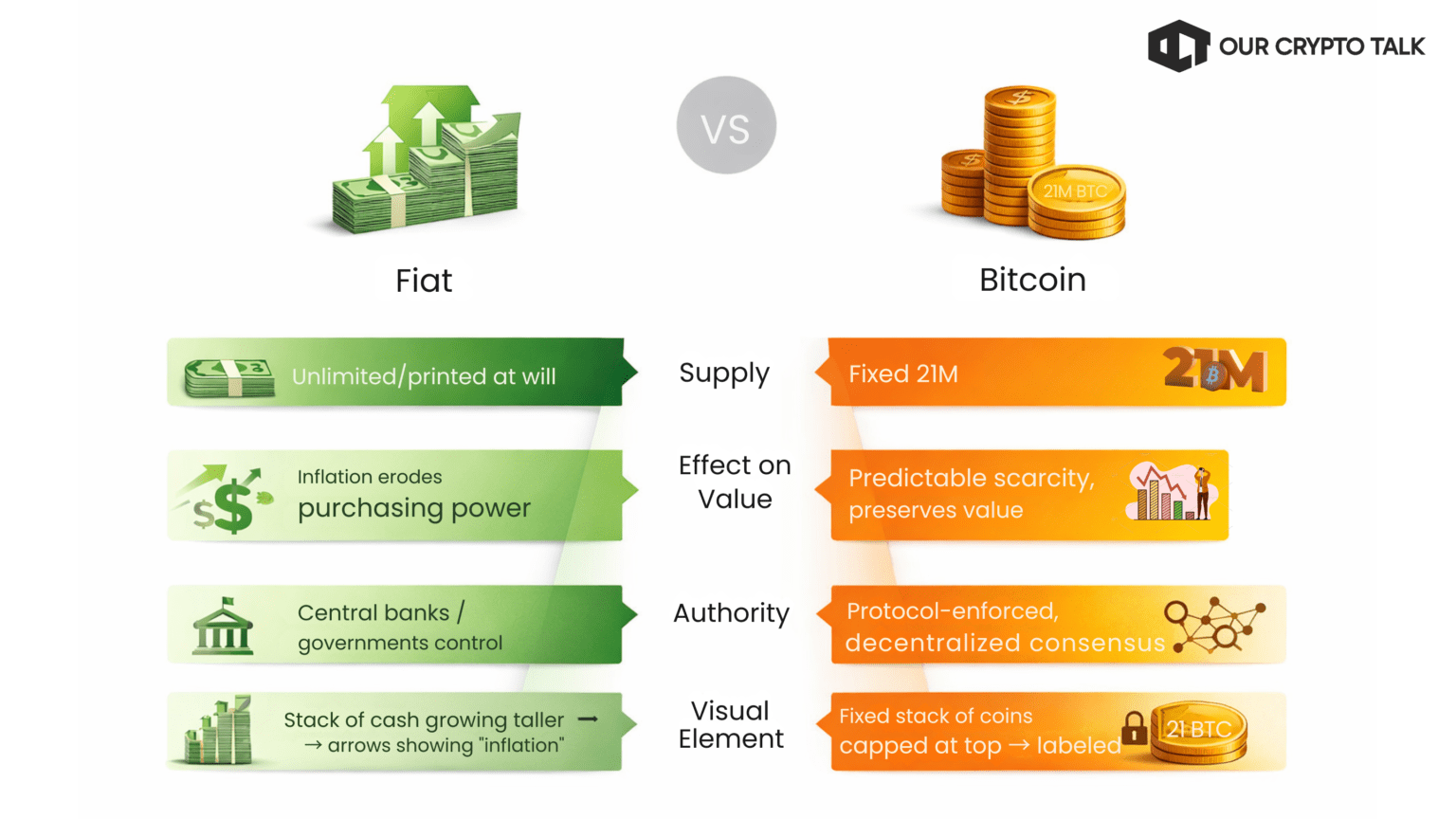
The supply cap is not just a technical detail. It shapes how Bitcoin behaves as an asset.
Everyone knows Bitcoin’s supply schedule, and only demand changes, making it fundamentally different from assets whose supply can respond to price.
Every ~4 years, Bitcoin cuts new supply in half, tightening the flow of coins entering the market.
Users have permanently lost an estimated 2.3–3.7 million BTC through forgotten keys, destroyed hardware, and early wallets, reducing the effective supply to around 17 million instead of 21 million.
As of March 2026, miners have mined around 20 million Bitcoin, and about 1 million coins remain, representing less than 5% of the total supply.
Around the year 2140, Bitcoin will stop issuing new coins, and miners will earn only transaction fees while the network continues operating without new supply.
Frameworks like stock-to-flow quantify scarcity and link it to price, helping us understand supply dynamics, but they cannot predict price because supply stays fixed while price changes.
Bitcoin’s supply cap is not just a feature. It is the foundation of the system. Everything else builds on it. The halving cycles. The issuance schedule. The idea of digital scarcity. It answers a simple question:
What if money could not be created endlessly?
Bitcoin’s answer is 21 million.
Bitcoin’s supply cap, halving schedule, and consensus enforcement are verifiable protocol facts. The comparison to gold and fiat is analytical, not a recommendation. Investment implications are the author’s assessment and do not constitute financial advice. Always do your own research.


Web3 Gaming Comeback 2026: GTA 6 Hype vs 99% Crashes
Layer 2 Projects Shutting Down: Who’s Next After Blast?
Embodied Data Pyramid and Decentralized Data Layer for Robotics
DeFi Needs Better Liquidity. Can Ramses Deliver?
Web3 Gaming Comeback 2026: GTA 6 Hype vs 99% Crashes
Layer 2 Projects Shutting Down: Who’s Next After Blast?
Embodied Data Pyramid and Decentralized Data Layer for Robotics
DeFi Needs Better Liquidity. Can Ramses Deliver?