Learn why the last Bitcoin won’t be mined until 2140 and how halving affects Bitcoin mining supply and scarcity.

Author: Arushi Garg
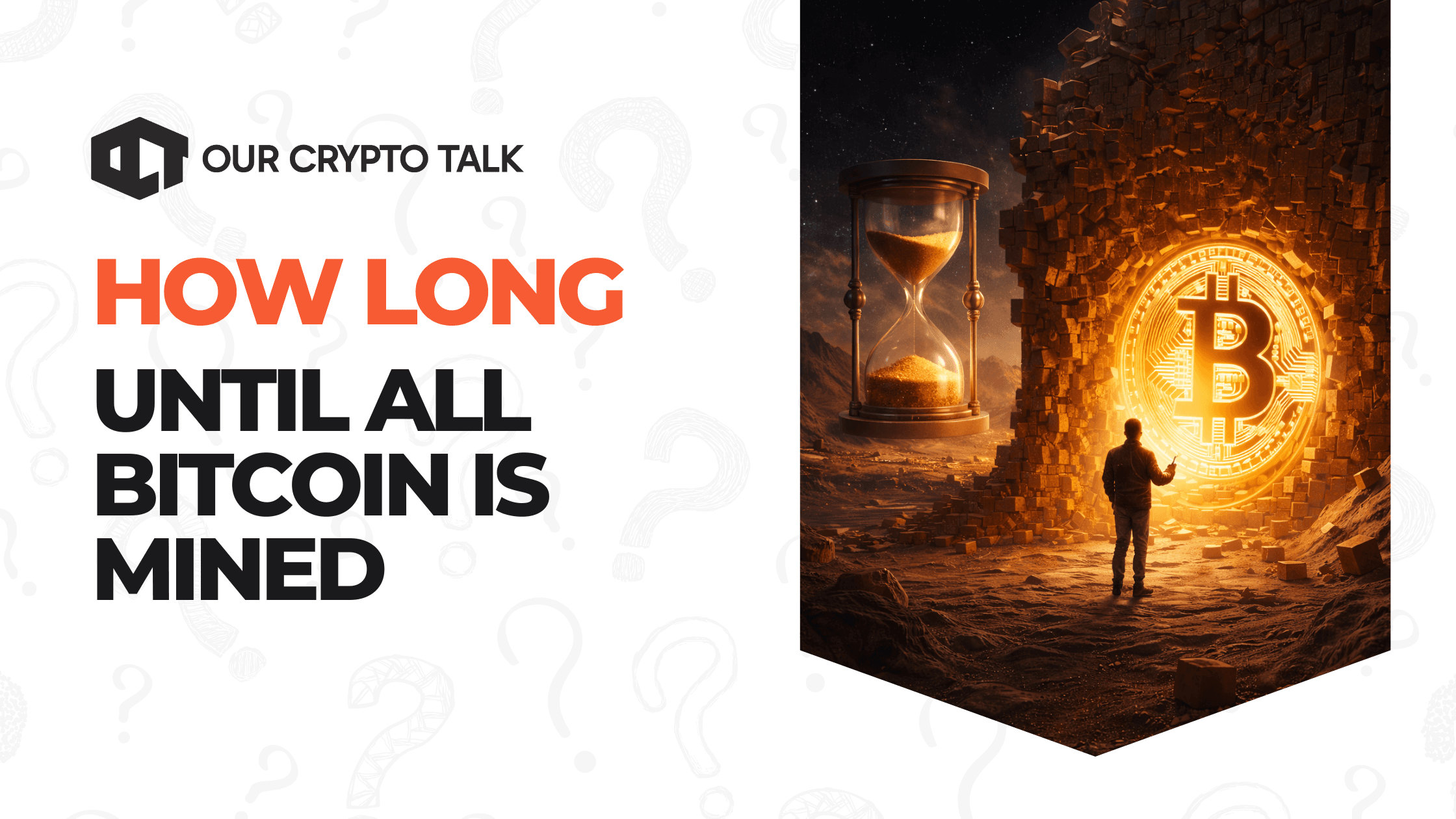
Miners are projected to mine the last Bitcoin around the year 2140, roughly 114 years from now. Here’s what many people miss: Miners have already mined about 95% of all Bitcoin. Producing the remaining ~5% will take more than a century. Why does the final fraction take so long when miners produced most coins in the early years?
One mechanism explains it: the halving.
Bitcoin doesn’t release new coins at a steady, linear rate. Instead, it follows a strict schedule where the mining reward is cut in half approximately every four years. The first block reward in 2009 was 50 BTC per block. By the 2012 halving, it dropped to 25 BTC, then 12.5 BTC in 2016, 6.25 BTC in 2020, and 3.125 BTC in 2024. The next halving, projected for 2028, will reduce the reward to 1.5625 BTC per block. This pattern continues indefinitely, cutting rewards in half again and again.
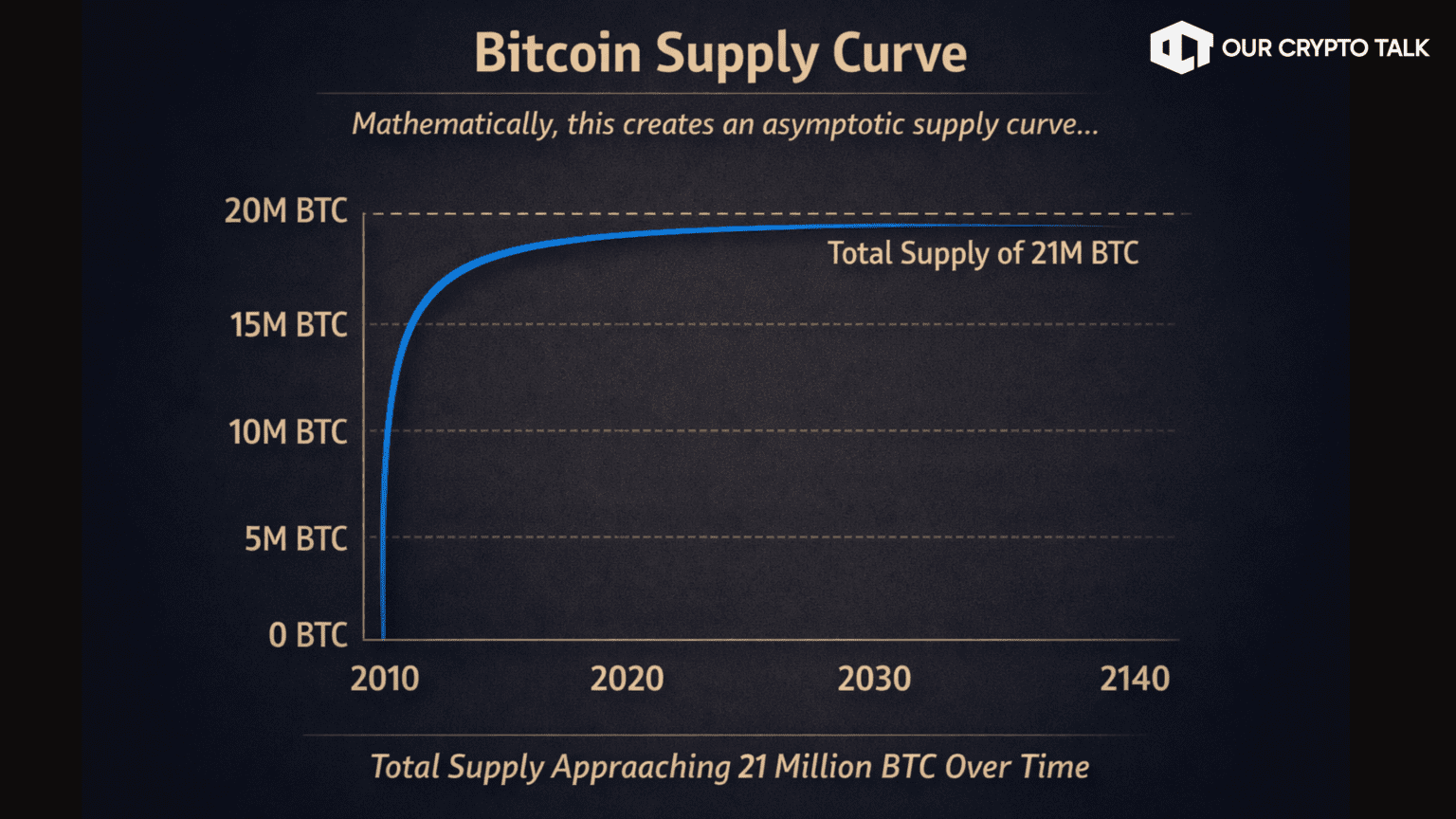
Each “era” lasts about 210,000 blocks, which takes roughly four years. But here’s the key: each era produces exactly half as much Bitcoin as the one before it. This is why the final coins take so long to mine. Think of it like this: imagine a pizza. You eat half, then half of what’s left, then half again. Then keep going, but the slices get smaller and smaller. You never finish the last crumbs. That’s how Bitcoin works.
Mathematically, this creates an asymptotic supply curve. The total supply approaches 21 million BTC but never overshoots it. The closer you get to the maximum, the slower new Bitcoin enters circulation. This slowdown is by design. Bitcoin’s creator, Satoshi Nakamoto, engineered the system so that supply would be predictable, transparent, and fixed in advance. No central authority can change it, and there’s no possibility of sudden inflation.
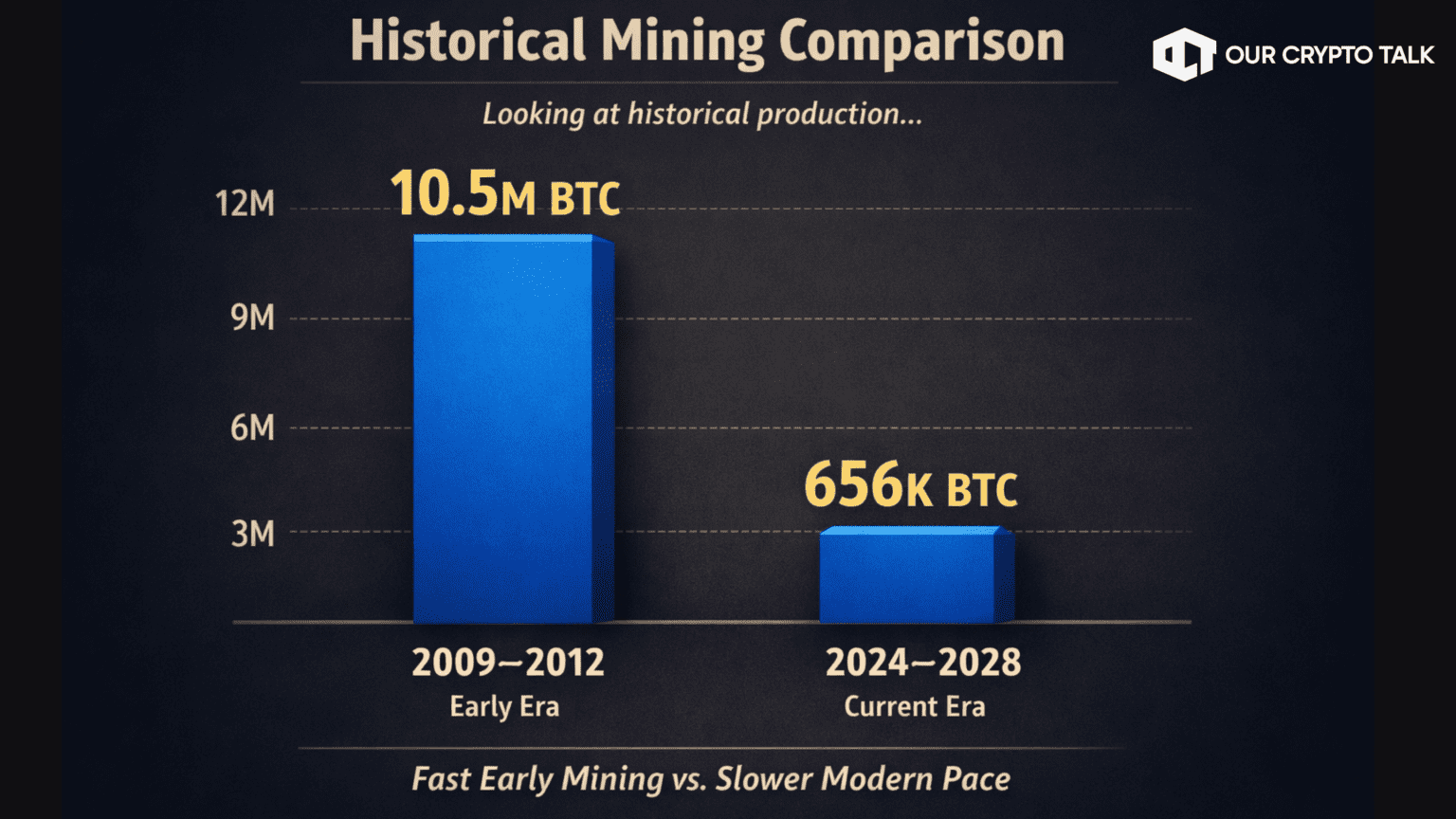
Looking at historical production, the first era (2009–2012) generated 10.5 million BTC, half of all Bitcoin in just four years. The current era (2024–2028) will produce only about 656,000 BTC in the same span. By the 2040s, entire four-year periods will yield fewer coins than a single day’s output in 2010. At some point in the early 2100s, the last whole Bitcoin will be mined. After that, only tiny fractions, or satoshis, remain. That’s why the mining clock stretches all the way to 2140. Time remains constant; supply slows.
The 2140 timeline assumes that miners can access every Bitcoin ever mined. In reality, this is not the case. Miners have already lost a significant portion of the supply. These coins remain on the blockchain but are effectively unreachable. Estimates put the lost supply at 2.3–3.7 million BTC, according to Chainalysis or roughly 10–18% of all Bitcoin.
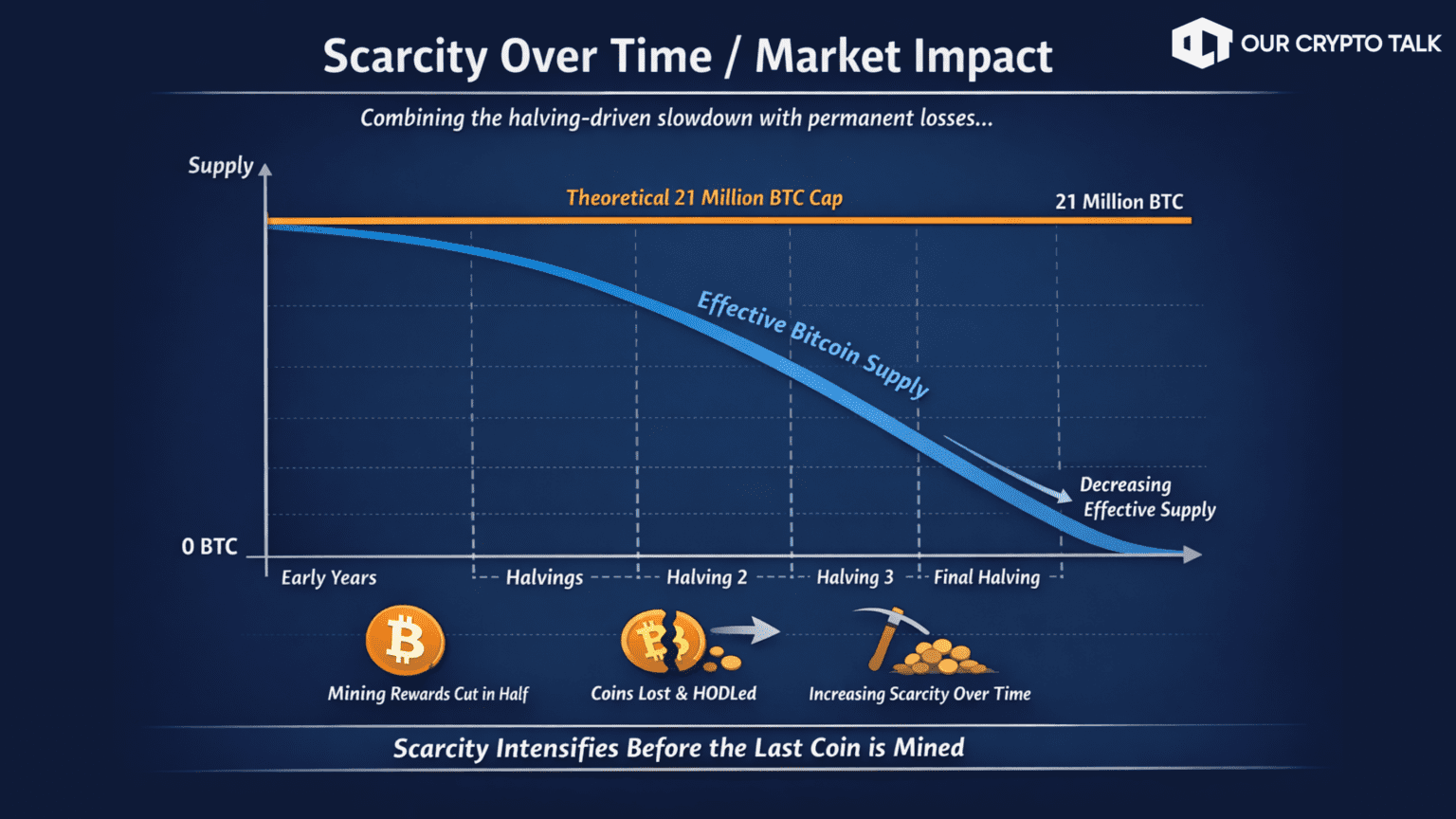
A famous case is James Howells, who accidentally threw away a hard drive containing thousands of BTC. Those coins remain buried in a landfill, unrecoverable. While lost coins don’t reduce Bitcoin’s protocol supply cap of 21 million, they do reduce the amount of Bitcoin that can circulate. In other words, while the protocol says 21 million, the market effectively operates on a much smaller supply.
This situation drives Bitcoin’s scarcity. The circulating supply falls short of the headline number, making each remaining coin more valuable, while future mining adds less to the total supply. As miners produce the final ~1 million BTC over the next century, they work within a system where millions of coins are already lost. Scarcity is already present, and it continues to increase over time.
This reality also reframes the timeline. The combination of halving-driven slowdown and permanent losses makes Bitcoin progressively harder to acquire long before miners reach the last coin. Many analysts argue that real Bitcoin scarcity comes not just from the 21 million cap, but from the interaction of fixed supply and irreversible losses.
(We will explore this further in our guide on how many Bitcoin are lost forever.)
As block rewards shrink, miners earn progressively less from new coins. This is not a flaw. It is a deliberate design. Bitcoin’s protocol gradually shifts miner incentives from collecting new coins to earning transaction fees.
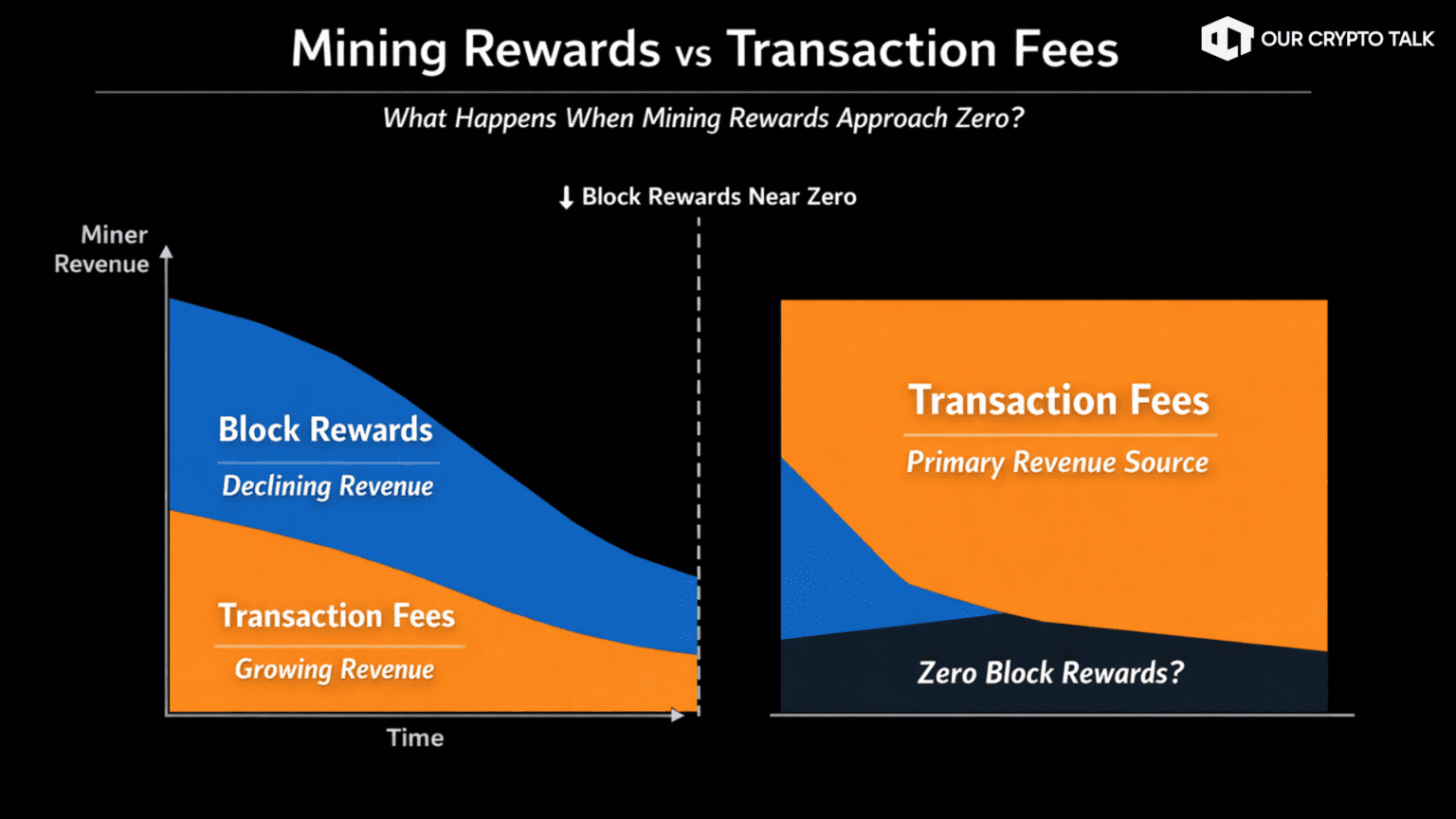
In other words, the network moves from a subsidy-based model, funded primarily by freshly mined Bitcoin, to a fee-based model, funded by the payments users include to prioritize transactions. This change happens slowly, with each halving reducing rewards and nudging miners toward fees.
When block rewards become negligible, transaction fees will provide most of the miners’ revenue. Miners remain economically motivated to validate transactions and protect the blockchain, keeping the network secure.
This gradual shift secures and stabilizes the network as block rewards decline. Miners adjust by earning more from transaction fees. To explore how they adapt and the economics behind this transition, read our full guide on what happens when all 21 million Bitcoin are mined.
The year 2140 is more than just a calendar milestone. It represents Bitcoin’s engineered monetary policy. What truly matters is the mechanism behind the timeline. Bitcoin is the first monetary system where supply is fully predictable, issuance declines systematically over time, and no authority can arbitrarily change the rules. The halving schedule acts as Bitcoin’s built-in monetary policy, replacing human discretion with code.
Understanding this mechanism changes your perspective on Bitcoin. It goes beyond a digital asset or speculative investment. Satoshi designed it as a system with controlled scarcity, where every participant sees exactly how much new supply enters the market and when. This predictability forms the foundation of Bitcoin’s long-term value.
Bitcoin’s halving schedule and supply cap are verifiable protocol facts. This article explains Bitcoin’s monetary design, not its future price. This is educational content, not financial advice.


Tokenization of RWA yields onchain might be the biggest opportunity that no one has noticed
Cold Wallet Safety 2026: Are Hardware Wallets Still Safe?
One Token, Multiple Products. Can Zylo Deliver?
The Rise of NEAR Protocol 2026: Inside the 530% Rally and the ETF
Tokenization of RWA yields onchain might be the biggest opportunity that no one has noticed
Cold Wallet Safety 2026: Are Hardware Wallets Still Safe?
One Token, Multiple Products. Can Zylo Deliver?
The Rise of NEAR Protocol 2026: Inside the 530% Rally and the ETF