Learn how Arcium powers confidential computing on Solana, enabling private AI, encrypted DeFi, and secure data processing.

Author: Akshat Thakur
Arcium is building a parallelized confidential computing network, often described as an “encrypted supercomputer,” that enables applications to process encrypted data without exposing the underlying information. The network combines Multi-Party Computation (MPC), Fully Homomorphic Encryption (FHE), and Zero-Knowledge Proofs (ZKPs) to deliver trustless, verifiable, and scalable confidential computation, with native integration across Solana and other ecosystems.
The project’s core thesis addresses one of blockchain’s biggest limitations. Most decentralized networks force users to choose between transparency and privacy. Public chains expose all activity, while existing privacy solutions are often slow, expensive, centralized, or difficult to compose with other applications.
Arcium aims to make confidential computation a default infrastructure primitive. Developers can build private DeFi applications, confidential order books, dark pools, private AI training systems, secure data marketplaces, and confidential token standards without sacrificing performance or verifiability.
The timing also appears favorable. Confidential computing has matured significantly over the past few years. MPC systems now support production workloads, FHE performance continues to improve, and hybrid cryptographic systems have become commercially viable. At the same time, AI applications increasingly require secure data collaboration, while DeFi continues to struggle with MEV, front-running, and data leakage.
Most competitors focus on a single cryptographic approach. Arcium instead combines multiple technologies into a unified execution layer. As demand for private computation expands across both finance and AI, the project is positioning itself at the intersection of two of crypto’s fastest-growing sectors.
The confidential computing market remains fragmented. Several projects dominate specific niches, but no clear leader has emerged across general-purpose confidential computation.
Privacy-focused blockchain projects primarily offer shielded transactions or private asset transfers. While effective for payments, these systems struggle with complex shared computation. Fully Homomorphic Encryption providers such as Zama deliver strong confidentiality guarantees but still face performance limitations for large-scale applications. Enterprise confidential computing providers serve institutional clients but remain centralized and permissioned.
MPC-focused projects face their own challenges. Many remain research-oriented or lack the throughput needed for modern decentralized applications. As a result, developers often sacrifice either privacy, scalability, or composability.
Arcium’s key differentiator is its Multiparty computation eXecution Environment, or MXE. This architecture combines MPC, FHE, and Zero-Knowledge Proofs into a single confidential execution framework. Instead of relying on one cryptographic primitive, the network uses each technology where it performs best.
The platform also introduces parallelized execution. Confidential computations can run simultaneously rather than sequentially, significantly improving throughput for high-performance environments such as Solana.
From an OCT perspective, the moat appears credible. Pure ZK systems excel at proving statements but struggle with persistent shared private state. Pure FHE remains computationally expensive. Centralized confidential computing lacks trustless guarantees. Arcium attempts to bridge these limitations through a hybrid architecture.
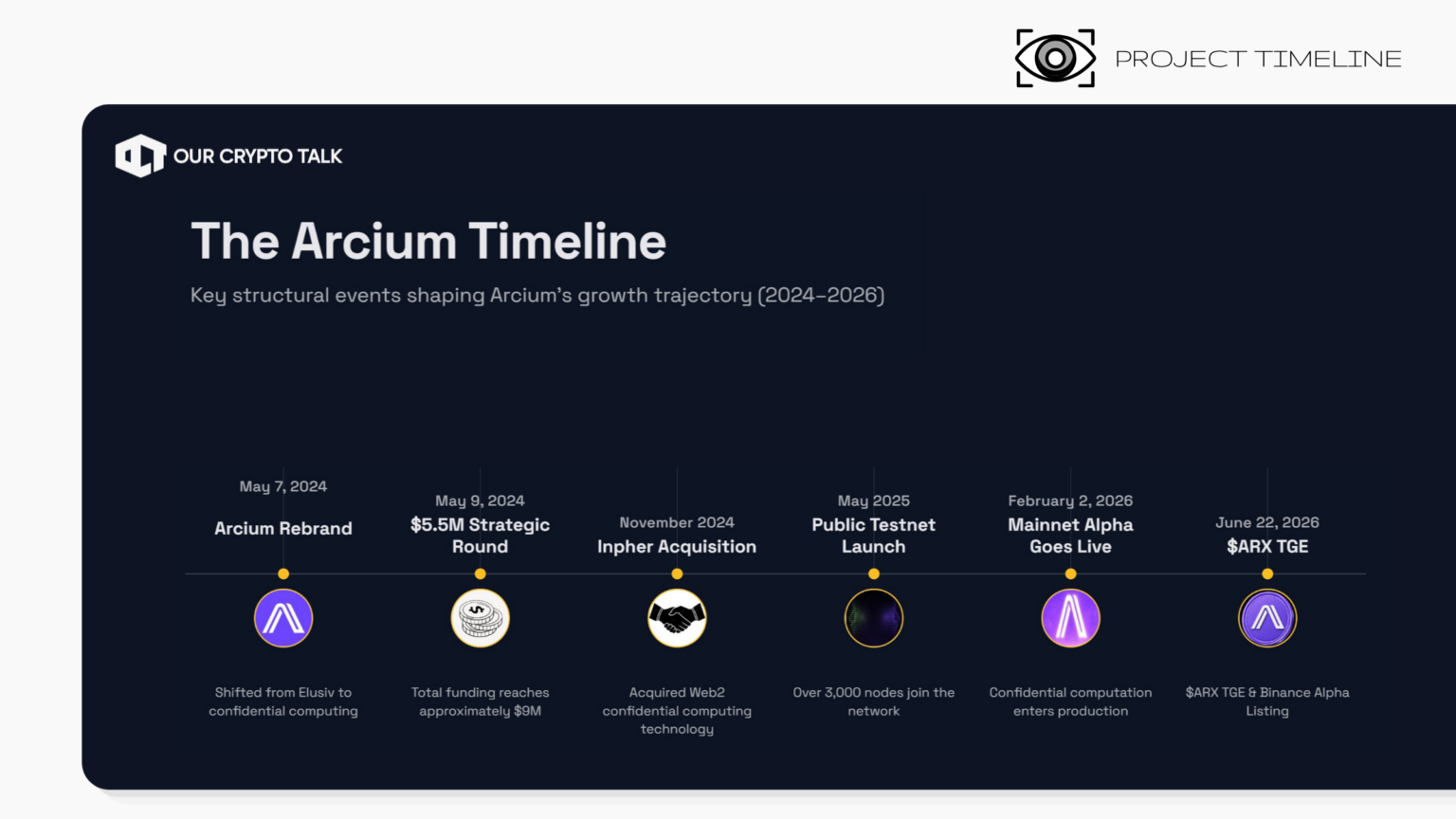
The acquisition of Inpher’s technology and team further strengthens the thesis, giving Arcium access to years of enterprise-grade MPC research and development that most crypto-native teams cannot easily replicate.
Arcium was founded by the team behind Elusiv, one of Solana’s earliest privacy infrastructure projects. Rather than continuing to focus solely on transaction privacy, the founders chose to pursue a broader opportunity centered on general-purpose confidential computation.
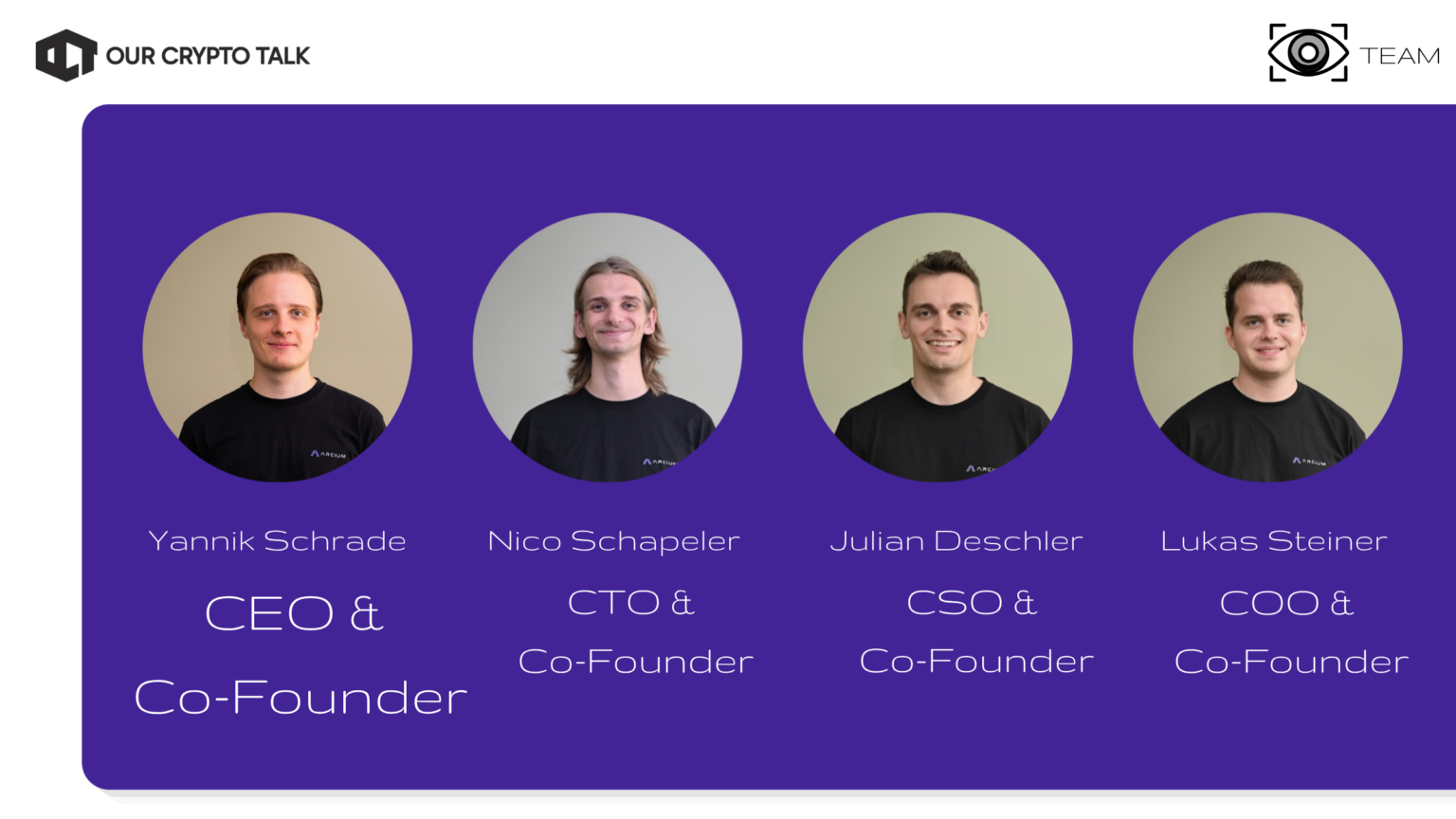
The four co-founders are Yannik Schrade, Nico Schapeler, Julian Deschler, and Lukas Steiner.
Yannik Schrade serves as Chief Executive Officer, while Nico Schapeler leads the project’s technical development as Chief Technology Officer. Together with Deschler and Steiner, the team brings years of experience building privacy-preserving infrastructure on Solana.
What makes the team particularly interesting is its willingness to pivot. Elusiv successfully delivered privacy infrastructure, but the founders recognized that transaction privacy represented only a small segment of the larger confidential computing market. They subsequently rebuilt the company around a significantly larger vision.
The team’s profile strengthened further through the acquisition of Inpher’s technology and personnel. Inpher was one of the most established confidential computing companies in the enterprise sector and specialized in secure Multi-Party Computation. The acquisition brought substantial cryptographic expertise into the project.
Track record matters more than resumes in infrastructure projects. The Arcium founders have already shipped production systems, operated privacy infrastructure under real network conditions, and successfully executed a major strategic transition. In a sector where advanced cryptography expertise remains scarce, that combination represents a meaningful competitive advantage.
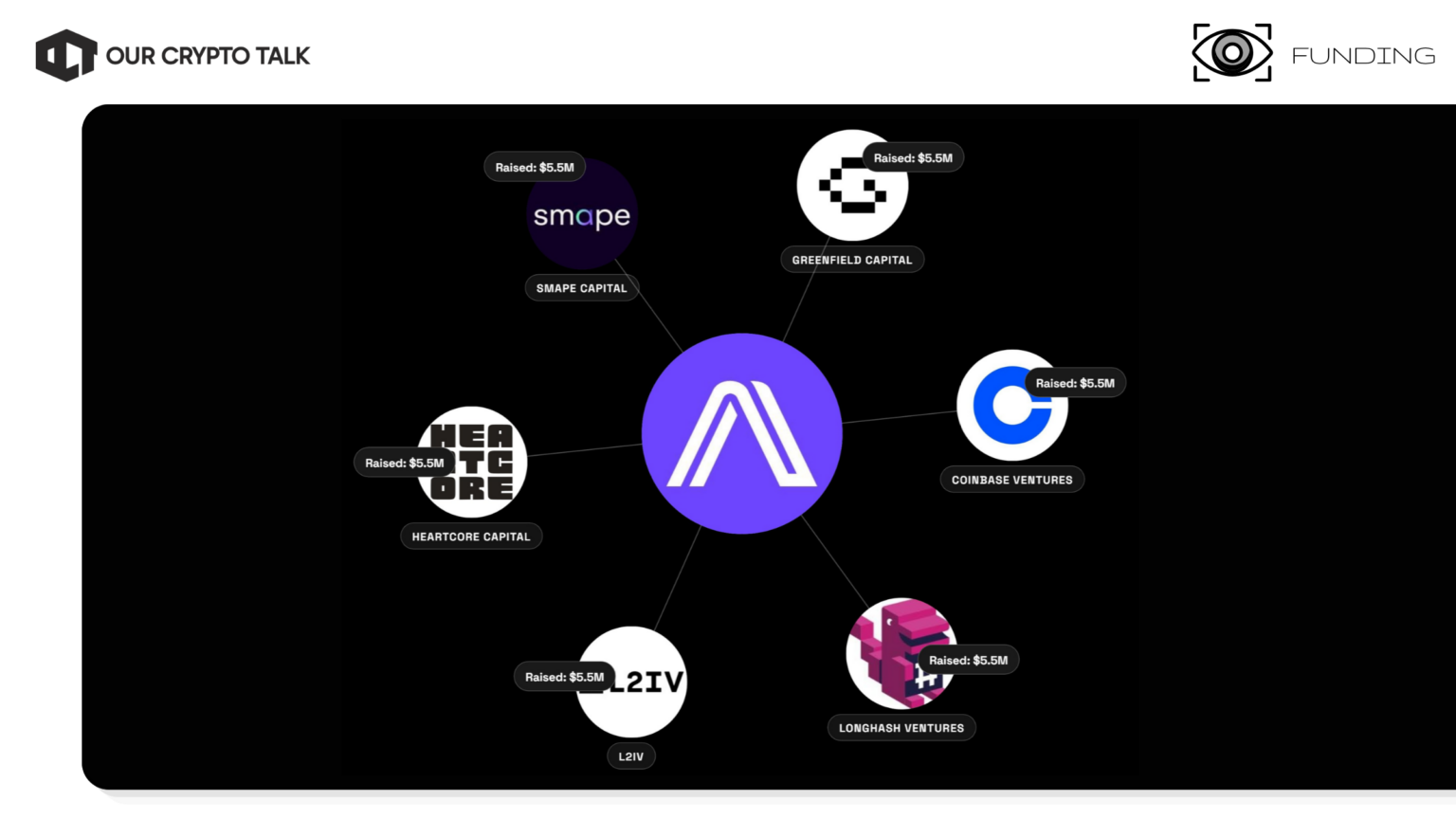
Arcium has raised approximately $9 million to $11 million across multiple funding rounds, including a notable $5.5 million strategic round announced in 2024.
The round was led by Greenfield Capital, with participation from Coinbase Ventures, Heartcore Capital, LongHash Ventures, L2 Iterative Ventures, Staking Facilities, Smape Capital, and Everstake.
The angel roster is equally impressive. Investors include Solana co-founder Anatoly Yakovenko, Monad co-founder Keone Hon, and several prominent founders and operators from across the crypto ecosystem.
This backing profile provides more than capital. Solana ecosystem alignment is particularly strong, which could prove valuable as Arcium expands integrations and attracts developers. Anatoly Yakovenko’s involvement is especially notable given Solana’s growing focus on confidential applications and institutional use cases.
The funding size also appears appropriate for the project’s stage. Confidential computing infrastructure requires significant research and engineering investment, yet Arcium does not appear overcapitalized. The team should have sufficient runway to continue development and progress toward broader adoption without immediate fundraising pressure.
From an OCT perspective, the investor mix significantly de-risks execution. The project has attracted support from both traditional venture firms and technically sophisticated crypto investors capable of evaluating advanced cryptographic systems. For an infrastructure project operating at the intersection of privacy, AI, and blockchain, this represents one of the stronger backing profiles in the current market.
Arcium is one of the stronger infrastructure plays in the current cycle because it already has a live network processing real workloads. The protocol has executed hundreds of millions of confidential MPC rounds, regularly processes millions of daily transactions, and supports applications that generate meaningful fee revenue on Solana.
Pre-TGE participants primarily earned exposure through Quests Phase 1 and retroactive ARX grants. That phase has largely passed. Going forward, the opportunity shifts toward node operation, staking, and ecosystem building.
This is not a low-effort airdrop farm. Running infrastructure requires real capital, technical expertise, and operational responsibility. Comparable infrastructure programs across restaking, MPC, and cryptography networks have historically generated meaningful returns for serious contributors, but only when network usage materialized.
Arcium’s advantage is that usage already exists. Applications like ZINC have demonstrated real demand, validating the network beyond theoretical use cases.
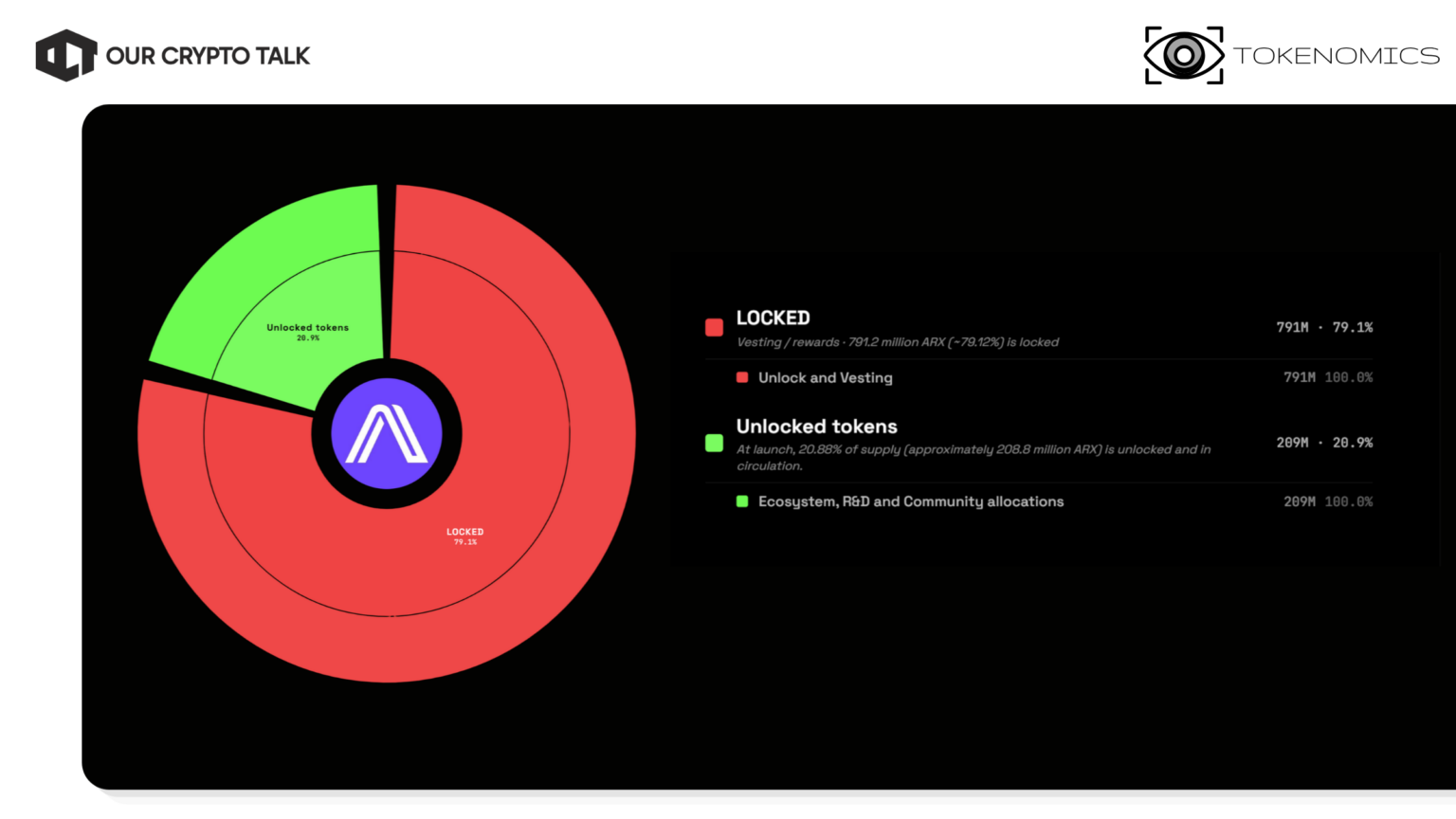
The expected value appears moderately positive for investors with conviction in confidential computing, AI infrastructure, and private DeFi. The team is technically strong, the backers are high quality, and the token launched with a healthy 20.9% circulating supply.
However, investors should size carefully. ARX captures value indirectly through staking demand and governance rather than direct fee accrual. In addition, roughly 79% of supply remains locked and will begin unlocking after the initial cliff period.
The bottom line is simple: Arcium looks attractive as a medium-term infrastructure bet, not as a short-term trading opportunity. If confidential computing becomes foundational infrastructure for AI and finance, current valuations could prove attractive. If adoption stalls, returns will likely disappoint.
The biggest risk is competition. Confidential computing is becoming one of crypto’s most crowded infrastructure categories. Projects focused on MPC, FHE, Zero-Knowledge systems, and hybrid architectures are all competing for developers. Traditional cloud providers also continue improving centralized confidential computing solutions.
Execution risk is equally important. Running a decentralized MPC network at scale is extremely difficult. Node coordination, low-latency communication, malicious security guarantees, and parallel execution all introduce significant complexity. Any major outage, exploit, or performance bottleneck could damage confidence.
Adoption risk remains substantial. Arcium’s thesis depends on developers building confidential applications and users paying for private computation. If demand for private AI or confidential DeFi develops more slowly than expected, network growth could stall.
Token economics present another challenge. Nearly 80% of supply remains locked. Although vesting schedules appear reasonable, future unlocks could create sustained selling pressure if ecosystem growth fails to keep pace.
Finally, value accrual remains indirect. Computation fees are paid in native chain assets such as SOL rather than ARX itself. As a result, long-term token value depends heavily on staking demand and network expansion.
Arcium is not a fork or incremental upgrade. The technology is genuinely differentiated. The challenge is proving that this differentiation translates into sustainable developer adoption and economic value.
The most important upcoming catalyst is the full rollout of node operation and staking. This will activate the network’s core economic loop by allowing operators to stake ARX, provide confidential compute capacity, and earn rewards.
A second major catalyst is the launch of Blackthorn, Arcium’s confidential AI product. Strong adoption here could significantly expand the project’s addressable market beyond crypto-native applications.
Ecosystem growth also matters. Applications such as ZINC have already demonstrated demand for confidential computation. Additional successful applications would further validate the network.
Other important milestones include governance activation, broader adoption of the Confidential SPL Token standard, and continued growth in daily confidential computations.
Investors who already believe in confidential computing may choose to participate now while network adoption remains early. More conservative investors may prefer to wait for node economics, staking yields, and Blackthorn adoption metrics before committing significant capital.
Arcium combines a live Mainnet Alpha network, measurable usage, strong technical founders, and high-quality investors. Unlike many infrastructure projects, it already processes millions of transactions and supports fee-generating applications.
The thesis is compelling. Confidential computing sits at the intersection of AI, privacy, and blockchain infrastructure, three markets with enormous potential. The acquisition of Inpher’s technology and expertise further strengthens the project’s competitive position.
This opportunity is best suited for investors with medium-term conviction. It is capital- and technically intensive rather than socially farmable.
The single milestone that could change the rating is successful node rollout combined with visible economic activity.
If node economics disappoint, adoption slows, or technical issues emerge, the rating would move to WATCH.
Treat Arcium as a long-duration infrastructure bet rather than a short-term narrative trade. The technology is real, the product is live, and adoption has begun. The next challenge is scaling from promising infrastructure to indispensable infrastructure.
All the opinions in this article are that of the author and in no way are financial advice. Our Crypto Talk and the author always suggest you do your own research in crypto and to never take anything as financial advice that you read on the internet. Check our Terms and conditions for more info.


Tokenization of RWA yields onchain might be the biggest opportunity that no one has noticed
Cold Wallet Safety 2026: Are Hardware Wallets Still Safe?
One Token, Multiple Products. Can Zylo Deliver?
The Rise of NEAR Protocol 2026: Inside the 530% Rally and the ETF
Tokenization of RWA yields onchain might be the biggest opportunity that no one has noticed
Cold Wallet Safety 2026: Are Hardware Wallets Still Safe?
One Token, Multiple Products. Can Zylo Deliver?
The Rise of NEAR Protocol 2026: Inside the 530% Rally and the ETF