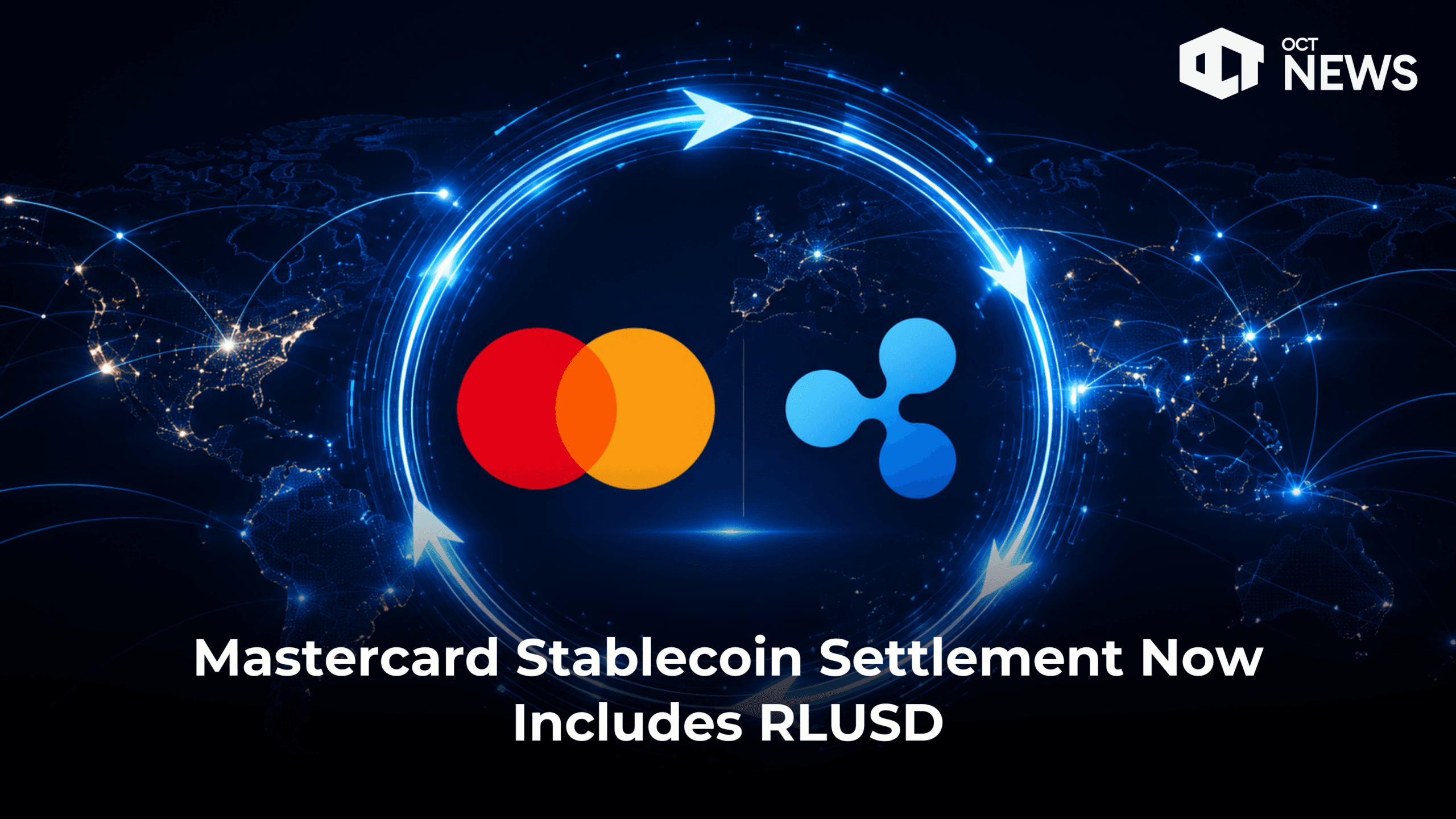
Mastercard expands its stablecoin settlement network to include RLUSD, enabling 24/7 card settlement across multiple blockchains and markets.

Author: Akshay
High attention and emotional sentiment detected.
3rd June 2026 – Mastercard Stablecoin adoption is expanding as Mastercard adds Ripple’s RLUSD to its settlement network. The move puts a regulated stablecoin on one of the world’s biggest card rails.
High Signal Summary For A Quick Glance
The company announced the change on June 3, 2026. In its official press release, Mastercard said it is adding intraday, weekend, and holiday card settlement options. These now cover both fiat currencies and on-chain settlement using regulated stablecoins.
The Mastercard stablecoin settlement expansion names four issuers. RLUSD from Ripple sits alongside Circle’s USDC, Paxos-issued PYUSD, USDG, and USDP, and SoFi’s SoFiUSD.
USDC is already live in early on-chain flows in select markets. So RLUSD now joins a list that a global card network treats as settlement-grade.
These stablecoins work across several blockchains. According to Mastercard, the supported chains include Arbitrum, Base, Canton, Ethereum, Polygon, Solana, Tempo, and the XRP Ledger.
The announcement is an expansion, not a brand-new product. It builds on earlier Mastercard pilots and live deployments, including USDC settlement tests that date back to 2021.
Card settlement is the step where banks square up after a customer spends. The issuing bank and the acquiring bank reconcile what each side owes.
Traditionally, that process batches during banking hours. So it runs on a T+1 or T+2 basis, and weekends and holidays cause delays.
Now Mastercard wants to remove that wait. Intraday, weekend, and holiday options let partners settle when timing and liquidity actually matter.
Regulated stablecoins make the always-on version possible. Because they move on public blockchains, settlement can reach near-real-time finality outside normal banking windows.
“The next phase of stablecoin adoption is about real-world utility, especially in settlement, where timing and liquidity matter most,” said Raj Dhamodharan, executive vice president, Blockchain and Digital Assets at Mastercard.
RLUSD is Ripple’s dollar-backed stablecoin. It launched fully in December 2024. Standard Custody and Trust Company regulates it under a New York trust charter.
The token passed $1 billion in market cap by late 2025. So its inclusion reflects real demand, not just a pilot experiment.
Crucially, RLUSD settles across multiple chains, including the XRP Ledger. As a result, the XRPL now appears directly inside a major card network’s settlement options.
Ripple framed the step as validation for public-chain settlement. The Mastercard release carried a direct quote from a Ripple executive.
“Mastercard’s move into on-chain settlement is a landmark validation that blockchain technology is ready for the world’s most critical payment infrastructure,” said Jack McDonald, senior vice president, Stablecoins, Ripple. He added that RLUSD’s inclusion “reflects growing demand for trusted, regulated stablecoins built for real-world financial use cases on public blockchains like the XRP Ledger.”
Notably, Ripple had not published its own standalone release on the news as of midday UTC. For now, the Ripple quote comes from Mastercard’s announcement.
Mastercard named several early participants for the stablecoin option. The first group covers the United States and Latin America.
These partners include ARQ, formerly known as DolarApp, plus CBW Bank, Cross River, Lead Bank, and Nuvei. Mastercard expects them to support the stablecoin optionality first.
A wider global rollout is planned through 2026. Still, Mastercard noted that further expansion remains subject to regulation in each market.
This builds directly on recent groundwork. In November 2025, Ripple announced a related pilot. The test paired Mastercard, WebBank, and Gemini to settle card payments in RLUSD on the XRP Ledger.
Timeline: Mastercard’s progression from early crypto settlement experiments to network-wide support for RLUSD and regulated stablecoin payments
Mastercard launches an early partnership with Circle to explore USDC-based settlement, marking one of its first major steps into regulated stablecoin infrastructure.
Mastercard introduces the Multi-Token Network, a blockchain-based framework designed to support tokenized assets, regulated payment tokens, and future stablecoin settlement applications.
Ripple officially launches RLUSD on the XRP Ledger and Ethereum after receiving regulatory approval, establishing the stablecoin that would later be integrated into Mastercard pilots.
Mastercard enables broader support for regulated stablecoins across merchant settlement, card issuance, cross-border payments, and programmable commerce through Mastercard Move and MTN.
Mastercard and Circle extend USDC and EURC settlement capabilities to acquirers across Europe, the Middle East, and Africa, increasing real-world stablecoin utility.
Mastercard, Ripple, WebBank, and Gemini launch a pilot exploring RLUSD settlement on the XRP Ledger for card-payment infrastructure and real-time transaction flows.
Mastercard expands settlement capabilities to support intraday, weekend, and holiday processing for regulated stablecoins, explicitly including RLUSD alongside USDC, PYUSD, USDG, USDP, and other digital payment assets.
Mastercard plans further expansion of stablecoin settlement services across additional regions and partners, with implementation timelines dependent on regulatory approvals and integration readiness.
The announcement leaves several questions open. So far, Mastercard has not disclosed live on-chain settlement volumes tied to RLUSD.
Exact go-live dates per partner and per stablecoin are also unconfirmed. As a result, the timeline beyond the named US and Latin America launch stays vague.
The change targets issuer and acquirer settlement, the back-end layer. It does not by itself confirm any immediate shift in how retail customers spend or get charged.
Market data stayed steady around the news. According to CoinGecko, RLUSD held a market cap near $1.7 billion to $1.8 billion. Its peg stayed close to $1.00.
XRP traded in a roughly $1.24 to $1.30 range in recent sessions. The data showed no confirmed immediate price spike. The news was barely two hours old during early crawls.
CoinDesk reported the expansion accurately, and major outlets posted no corrections or walk-backs. So the RLUSD inclusion stands as confirmed by the primary source.
The next signals to watch are concrete go-live dates and the first reported settlement volumes. Those numbers will show whether always-on settlement gains real traction.
If the rollout holds, the Mastercard stablecoin settlement push could pull more regulated stablecoins toward mainstream card infrastructure. For now, the named partners and the 2026 timeline set the pace.
This article is for information only and is not financial advice. Always do your own research before making any investment decision.
Our Crypto Talk is committed to unbiased, transparent, and true reporting to the best of our knowledge. This news article aims to provide accurate information in a timely manner. However, we advise the readers to verify facts independently and consult a professional before making any decisions based on the content since our sources could be wrong too. Check our Terms and conditions for more info.


euroman
@euromandriver

🚨 BREAKING NEWS: 👉 Mastercard expands stablecoin settlement support with USDC, RLUSD, PYUSD, USDG, USDP and SoFiUSD across Ethereum, Solana, XRP Ledger, Base, Arbitrum and Polygon. $XRP $USDC $RLUSD $POL $ARB $COIN Source: Mastercard https://t.co/J9NU5qyCVC
09:40 AM·Jun 3, 2026

NADZZZZ⋆☾IN CRYPTO
@NADZOE93
🚨 JUST IN: Mastercard Launches 24/7 Stablecoin Settlement Including #Ripple’s RLUSD. https://t.co/M3EXc5I37t https://t.co/RpzFZn3loq
🚨 JUST IN: Mastercard Launches 24/7 Stablecoin Settlement Including #Ripple’s RLUSD.
08:19 AM·Jun 3, 2026

XRP