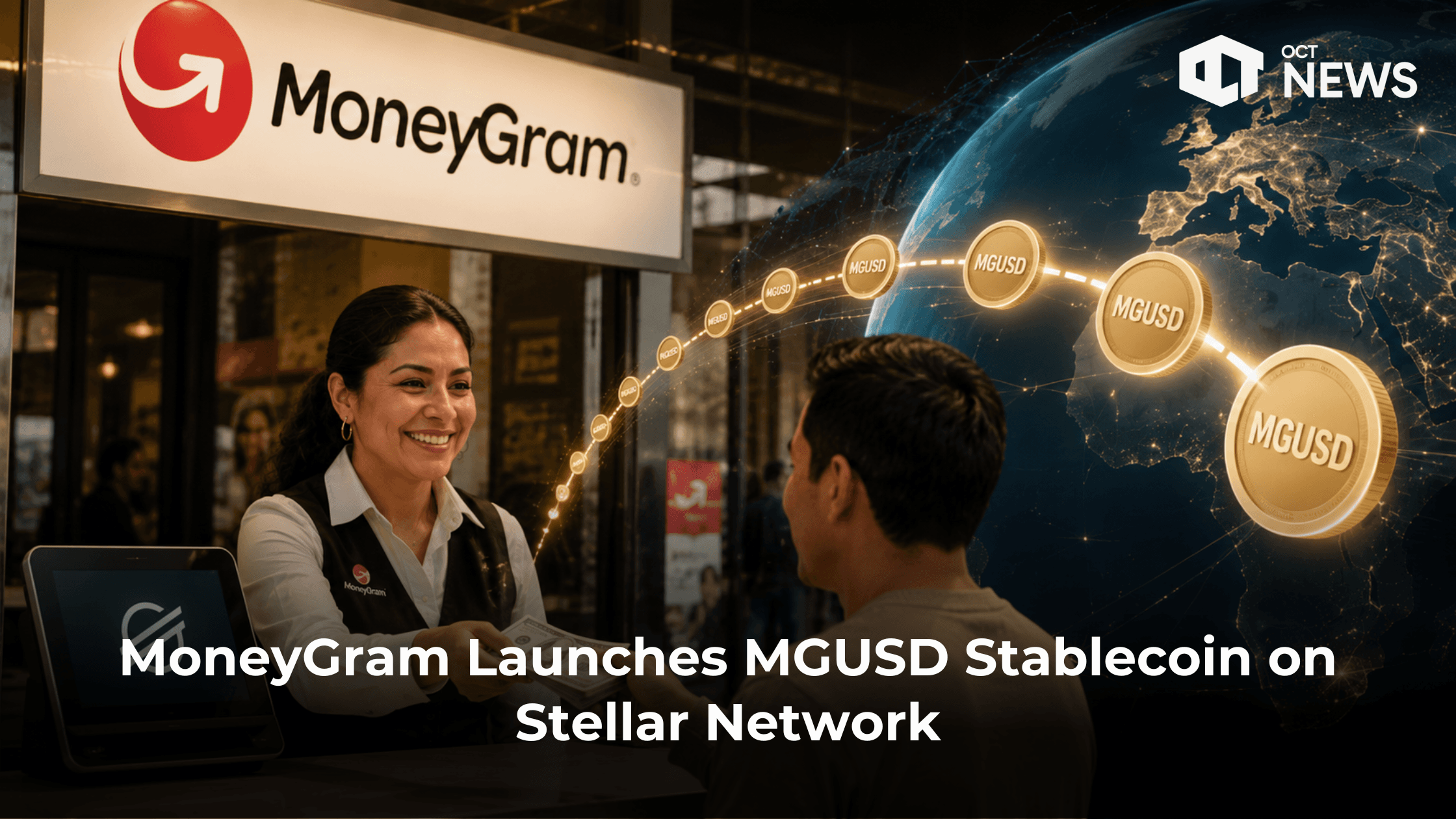
MoneyGram MGUSD stablecoin launches on Stellar, linking remittance payments with tokenized dollar settlement and global cash rails.

Author: Kritika Gupta
2nd June 2026- MoneyGram launched MGUSD, its native U.S. dollar stablecoin, live on the Stellar network on June 2, 2026. The MGUSD stablecoin starts in the U.S. market, and the company plans a global rollout from there.
The token does more than sit in a wallet. MoneyGram designed it as the base layer for its payments network. So customers can hold dollars, send money abroad, and cash out through agents.
High Signal Summary For A Quick Glance

nae
@Nae5000

@DenelleDixon @MoneyGram SDF Q1 2026: 598M XLM-equivalent deployed. Where is the per-recipient breakdown? How can $XLM holders verify these deployments created real network value, not just distribution pressure?
MGUSD is a testament to what's possible when you build with purpose, and a meaningful step forward in our shared mission to create better financial infrastructure for the global economy. Congrats to the @MoneyGram team! https://t.co/SNMweiWkyQ
03:47 PM·Jun 2, 2026

Crypto Phantom
@CryptoPhantomUS
@StellarOrg @MoneyGram First tokenized assets. Now native stablecoins. MGUSD joining Stellar is another sign that real financial infrastructure is moving on-chain. The ecosystem keeps growing. 🚀 $XLM #Stellar
MGUSD, @MoneyGram's native U.S. dollar stablecoin, is live on the Stellar network. MGUSD is designed to plug seamlessly into MoneyGram's suite of financial services, making cross-border payments easier than ever. Built on Stellar. Built for the world. https://t.co/PzOu97a1IN
01:55 PM·Jun 2, 2026

chewy
@chu131309
@StellarOrg @MoneyGram got ondo stablecoin , circle stablecoin,latin area stablecoins, Franklin templton stable coin ,moneygram stablecoin..and MORE. thank god for GENUIS ACT :). LETS GO STELLAR :)... @lobstr I Love you https://t.co/U84ZuEJR8c

MGUSD, @MoneyGram's native U.S. dollar stablecoin, is live on the Stellar network. MGUSD is designed to plug seamlessly into MoneyGram's suite of financial services, making cross-border payments easier than ever. Built on Stellar. Built for the world. https://t.co/PzOu97a1IN
01:27 PM·Jun 2, 2026
High attention and emotional sentiment detected.
Customers now hold MGUSD in a self-custodial wallet built into the MoneyGram app. From there, they can move dollar value across borders in seconds and convert to local currency through the company’s network.
That network is the real story. MoneyGram operates nearly 500,000 retail locations and serves more than 60 million customers worldwide. More than 70% of its transactions are already digital, according to the company’s official announcement.
So the launch bridges two worlds. On one side sits on-chain dollar value. On the other sit physical cash rails that reach people far from traditional banks.
MGUSD is MoneyGram’s native token, but a partner issues it. That partner is Bridge, a Stripe company, which the firms describe as a regulated and GENIUS Act-ready issuer.
Minting and burning run through M0’s smart contract infrastructure on Stellar. MoneyGram then holds its MGUSD in Fireblocks custody wallets before pushing the tokens out to customer wallets.
The stablecoin is U.S. dollar-backed. MoneyGram has not yet detailed the reserve custodian or the attestation cadence. It also has not named the exact mix of cash and Treasuries behind the token.
Stellar suits this job for clear reasons. Transactions settle in seconds, fees stay near zero, and the network already powers real remittance flows. As a result, MoneyGram can move small payments without the high gas costs seen on many other chains.
MoneyGram framed the launch around distribution, not speculation. The pitch is that reach matters more than the token itself.
“The stablecoin market has largely focused on the asset itself,” said MoneyGram Chairman and CEO Anthony Soohoo. “MoneyGram is taking a fundamentally different approach. Starting with our distribution platform, we’re using stablecoin as a foundation to build future applications on our global network.”
Soohoo also tied the product to its users. He called MGUSD “the stablecoin we built for our customers, for the families sending money home and for the billions of people around the world with limited financial access.”
This control also matters strategically. By issuing its own token, MoneyGram leans less on Circle’s USDC. It had used USDC for years through its cash ramps.
Relative positioning against fiat-network and TradFi stablecoins
The two sides go back a while. MoneyGram first built USDC cash-in and cash-out ramps on Stellar around 2021. Those ramps let users turn crypto into cash at agent locations, even without a bank account.
Then, on April 22, 2026, MoneyGram and the Stellar Development Foundation extended the partnership for several more years. The MGUSD launch is the next step in that relationship.
“Stellar was built for real-world utility at institutional scale,” said Stellar Development Foundation CEO Denelle Dixon. “Our five-year partnership with MoneyGram is proof that stablecoins have moved well beyond pilots.”
Dixon called the token “the next milestone that demonstrates what purpose-built blockchain can deliver when paired with a trusted payments network.”
Key milestones related to this development
MoneyGram begins working with Stellar to support blockchain-based settlement using USDC.
The partnership extends into cash-in and cash-out access through MoneyGram locations.
MoneyGram launches MGUSD on Stellar, marking a multi-year shift from cash remittance rails toward tokenized dollar settlement.
MGUSD now enters a packed market. It competes with USDC from Circle, USDT from Tether, PayPal’s PYUSD, and Ripple’s RLUSD, among others.
Stellar already hosts a meaningful stablecoin base. Its stablecoins carry a combined market value near $741 million, according to DefiLlama. MGUSD adds to that total, though it starts small for now.
Some observers question the move. They ask whether a proprietary token adds real value or simply tokenizes a business MoneyGram already runs. The skeptics also note that other payments firms are chasing similar digital-dollar products.
The market reaction stayed muted, too. XLM showed no clear launch-driven spike, and one CoinDesk snapshot even showed the token down on the day. Investors appear focused on long-term utility rather than a quick trade.
None of this is financial advice. Readers should research any token and weigh the risks before acting.
Several questions stay open. MoneyGram has not disclosed the initial supply, the fee structure, or which corridors come online after the U.S. launch.
Reserve attestations and redemption mechanics also remain undefined for now. On-chain data is thin as well. The asset is only hours old, and major Stellar explorers have not fully indexed it yet.
Still, the direction looks clear. If the MGUSD stablecoin scales across MoneyGram’s global footprint, the payoff could be big. It could turn a legacy remittance giant into a major real-world stablecoin operator. Watch the rollout corridors and the first reserve reports for the next signals.
Our Crypto Talk is committed to unbiased, transparent, and true reporting to the best of our knowledge. This news article aims to provide accurate information in a timely manner. However, we advise the readers to verify facts independently and consult a professional before making any decisions based on the content since our sources could be wrong too. Check our Terms and conditions for more info.



Stellar