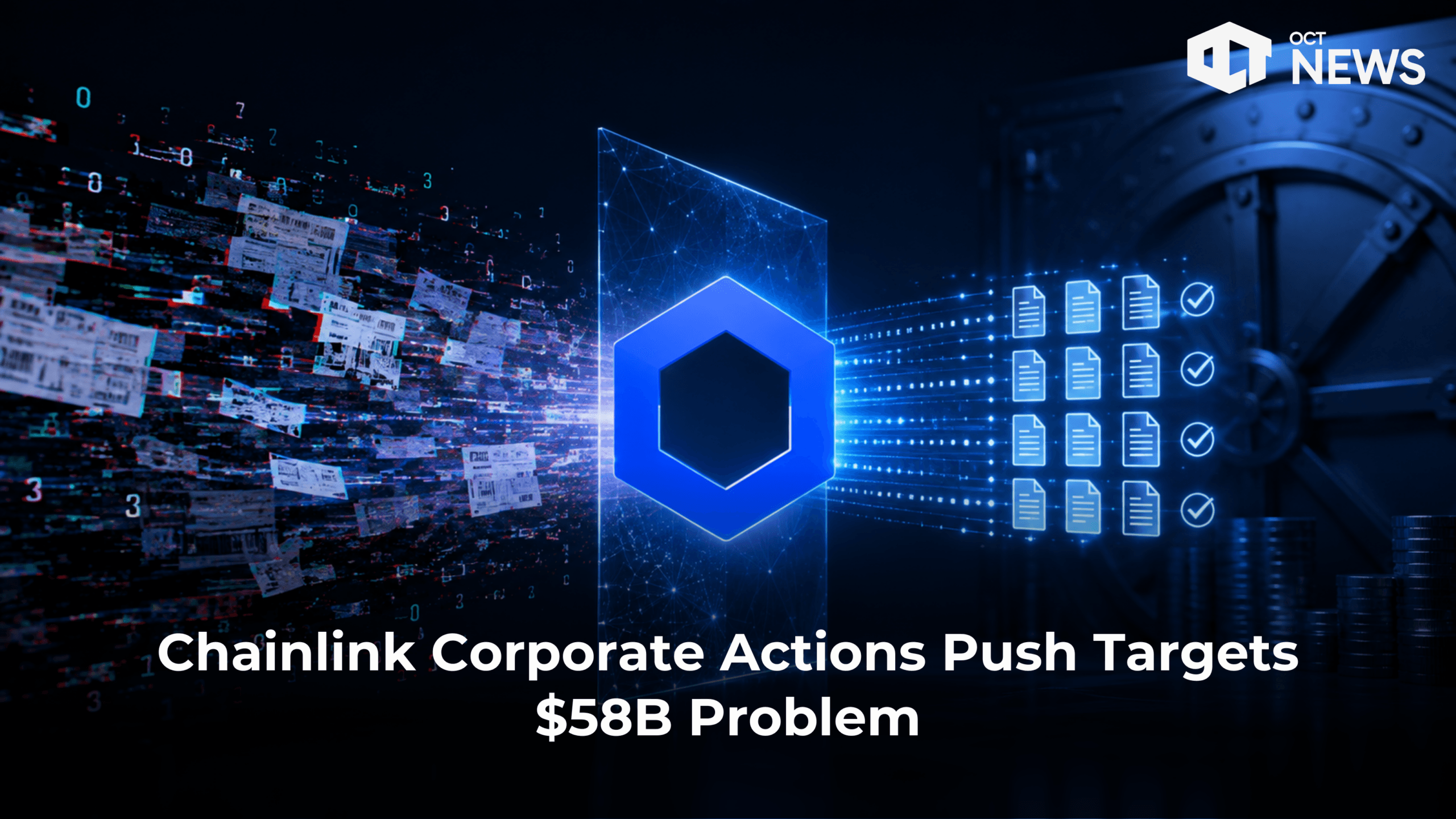
Learn how Chainlink Corporate Actions uses AI, CCIP, Swift, UBS and Euroclear to standardize financial events and reduce costs.

Author: Akshay
1st August 2026 – Chainlink Corporate Actions returned to the spotlight on Friday as the project revived its “$58 billion problem” campaign. The post highlights how Swift, UBS, Euroclear and 20+ institutions use its network to improve corporate actions processing.
High Signal Summary For A Quick Glance

8lends
@eightlends

@chainlink Corporate actions in traditional markets are wild AI will change everything in a couple of years
Financial markets have a $58 billion problem nobody knows about. To solve an annual $58B+ problem for financial markets, Swift, UBS, Euroclear, & 20+ leading institutions leveraged Chainlink to reduce AI hallucination risk in corporate actions. https://t.co/8rLnCQfzhz
01:04 PM·Aug 1, 2026
High attention and emotional sentiment detected.
The post went live at 13:00 UTC with a short video. It is recap content, not a new launch. Instead, it revives results the project first shared at Sibos 2025.
Those Chainlink corporate actions results landed on 29 September 2025 in Frankfurt. Since then, Chainlink has recirculated the same framing several times through 2026.
The initiative aims to standardize how markets process corporate actions. These are events like dividends, stock splits, mergers and rights issues. Each one forces intermediaries to update holdings and entitlements.
According to the official Phase 2 announcement, the work moved from a pilot into a production-grade solution. It runs on the Chainlink oracle platform, including the Chainlink Runtime Environment, or CRE.
At its core, the system builds “unified golden records.” In plain terms, these are attested, standardized, near-real-time sources of truth for each event. So every party can rely on one confirmed record instead of many conflicting ones.
Then Chainlink distributes those records two ways. First, its Cross-Chain Interoperability Protocol, or CCIP, pushes them across public and private blockchains. Second, a custom adapter sends ISO 20022 messages to Swift for its network.
Timeline: Chainlink’s progression from blockchain interoperability with Swift to AI-assisted corporate actions infrastructure adopted by global financial institutions.
Swift and Chainlink begin working together on connecting traditional financial messaging with blockchain networks. Early discussions focus on using Chainlink infrastructure, including the future Cross-Chain Interoperability Protocol (CCIP), to bridge existing Swift messaging with digital asset ecosystems.
Swift and Chainlink publish the results of interoperability experiments involving more than 12 global financial institutions, including Euroclear, ANZ, Citi, BNY Mellon, and BNP Paribas. The tests demonstrate tokenized asset transfers across public and private blockchains initiated through existing Swift infrastructure.
DTCC, Chainlink, and ten major financial institutions, including JPMorgan, Franklin Templeton, BNY Mellon, and State Street, complete the Smart NAV pilot, demonstrating onchain mutual fund NAV dissemination using CCIP for tokenized fund infrastructure.
Chainlink, Swift, Euroclear, and six financial institutions unveil the first phase of their corporate actions initiative. The solution combines AI models and decentralized oracles to transform unstructured corporate-action announcements into standardized onchain “golden records.” Parallel work with UBS on tokenized fund settlement also continues.
UBS adopts the Chainlink Digital Transfer Agent (DTA) standard while integrating Swift messaging and Chainlink CRE into tokenized fund subscription and redemption workflows alongside Euroclear.
The initiative expands to 24 financial institutions, adding organizations such as DTCC, SIX, and TMX. The production-grade architecture combines multi-LLM consensus, Chainlink Runtime Environment (CRE), ISO 20022 messaging, Swift infrastructure, and CCIP distribution to reduce AI hallucination risk in corporate actions processing.
Chainlink publicly promotes the ongoing initiative, emphasizing how Swift, UBS, Euroclear, and more than 20 financial institutions are using Chainlink infrastructure to reduce AI hallucination risk in corporate actions processing while addressing an industry problem estimated at approximately $58 billion annually.
The initiative is expected to continue evolving from blockchain interoperability into standardized AI-validated corporate actions infrastructure, supporting broader tokenized asset workflows, automated settlement, and cross-chain distribution across global financial markets.
Corporate actions data often starts as messy, unstructured text. Issuers publish PDFs and press releases in many languages and formats. As a result, firms re-key and re-check the same details again and again.
Chainlink uses large language models to read those documents and extract structured data. Yet LLMs can hallucinate, because they predict text rather than guarantee facts. So a single model might invent a wrong split ratio or date.
To reduce that risk, the design runs several models at once inside a Decentralized Oracle Network. Then the models must reach consensus before a record counts as confirmed. Institutions can also attest to records cryptographically.
Chainlink says this approach reached near-100% consensus across the events it evaluated, with 100% on confirmed records. It also handled multiple languages, including Spanish and Chinese. Still, those figures describe tested events, not full production volume.
Phase 2 grew to 24 named institutions. That total lines up with the tweet’s “20+” framing. Ten of them are financial market infrastructures.
On the infrastructure side sit Swift, DTCC, Euroclear, SIX, TMX and several others. On the bank side sit UBS, DBS Bank, ANZ and BNP Paribas’ Securities Services. Asset managers include Wellington Management and Schroders.
Chainlink co-founder Sergey Nazarov framed the data problem as the key blocker. He said solving corporate actions onchain matters “in order for tokenized public equity to scale up and work correctly onchain.”
Euroclear also weighed in through Stephanie Lheureux, who directs its Digital Assets Competence Center. She said industry-wide coordination around standards and interoperability “is key to achieving that at scale.”
The headline figure comes mainly from DTCC. It estimates the global industry spends more than $58 billion a year processing corporate actions. Meanwhile those costs rise roughly 10% each year.
The pain traces back to fragmented, manual work. Automation still sits below 40%, according to DTCC. So errors, delays and duplicate checks pile up at every intermediary.
Citi’s 2025 asset servicing report adds more detail. On average, a single event touches over 110,000 firm interactions and costs $34 million to process. On top of that, 75% of participants still revalidate data by hand.
Coverage of the launch was broadly consistent. CoinDesk, Blockworks and Ledger Insights all reported the 24 institutions and the near-total consensus. None flagged major conflicts in the numbers.
Even so, Ledger Insights noted the solution helps standardization but “doesn’t claim to solve every issue.” That hedge matters, because demonstrated results differ from daily production use.
Several open questions also remain. For now, the public materials show no live golden-record volume and no full rollout dates. They also list no public onchain addresses for the records. So the system stays hybrid, with heavy off-chain integration for legacy systems.
Some crypto commentators raise a further point. Enterprise usage of oracles and CCIP does not always translate into visible LINK token demand. Around the tweet, LINK traded near $8.10 to $8.25, down about 1% to 2% on the day.
The 2026 promotion suggests Chainlink wants to keep this use case front of mind. Tokenized equities need clean, trusted event data, and corporate actions sit right in that path.
The next real test is scale. Watch for named production users, live record volume and clear rollout dates. Until those arrive, the Chainlink corporate actions story stays a strong demonstration rather than a finished rollout.
This article is informational only and not financial advice. Always do your own research before making any investment decision.
Our Crypto Talk is committed to unbiased, transparent, and true reporting to the best of our knowledge. This news article aims to provide accurate information in a timely manner. However, we advise the readers to verify facts independently and consult a professional before making any decisions based on the content since our sources could be wrong too. Check our Terms and conditions for more info.


Harmony to ShutDown Block Explorer Wiping Pre-2025 Data
Solana Alpenglow Goes Live Cutting Finality to 150ms
IoTeX Zanzibar Upgrade Moves Staking Rewards On-Chain
Altitude Demos X9.150 QR Payment Standard With USDC
Harmony to ShutDown Block Explorer Wiping Pre-2025 Data
Solana Alpenglow Goes Live Cutting Finality to 150ms
IoTeX Zanzibar Upgrade Moves Staking Rewards On-Chain
Altitude Demos X9.150 QR Payment Standard With USDC

Chainlink